Quantum-stabilized patterns in a vector Hopfield network
Published 4 Jun 2026 in quant-ph, cond-mat.dis-nn, and cond-mat.stat-mech | (2606.06597v1)
Abstract: We introduce the quantum vector Hopfield network, in which patterns are formed by orientations of quantum vector spins; quantum dynamics arise intrinsically from the non-commutativity of the spin operators. We derive the equations of state and the phase diagrams for this network as well as its classical counterpart. We find that quantum fluctuations, surprisingly, stabilize the stored patterns. Both the critical retrieval temperature and the target pattern overlap are enhanced relative to the classical network. Additionally, we find that this enhancement grows with pattern loading up to network capacity. We interpret this effect as an analog of quantum order-by-disorder, a mechanism by which quantum fluctuations promote the formation of ordered phases. These findings offer a new route to quantum-enhanced associative memory.
The paper demonstrates that intrinsic quantum fluctuations enhance retrieval stability and increase Mattis overlap in quantum Hopfield networks.
The methodology employs the replica method and numerical simulations to derive disorder-averaged free energy and phase diagrams under various loading conditions.
The findings indicate that quantum order-by-disorder robustly stabilizes retrieval states, paving the way for quantum-enhanced associative memory systems.
Quantum-Stabilized Pattern Retrieval in Vector Hopfield Networks
Introduction and Context
"Quantum-stabilized patterns in a vector Hopfield network" (2606.06597) systematically investigates the retrieval properties of associative memory in a quantum generalization of the classical vector Hopfield network (CVHN). The Hopfield model, introduced as an archetype of associative memory, is generalized here to quantum spins, forming the quantum vector Hopfield network (QVHN), where patterns are comprised of orientations of quantum vector spins. The primary technical novelty arises from the intrinsic quantum dynamics—generated via operator non-commutativity—rather than externally imposed transverse fields as in prior quantum neural network models.
Recent advances on classical Hopfield networks highlight exponentially increasing storage capacity with vector-valued or higher-order pattern encodings, dovetailing with foundational connections to attention-based mechanisms in deep learning. The quantum extension of such memory models explores the intersection with quantum spin glass physics, engaging the replica framework for disorder-averaged free energy analysis. The QVHN introduced here is constructed by promoting classical spins to quantum Pauli vector operators, and the main analytic message is that quantum fluctuations resulting from this construction enhance both retrieval stability and pattern overlap—contradicting the common suppression of retrieval seen when quantum dynamics are introduced via transverse fields.
Model Formulation and Analytical Approach
The QVHN Hamiltonian encodes p patterns in N spins via:
H=−N1μ=1∑pi<j∑(ξiμ⋅σi)(ξjμ⋅σj)
where ξiμ are unit vectors, σi are either classical Heisenberg vectors (CVHN) or quantum Pauli vectors (QVHN), and α=p/N controls pattern loading. Memory retrieval is measured by the Mattis magnetization mμ, quantifying the overlap between the current network state and the μ-th pattern.
The replica method within the static approximation is deployed to derive the disorder-averaged free energy density and phase diagrams of both classical and quantum models. This approximation, standard in quantum spin glass analysis, averages order parameters over imaginary time, capturing leading quantum fluctuation effects. Four essential order parameters emerge: Mattis overlap m, local (Edwards-Anderson) freezing qEA, quantum-connected autocorrelation N0, and quantum-uncondensed pattern autocorrelations N1 and N2. In the classical limit, N3 and N4 reduce to functions of N5 and N6.
Phase Structure and Retrieval Enhancement
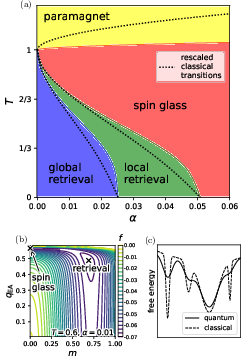
Three principal phases are identified via order parameter values: paramagnetic (N7), spin glass (N8), and retrieval (N9). Retrieval is further subdivided into global (energy minimum) and local (metastable) retrieval, with critical lines determined analytically and numerically.
Figure 1: Phase diagram of the QVHN showing retrieval up to finite loading H=−N1μ=1∑pi<j∑(ξiμ⋅σi)(ξjμ⋅σj)0; quantum memory states are stabilized relative to classical baselines, with elevated critical temperatures and enhanced global retrieval.
Quantum fluctuations in the QVHN intrinsically stabilize stored memory patterns—contravening the degradation seen with transverse field models. Both the critical temperature for retrieval and the Mattis overlap are consistently higher in the quantum model compared to CVHN, with the enhancement increasing as pattern loading H=−N1μ=1∑pi<j∑(ξiμ⋅σi)(ξjμ⋅σj)1 approaches the precise retrieval capacity H=−N1μ=1∑pi<j∑(ξiμ⋅σi)(ξjμ⋅σj)2.
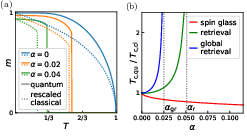
Numerical solution of the saddle-point equations confirms these results, showing that quantum Mattis magnetization retains its zero-temperature value up to higher temperatures before decay. The ratio of quantum to classical critical temperatures for retrieval and global retrieval diverges at H=−N1μ=1∑pi<j∑(ξiμ⋅σi)(ξjμ⋅σj)3 and H=−N1μ=1∑pi<j∑(ξiμ⋅σi)(ξjμ⋅σj)4 respectively, indicating maximized quantum stabilization near capacity.
Figure 2: (a) Mattis magnetization H=−N1μ=1∑pi<j∑(ξiμ⋅σi)(ξjμ⋅σj)5 vs. temperature for quantum, classical, and rescaled classical networks at several H=−N1μ=1∑pi<j∑(ξiμ⋅σi)(ξjμ⋅σj)6; quantum network exhibits less steep decline. (b) Ratios of quantum/classical critical temperatures; retrieval enhancement diverges near maximal loading.
Numerical Simulations and Collective Quantum Effects
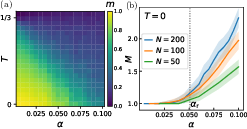
Simulations of the CVHN further validate the analytical results, using Gibbs sampling to estimate equilibrium behavior in large networks (H=−N1μ=1∑pi<j∑(ξiμ⋅σi)(ξjμ⋅σj)7). The average Mattis magnetization is high in the predicted retrieval region, but exhibits a smooth dependence on H=−N1μ=1∑pi<j∑(ξiμ⋅σi)(ξjμ⋅σj)8—interpreted as arising from mixture states with multiple condensed patterns. Analysis of the number of condensed magnetizations confirms the emergence of mixture states near predicted critical values.
Figure 3: (a) Simulated equilibrium Mattis magnetization H=−N1μ=1∑pi<j∑(ξiμ⋅σi)(ξjμ⋅σj)9 as a function of temperature and loading ξiμ0; transition at fixed ξiμ1 is smoother than analytically predicted. (b) Average number of condensed magnetizations at ξiμ2 increases near theoretical retrieval transition.
Interpretation: Quantum Order-by-Disorder
The observed quantum enhancement in retrieval is interpreted as quantum order-by-disorder. Quantum fluctuations effectively smooth the classical free energy landscape, preferentially elevating the energies of spin glass states residing in narrow, rugged minima, while stabilizing retrieval states associated with broader basins. This mechanism is corroborated by computed free energy landscapes and basin analyses, demonstrating that retrieval states are more robust to quantum renormalization than spin glass states.
Stabilization increases with pattern loading, suggesting that quantum collective effects become more important as the classical landscape grows increasingly complex and rough. The quantum network thus not only inherits higher susceptibility from individual spin-1/2 quantum behavior but also collectively leverages quantum fluctuations to enhance pattern retrieval capacity and accuracy, particularly at critical loading.
Practical and Theoretical Implications
This work establishes that intrinsic quantum fluctuations can be leveraged to enhance associative memory performance, by both raising retrieval temperatures and improving pattern overlap. These results are directly relevant for the design of quantum neural associative memories, and highlight new mechanisms—distinct from transverse-field-induced suppression—for quantum enhancement.
The theoretical structure motivates further investigation into quantum energy-based models for memory storage and retrieval, with potential connections to quantum variants of attention mechanisms. The order-by-disorder interpretation also suggests broader applications to quantum optimization and information storage, where quantum fluctuation-induced stabilization could circumvent classical limitations.
These findings point to the rich physics arising from collective quantum effects in high-capacity memory networks, and suggest the possibility of achieving robust, quantum-enhanced associative memories in future quantum hardware architectures.
Conclusion
The quantum vector Hopfield network uniquely demonstrates that intrinsic quantum dynamics can stabilize memory retrieval in associative networks, enhancing both retrieval temperature and target overlap in ways unattainable in classical systems. The enhancement increases with pattern loading, and is attributable to both increased quantum susceptibility and collective quantum order-by-disorder effects. This research opens promising avenues for quantum-enhanced associative memory systems and provides new foundations for exploring the interplay between quantum many-body physics and machine learning architectures.