- The paper introduces Shallow-RHS, an asymmetric graph model that aligns semantic content features with collaborative signals for cold-start recommendation.
- It leverages inductive embeddings and surrogate neighbor completion to boost cold-content promotion, achieving up to +0.42% TVT lift in real-world tests.
- The approach employs demographic cohorting for device cold-start, enhancing initial user engagement by up to +0.43%.
Asymmetric Graph Architectures for Cold-Start Item Recommendation
Introduction and Motivation
The persistent challenge of cold-start recommendation—where items or users possess no prior interaction history—remains a limiting factor for collaborative filtering (CF) and graph-based recommender systems. This problem is prominent in large-scale applications such as streaming media platforms, wherein immediate and effective recommendation of new content and onboarding of new devices is crucial. The paper "Bridging the Semantic-Collaborative Gap: An Asymmetric Graph Architecture for Cold-Start Item Recommendation" (2606.06225) addresses these requirements by introducing Shallow-RHS, an inductive, asymmetric graph learning framework tailored for scalable cold-start recommendation under strict production and latency constraints.
The proposed approach formulates device–content recommendation as a temporal bipartite link prediction task. Devices (users) and content (items) are nodes partitioned into two sets, and edges represent temporally stamped viewing events (with additional features such as total view time). The model distinguishes between warm content (nodes with observed edges), which can participate in standard message passing to accumulate CF signals, and cold content (nodes lacking interaction history), for which no collaborative signals are available.
The core learning objective is to construct two embedding functions:
- A device encoder fθd(xd,N<t(d)) that leverages device features and historical watch context via graph message passing.
- A content encoder fθc(xc) that maps intrinsic item attributes into the CF-induced embedding space, usable immediately upon content ingestion.
This representation completion task thus requires semantic-to-collaborative alignment: the content encoder must map feature-rich but history-less items into an embedding space structured by audience preference patterns.
Shallow-RHS: Asymmetric Architecture
Shallow-RHS is purposefully asymmetric in its architectural design:
- Left-Hand Side (LHS) Device Tower: Receives device features and temporally valid history, applying FTTransformer-based message passing to aggregate behavioral/contextual information from the surrounding interaction graph.
- Right-Hand Side (RHS) Content Tower: Remains strictly feature-only, encoding content based solely on intrinsic and semantic features (metadata, taxonomy, LLM-derived embeddings), intentionally avoiding ID lookup, content-side message passing, or any collaboration-derived signals.
This architecture prohibits the RHS from memorizing warm titles or leveraging neighbor aggregation, forcing content embeddings to generalize and align with user-centric collaborative signals solely from side information.
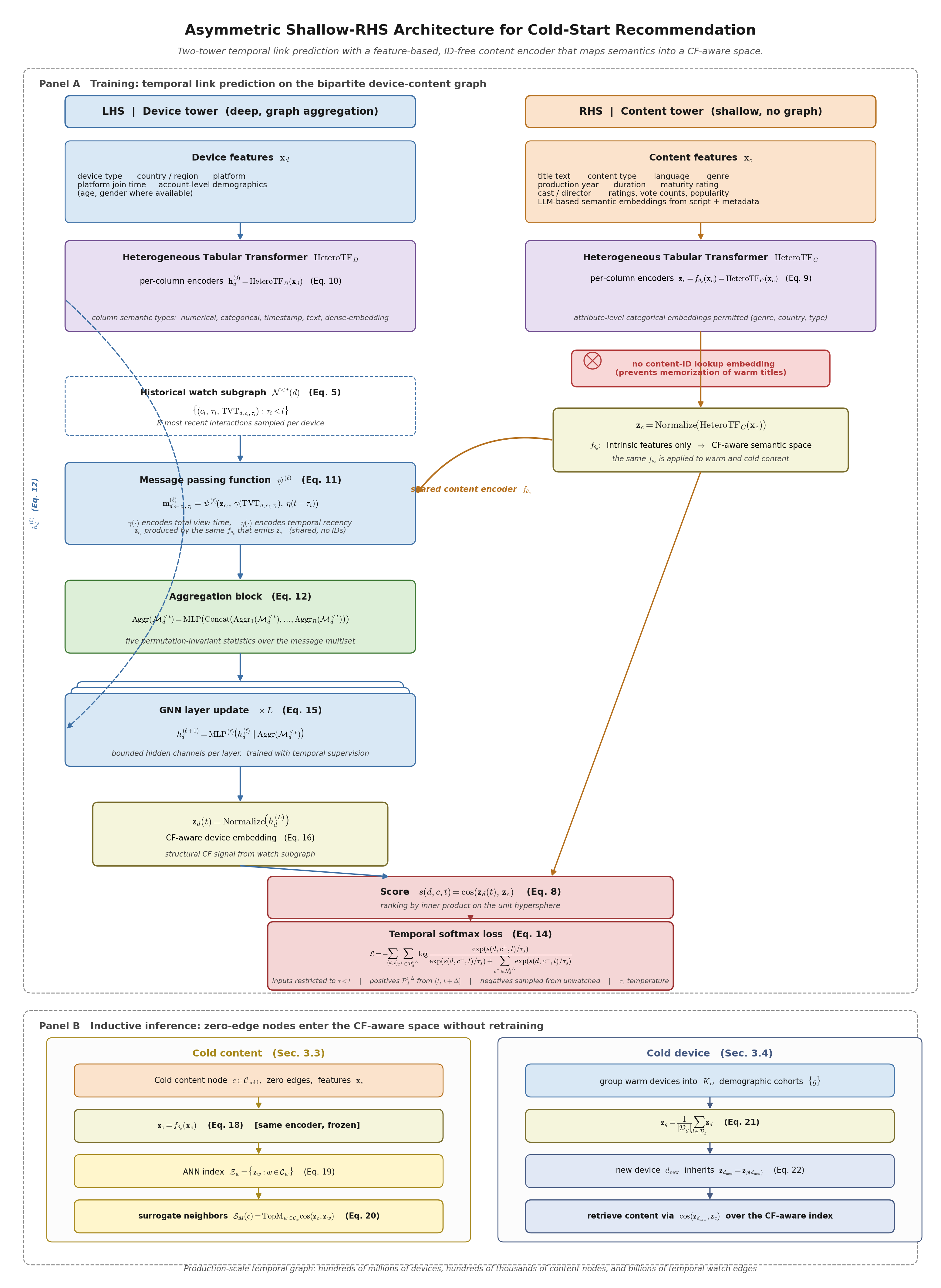
Figure 1: Overview of the Shallow-RHS architecture for content and device cold-start recommendation.
Surrogate-Neighbor Completion and Device Cold-Start
A distinct operational innovation is the deployment of implicit graph completion for cold content nodes via surrogate neighbors. After training, the content encoder fθc generates embeddings for both cold and warm titles; cold items then inherit collaborative priors by identifying their nearest warm neighbors in the shared space. These surrogates act as behavioral proxies for retrieval and promotion without fabricating synthetic edges, retaining strict interaction fidelity.
For device cold-start, a parallel strategy uses demographic cohorting: newly activated devices are grouped into clusters based on observable attributes (e.g., geography, device type). The centroid of each cohort (computed from the average warm-device embeddings) serves as the initial representation for unseen devices, enabling immediate recommendation prior to individualized behavioral accumulation.
Experimental Evaluation and Ablation Studies
Large-scale online A/B tests within Tubi's production pipeline validate the practical gains of the proposed method. Performance is assessed by holistic metrics, including total view time (TVT), qualified view days, and first-touch device engagement, all under real-world retrieval and latency constraints.
A phased experimental program evaluates incremental improvements:
- Phase 1: Semantic-to-CF Replacement: Replacing legacy semantic embeddings with Shallow-RHS yields a +0.10% TVT lift and 13% faster cold-content promotion.
- Phase 2: Metadata Enrichment: Improved feature/metadata coverage and calibrated promotion predicates raise TVT lift to +0.16%.
- Phase 3: Feature Completion: Broader feature coverage yields a pronounced +0.42% TVT lift, underlining the importance of semantic alignment.
- Phase 4: Surrogate/Deep Semantic Fallback: Generalization to the long tail via surrogate neighbor completion and further semantic enrichment gives a +0.17% TVT improvement.
On the device side, demographic cohorting improves first-touch conversion and daily engagement by up to +0.43%.
Embedding Space Analysis
A key diagnostic is the evolution of similarity score distributions across item embedding strategies:
- CF-only Embeddings: Cold items cluster near-zero similarity, effectively isolated from warm content.
- Semantic-only Embeddings: Similarity is more uniform yet remains detached from behavioral context.
- Shallow-RHS Embeddings: Distributions shift rightward, with cold items showing higher similarity to relevant warm items, confirming effective semantic-to-collaborative mapping.
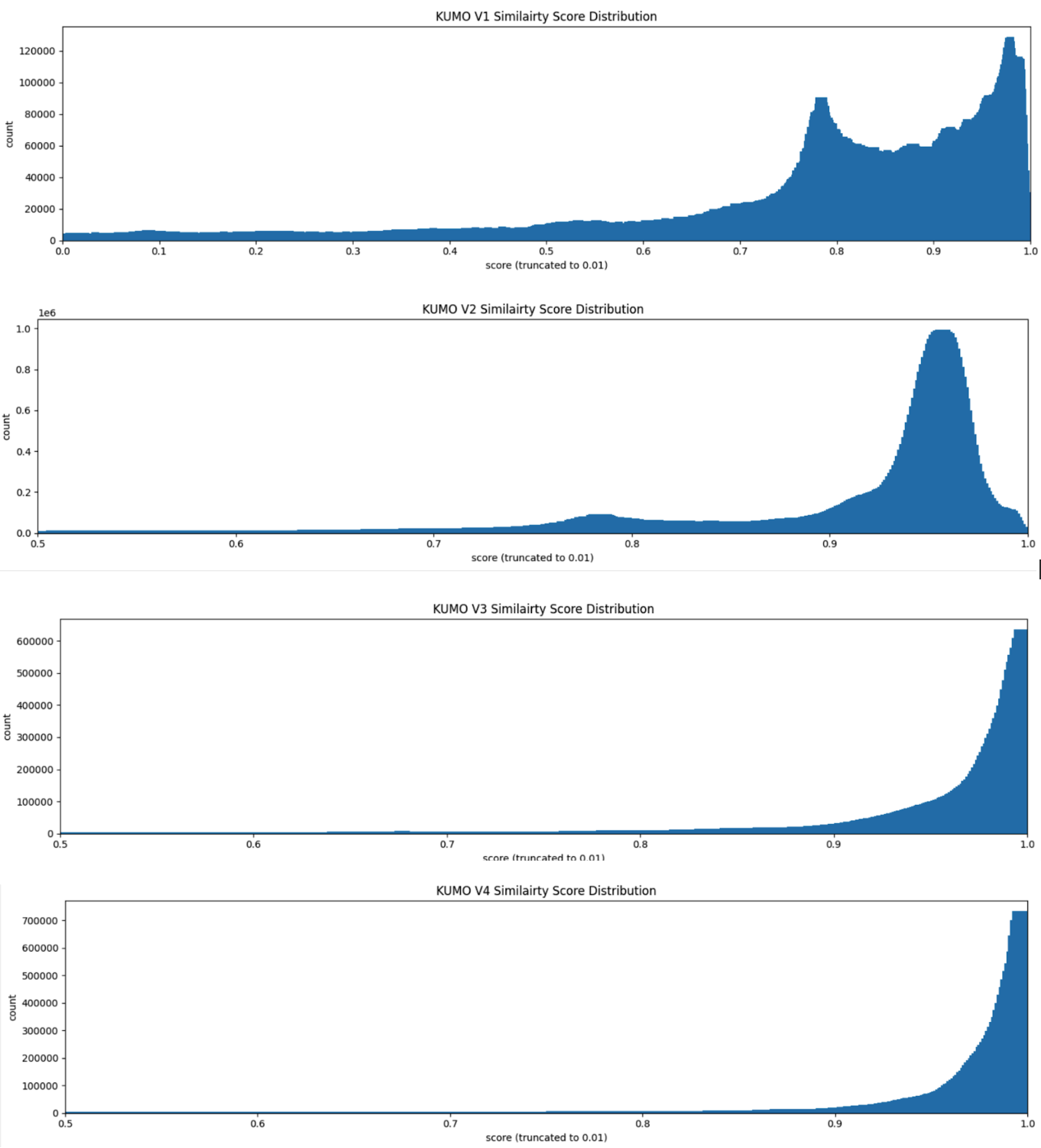
Figure 2: Similarity score distribution progress across baseline and Shallow-RHS content representations, demonstrating the shift towards collaborative filtering alignment for cold-start items.
Theoretical and Practical Implications
The asymmetric architecture offers several implications:
- Representation Generalization: By constraining the content encoder, it enables inductive generalization across the item cold-start regime, mitigating interaction-sparsity bottlenecks typical of GNN-CF systems.
- Modular Surrogacy: Surrogate completion operationalizes graph completion without synthetic edge addition, facilitating seamless integration into ANN-based retrieval stacks.
- Universal Inductive Heads: The approach motivates further research into asymmetric, feature-only towers for other modalities and interaction graphs (e.g., cross-lingual, cold-user, or cross-domain cold-start).
- Feature Enrichment as Bottleneck: The pronounced effect of metadata and semantic coverage suggests future work in automated side-information imputation and representation learning for robust cold-start generalization.
Conclusion
This paper establishes a principled, production-validated architecture for industrial cold-start recommendation, reframing the task as inductive representation completion via asymmetric temporal GNNs. Shallow-RHS couples collaborative signal transfer from a feature-informed device tower to a strictly inductive content encoder, supported by surrogate-neighbor and demographic-cohort completion. Empirical results confirm consistent improvements in content and device cold-start engagement. Subsequent research may extend these techniques to domain adaptation, cold-user generalization, and deeper integration of unstructured semantic modalities.

