- The paper shows that the full L2 score error can be misleading because solenoidal errors do not affect the generated marginal distribution.
- It introduces a Helmholtz-Hodge decomposition to separate observable gradient components from invisible solenoidal parts that are irrelevant for marginal evolution.
- Empirical results reveal a strong correlation (>0.95) between the gradient components and FID, supporting geometry-aware diagnostics and training adjustments.
Geometric Decomposition of Score Matching Errors in Diffusion Models
Motivation and Background
Score-based diffusion models are widely adopted for generative modeling by approximating an unknown target distribution p⋆ via iterative noise perturbations and reverse-time sampling. Denoising Score Matching (DSM), together with its extensions, supplies the prevailing score-estimation objectives. Conventional theory links the L2 score matching error to sample quality by supplying upper bounds on distributional divergences (e.g., KL) between the generated and true distributions. However, the paper "Diffusion Models Observe Only Gradients: A Geometric Perspective on Score Matching Errors" (2606.06179) establishes that this L2 score error is not intrinsic to marginal sampling quality.
Helmholtz-Hodge Decomposition and Marginal Observability
The central geometric insight is that the score estimation error es can be orthogonally decomposed into a pure gradient (observable) component and a solenoidal (invisible) component via the Helmholtz-Hodge decomposition. The gradient part, ΠGes, tangibly affects the marginal distribution via the Fokker-Planck dynamics, while the solenoidal component, ΠG⊥es, is filtered out and does not contribute to marginal evolution.
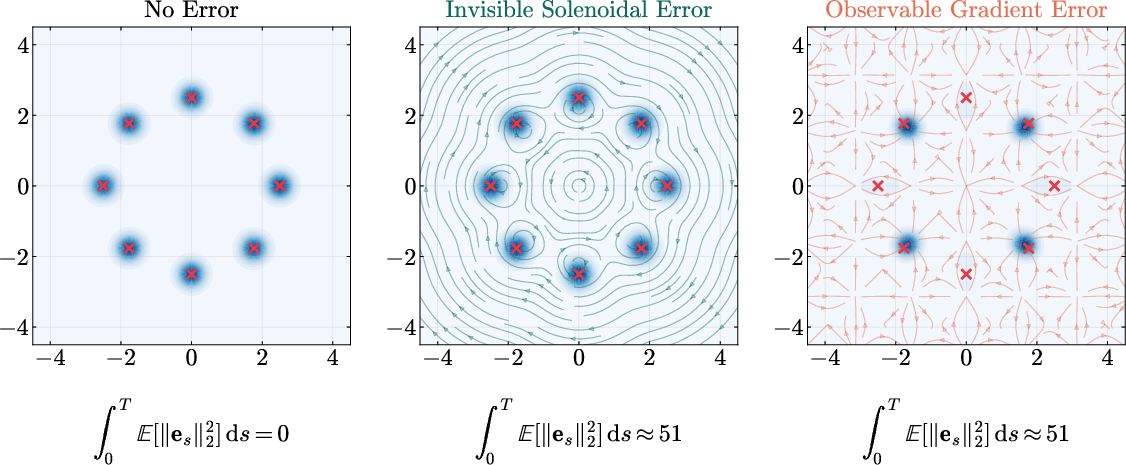
Figure 1: Visualization of solenoidal versus gradient score errors: solenoidal components (center) do not impact the generated distribution, unlike gradient-like errors (right), despite similar L2 scores.
The paper rigorously proves that a model may incur arbitrarily large L2 score error (due exclusively to solenoidal components) while perfectly matching the target distribution in terms of marginals. Thus, any monotone function of the L2 score error fails to provide a meaningful uniform lower bound on divergences between learned and true distributions.
Observable-Only Bounds and Tightening Girsanov
The derivation replaces classical bounds (which depend on the full L2 norm) with one strictly determined by the projection onto gradients: L20
The observable gradient component exclusively governs marginal discrepancies; ignoring the solenoidal parts tightens the bound and identifies the slack in standard Girsanov-based arguments as stemming from path-space versus marginal-space analysis.
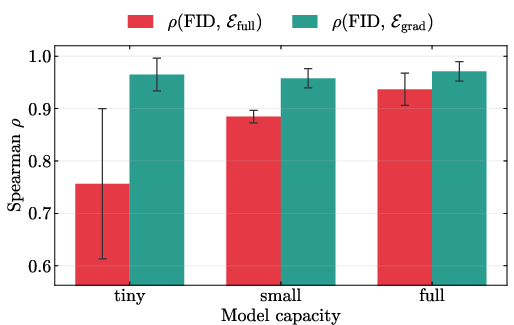
Figure 2: Spearman rank correlation between FID and error metrics; the gradient component aligns significantly better with sample quality versus the full error.
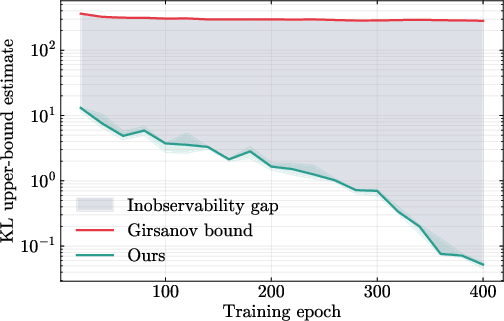
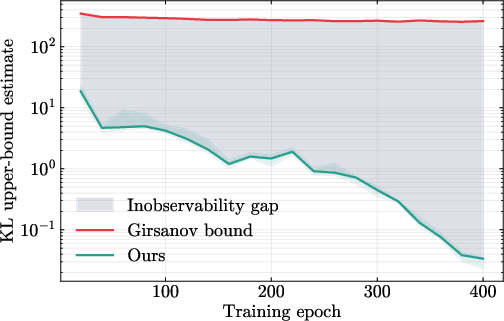
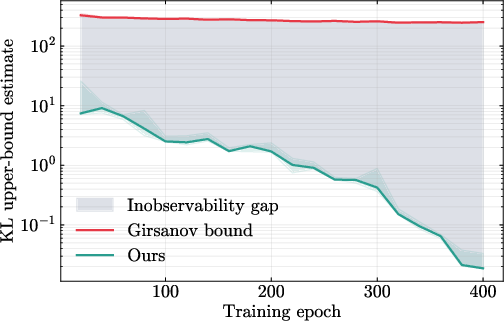
Figure 3: Comparison between classical Girsanov and geometry-aware bounds; the classical bound saturates at the solenoidal floor, while the geometry-aware bound keeps decreasing.
Empirical results demonstrate that across dataset and capacity variations (Fashion-MNIST, CIFAR-10), the observable (gradient) component correlates strongly (L21) with FID, outperforming the full score error norm which may have correlations as low as L22.
Unobservable Error Saturation During Training
DSM objectives do not penalize solenoidal error components, so after initial phases where the observable gradient components decrease substantially, invisible error components persist and dominate the residual score error.
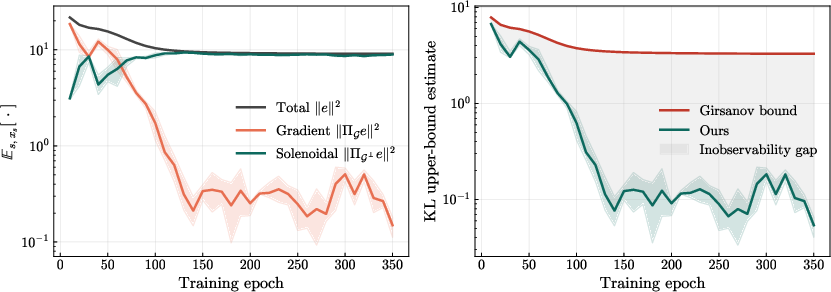
Figure 4: DSM fails to reduce solenoidal (invisible) error components during training; gradient errors decline while invisible errors plateau.
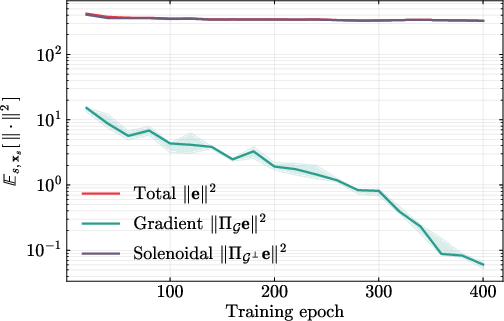
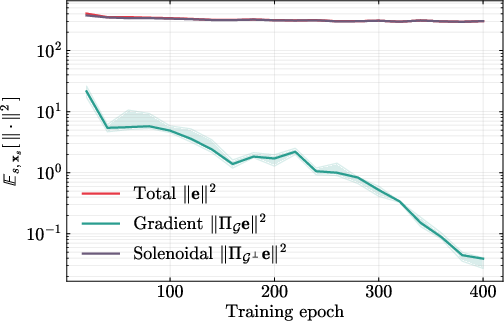
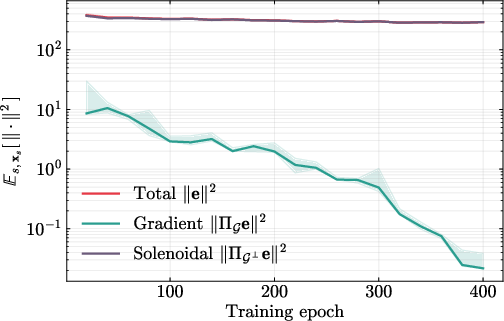
Figure 5: Full decomposition of score error across model sizes, showing persistent solenoidal plateaus even as gradient errors are minimized.
This separation undermines the reliability of full L23 score error as a proxy for sample quality; only the geometry-aware gradient projection yields a valid indicator.
Computational Estimation and Diagnostics
The paper proposes a tractable dual Sobolev variational reformulation for estimating L24 without explicit projection, by gradient ascent on scalar-valued critic networks. This estimator can be used as a standalone diagnostic, efficiently computable during or post training, and is robust across architectures and capacity tiers.
Theoretical and Practical Implications for AI
The findings imply that standard DSM loss is wasteful, penalizing error modes that are structurally unobservable in generated samples. The principal consequence is a refined theoretical taxonomy of score errors:
- Only gradient modes affect marginal generation, as dictated by Fokker-Planck dynamics.
- Solenoidal errors, prevalent in unconstrained architectures (U-Nets, Transformers), inflate classical bounds and decouple learning curves from actual sample quality.
Practically, this motivates the adoption of geometry-aware diagnostics during score network development, and suggests future research directions:
- Integrating gradient component estimation into training objectives, potentially via min-max schemes where critic networks guide the score network toward observable improvements.
- Further analysis of endpoint observability—identifying which gradient errors persist or dissipate en route to sampled outputs, especially in high-dimensional settings.
- Extensions to constrained score parametrizations (energy-based models, input-convex architectures), where the Helmholtz-Hodge gap vanishes.
Theoretically, the decomposition aligns with Wasserstein-2 geometry, identifying L25 as the tangent space element and connecting to optimal transport regularization and manifold-based modeling.
Conclusion
This work redefines the analysis of score-based diffusion models by identifying the geometric structure of score estimation errors. Observable gradient components, not the full L26 error, exclusively determine marginal quality. This insight produces strictly tighter sample quality bounds, motivates robust computational diagnostics, and reframes both theoretical understanding and practical training of diffusion models. Future advances should exploit this geometric perspective for improved generative modeling, regularization, and principled architecture design in AI.

