- The paper demonstrates that sparse dictionary regression bridges the gap between interpretability and predictive accuracy in modeling pediatric asthma exacerbation.
- It shows neural networks outperform GLMs by capturing complex interactions among environmental and socioeconomic risk factors with higher R² and lower MAE.
- Findings highlight synergistic effects between NO₂ and temperature, underscoring the need for high-resolution exposure data in public health interventions.
Modeling Pediatric Asthma Exacerbation from Environmental and Socioeconomic Risk Factors in Coastal Virginia
Introduction
This paper presents a comparative study of statistical and machine learning frameworks for modeling pediatric asthma exacerbation (AE) in the Hampton Roads region of coastal Virginia. The research addresses the need to disentangle the influence of multiple ambient, meteorological, and socioeconomic risk factors in predicting daily acute asthma-related healthcare visits at a granular (zip code-level) spatial and daily temporal resolution. The authors systematically compare three modeling paradigms: conventional generalized linear models (GLM), fully-connected neural networks (NN), and a sparse dictionary regression approach that lies between the two in the trade-off spectrum of interpretability and predictive accuracy.
Study Data and Predictors
The study population consists of pediatric visits (ICD10 J45) to the CHKD healthcare network from 2018 to 2023 across 42 zip codes. Environmental features comprise air quality metrics (NO₂, SO₂, CO, PM₂.₅, PM₁₀) interpolated from federal monitors, meteorological variables (temperature, precipitation, relative humidity), area-level composite socioeconomic indices (COI and SVI), and pandemic-related infection rates. The structured design allows systematic assessment of both main effects and interactions across these diverse domains.
Model Architectures and Evaluation
The GLM serves as the baseline, employing linear additive exposures with interpretable coefficients quantifying exposure-outcome associations via relative risks (RRs). The NN, with two hidden layers and tanh activation, is optimized for predictive performance, serving as a black-box upper bound on learnable complexity within the available data. To bridge the interpretability-predictive power dichotomy, the sparse dictionary regression selects a parsimonious subset from a library of linear and quadratic terms—allowing for explicit capture of nonlinearities and pairwise interactions while preserving model transparency.
Performance metrics include out-of-sample R2 and mean absolute error (MAE) on daily AE counts, with cross-validation stratified by zip code to guard against data leakage due to spatial autocorrelation.
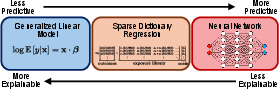
Figure 1: Modeling methods range from less predictive but more explainable (GLM) to more predictive but less explainable (NN). Sparse dictionary regression bridges the gap between two techniques.
Neural networks substantially outperform GLMs in both R2 and MAE, attributable to their expressive capacity for capturing complex patterns in the data. However, the sparse dictionary model—when appropriately tuned—narrows much of this performance gap (48% higher R2 and 10% lower MAE than GLM) while limiting the number of parameters. This demonstrates that a modestly-complex feature space encompassing polynomial and interaction terms can encode the principal nonlinearity present in the data.
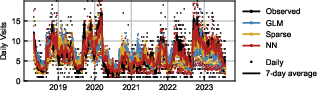
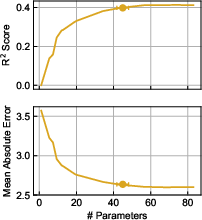
Figure 2: Model parameter count and test accuracy, with sparse models achieving intermediate accuracy. (Left: model comparison table; Right: 7-day rolling averages of predicted AE visits for each model type; Lower right: Sparse model accuracy as a function of coefficient threshold, demonstrating a performance plateau).
Consistency and Discrepancies in Exposure-Outcome Associations
Despite differences in functional form, all three models yield consistent risk hierarchies: NO₂ is robustly associated with elevated AE risk (NN RR=1.49±0.10, GLM RR=1.27±0.04, Sparse RR=1.27±0.05), and higher COI is protective. Discrepancies arise for SO₂ and temperature, where sparse models attenuate or eliminate the effects observed in both GLM and NN. The authors attribute these differences to the capacity of the sparse model to resolve or reallocate effect attribution through higher-order terms and interactions.
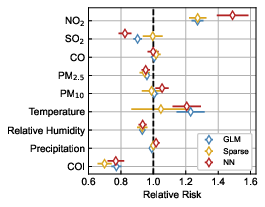
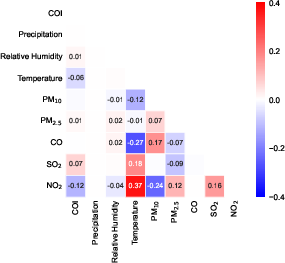
Figure 3: Relative excess risk due to interaction (RERI) for Sparse models. Interactions are detected where additive models cannot, enabling mechanistic hypotheses about synergies among exposures.
Interpretation of Interactions and Mechanistic Insights
Sparse models offer an explicit mechanism for detecting and quantifying interactions through RERI analyses. Key findings include a synergistic interaction between NO₂ and temperature—possibly reflecting unmeasured O₃-mediated pathways (as O₃ was unavailable for most of the time series). Additional interactions involve socioeconomic variables, suggesting that variations in built environment, local emission sources, and urban heat contribute non-additive risk.
The study contextualizes these interactions within the urban and coastal landscape of Hampton Roads, linking model findings to known differential distributions of emission sources and social determinants at the neighborhood scale.
Sensitivity Analyses and Stratified Effects
The authors probe model robustness by substituting SVI for COI; results are congruent, with higher social vulnerability consistently correlating with increased risk. Days characterized by atmospheric wildfire smoke further modulate AE risk, particularly for particulate species, with preliminary evidence for effect modification by extreme events. These findings underscore the value of high-resolution exposure data and granular socioeconomic indicators for environmental health modeling.
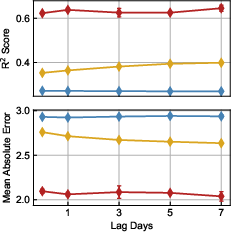
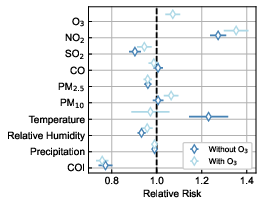
Figure 4: Model performance as a function of exposure lag and inclusion/exclusion of ozone as a predictor; inclusion of O₃ alters risk attribution, confirming collinearity and indirect mediation.
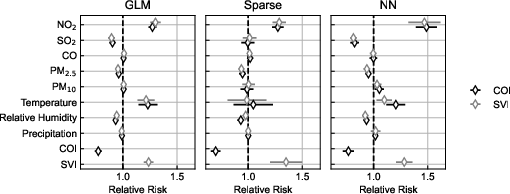
Figure 5: Consistency of modeled relative risks when using SVI versus COI as social determinant indices.
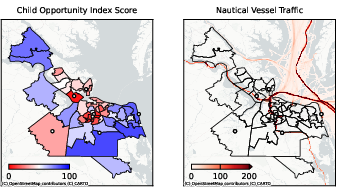
Figure 6: Distribution of child opportunity index and vessel traffic demonstrates environmental justice and emission source localization at neighborhood scales.
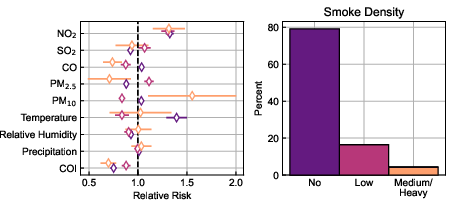
Figure 7: GLM relative risks stratified by wildfire smoke exposure demonstrate effect modification by episodic environmental events.
Theoretical and Practical Implications
Methodologically, the paper substantiates sparse dictionary regression as a viable and interpretable alternative to opaque neural approaches for large-scale spatiotemporal health outcome modeling. The explicit encoding and estimation of interactions allow for hypothesis-generating exploration of risk mechanisms, opening new avenues for explainable ML in syndemic and exposomic epidemiology.
Practically, the work highlights the need to integrate higher spatiotemporal fidelity in environmental measurements and to consider multi-level social determinants for actionable public health forecasting and intervention. Model-derived interactions could inform targeted alerts (e.g., for children in at-risk zip codes during high-NO₂ and high-temperature periods) or resource allocation for environmental mitigation.
Future Directions
The current approach is limited by the resolution of observational data (e.g., ambient air monitoring, zip-level social indices) and the functional form restrictions of the candidate feature library. Future developments may include dynamic, autoregressive sparse models, the integration of atmospheric transport and chemistry models, more granular socioeconomic or mobility data, and hybrid neural-symbolic methods where sparse identification regularizes neural architectures for principled feature selection and interpretability.
Conclusion
This case study advances a technical framework for integrating predictive and explanatory models in environmental health at urban scale. Sparse modeling approaches can bridge accuracy and interpretability in multifactorial health outcome prediction, elucidate mechanistic interactions, and support the design of more effective, localized interventions for pediatric asthma management in complex environmental settings.