- The paper proposes a multi-aspect iterative refinement framework that decomposes translation quality into fluency and literary effect.
- It leverages high-quality reference data and detailed preference pairs to achieve significant numerical gains over baseline models.
- The approach reduces computational costs and challenges implicit preference methods with an explicit reward modeling strategy.
Multi-Aspect Data Generation and LLM Training for Literary Translation
Literary translation fundamentally diverges from general machine translation due to its dual requirement: high fidelity in preserving complex artistic and cultural content, including metaphors and stylistic nuances, while simultaneously maintaining fluency and acceptability for target-language readers. The scarcity of high-quality annotated corpora for literary translation further exacerbates the challenge. Prior methods either depend heavily on expensive LLM-as-a-judge inference or chain-of-thought (CoT) data that increase both computational and inference costs. The limitations of rejection-based sample selection and monolithic CoT reasoning have made scalable, effective literary translation modeling elusive.
Multi-Aspect Iterative Refinement Framework
The paper proposes a multi-aspect, iterative refinement framework that operationalizes the decomposition of literary translation quality into two major axes: expression fluency and literary effect. The architecture involves a pipeline where specialized LLM translators—one optimizing for fluency, another for literary/aesthetic fidelity—iteratively improve the candidate translation. An evaluator module, also based on an LLM, provides scalar feedback and targeted suggestions, and an aggregator synthesizes the improved versions. The process iterates until a convergence criterion is met.
This design enables the generation of (i) high-quality reference translations for supervised fine-tuning (SFT); and (ii) fine-grained preference pairs, derived from all intermediate outputs, capturing nuanced trade-offs between fluency and literary preservation.
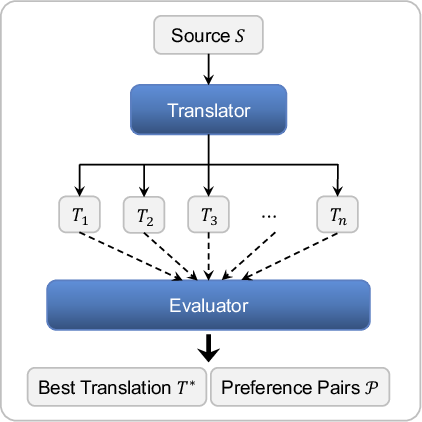
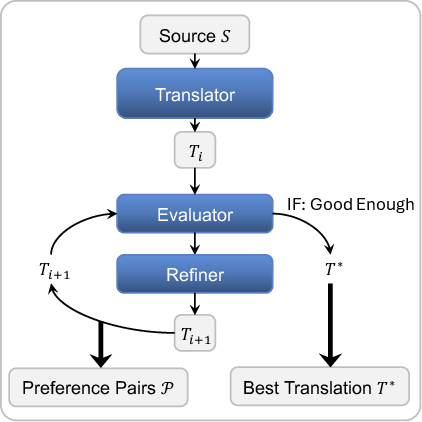
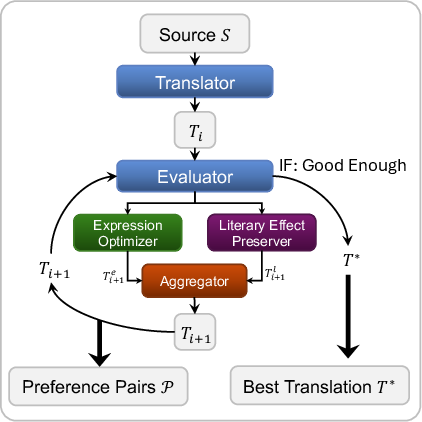
Figure 1: The data generation pipeline compares Sampling+LLM Judge, Self-Refinement, and the proposed Multi-Aspect Refinement pipeline with specialized agents and iterative aggregation.
Data Generation and Training Paradigms
The approach generates data via a fixed backbone LLM (>200B parameters) but enables downstream model training independent of repeated high-cost inference. Two forms of generated data are leveraged:
- High-quality references: Used for SFT; direct improvement over human references and previous distillation approaches.
- Preference pairs: Employed for RL-based preference optimization.
The study systematically contrasts implicit preference modeling (DPO, SimPO, CPO) and explicit reward modeling (a reward model trained on preference pairs, followed by GRPO optimization). All generated data are reusable, amortizing the LLM inference cost across all subsequent training runs.
Experimental Results and Numerical Gains
Experiments conducted on the MetaphorTrans English-to-Chinese benchmark and the O. Henry out-of-domain test set demonstrate several strong numerical results:
- SFT with generated references yields +8.65 CEA100 over original human ground truth.
- Explicit reward modeling with GRPO outperforms DPO-series RL methods, providing +1.51 CEA100 gain beyond SFT.
- LitMT-8B and LitMT-14B achieve 67.25 and 69.07 CEA100, respectively, competitive with large-scale proprietary LLMs (Claude Sonnet 4.5 at 68.43).
- Parameter efficiency: LitMT-8B (8B) outperforms Qwen3-235B-A22B (22B active) by 1.63 CEA100 with over an order-of-magnitude fewer parameters—indicating genuine improvements instead of simple knowledge distillation.
Ablation studies confirm that best-of-N sampling and one-dimensional refinement are consistently inferior to the full multi-aspect approach. The increased CEA100 differential (4.66 points over direct model distillation) underlines that iterative, modular, aspect-targeted refinement produces higher intrinsic data quality.
Comparative Analysis of Training Methodologies
A critical empirical finding is the inferior performance of DPO/Supplementary preference-only approaches in this domain: all DPO-series methods degrade model performance relative to SFT, while reward model-based GRPO yields systematic improvement. This contrasts with many general-domain RLHF results and confirms that, for literary translation, explicit reward modeling with group-normalized policy optimization—using a composite reward—better captures the complex trade-offs encoded in the preference pairs.
Additionally, reward model validation on held-out sets shows >96% pairwise accuracy for unambiguous preferences, with balanced calibration for subtler distinctions, confirming the learnability and informativeness of the multi-aspect preference data.
Evaluation Protocol and Reliability
LLM-based metrics, especially with advanced evaluators (Claude Opus 4.5), are adopted as primary evaluation tools. Inter-judge correlation analyses using four top-tier LLMs reveal system-level ranking agreement over 88% and sample-level Kendall’s τ coefficients (0.36–0.62) that match or exceed reported human-LLM agreement on MQM, substantiating the objectivity of automatic evaluation. The evaluation framework supports fine-grained and scalable assessment across large sample sizes.
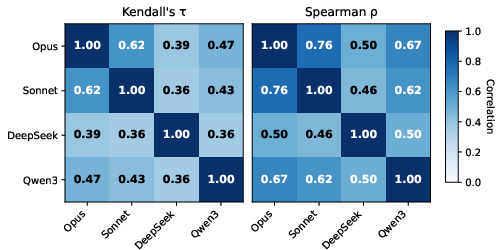
Figure 2: Pairwise sample-level correlations among four LLM judges on 12,000 translation outputs, demonstrating substantial inter-judge agreement at both system and sample level.
Cost-Efficiency and Practical Implications
The framework achieves significant reductions in amortized computational cost. High-quality data is generated via a one-time LLM inference, after which all training and experimentation—including hyperparameter search—can proceed without repeated API calls or reward scoring, in contrast to prior RL pipelines where every run incurs substantial LLM-as-a-judge expenses and GPU utilization inefficiencies.
Furthermore, the approach obviates the need for expensive long-chain CoT reasoning at inference, making deployment in real-time or production scenarios feasible.
Theoretical and Practical Implications
This work empirically validates that multi-faceted, aspect-targeted iterative refinement, coupled with explicit reward modeling, is more effective for modeling complex translation quality trade-offs than end-to-end implicit preference optimization. The implications are significant:
- Practical: The pipeline provides a reproducible and cost-effective solution for developing parameter-efficient LLMs competitive with frontier proprietary models for literary (and potentially other) translation domains.
- Theoretical: These findings challenge the general superiority of DPO/implicit preference alignment for complex generative domains, motivating further investigation into when explicit reward modeling is required for successful RLHF.
Future Directions
Promising next steps include extending the multi-aspect paradigm to other language pairs and translation domains, integrating long-form or document-level context, and unifying iterative refinement with CoT-enhanced LLM inference. The explicit modeling of preference axes suggests utility for broader NLG domains (e.g., dialogue, summarization) where multi-dimensional quality judgments apply.
Conclusion
The paper presents a robust, theoretically motivated, and empirically validated approach to high-quality literary translation with LLMs. By decomposing translation quality and generating reusable multi-aspect reference and preference data, it enables parameter-efficient LLM training surpassing strong baselines and competitive proprietary models. The findings emphasize the practical and methodological importance of aspect-targeted data generation and explicit reward modeling, and offer an extensible framework for future research in high-fidelity generative language technologies.