- The paper demonstrates that LoRA adapters yield significant QA performance gains, recovering 13–21 ROUGE-L points when explicit document context is absent.
- It reveals that enabling LoRA exclusively during answer generation optimizes performance under aggressive KV cache compression.
- The study confirms that QA-only training and targeting MLP modules are crucial for robust parametric memory in high-compression regimes.
Rethinking LoRA Memory Through the Lens of KV Cache Compression: An Expert Analysis
Introduction and Context
This paper, "Rethinking LoRA Memory Through the Lens of KV Cache Compression" (2606.05698), contributes an empirical examination of the interplay between parametric document memory instantiated as LoRA adapters and context-side memory controlled via key-value (KV) cache compression in document-level question answering (QA). The investigation is motivated by two orthogonal approaches to reducing context-length bottlenecks in LLM inference: (1) KV-cache compression, which reduces the runtime and memory cost by discarding or merging unimportant context tokens, and (2) parametric retrieval augmentation, where retrieved document information is distilled into lightweight, document-specific model parameterizations, such as LoRA adapters.
The study advances understanding of when and how document LoRA and compressed KV caches provide complementary or redundant sources of information, with implications for both efficient LLM serving and the design of memory-augmented architectures for knowledge-intensive tasks.
Experimental Protocol
The authors formalize a controlled experimental framework:
- For each long document, a dedicated LoRA adapter is trained using document-derived supervision (with an ablation across several supervision formats).
- At evaluation, question answering is performed by varying the compression ratio ρ of the document segment of the KV cache, testing settings from full context (no compression) to the extreme case of zero retained document tokens.
- Multiple inference-stage controls are employed to dissect the function of LoRA: the adapter can be enabled during document prefill, compression scoring, answer decoding, or any combination.
- Experiments are conducted using Llama-3.1-8B-Instruct and Qwen3-4B, with NarrativeQA and LongHealth as document-level QA benchmarks.
Main Findings: LoRA vs. Compressed KV Cache
LoRA Value Emerges Under Aggressive Compression
The core empirical result demonstrates that document LoRA adapters offer negligible gains in QA performance when most of the document context is preserved in the KV cache. As the compression ratio increases, and explicit document tokens are evicted, the utility of LoRA rises sharply and peaks when document context is completely absent.
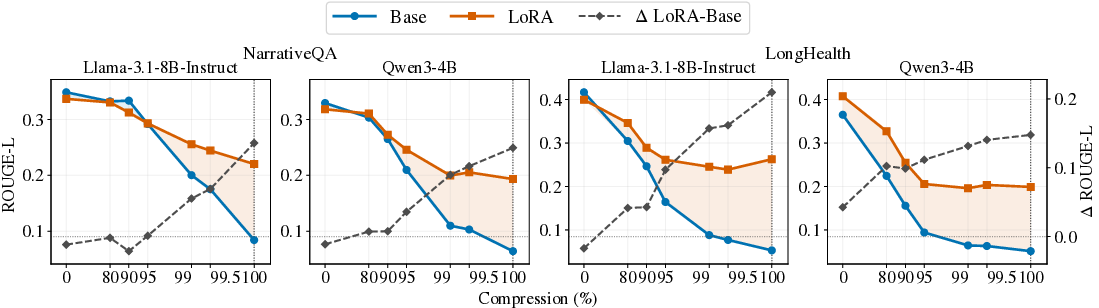
Figure 1: Document LoRA complements aggressive KV-cache compression. LoRA offers little benefit with substantial context, but becomes critical at high compression rates and the no-context endpoint.
Quantitatively, at the no-context setting, the LoRA-improved model recovers 13–21 ROUGE-L points over the base model. The transition from reliance on context to reliance on parametric memory occurs between moderate and very high compression regimes, suggesting that LoRA adapters are not a general replacement for retrieved context, but serve as an orthogonal, fallback memory channel activated by context scarcity.
Inference-Stage Application: Decoding-Time Primacy
Ablation on the inference stage at which LoRA is enabled reveals that the strongest configuration is to use the base model for document prefill and compression scoring, enabling LoRA only during answer generation. This allocation maximizes the information retained in the compressed KV cache while exploiting LoRA’s ability to inject document knowledge into the generative process under resource-limited conditions.
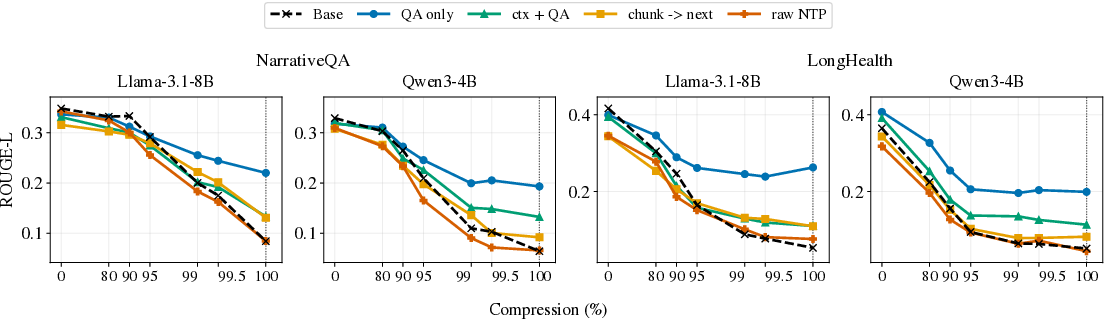
Figure 2: Training-format comparison. QA-only supervision yields the strongest LoRA adapters in the high-compression and no-context regime for both datasets and models.
The result indicates that the parametric memory stored by LoRA is optimally expressed at decoding time, supporting generation when context-dependent evidence is maximally restricted.
Direct comparison among various training formats for document adapters—raw next-token prediction, chunk-to-chunk continuation, context-plus-QA, and QA-only—shows that only QA-style, answer-supervised training yields strong improvements in the no-context QA setting.
Other formats, even if they expose the adapter to document text or utilize QA-formatting but with available context, fail to impart the necessary mapping from question to answer in the absence of explicit context. This emphasizes that parametric adapters must be trained in a manner congruent with downstream usage under context-deprivation.
Ablation Analyses
Compression Algorithm Robustness
The nontrivial margins in LoRA's benefit are invariant to the choice of compressor, as shown in a comparison between Compactor and Expected Attention. The trajectory—negligible difference at low compression, growing LoRA advantage at high compression—is consistent irrespective of which tokens are selectively retained, reinforcing that LoRA’s role emerges from the removal of context, not peculiarities of specific token selection methods.
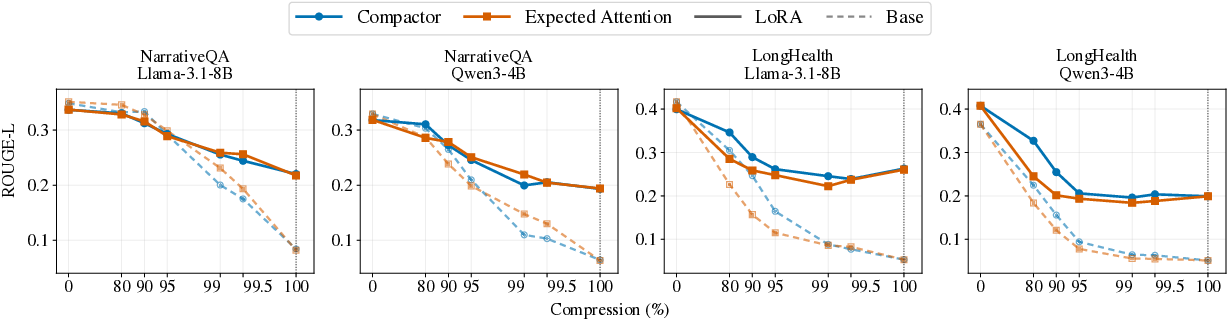
Figure 3: Compression method ablation. The LoRA margin over base persists across both algorithmic strategies, confirming the robustness of findings to compression implementations.
LoRA Target Module Analysis
Contrary to common intuition, targeting only the MLP (feed-forward) modules for LoRA is at least as effective, and sometimes superior, compared to all-linear (MLP + attention) targeting. Attention-only adapters are consistently weak. This result is consistent with prior findings that MLPs in transformers serve as high-capacity, key-value associative memory repositories, making them natural adaptation targets for factual knowledge insertion.
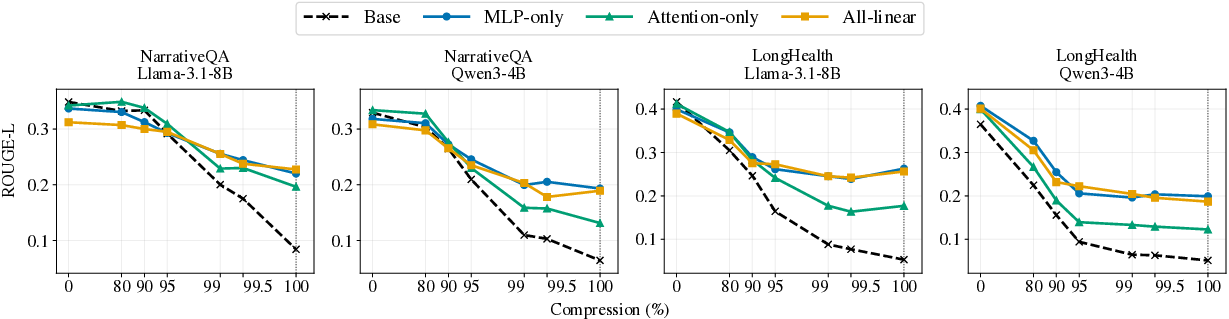
Figure 4: Target module ablation. MLP-targeted adapters are optimal in memory-scarce regimes, supporting the role of feed-forward layers as semantic memory.
Training Hyperparameters
Learning-rate and chunk-size ablations (not shown here but detailed in the appendix) indicate that moderate chunking and carefully chosen learning rates are necessary for robust high-compression performance. These settings enable the LoRA adapters to capture a more distributed and generalizable mapping from questions to answers.
Additional Insights
- Moderate compression already begins to expose the limitations of parametric-only retrieval augmentation, with the full LoRA margin realized only at the extreme context removed endpoint.
- Context distillation and more advanced forms of synthetic QA construction could potentially enhance LoRA’s effectiveness, but naive document exposure or unsupervised objectives are substantively insufficient.
Practical and Theoretical Implications
The central implication is that document LoRA adapters are not competitive replacements for explicit document context under unconstrained memory. Their utility is maximized when context bandwidth is throttled due to hardware or application constraints (serving multiple long requests, prefetching for repeated queries, or LLM-as-a-service use-cases with strict throughput requirements).
In practice, this motivates hybrid systems: retain as much relevant document context in the KV cache as resources allow, and supplement with parametric adapters distilled from document QA when compression becomes severe. The findings also suggest that memory-augmented LLM architectures should flexibly incorporate both context and parametric sources, with routing or adapter selection policies contingent on real-time resource profiles.
From a theoretical perspective, this work clarifies the memory duality in LLMs: context memory (via KV caches) remains orthogonal to parameter memory (via adapters), and only when one is depleted does the other manifest its unique advantage. It also underscores the necessity of task-aligned supervision when learning parametric document memories.
Future Directions
Potential research avenues include:
- Online adaptation of document LoRA when documents change dynamically.
- Policy learning for adaptive allocation between context and parametric memory sources based on query distribution and memory budgets.
- Integration with scalable adapter routing and retrieval mechanisms for multi-document scenarios.
- Exploration of richer supervision signals for LoRA training, possibly via improved synthetic QA generation or human-in-the-loop labeling.
Conclusion
This work provides a rigorous empirical dissection of the boundaries and synergies between compressed context and parametric LoRA memory for knowledge-intensive tasks. Document LoRA excels as a decoding-time memory augmentation mechanism specifically in high KV-cache compression regimes, but yields little benefit when context is ample. Effective utilization of such adapters is contingent on QA-style, answer-specific supervision and careful application during answer generation. The insights provide guidance for the deployment and design of efficient, hybrid memory-augmented LLM serving systems under practical constraints.

