- The paper introduces RidgeFT, a framework using closed-form updates for incremental text attribution across evolving generators.
- It employs covariance calibration, random feature lifting, and class-balanced ridge regression to efficiently assimilate new generators.
- Experimental results show robust macro-F1 performance, maintaining high accuracy even in low-resource and imbalanced settings.
Lifelong Machine-Generated Text Attribution via Analytic Ridge Feature Transfer
Problem Overview and Motivation
The proliferation of LLMs has accentuated the necessity for fine-grained MGT attribution, wherein the objective is not simply to detect machine-generated text but to identify its specific generative source for purposes such as forensic accountability and the investigation of model misuse. Classical attribution systems generally operate under a static generator set assumption, which is fundamentally misaligned with practical conditions—the generator landscape evolves consistently with the introduction of new LLMs. This continual evolution gives rise to the lifelong MGT attribution setting, in which the class space is incrementally expanded, presenting substantial challenges in adapting to new generators while avoiding catastrophic forgetting of previously seen ones. Constraints on data retention (due to privacy, licensing, or cost) make exemplar replay or repeated full retraining infeasible in many deployment scenarios.
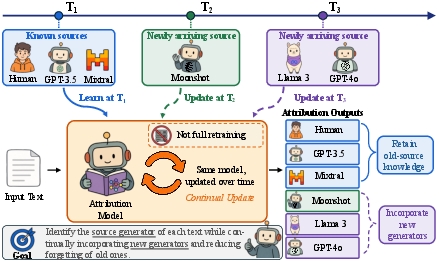
Figure 1: Illustration of the lifelong MGT attribution setting, where generators are incrementally introduced and must be attributed without replaying historical data.
Methodological Contribution: RidgeFT
The proposed Ridge Feature Transfer framework (RidgeFT) addresses lifelong MGT attribution by decoupling representation learning from incremental adaptation. The key insight is to freeze a task-tuned encoder after supervised training on the initial generator set. All subsequent adaptation—i.e., incorporating new generator classes—is performed analytically in the feature space via a sequence of transformations and a closed-form, memory-efficient update rule that eliminates the need for text replay.
The RidgeFT pipeline comprises three pivotal stages:
- Covariance Calibration (Fractional Whitening): Nuisance variation (topic, style, domain) in encoder representations is suppressed via a fractional trace-shrunk whitening transform computed from base-class statistics.
- Isotropic Random Feature Lifting: The calibrated feature vectors are projected via a fixed, non-trainable Gaussian matrix, followed by nonlinearity and normalization, expanding expressivity while preventing representation drift.
- Class-Balanced Analytic Ridge Regression: Incremental classification is reduced to closed-form ridge regression on class-wise sufficient statistics, with weighting to mitigate class/sample-size imbalance.
The entire process requires only (i) the frozen encoder, (ii) calibration parameters, (iii) a fixed projection matrix, and (iv) per-class sufficient statistics, supporting strict memory constraints and replay-free updating. Each new generator is assimilated by updating the class statistics and analytically computing the new classifier head.

Figure 2: Overview of RidgeFT, showing analytic incremental updates in a frozen feature space, with covariance calibration, random feature expansion, and class-balanced regression.
Experimental Analysis
Multi-protocol evaluation (P3, P4, P5, differing in the number and sequence of added generators) is conducted across multiple domains (academic, social media), using DeBERTa-v3-base and RoBERTa-base backbones. RidgeFT consistently demonstrates robust performance across all protocols, outperforming all replay-based and replay-free continual learning baselines with respect to both aggregate macro-F1 and new-class adaptation. In P5 (the standard protocol), RidgeFT attains macro-F1 = 0.886 (RoBERTa) and 0.885 (DeBERTa), improving full-F1 by 0.037 over the strongest continual-learning baseline. The framework notably achieves new-class F1 improvements exceeding 0.10 over all baselines, evidencing its capacity for efficient generator assimilation without significant retention loss.
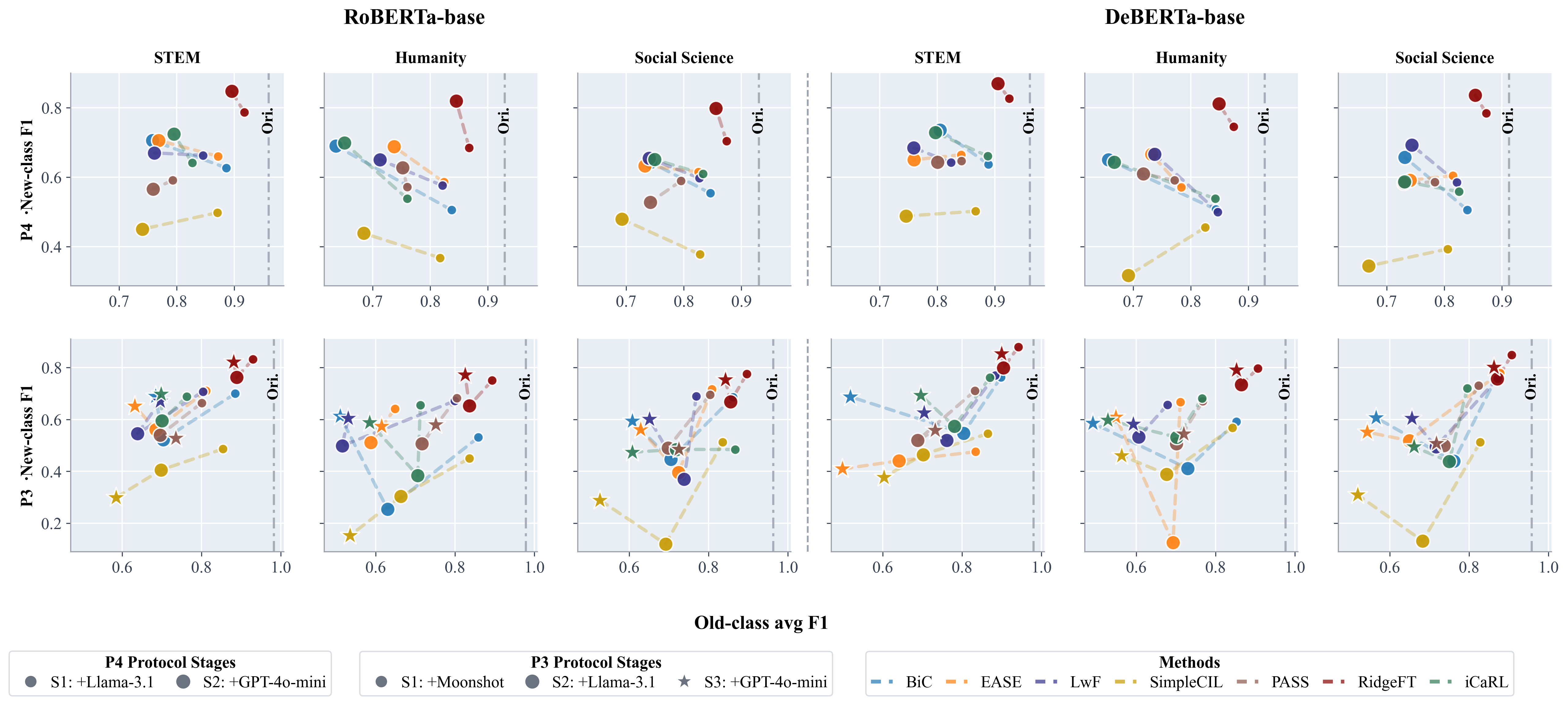
Figure 3: Progressive macro-F1 performance on academic topics as new generators are sequentially added, demonstrating RidgeFT's stability and superiority over replay baselines.
Data efficiency is also emphasized: with only 5% of the new generator’s training data, RidgeFT maintains a full-F1 above 0.90, with baselines degrading significantly under the same low-resource regime.
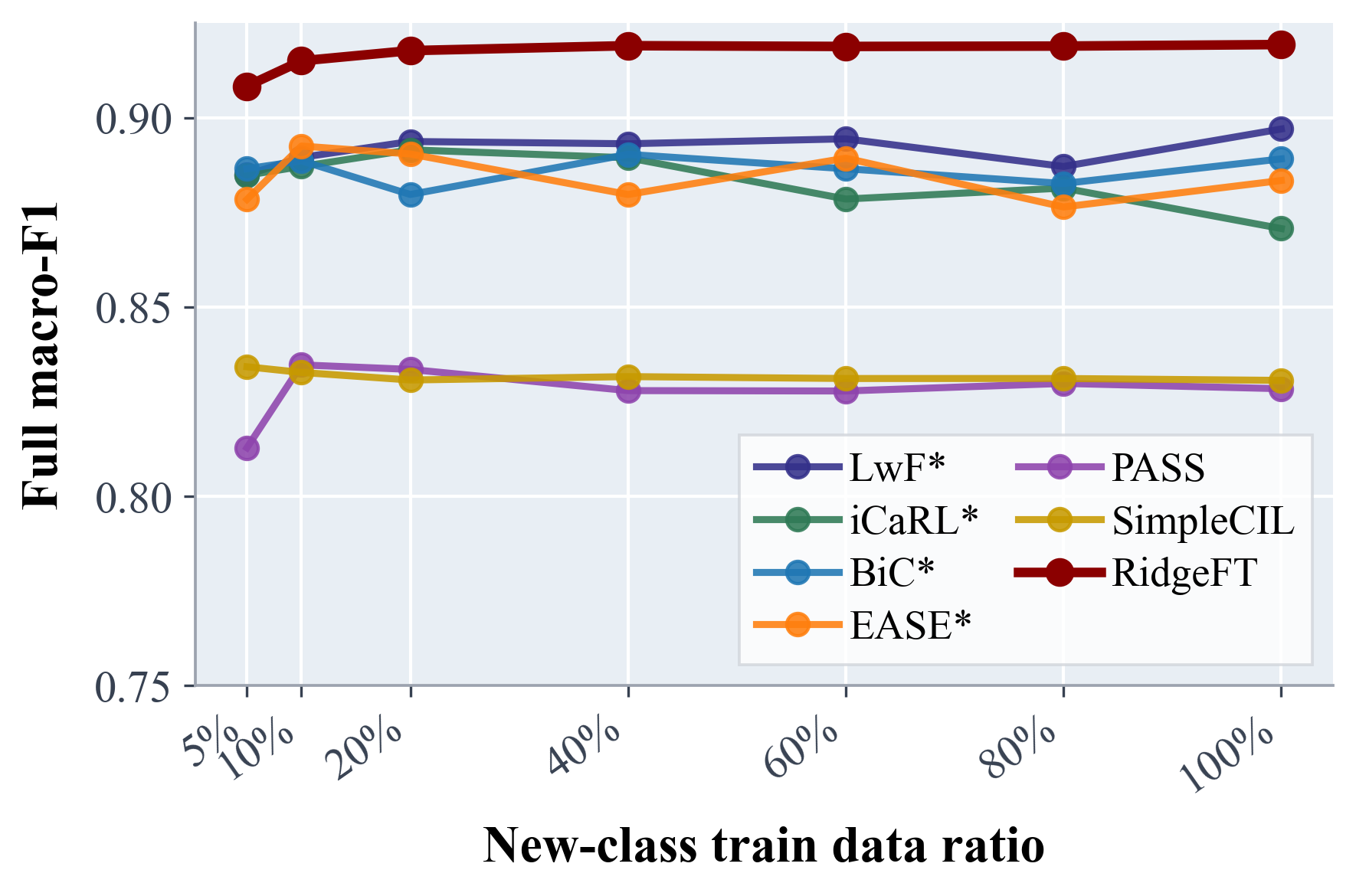
Figure 4: Macro-F1 remains stable for RidgeFT as the target-class data fraction is reduced, underlining its robustness to low-resource additions.
Ablation and Analysis
Component ablations dissect the individual and joint contributions of covariance calibration, random feature lifting, and class-balanced regression. Isolated use of class-balanced regression yields the highest new-class F1 among single components, but their combination is strictly optimal, particularly in data-poor regimes. Hyperparameter sweeps (covering calibration strength, shrinkage, feature dimension, class weighting, etc.) indicate RidgeFT's broad robustness, with the random feature dimension and class weighting parameter β being most influential.
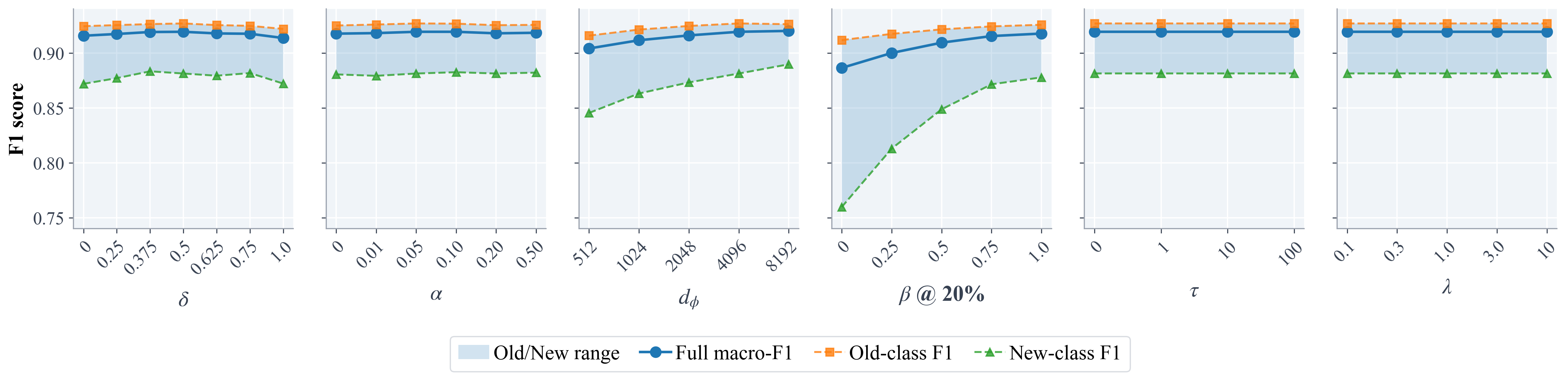
Figure 5: Parameter sensitivity of RidgeFT, profiling the influence of each hyperparameter on macro-F1 and highlighting robust regions.
Statistical memory efficiency is analyzed, demonstrating that low-precision (bf16) storage of merged class statistics can reduce storage by nearly 17× with negligible performance loss. RidgeFT is shown to be replay-free, not storage-free; additional compression strategies are possible via further statistic amalgamation or quantization.
Representation Stability and t-SNE Visualizations
Freezing the encoder retains generator-discriminative information even for future, unseen models, provided the initial encoder is adequately task-tuned. t-SNE projections illustrate that RidgeFT’s transform sequence sharpens class clustering and maintains separability of incoming generators without collapasing new classes into old decision boundaries.
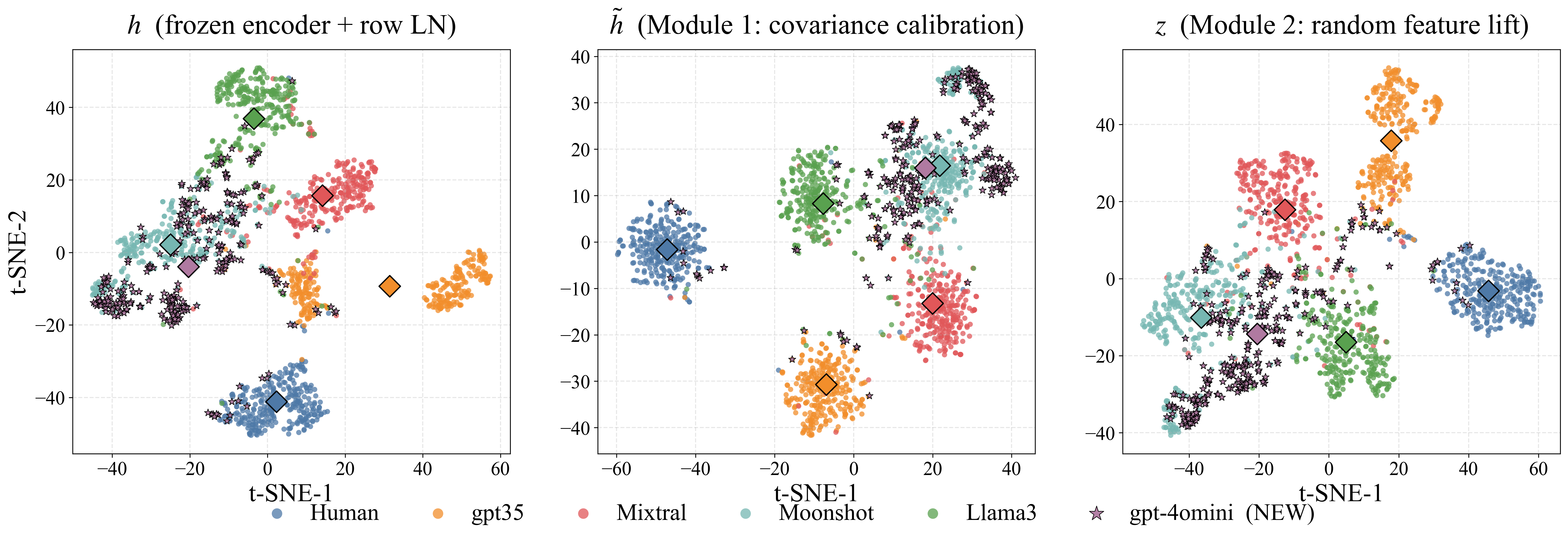
Figure 6: t-SNE plots revealing that RidgeFT's feature transformations enhance inter-generator class separation while preserving structure after incremental updates.
Practical and Theoretical Implications
RidgeFT provides a scalable analytic alternative to encoder fine-tuning and replay for lifelong MGT attribution. Practically, it enables efficient, logistically feasible attribution system maintenance as the LLM landscape evolves, avoiding retraining/deployment bottlenecks associated with batch-continual approaches. Theoretically, the work suggests that freezing encoder representations—when task-adaptive—does not fundamentally hamper incremental class assimilability, provided analytic ridge and random feature-based expansion in the feature space.
However, the rigid reliance on frozen representations could degrade over indefinite generator divergence, setting open questions on hybrid strategies incorporating periodic encoder re-tuning or calibration refresh. The method’s statelessness with regard to raw text will especially appeal to constrained-data or privacy-critical deployment scenarios in enterprise, academic, or social media oversight settings.
Conclusion
This paper formally introduces RidgeFT for lifelong MGT attribution, leveraging analytic closed-form updates in calibration-augmented random feature spaces while maintaining strict replay-free operation. Extensive experiments confirm that RidgeFT achieves a superior trade-off relative to continual learning baselines on both past knowledge retention and rapid new generator adaptation, including under low-resource and severe class imbalance conditions. The analytic framework outlined here marks a robust baseline for future MGT attribution systems required to operate under open-ended, data-constrained, and dynamically evolving generator class spaces.