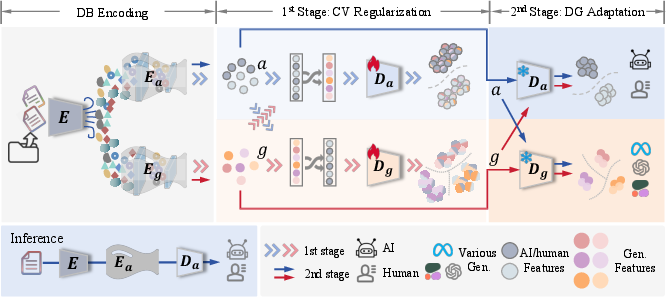
- The paper introduces a dual-bottleneck encoding framework that disentangles semantic cues from generator-specific artifacts, achieving up to 26.2% F1 improvement.
- It employs progressive cross-view regularization and discriminator-guided adaptation to enforce robust separation of features under generator shifts.
- The framework demonstrates scalability and resilience under adversarial conditions, suggesting potential for continuous deployment in dynamic environments.
Disentangled Representation Learning for Generalizable AI-Text Detection
Motivation and Problem Statement
With the advent of increasingly sophisticated LLMs, distinguishing AIGT from human-written text poses a persistent challenge, especially under rapidly evolving unseen generator distributions. Existing approaches relying on generator-specific artifacts are highly brittle, often exhibiting poor generalization and robustness as new generators emerge. The central research problem is to enable AIGT detection that is resilient to generator shift—distinguishing semantic cues of AI-generated text independently from generator-specific patterns.
Methodological Framework
The proposed framework achieves semantic disentanglement via a progressive, modular pipeline:
This structured design delivers generator-invariant AI-detection features and generator-aware auxiliary features, tailored for robust and interpretable AIGT classification.
Experimental Analysis and Results
Cross-Generator Generalization
The framework is evaluated on the MAGE benchmark, spanning 20 LLMs from 7 generator families. The leave-one-generator-out protocol tests detection on completely unseen generators. The model achieves consistent improvements in accuracy and F1 measure across all held-out generator categories, with up to 24.2% accuracy and 26.2% F1 increase over leading alternatives.
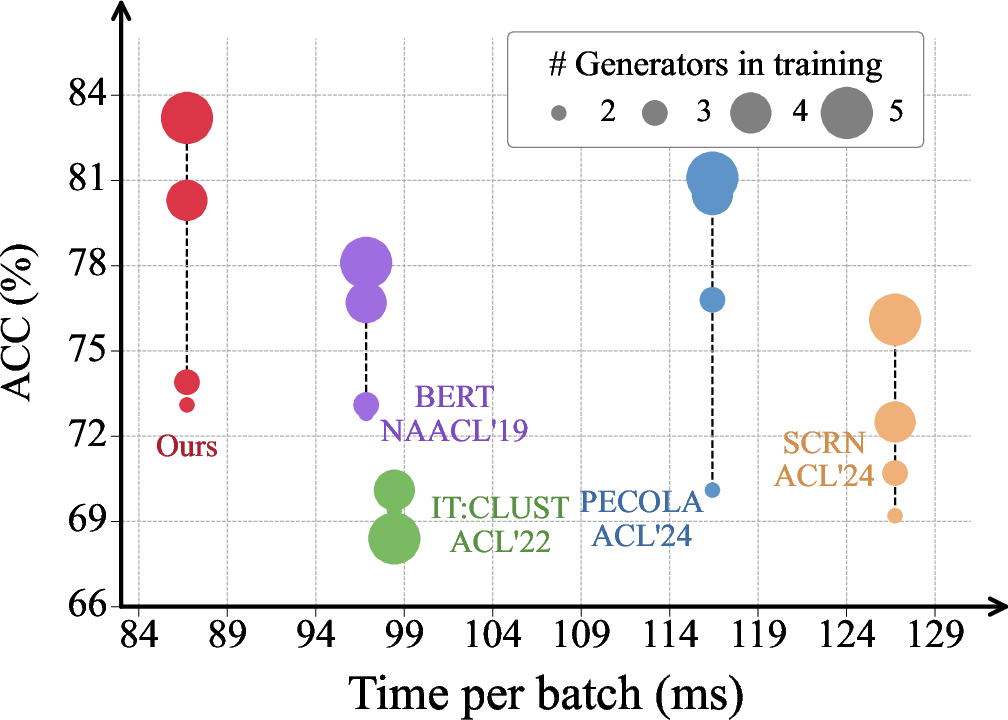
Figure 2: On unseen OPT generators, the proposed method achieves the strongest accuracy/efficiency tradeoff, with performance improving as training generator diversity increases.
Generalization gains are especially pronounced when training on diverse generators, confirming that diversity—not volume—is the primary driver of robustness. The impact of increased generator diversity is quantified, showing robust scalability across open-set conditions.
Visualization of Disentangled Feature Spaces
Progressive t-SNE projections illustrate the incremental effects of model components. The baseline BERT collapses feature space, entangling unseen generator samples. Dual-bottleneck encoding compacts clusters and reduces generator noise; cross-view regularization smooths inter-class boundaries; adaptation yields clear human–AI separation and generator-invariant alignment.
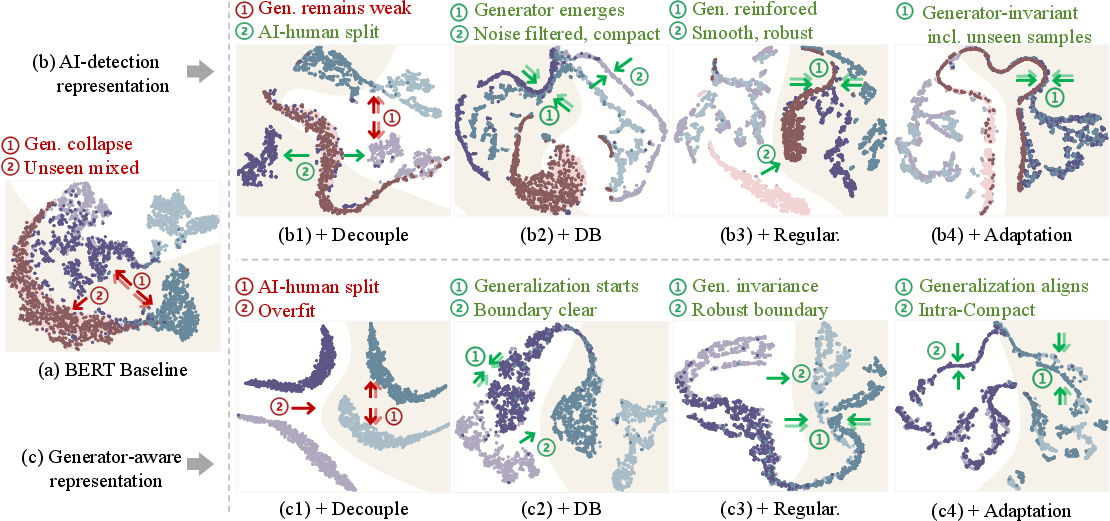
Figure 3: Cumulative t-SNE projections reveal enhanced compactness, clearer human–AI separation, and generator-invariant alignment as disentanglement modules are added.
Robustness Studies
Perturbation-based regularization provides marked resilience to word-level noise and adversarial attacks compared to BERT and SCRN baselines. Under both structured generator-style perturbations and Gaussian noise, accuracy drops are minimized, and attack success rates are reduced.
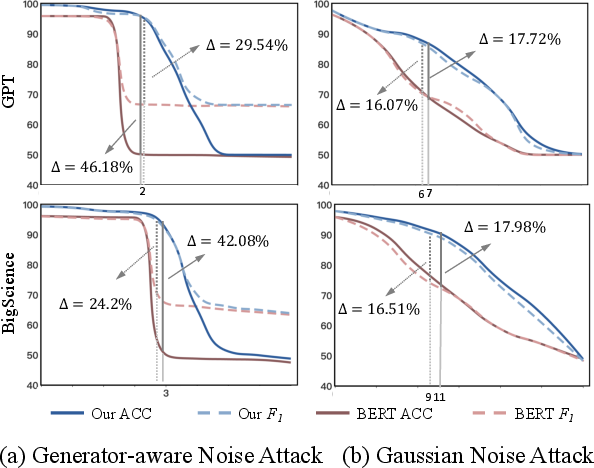
Figure 4: Perturbation regularization substantially increases classification robustness under both structured and random noise.
Intra-class compactness improves with adaptation, as measured by multiple clustering metrics.
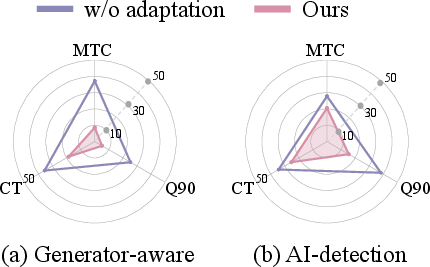
Figure 5: Adaptation stage consistently reduces intra-class dispersion, yielding task-aligned compact feature clusters.
Module Ablations and Feature Analysis
Ablation studies demonstrate additive gains from dual-bottleneck encoding, regularization, and adaptation. DB encoding delivers the greatest improvement by suppressing generator noise. Feature visualization shows that DB encoding attenuates generator bias, yielding compact and generator-invariant AI-detection features.
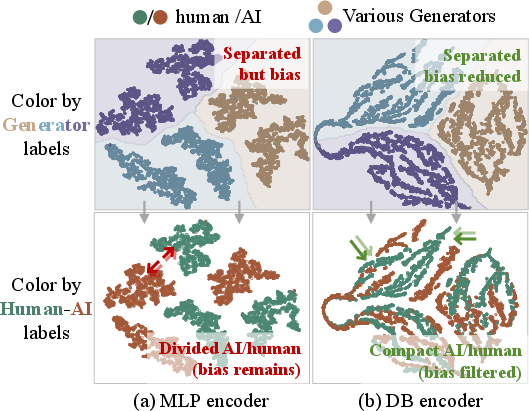
Figure 6: DB encoding filters generator bias in generator-aware branches, yielding compact and semantically pure representations.
Implications and Future Directions
The disentangled representation approach establishes a scalable methodology for open-set AIGT detection. The strong empirical gains and modular design suggest broad applicability in settings where distributional shifts are pervasive and generator artifacts are unreliable. Theoretically, this work highlights the utility of progressive disentanglement, adversarial adaptation, and perturbation-based independence enforcement for generalization under semantic shifts.
Practically, the framework's adaptability is relevant for continuous deployment as new generator models emerge. However, uncertainty remains regarding interpretability of learned features and robustness against adaptive attacks. Further work is needed to pinpoint specific linguistic markers and optimize hyperparameters for stable performance in dynamic environments.
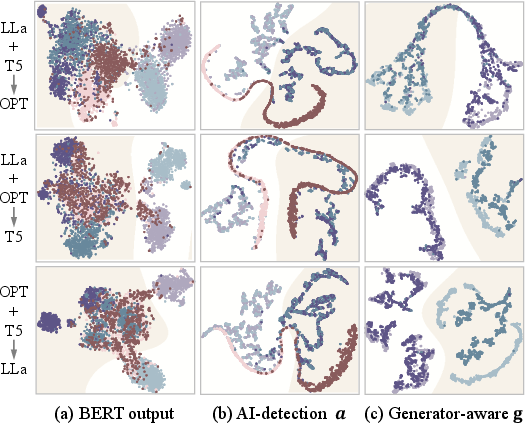
Figure 7: Across LLaMA, OPT, and FLAN-T5, disentanglement yields improved human–AI separation and explicit generator isolation, mitigating generator bias.
Conclusion
By progressively disentangling AI-detection cues from generator-aware artifacts, the proposed framework achieves superior cross-generator generalization and robustness in AI-text detection tasks. The modular approach delivers semantic purity, compactness, and resilience, positioning it as a highly effective solution to the generator shift challenge in AIGT detection (2604.13692).