- The paper demonstrates that a minimal GRU-based architecture, enhanced by sequential learning and a proprioceptive signal, can differentiate self-caused from environmental changes.
- The study employs 40 controlled experiments with novel metrics like agency gain and spike tests to rigorously quantify causal attribution in neural predictions.
- The results highlight key limitations of end-to-end learning, emphasizing the necessity of explicit feedback and staged protocols for reliable self-representation and agency.
Developmental Conditions for Agency in Minimal Neural Systems
Introduction
This essay analyzes "From Prediction to Self: Developmental Conditions for Agency in Minimal Neural Systems" (2606.05605), which provides a comprehensive empirical framework for the emergence of agency and self-world decomposition in recurrent neural architectures. The work isolates, via 40 controlled experiments and a developmental sequence, the minimal necessary and sufficient architectural and learning conditions required for a predictive system to distinguish self-caused changes from those driven by the environment. The analysis also maps the precise boundaries where plausible avenues for self-representation and agency fail, offering critical negative results that inform the design and interpretation of artificial agents.
Experimental Framework and Methodology
The study employs a minimal architecture: a 192-dimensional GRU augmented by multi-scale exponential moving averages, functioning continuously without resets, to capture persistent internal state.
The experimental paradigm systematically adds one component at a time—from perception only, through closed-loop actions, to proprioceptive feedback and staged learning—monitoring each step’s effect on the system’s ability to distinguish self-caused from world-caused changes. Causal attribution is verified via carefully matched control groups, where statistical properties of the action channel are preserved but causal connections are severed, isolating genuine agency signals from spurious statistical structure.
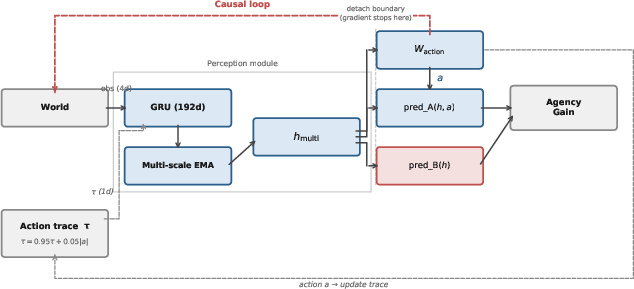
Figure 1: System architecture outlining the perception GRU, multi-scale EMA, dual action-aware/action-blind prediction heads, and the causal action loop.
A novel metric, agency gain (A), is introduced, defined as the empirical prediction error gap between an action-aware head and an action-blind baseline, quantifying the genuine predictive advantage of self-causation. Additionally, a “spike” test, which disconnects the action channel and measures the relative increase in prediction error, acts as a robust operationalization of causal dependence.
The Developmental Path: Key Stages
The empirical analyses chart a strict sequence (Figure 2), each stage building on the prior, falsifying the utility of skipping steps or rearranging the order.
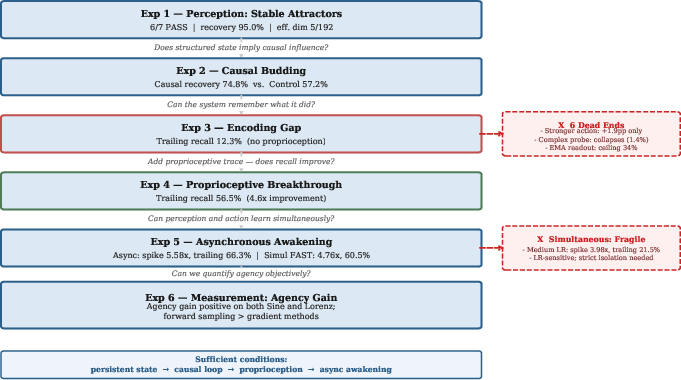
Figure 2: The developmental chain of the six main experiments, indicating key bottlenecks (Encoding Gap, Proprioceptive Breakthrough) and failure points of alternate hypotheses.
Without action, the system organizes high-dimensional observations into stable, low-dimensional attractors. PCA shows more than 95% of internal variance is compressed into a small number of dimensions, demonstrating the GRU’s efficacy at extracting regularities. However, this structure is agnostic to causal agency.
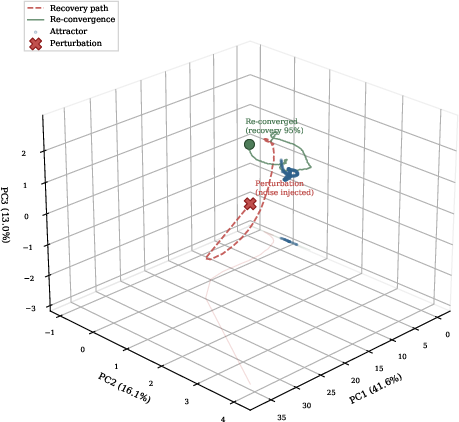
Figure 3: PCA projection of hmulti during prediction-only phase, demonstrating rapid recovery and high attractor stability post-perturbation.
Causal Budding: Emergence of Implicit Self-World Decomposition
Adding a causal action loop dramatically alters system behavior. Disconnecting the action pathway causes a large, channel-specific prediction error spike (e.g., 13.8× on the intervened channel), which remains absent for non-causally linked channels. The Causal group, but not the AR-process-matched Control, demonstrates rapid prediction error recovery when the action loop is re-engaged, confirming that the model has internalized which changes are self-caused.
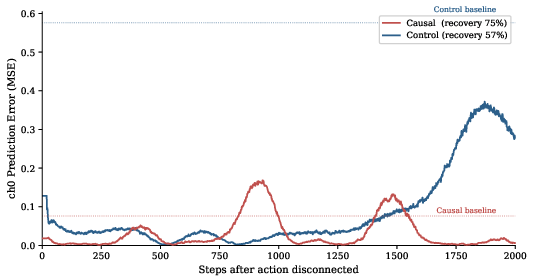
Figure 4: Channel-0 prediction error after action disconnection, with rapid recovery in the Causal group versus persistent drift in the Control.
Critically, self-representation remains implicit and not explicitly accessible via linear or non-linear probes: the system knows “what changes I caused” for prediction but not “that I am (or was) acting” as an explicit variable.
The Encoding Gap
A battery of interventions fails to render implicit self-causation explicit. Linear and GRU-based probes, stronger action magnitudes, slow EMA readouts, and increased supervision through auxiliary classification heads yield marginal or no improvements in trailing recall. The system’s predictive competence is thus fundamentally dissociated from explicit self-state representation—a central conceptual result.
Proprioceptive Breakthrough
Explicit self-representation only emerges when a proprioceptive signal (an exponentially-decayed trace of past actions) is appended to the GRU input. This single input dimension raises trailing recall from near chance (12.3%) to 56.5%, enabling robust classification of recent self-action and successful symbolic grounding (“I caused this”), even in extrapolation tests.
Asynchronous Awakening: Temporal Separation in Learning
Joint end-to-end learning of perception and action proves highly unstable, with optimal results emerging only under “asynchronous awakening”—a sequential protocol where perception consolidates before action policy learning commences. Only this staged approach yields robust, high-magnitude agency metrics (e.g., spike ratios up to 5.58×), highlighting severe gradient interference in simultaneous schemes.
Measurement and Analysis of Agency
The dual-head architecture (Figure 1) allows direct computation of agency gain. During structured action selection, the action-aware predictor consistently outperforms its action-blind counterpart under both periodic (sinusoidal) and chaotic (Lorenz) environments, and this performance gap is validated by the spike test as a marker of genuine causal agency.
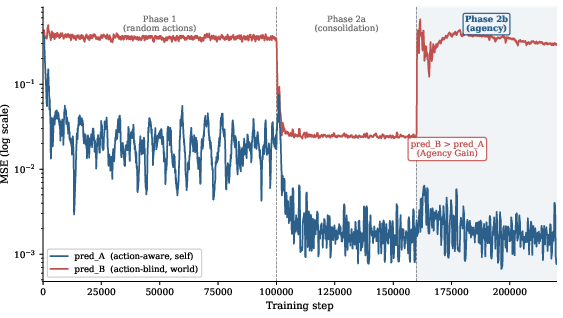
Figure 5: Training curves on the Lorenz signal showing persistent prediction advantage of the action-aware head across all learning phases.
Notably, only non-gradient-based, forward-sampled action policies yield substantial and interpretable agency gain. Gradient-based strategies for maximizing the prediction gap degenerate into pathological behavior with either trivial policies or catastrophic overfit (pred gap < 0, spikes < 1).
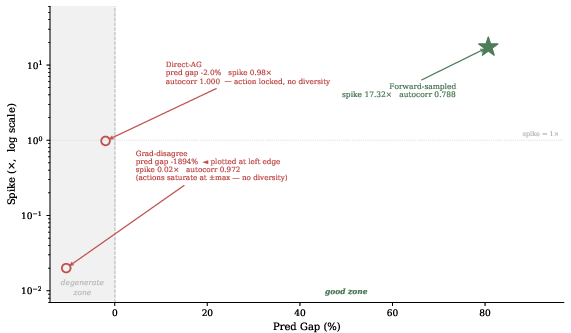
Figure 6: Action strategy comparison, with forward-sampled disagreement achieving maximal pred gap and spike, whereas both gradient-based alternatives collapse or saturate.
Ablation studies demonstrate that explicit proprioceptive trace is not required for agency measurement per se, though it is essential for readable self-representation. Agency gain is reliably positive across signal types, indicating the generality of the metric.
Falsified Hypotheses and Negative Results
A critical scientific contribution is the systematic mapping of 12 plausible-but-ineffective strategies—such as increasing action magnitude, using slow-dynamics readouts, nonlinear probes, or co-learning awareness and intention—that fail to bridge the encoding gap or support explicit self-representation. These negative results delineate the expressive and learning-theoretic limits of minimal recurrent architectures for agency.
Theoretical Implications
The empirical developmental path aligns with information-theoretic constructs at each stage: attractor formation (I(Zt;Ot+1)), conditional mutual information for action (I(Ot+1;At∣Ht)), and the necessity of explicit channels for self-state encoding. Agency gain approximates information-theoretic agency and satisfies critical operational requirements: it is measurable, ablatable, and environment-agnostic without the need for density estimation or strong model priors.
The dissociation between prediction skill and explicit self-representation highlights that agency in AI systems is not guaranteed by predictive power or autoregressive generation, and requires architectural and developmental constraints often overlooked in the literature.
Practical Implications and Future Work
The findings inform the design of artificial agents (in robotics or interactive AI) by clarifying that robust agency and self-attribution require staged learning protocols and explicit feedback signals, adding caution to end-to-end or purely predictive approaches. The highlighted limitations—failure to handle significant action delays, scaling dependencies, and inability to disambiguate specific external agents—suggest critical paths for scaling and generalizing agency-aware architectures.
Future work should examine if these developmental constraints reflect universal principled bottlenecks (beyond the GRU and controlled-signal regime) or if alternative architectures (e.g., transformers, more complex memory) can circumvent or modulate the observed sequence and boundaries.
Conclusion
This work provides a formal developmental map of how agency emerges in a minimal neural system, empirically establishing strict necessary and sufficient conditions for self-world decomposition. Self-representation and agency are shown to demand more than persistent prediction and closed-loop learning; explicit proprioceptive feedback and temporally-structured learning protocols are indispensable. These insights are reinforced by both positive results and a substantial catalogue of falsified hypotheses, offering a rigorous foundation for future research in agency, self-representation, and adaptive AI system design.

