- The paper presents a full analytical framework for classifying wavepacket and entanglement dynamics in resonant many-body kicked rotors.
- It employs large-scale numerical simulations to validate regimes such as quadratic spreading, period-2 oscillations, and hybrid dynamics.
- The findings establish symmetry-driven selection rules linking wavepacket growth to bipartite entanglement behavior in quantum chaos.
Dynamics of Wavepackets and Entanglement in Many-Body Kicked Rotors under Quantum Resonance
Introduction and Motivation
The study of many-body quantum chaos and entanglement dynamics is central in the ongoing development of quantum information science. The quantum kicked rotor (QKR) occupies a foundational role in this context as a minimal, paradigmatic model for quantum chaos. This paper systematically analyzes the non-equilibrium wavepacket and entanglement dynamics in a generic many-body QKR model, with each rotor adjusted to quantum resonance—an unusual regime in which the dynamical localization characteristic of QKRs is destroyed and is replaced by unbounded ballistic spreading.
Through comprehensive analytical results, supported by large-scale numerical simulations, the work reveals that the interplay of multiple in-resonance rotors leads to intricate many-body dynamical regimes. These regimes—quadratic wavepacket spreading, period-2 oscillations, and their symmetry-governed hybrids—are explained in terms of precise symmetry properties of the effective potentials and interactions. The study further bridges the connection between wavepacket and bipartite entanglement dynamics, pinpointing the role of these symmetries and establishing constraints between the possible dynamical regimes of each.
Analytical Framework for Many-Body QKRs in Quantum Resonance
In the conventional QKR, quantum resonance occurs when the system's effective Planck constant is a rational multiple of 2π, resulting in momentum-space spreading that is either quadratic or oscillatory, governed by the symmetry of the kicking potential. Extending this to the many-body case, the authors formulate the model with N rotors, each tuned to a principal or secondary resonance, and with general momentum-conserving coupling.
By partitioning the system into arbitrary subsystems A and B, they analyze both single-particle observables (e.g., mean-squared momentum displacement) and the bipartite linear entanglement entropy using a reduced density matrix formalism. A crucial result is the discovery that the time evolution operator for these systems factorizes into coordinate- and momentum-dependent components under resonance and that the symmetries of the potential under certain coordinate shifts directly determine the structure of the dynamical evolution.
Classification of Dynamical Regimes
The study analytically demonstrates three primary dynamical regimes, determined by the symmetry (with respect to a π-shift for secondary resonance, or more generally by resonance-specific translation) of both the rotor's effective potential and the interaction potential between subsystems:
- Quadratic (Ballistic) Growth: If the effective or interaction potential is symmetric under the relevant transformation, both wavepacket variance and linear entanglement entropy exhibit quadratic-in-time growth before finite-size or dephasing saturation.
- Period-2 Oscillation (Anti-Resonance): If the potential is antisymmetric, both observables oscillate with period 2, precluding any long-term spreading or entanglement growth.
- Hybrid Regimes: If the potential is asymmetric, dynamics are hybrid: quadratic growth is interleaved with period-2 oscillations, resulting in a superposed behavior.
The explicit analytic forms are derived for all parameters and initial conditions. The symmetry of the inter-subsystem interaction imposes "selection rules," i.e., constraints on which combinations of wavepacket/entanglement regimes are possible.
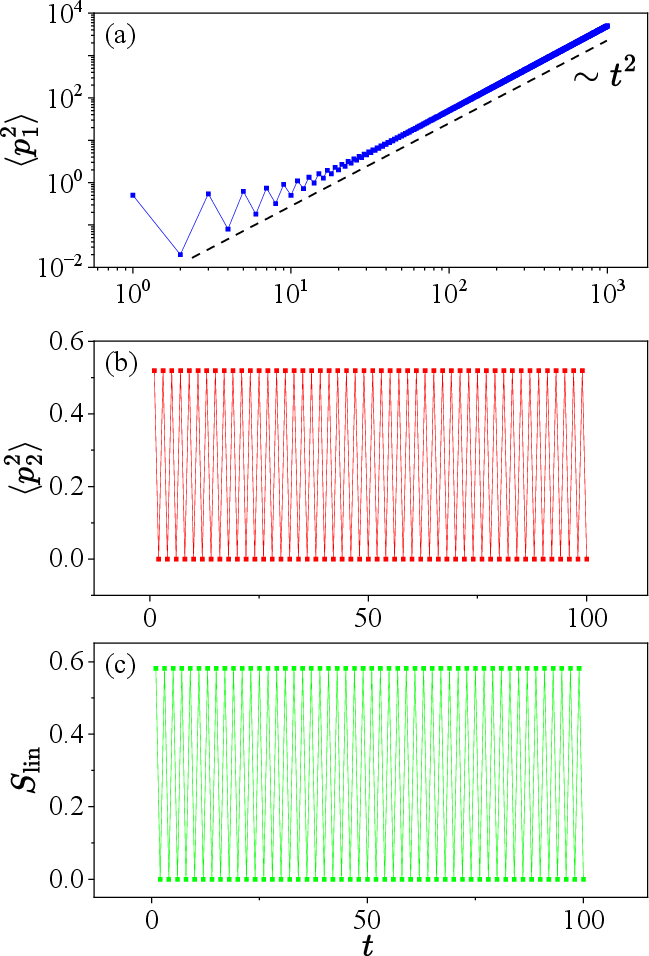
Figure 1: Dynamics of the two-rotor system with potential V=k1cosθ1+k2cosθ2+ξcos(θ1−θ2) reveals hybrid and oscillatory behaviors controlled by resonance and potential symmetry.
Detailed Numerical Analysis and Robustness
Extensive simulations validate the theoretical predictions for different resonance conditions (principal, secondary, and high-order), various potential choices, and both two-rotor and extended many-body systems. For example, when both rotors are at principal resonance with symmetric coupling, both wavepacket broadening and entanglement entropy exhibit ballistic growth. When one rotor is moved to secondary resonance, hybrid and oscillatory behaviors emerge in full agreement with analytical expectations.
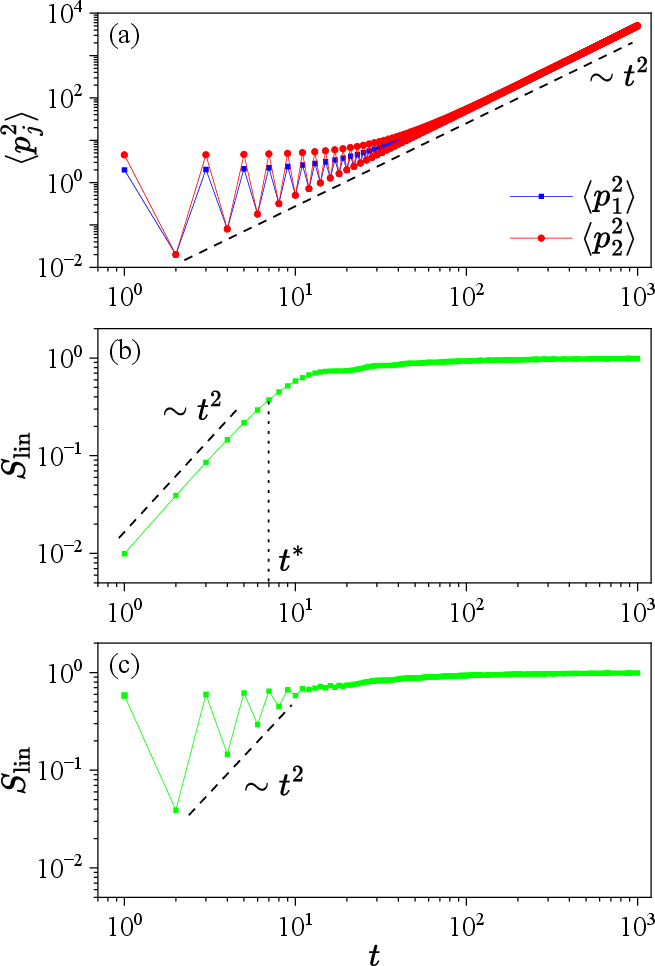
Figure 2: Hybrid wavepacket spreading and quadratic-to-saturating entanglement entropy in two-rotor models under asymmetric conditions and varying resonance combinations.
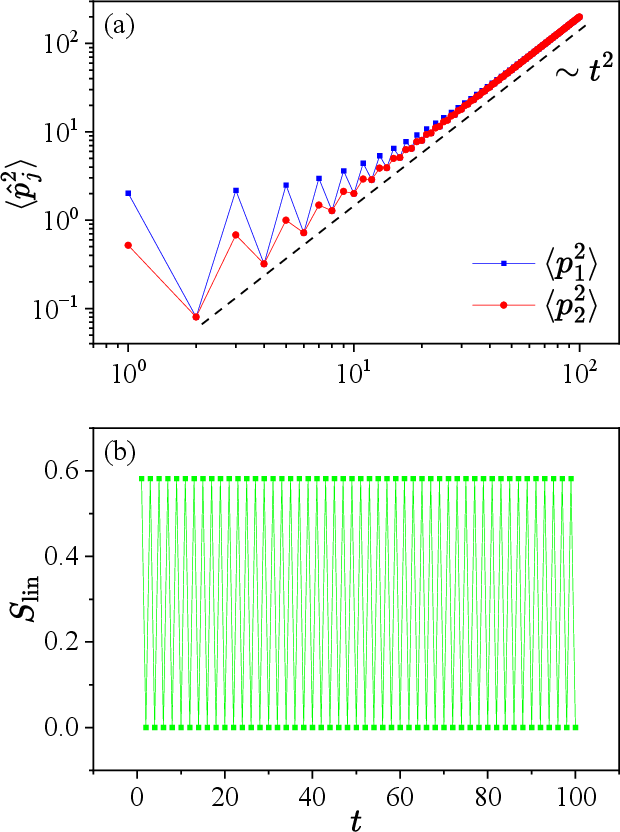
Figure 3: Extended models with high-frequency mode potentials showcase the predicted hybrid dynamical regimes robustly across parameter changes.
The analysis also demonstrates that these symmetry-determined dynamical regimes persist robustly under small detuning away from exact resonance, with the agreement time scale diverging as the detuning strength vanishes.
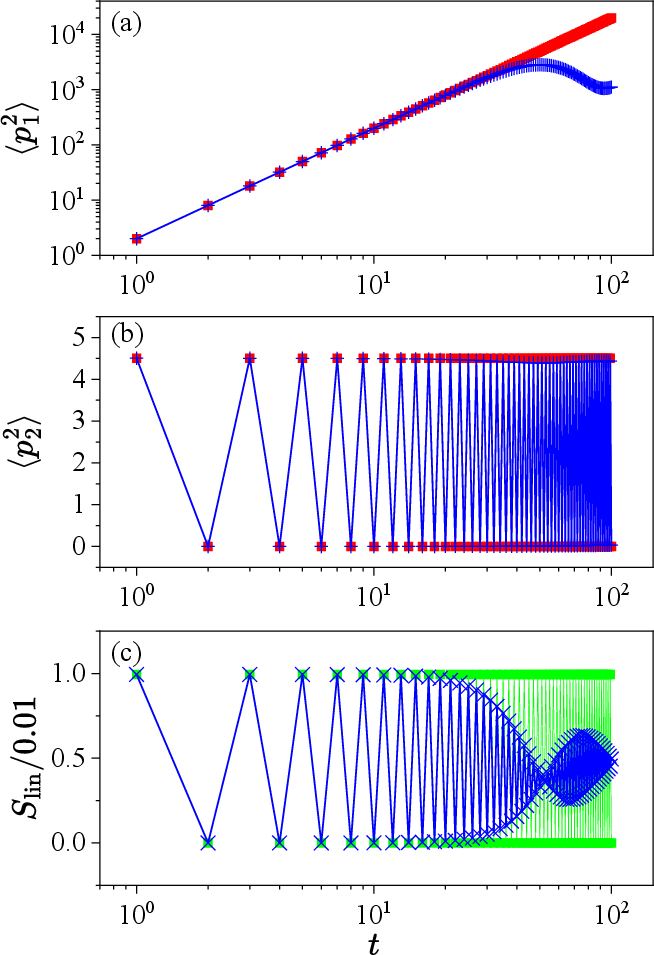
Figure 4: Near-resonant detuning preserves ballistic and oscillatory behaviors for long transient times, confirming regime robustness and potential experimental accessibility.
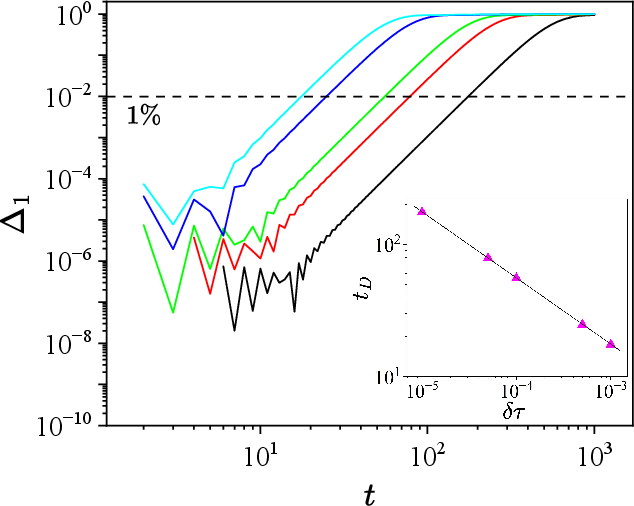
Figure 5: Relative deviation between in-resonance and weakly detuned cases grows slowly with time, with agreement time scaling as tD∼(δτ)−1/2.
Higher-Order Quantum Resonances and Symmetry Imposed Solvability
The results generalize to arbitrary high-order resonance with rational Planck constant provided the kicking potential possesses a specific translation symmetry. This symmetry ensures analytic tractability by suppressing wavepacket proliferation, analogous to the single-body QKR case.
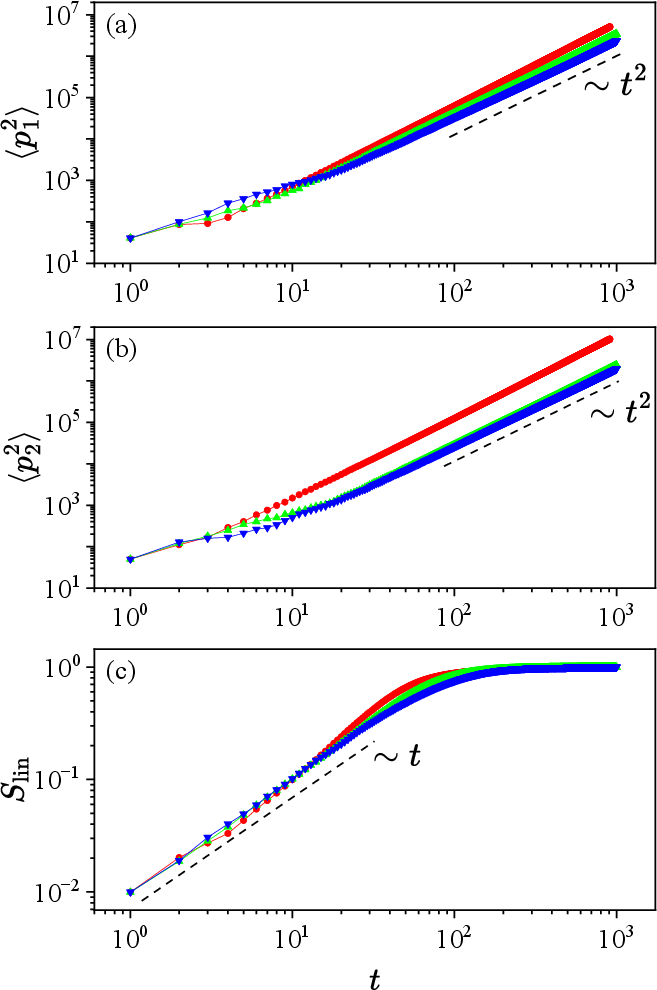
Figure 6: Wavepacket and entanglement dynamics for a range of high-order resonance configurations demonstrate persistent quadratic spreading and highlight the role of symmetry in constraining entanglement growth.
Extension to Many-Body Kicked Tops
A parallel analytical structure is established for the quantum kicked top (QKT), a model with finite-dimensional Hilbert space and spherical phase space. The analysis shows that, under resonance, the same symmetry-governed classification of dynamical regimes applies, though the compact phase space bounds the wavepacket spreading and leads to quantum revival effects.
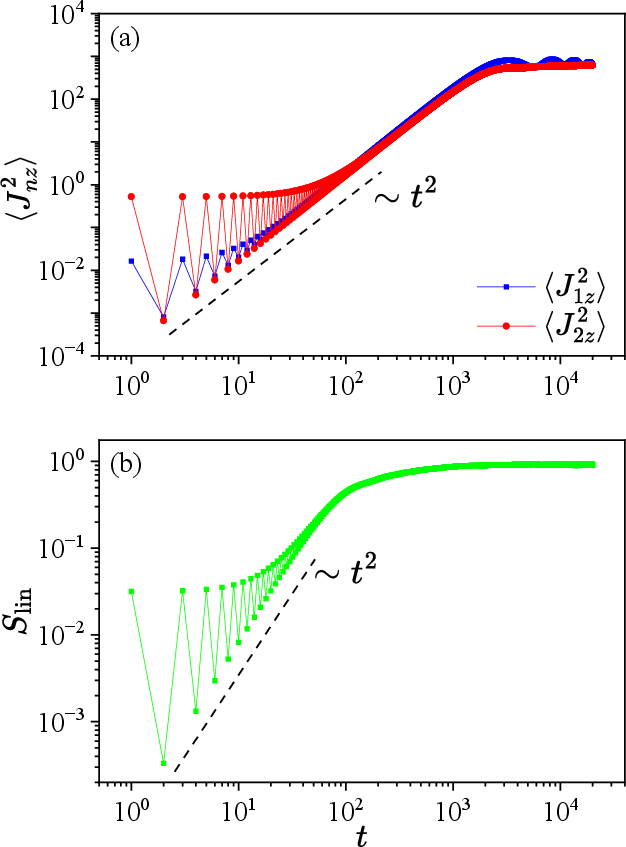
Figure 7: Simulations for the two-top model with parameters tuned to resonance display hybrid dynamical regimes, demonstrating the parallel symmetry-based framework of QKT and QKR models.
Implications and Future Directions
The identification and full analytic characterization of these dynamical phases in many-body quantum resonance systems have both foundational and practical implications. The results provide rare exactly or near-exactly solvable models for many-body entanglement dynamics and nonequilibrium quantum chaos. Experimentally, these dynamical signatures should be accessible with current cold-atom and quantum simulation setups, particularly in platforms realizing kicked rotor and kicked top models, including generalized interaction forms (e.g., Lieb-Liniger and delta-function coupled rotors).
From a theoretical perspective, these insights offer new avenues to probe the relationship between quantum entanglement growth and classical/quantum chaos—especially the effect of resonance, conserved quantities, and symmetry "selection rules" on entanglement scaling. The established correspondence with single-body, many-body, and top-level models further enhances the generality of the framework.
The presented models serve as an extensible platform for studying other quantum dynamical phenomena, such as out-of-time-ordered correlators, fidelity decay, non-Hermitian dynamics, and quantum-classical correspondence in deep quantum regimes.
Conclusion
This work delivers a comprehensive analytical and numerical characterization of dynamics in many-body kicked rotor and top systems under quantum resonance. The classification of regimes based on symmetry—encompassing quadratic spreading, period-2 oscillation, and hybrid dynamics—precisely organizes the possible behaviors of both wavepackets and entanglement entropy, providing constraints and connections between them. The results have direct implications for experimental realization and the deeper understanding of nonequilibrium entanglement generation in quantum chaotic many-body systems.

