- The paper introduces a unified Floquet control framework that achieves steady-state squeezed phonon lasing in hBN membranes.
- It combines periodic spin-driving protocols with engineered spin-mechanical and inter-spin couplings to induce phase locking and quadrature squeezing.
- The study provides robust numerical and analytic evidence for enhanced nonclassical acoustic outputs relevant for quantum metrology and scalable hybrid systems.
Squeezed Phonon Lasing via Floquet-Engineered Solid-State Spin Defects
Introduction and Context
The paper presents a unified Floquet control framework for phonon lasing in solid-state platforms, specifically utilizing spin defects in hexagonal boron nitride (hBN) membranes. The proposal demonstrates both a methodological and architectural advance, marrying periodic spin-driving protocols with engineered spin-mechanical couplings to achieve a regime where coherent acoustic lasing, quadrature squeezing, and phase locking are accessible and tunable within a single device. This approach directly interfaces nonclassical state engineering and quantum acoustics, relevant for quantum metrology and sensing applications.
Existing studies on phonon lasing have explored optical, microwave, ion-trap, and defect-based platforms. However, the persistent challenge is achieving robust nonclassical (i.e., squeezed) lasing that is stabilized at the steady state without the need for complex cavity QED architectures or external feedback. The current work addresses this gap by employing Floquet driving to engineer both amplification and engineered dissipation, delivering highly nonclassical steady states without relying on traditional cavity architectures.
Theoretical Model: Floquet-Controlled Spin-Mechanical System
The basic quantum model consists of two electronic spins, with one dispersively coupled to a mechanical mode (MO; e.g., a vibrational eigenmode of the hBN membrane), and the other subject to a local coherent drive. The spins are also coupled via a driven exchange interaction. The time-dependent Hamiltonian includes terms describing:
- Mechanical mode energy.
- Zeeman energy for both spins.
- Dispersive spin-motion coupling.
- Modulated spin-spin exchange.
- Local periodic drive on one spin.
This structure enables Floquet control by modulating both the exchange and the local drive, inducing sideband-selective interactions. Importantly, the system is subject to Markovian decoherence via phononic and spin relaxation/dissipation, modeled in a Lindblad form. Resonance conditions are chosen so that higher-order multiphoton (multiphonon) processes can be selected or suppressed, allowing for activation of both standard and squeezed amplification pathways.
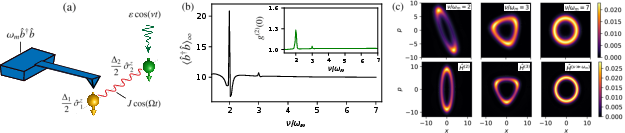
Figure 1: Schematic depiction of the core theoretical model, showing a mechanical oscillator coupled to a spin and indirectly to a second spin via a Floquet-modulated exchange.
Numerical solutions of the full master equation and analytic treatments via an effective Floquet Hamiltonian demonstrate that with ν=2ωm (local drive at twice the mechanical frequency), a transition from standard (coherent) lasing to squeezed-state amplification arises. The Wigner representations of the MO's state display a continuous transformation from phase-space rings (typical for phase-diffused lasers) to elliptically squeezed lasing modes. For instance, at ν=2ωm, g(2)(0)∼1.3 indicates enhanced super-Poissonian statistics at the squeezing point.
hBN Membrane Realization and Squeezed Lasing Stabilization
The proposed physical implementation leverages hBN devices, where color centers act as the spin defects and mechanical flexural modes provide the phononic subsystem. Expanding the basic model, the authors introduce a mirrored pair of ancillary spins coupled to the same MO. These ancillas are driven and detuned to implement squeezed cooling (engineered dissipation in a squeezed mode), following an adiabatic elimination protocol akin to reservoir engineering. The key is that the engineered dissipation acts preferentially on the squeezed quadrature.
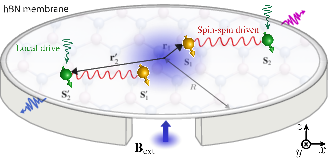
Figure 2: Layout of the experimental platform—a suspended hBN membrane with color centers subject to a magnetic field gradient, enabling selective spin-motion couplings and modulated inter-spin interactions.
Under these engineered conditions, the full hybrid system master equation supports an unambiguously lasing state with robust squeezing. The threshold behavior, spectral narrowing, and second-order statistics are all characterized:
- The phonon population displays sharp thresholding as a function of control parameters.
- g(2)(0) transitions from unity (Poissonian) in the conventional case to ∼1.5 for squeezed lasing, matching analytic predictions for squeezed lasers.
- The Wigner function reveals squeezed elliptical structures, and the emission spectrum exhibits pronounced linewidth narrowing above threshold.
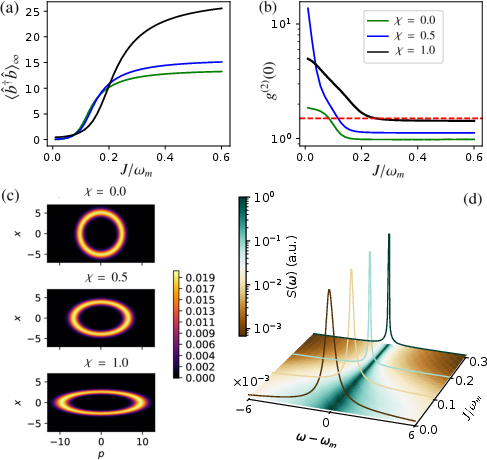
Figure 3: Steady-state phonon number, g(2)(0), Wigner function contours, and power spectrum vs. drive field amplitude, demonstrating the distinct regimes of coherent and squeezed phonon lasing.
Inclusion of the ancillary spins and the proper resonance conditions for their drives ensure that squeezed phonon lasing is both achievable and thermally robust. Numerical analysis confirms the resilience of squeezing and nonclassical statistics for thermal occupations up to nˉm∼1, provided the engineered dissipation rate exceeds intrinsic phonon losses by at least an order of magnitude.
Phase Control: Phase-Locked Squeezed Lasing
A further theoretical advance is the demonstration that the system can transition from phase-diffused to phase-locked squeezed lasing, entirely via spin control—without external classical feedback. By adjusting the Floquet sidebands and resonance conditions, specific collective spin terms are engineered which explicitly break phase symmetry and induce phase locking; this reduces phase diffusion analogous to injection-locking in optical systems.
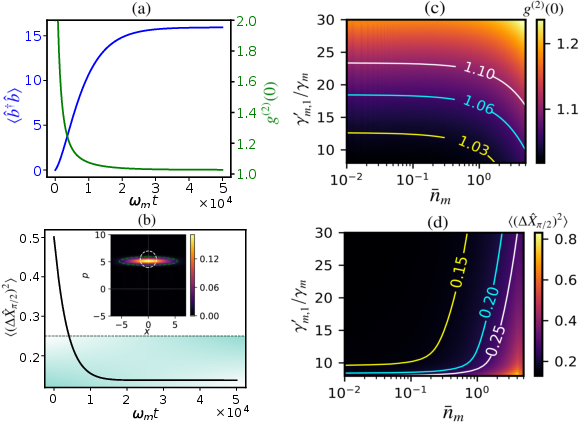
Figure 4: Dynamics of phonon population, g(2)(0), quadrature fluctuations, and steady-state Wigner contours under phase-locked resonance conditions, evidencing robust steady squeezing and phase coherence.
Time-dependent simulations of the master equation, including this controlled symmetry-breaking, show rapid convergence to g(2)(0)→1, sub-vacuum quadrature fluctuations, and steady-state Wigner distributions that are both displaced and squeezed. The minimal g(2)(0) and the maintenance of squeezing in the presence of finite ν=2ωm0 and controlled engineered dissipation strongly corroborate the claim of phase-locked, steady-state squeezed phonon lasing stabilized by Floquet spin control.
This work provides a clear protocol for engineering nonclassical acoustic lasers entirely in solid-state platforms, requiring only Floquet-controlled spin drives and effective ancilla engineering, both experimentally accessible in hBN-based devices. The results have several significant implications:
- Integrated nonclassical sources: Solid-state, chip-compatible squeezing sources for quantum metrology, magnetometry, and force sensing, exploiting the high tunability of drive and dissipation engineering.
- Enhanced quantum measurement: Squeezed states provide quantum-enhanced sensitivity. The demonstrated robustness against moderate thermal phonon occupancy as well as continuous squeezing control makes these devices attractive for realistic on-chip sensing environments.
- Scalability and hybridization: The flexible architecture allows for scale-up to arrays and coupling to optical or microwave platforms, supporting future developments in quantum transduction and hybrid quantum networks.
- Exploration of driven-dissipative phase transitions: The control over amplification, squeezing, and phase symmetry breaking enables detailed study of nonequilibrium phase transitions and critical phenomena in mesoscopic quantum systems.
Conclusion
The paper establishes a rigorously controlled protocol for robust, steady-state, squeezed phonon lasing via Floquet-engineered spin-mechanical platforms in hBN. Tailored periodic spin and exchange drives, in combination with engineered dissipation through ancillary defect spins, allow for in situ switching between conventional and squeezed lasing, as well as phase locking—all using components accessible in real devices. The analytic and numerical analyses confirm that all relevant observables—threshold, Wigner tomography, second-order coherence, spectral linewidth, and quadrature squeezing—are tunable and resilient. These findings open avenues for practical quantum acoustic sources in metrology and pave the way to the scalable quantum engineering of mechanical nonclassicality in solid-state environments.

