SURF: Separation via Unsupervised Remixing Flow
Abstract: The goal of single-channel source separation is to reconstruct $K$ sources given their mixture. In supervised settings where vast amounts of clean source data are available, this challenging, ill-posed problem has been addressed successfully by generative diffusion and flow-based prior models. However, access to such clean source samples is often limited, and even when available, supervised models are vulnerable to domain shifts. To bridge this gap, we present Separation via Unsupervised Remixing Flow (SURF), an unsupervised flow matching approach for source separation that learns directly from observed mixtures. This method relies on a novel combination of state-of-the-art supervised flow matching and regression-based self-supervised techniques. At a high level, starting from a teacher model, we utilize a "remixing" step to bootstrap the learning of a student flow model from the teacher's estimates. We provide insights into the objectives optimized by this approach and draw a novel connection to the Wake-Sleep algorithm. Empirical evaluations on image and audio benchmarks demonstrate that SURF establishes a new state-of-the-art, significantly outperforming existing unsupervised methods. See our demo page for examples. https://google.github.io/df-conformer/surf/
Paper Prompts
Sign up for free to create and run prompts on this paper using GPT-5.
Top Community Prompts
Explain it Like I'm 14
What this paper is about
Imagine hearing a song and wanting to listen to just the vocals, or just the guitar, even though they’re mixed together in one track. Or imagine two pictures laid on top of each other and wanting to peel them apart. That task is called single-channel source separation: taking a single mixed signal and splitting it back into its original pieces.
This paper introduces SURF (Separation via Unsupervised Remixing Flow), a new way to do that without needing a big collection of clean, separate examples to learn from. SURF learns directly from mixtures themselves, and it uses a modern kind of generative model, called a flow model, to produce cleaner, more realistic results.
The key questions the paper asks
- Can we train a strong, generative source-separation model using only mixed signals, with no clean “ground-truth” sources?
- Can we combine the best parts of two worlds: self-supervised “teacher–student” remixing (which works with mixtures) and flow-based generative modeling (which makes realistic outputs)?
- Why do these remixing methods work, and how can we understand them better?
How SURF works (in everyday language)
First, a few simple ideas:
- Mixture: Like a smoothie made from K fruits. You taste the smoothie (the mixture) and want to figure out the individual fruits (the sources).
- Permutation doesn’t matter: Whether we call a source “fruit 1” or “fruit 2” doesn’t change anything. The order is not important.
- Mixture consistency: The separated pieces should add back up to the original mixture (the smoothie should be exactly those fruits combined).
Now, the method has three main parts:
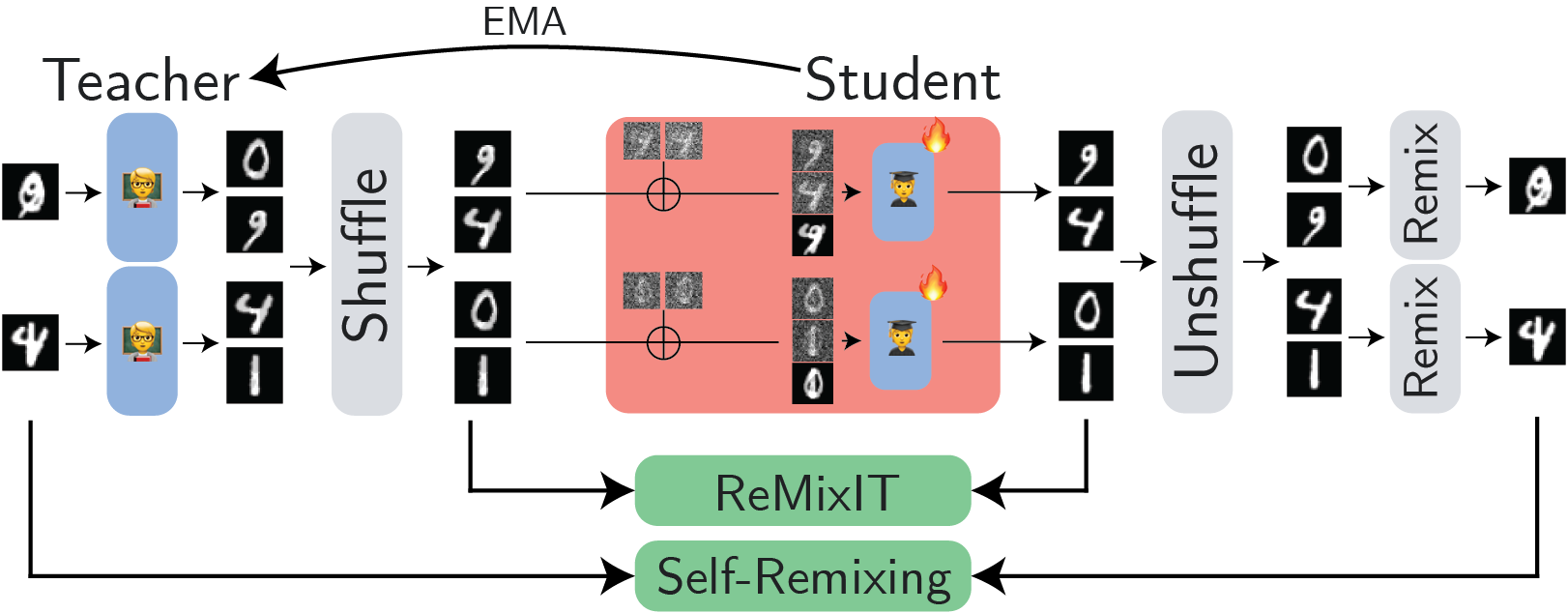
- Teacher–student remixing (self-supervision)
- Teacher: Start with a “teacher” model (not perfect) that tries to separate the mixture into sources.
- Remixing: Take the teacher’s separated sources from many different mixtures and shuffle them like a deck of cards. Then add K of those shuffled sources together to create new, fake mixtures. In these fake mixtures, we know which pieces were added because we chose them.
- Student: Train a new “student” model on these fake mixtures. The student either:
- tries to match the teacher’s pieces (ReMixIT style), or
- tries to reconstruct the original mixture when the pieces are re-added (Self-Remixing style).
- Update: Slowly update the teacher to follow the student (using a gentle averaging step), then repeat. Over time, the student becomes better than the original teacher.
- Flow matching (a generative approach)
- Think of each training example as a point on a path that moves from a noisy guess to a clean, separated set of sources.
- The model learns a “velocity field,” which is like tiny arrows that tell you in which direction to move your current guess to get closer to the true clean sources.
- Why this helps: Generative models tend to produce more natural, realistic outputs, reducing weird artifacts that simple regression models can make.
- Bridging remixing and flows
- Regular remixing trains models to directly predict the separated sources.
- Flow models, however, predict the “arrows” (how to move from a guess to a clean result).
- The paper shows a simple link between the two: from the arrows, you can form a good estimate of the clean result at any point along the path. That lets the remixing idea work with flows.
A few terms in plain words:
- Permutation-invariant training (PIT): Because the order of sources doesn’t matter, the model learns to match any source to any output slot, choosing the best ordering automatically.
- Mixture consistency layer: A little step that ensures the outputs always add up exactly to the original mixture.
- EMA (exponential moving average): A smooth way to update the teacher so it follows the student slowly, avoiding instability.
What did they find?
On both images and audio, SURF set a new bar for unsupervised separation:
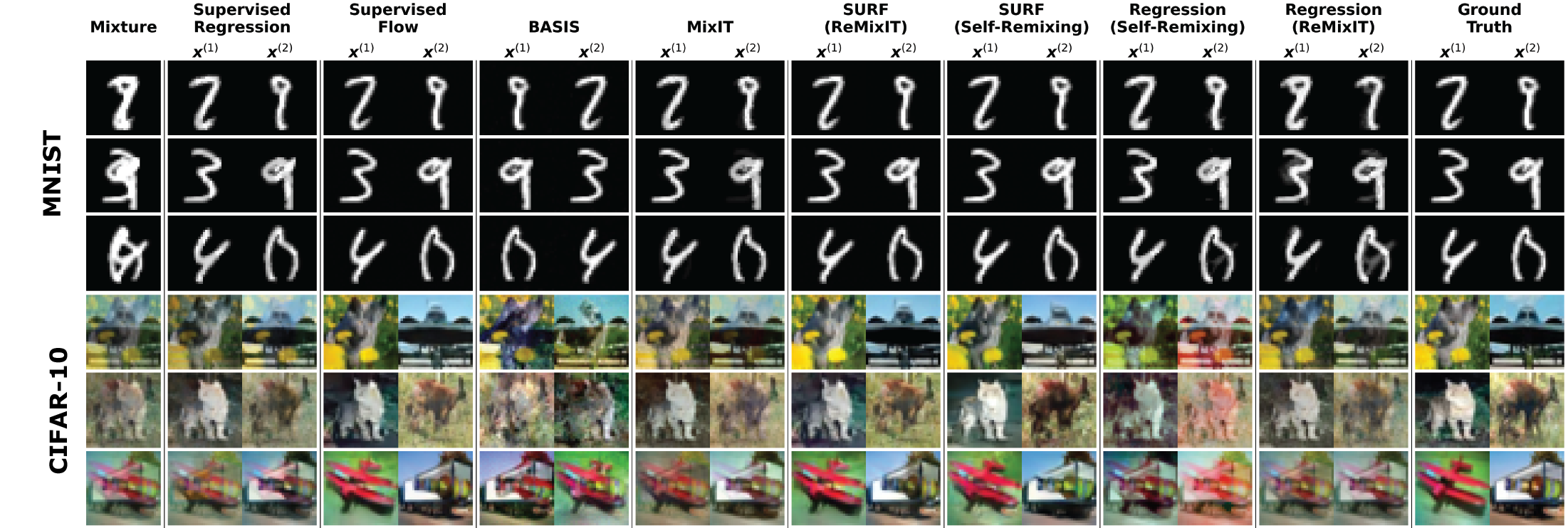
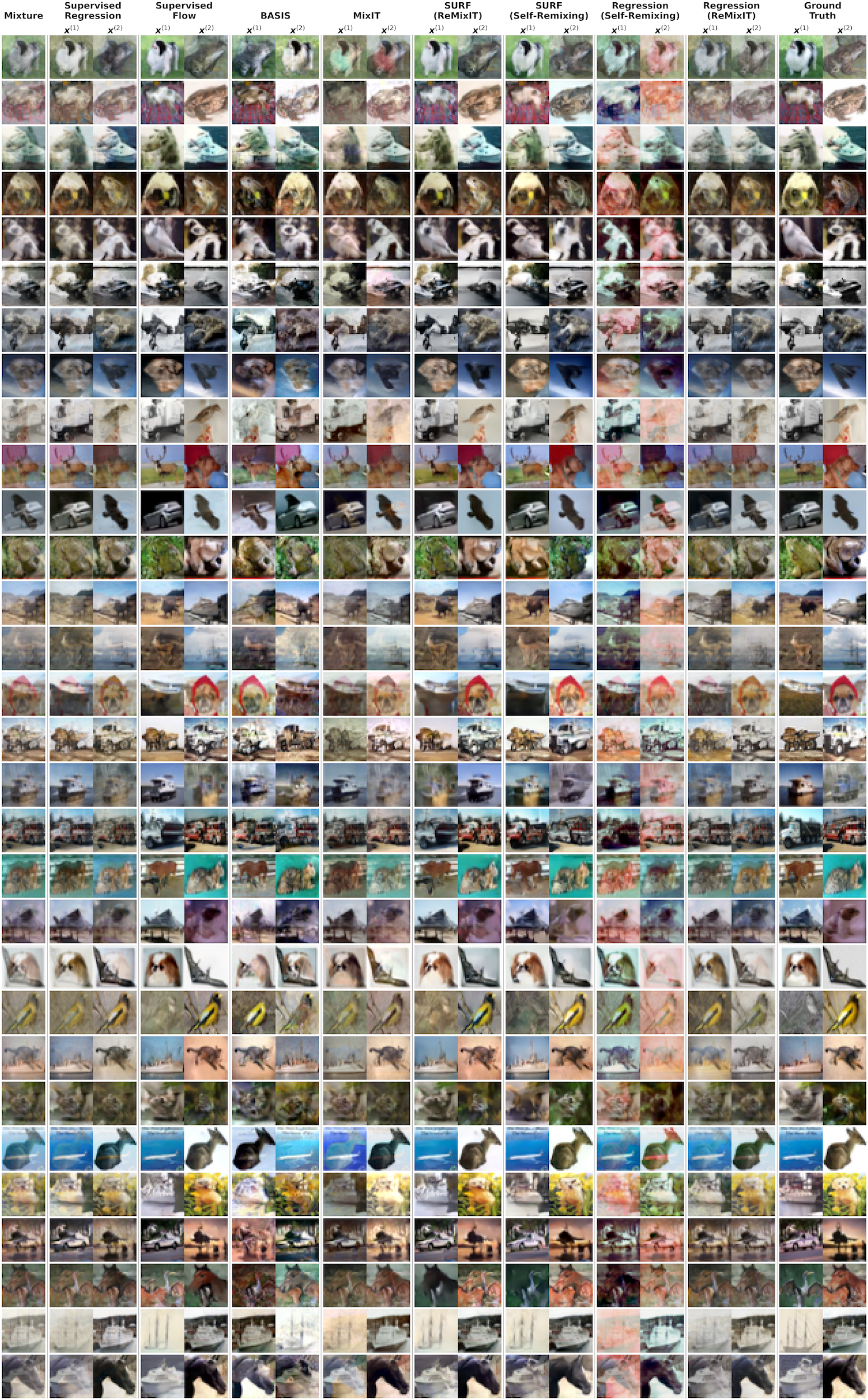
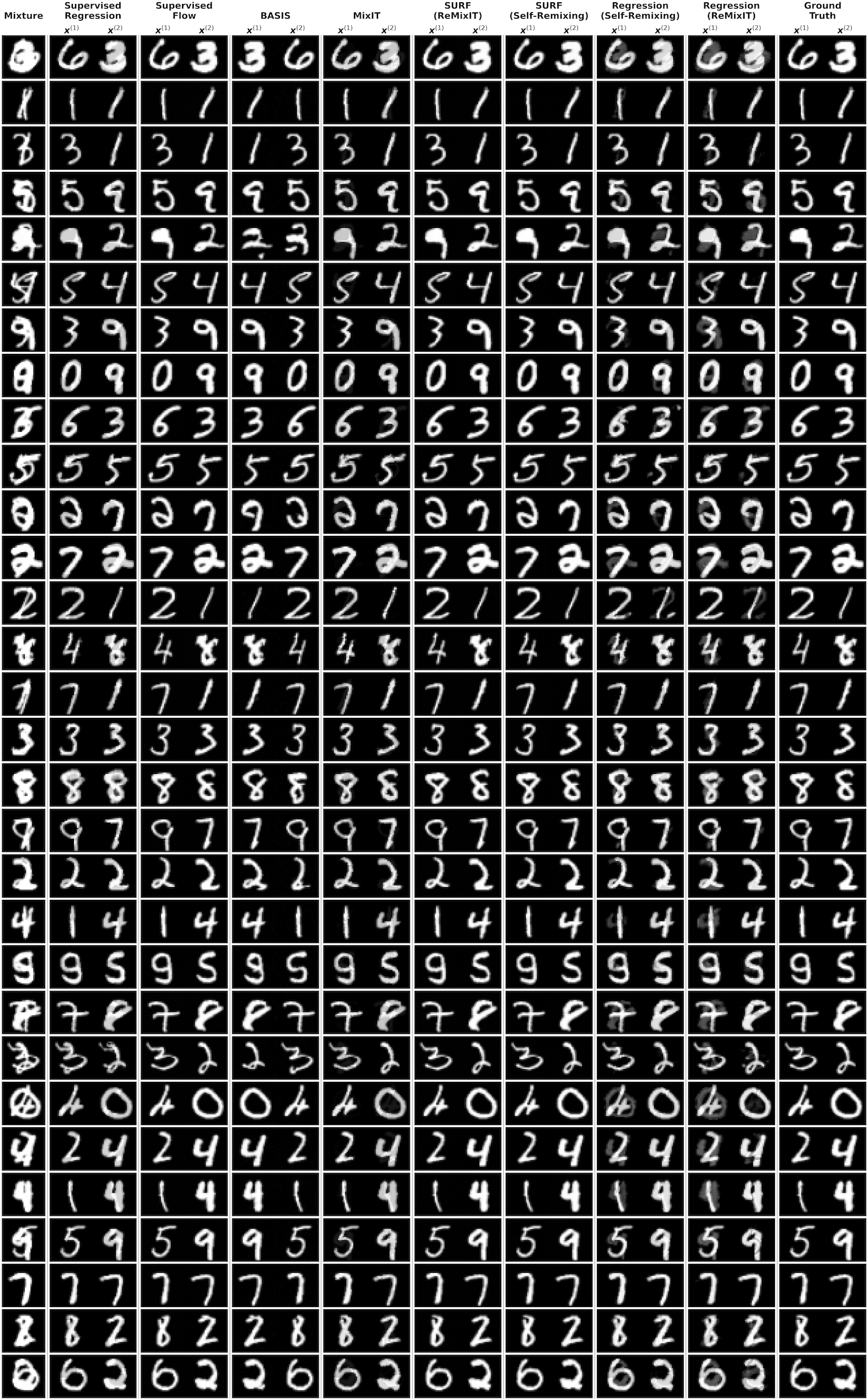
- Images (MNIST and CIFAR-10): SURF separated overlapped pictures more cleanly and with more realistic detail than previous unsupervised methods. It even came close to supervised generative models that had access to clean data.
- Audio (AudioSet and Libri2Mix): SURF improved standard audio quality metrics (like SI-SDR and perceptual scores) over existing unsupervised approaches. It handled speech-in-noise and general sounds better, producing clearer, more natural results.
Why this matters:
- It shows you can get strong, realistic separations without needing large collections of perfectly clean, labeled sources.
- It addresses a big weakness of many older methods, which either required clean data or produced unnatural artifacts.
Extra insight: Why does this work?
The authors also give a theoretical explanation:
- They analyze how the student learns from the remixed examples and show that, in many cases, it behaves like being trained on “fake but useful” supervised data.
- They connect SURF’s remixing strategy to a classic idea called the Wake–Sleep algorithm. In simple terms: the teacher makes synthetic data (Sleep), and the student learns to do well on it; then the teacher slowly updates to better match what the student is learning (Wake). This explains the teacher–student improvement loop.
What this could change
- Real-world use without clean data: In fields like wildlife sounds, medical signals, satellite or hyperspectral images, or even gravitational waves, it’s often impossible to get perfectly clean sources. SURF can learn in those settings directly from messy, real-world mixtures.
- More robust models: Because it doesn’t depend on a specific clean dataset, SURF can be less sensitive to “domain shift” (changes between training and real-world data).
- Better building blocks: The paper shows a practical way to combine self-supervised remixing with modern generative flow models, which could inspire better separation systems in music, speech enhancement, and beyond.
In short, SURF shows that you can train a high-quality, generative separator using only mixtures, by cleverly remixing teacher outputs and teaching a flow model to follow the right “arrows” toward clean sources.
Knowledge Gaps
Below is a consolidated list of concrete knowledge gaps, limitations, and open questions that remain after this work. Each point highlights a specific avenue where further research could add clarity or improve the method.
- Theoretical guarantees for the teacher–student loop
- No convergence guarantees for the EMA-based Wake–Sleep-style updates; conditions for monotonic improvement, stability, or fixed-point behavior remain unknown.
- Lack of analysis on failure modes (e.g., catastrophic confirmation bias) when the teacher is weak or biased.
- Approximation gaps in the FM-to-regression bridge
- The key relation E[x1 | xt, m] ≈ xt + (1 − t) vθ(xt, t, m) is used without quantifying approximation error; how this bias affects SR-FM training and final separation quality is unknown.
- The reweighting change from the “auxiliary” (1 − t)2-weighted objective to the unweighted SR-FM loss is motivated heuristically; a principled derivation or conditions under which the two are equivalent is missing.
- Distribution mismatch in “pseudo-supervised” training
- The pseudo-supervised FM term optimizes for synthetic data induced by remixed teacher outputs rather than the true mixture distribution; the impact of this mismatch on generalization and identifiability is unquantified.
- The analysis uses a population limit and an alignment convention referencing latent sources; practical finite-batch deviations and their effect on bias/variance are not characterized.
- Wake–Sleep interpretation with an implicit, intractable prior
- The “prior” over sources is the aggregate posterior of the teacher and is implicit; there is no tractable likelihood or variational bound. A precise characterization of the divergence actually optimized and its gap to the intended KL is missing.
- It remains open whether alternative amortized priors (learned explicitly) could improve stability and sample quality compared to the EMA surrogate.
- Sensitivity to teacher quality and remixing artifacts
- How SURF behaves under severely inaccurate teacher estimates, correlated teacher errors, or teacher-induced artifacts (e.g., residual mixture bleed) is unstudied.
- The independence assumption underpinning remixing (via batch shuffling) may be violated if teacher outputs share structured artifacts; there is no mechanism to detect or mitigate this.
- Assumptions on sources and mixing process
- SURF assumes i.i.d. sources, strict additive mixing, and mixture consistency; extensions to correlated sources, non-additive interference, or real room acoustics (convolutive mixing, reverb) are not addressed.
- Unknown source count: training and inference require a fixed K; handling variable or unknown K (and avoiding under/over-separation) with flow matching remains open.
- Permutation handling and scalability
- PIT-based routing at t = 0 is used with a stop-gradient, but its computational and stability implications for larger K are not analyzed; scalable approximations (e.g., differentiable relaxations) are unexplored.
- The effect of ambiguous permutations (near ties) on training dynamics and gradient noise remains unclear.
- ODE/path design and weighting
- The choice of the linear path (xt = (1 − t) x0 + t x1), the time weighting λt, and initial noise distribution p0 are taken from prior work; alternatives (nonlinear paths, time schedules, data-adaptive noise) could reduce bias but are unexplored.
- No ablations quantify the sensitivity to λt, path choices, or the PIT-at-t=0 alignment strategy versus aligning at other times.
- Compute, efficiency, and scalability
- Training/inference cost, memory footprint, and ODE solver choices (number of steps, stiffness, error control) are not reported; trade-offs versus regression and diffusion alternatives remain unknown.
- Practical limits for long sequences, high sampling rates, or high-resolution images/audio are not characterized.
- Robustness and generalization
- Robustness to domain shift is a key motivation, but systematic stress tests across severe shifts (e.g., different recording conditions, unseen acoustic scenes, or out-of-distribution image classes) are limited.
- The method’s tolerance to distributional skew in the mixture dataset (e.g., class imbalance, rare events) is unstudied.
- Qualitative and quantitative evaluation gaps
- While FID/IS and DNSMOS are reported, the diversity and uncertainty of sampled separations (e.g., multiple valid decompositions) are not assessed; mechanisms to sample multiple plausible separations or quantify uncertainty are absent.
- Comparisons against recent unsupervised generative approaches (e.g., EM-trained diffusion priors on corrupted data) are missing for single-channel separation, leaving relative positioning unclear.
- Architecture and inductive biases
- The permutation-equivariant architecture and mixture consistency projection are adopted, but alternatives (e.g., cross-source attention, structured latent variables, multi-resolution flows) are not explored.
- It is unclear how architectural choices influence the systematic error terms δθ,t(k) that drive the correction terms in the analysis.
- Practical training details and stability
- A “hybrid teacher sampler” is referenced for stability, but its mechanism, necessity, and impact are not quantified; reproducibility may suffer without detailed ablations.
- The EMA schedule and its coupling to student learning rate/optimizer are not theoretically or empirically optimized.
- Extension to multichannel or multimodal settings
- The approach targets single-channel mixtures; extending SURF to multichannel (spatial cues), cross-modal conditioning, or joint audio–vision separation remains open.
- Incorporating physically informed constraints (e.g., room impulse responses, spatial mixing models) into FM paths and objectives is unexplored.
- Identifiability and evaluation beyond PIT
- Conditions under which SURF recovers sources up to permutation and scale (or stricter notions of identifiability) are not established.
- Evaluation focuses on per-sample fidelity and distributional similarity; semantic consistency of separated content (e.g., class-aligned separation in CIFAR-10) is not measured.
- Handling of reverb, noise, and nonstationarity
- Realistic mixtures often include reverb, time-varying noise, and nonstationary interference; the current formulation enforces exact mixture consistency and may be brittle in such settings. Relaxed or probabilistic consistency constraints are not considered.
- Learning the number of sources and post-hoc clustering
- Mechanisms to infer K at test time, merge spurious outputs, or split under-segmented sources (post-hoc clustering, adaptive stopping) are not integrated with the flow framework.
- Quantifying and reducing correction terms in the analysis
- The analysis introduces correction terms for ReMixIT and Self-Remixing (involving teacher error e(k) and cross-correlation of δθ,t(k)), but there is no empirical quantification of their magnitude or practical strategies to minimize them (e.g., background decorrelation, targeted regularizers).
- Reproducibility and ablations
- Key choices (λt schedule, PIT solver, EMA rate α, noise scale, teacher sampling policy) lack systematic ablations; their effect on performance and stability is unclear.
- Code-level details (e.g., batching, normalization, curriculum) that might critically affect unsupervised training are not fully disclosed.
Practical Applications
Overview
The paper introduces SURF (Separation via Unsupervised Remixing Flow), a generative, unsupervised framework for single-channel source separation. It combines flow matching (a generative model that learns a velocity field) with self-supervised remixing (teacher–student bootstrapping from mixtures only) to learn separation models without clean source data. SURF achieves state-of-the-art performance among unsupervised methods on image and audio benchmarks and is explicitly designed to reduce reliance on labeled, clean sources and to be more robust to domain shift.
Below are actionable applications derived from the method’s findings and innovations. Each item lists relevant sectors, potential tools/products/workflows, and feasibility assumptions or dependencies.
Immediate Applications
These can be piloted or deployed now with existing datasets and compute, particularly in offline or cloud settings where latency is not critical.
- Noise-robust speech pre-processing for ASR and transcription
- Sectors: Software, Telecom, Enterprise IT, Customer Support
- Tools/products/workflows: Cloud service or SDK that separates speech from background in call-center recordings, meeting audio, and voicemail to improve ASR and diarization. SURF can be trained on unlabeled, in-domain mixtures (e.g., enterprise corpora).
- Assumptions/dependencies: Additive mixture assumption holds reasonably for audio; availability of large unlabeled mixture datasets; initial teacher (e.g., MixIT) and compute for training; inference latency acceptable in batch/cloud pipelines.
- Audio post-production for creators (podcasts, video)
- Sectors: Media/Entertainment, Creator Economy, Software
- Tools/products/workflows: DAW plug-ins or NLE integrations that separate speech, ambience, and music stems from single-channel tracks for cleanup and remastering; batch processing services for archives.
- Assumptions/dependencies: Offline processing acceptable; music mixtures vary—may require domain-specific tuning; mixture consistency enforced by SURF reduces artifacts compared to regression.
- Forensic and investigative audio enhancement
- Sectors: Public Safety, Legal/Forensics, Policy/Government
- Tools/products/workflows: Workflow to separate target voices from environmental noise (bodycam, dashcam, 911 recordings) trained on unlabeled agency audio; improved intelligibility for human review and ASR.
- Assumptions/dependencies: Chain-of-custody and reproducibility requirements; documentation of method limitations (non-uniqueness of separation); careful policy and ethics review.
- Customer analytics and QA for contact centers
- Sectors: Finance, Insurance, Retail, Telecom
- Tools/products/workflows: Pre-processing to isolate agent and customer channels from single-channel recordings; improves diarization, sentiment, and compliance detection without needing clean training data.
- Assumptions/dependencies: Sufficient volume of unlabeled mixture recordings; acceptable latency in back-office analytics; mixture of two dominant sources (agent/customer) typical.
- Smart speakers and voice assistants (cloud-assisted)
- Sectors: Consumer Electronics, Software
- Tools/products/workflows: Cloud-side separation of voice commands from background TV/music to improve wake-word detection and ASR accuracy.
- Assumptions/dependencies: On-device real-time constraints still challenging for generative flows; privacy considerations for cloud transfer; robust to domain shift across households.
- Field bioacoustics and ecology monitoring
- Sectors: Environmental Monitoring, Academia (Ecology/Biology), NGOs
- Tools/products/workflows: Separate and catalog multiple species calls from noisy field recordings without labels; pipeline for detection and counting using separated sources.
- Assumptions/dependencies: Additive acoustic mixtures hold; unlabeled in-situ recordings available; computational batches run offline; domain-specific evaluation metrics.
- Industrial acoustic monitoring and maintenance
- Sectors: Manufacturing, Energy, Transportation
- Tools/products/workflows: Separate machine signatures from ambient noise to feed anomaly detection; train from unlabeled plant recordings; augment conventional vibration sensing.
- Assumptions/dependencies: Acoustic mixtures approximately additive; stationary sensor placements; offline or nearline processing acceptable.
- Dataset curation/cleaning for downstream models
- Sectors: Software/ML Infrastructure, Academia
- Tools/products/workflows: Pre-processing pipeline to separate speech/sounds from background to create cleaner training sets for ASR, sound event detection, TTS, and music tagging without labeled clean sources.
- Assumptions/dependencies: Mixture data covers target domain; pipeline adds compute cost; human validation for quality control.
- Universal audio separation for research and benchmarking
- Sectors: Academia, ML R&D
- Tools/products/workflows: Reproducible pipelines to train generative unsupervised separators on open mixture datasets (e.g., AudioSet) for benchmarking with FUSS, DNSMOS, ESTOI, etc.
- Assumptions/dependencies: Availability of mixture-only datasets; compute; awareness of non-uniqueness in ground-truth alignments.
- Image layer separation in document and media processing (offline)
- Sectors: Software, Digital Archiving, Education
- Tools/products/workflows: Separate overlays (e.g., stamps, watermarks, bleed-through) from scans for improved OCR; unsupervised training on mixed image corpora.
- Assumptions/dependencies: Real-world image “mixing” may not be simple averaging (varies by capture); requires domain-specific modeling and validation; offline acceptable.
- Music demixing from single-channel recordings (prototype/batch)
- Sectors: Media/Entertainment, Research
- Tools/products/workflows: Batch separation of vocals/accompaniment for practice or remixing using unlabeled recordings; exploratory tool for creators.
- Assumptions/dependencies: Music mixtures can violate simple additive independence due to mastering and effects; quality varies with domain shift; best as a pilot or creative aid.
Long-Term Applications
These require further research, domain adaptation, scaling, or engineering (e.g., latency reduction, model compression, physics-informed mixing).
- Real-time on-device separation for hearing aids and mobile accessibility
- Sectors: Healthcare, Consumer Electronics
- Tools/products/workflows: Low-latency SURF variants (compressed flows, accelerated ODE solvers) for live noise suppression and multi-talker separation in hearing aids and AR earbuds.
- Assumptions/dependencies: Significant optimization for latency/power; clinical validation; robust performance in diverse acoustics; safe failure modes.
- Hyperspectral unmixing in remote sensing
- Sectors: Energy, Agriculture, Mining, Climate/Environment
- Tools/products/workflows: Unsupervised separation of material spectra in single-pixel measurements (e.g., land cover or mineral mapping) where clean, per-material spectra are unavailable.
- Assumptions/dependencies: Mixing model may be nonlinear/illumination-dependent; domain-specific constraints needed; large-scale inference.
- Gravitational wave and astrophysical signal separation
- Sectors: Space/Defense, Academia (Physics)
- Tools/products/workflows: Separate astrophysical signals from instrument noise and overlapping events using unlabeled detector streams; improve event detection/characterization.
- Assumptions/dependencies: Physics-informed mixture modeling; extreme class imbalance; validation on synthetic injections and cross-detector consistency.
- Seismic and geophysical exploration
- Sectors: Energy, Civil Engineering
- Tools/products/workflows: Separate reflections, multiples, and noise in single-channel (or single-sensor) records using unlabeled field data; improves imaging and inversion.
- Assumptions/dependencies: Convolutional/propagation effects require extending beyond simple additive models; integration with traditional processing chains.
- Biomedical signal isolation (stethoscope, ECG/EEG artifact removal)
- Sectors: Healthcare, Medical Devices
- Tools/products/workflows: Separate heart/lung sounds from ambient or isolate fetal/maternal signals in auscultation; denoise ECG/EEG without clean labels.
- Assumptions/dependencies: Clinical data access and regulatory approval; patient safety; mixture models can be non-additive and contact-dependent; longitudinal validation.
- Radio astronomy and RF signal separation
- Sectors: Space/Defense, Telecom
- Tools/products/workflows: Separate overlapping celestial sources or interference from observations; unsupervised training on telescope data where ground truth is unavailable.
- Assumptions/dependencies: Instrumental response and deconvolution (PSF/beam) complicate mixing; requires physics-informed priors and calibration.
- Multimodal separation (audio-visual, audio-text) with unsupervised generative flows
- Sectors: Software, Robotics, Media
- Tools/products/workflows: Extend SURF to condition on video or other sensors to improve separation; robust scene understanding in the wild.
- Assumptions/dependencies: New architectures and objectives; synchronization challenges; higher compute and data requirements.
- Large-K and reverberant environments for universal source separation
- Sectors: Robotics, Smart Cities, Public Safety
- Tools/products/workflows: Scale to many sources in reverberant, non-stationary environments (cocktail party problem) and enforce mixture consistency with room acoustics.
- Assumptions/dependencies: Advanced conditioning and priors; stability for K>4; real-time feasibility remains open.
- Edge auditory perception for robots and drones
- Sectors: Robotics, Defense, Logistics
- Tools/products/workflows: Onboard separation of salient sounds (alarms, speech, machinery) to inform navigation and safety.
- Assumptions/dependencies: Tight power and compute budgets; integration with localization/beamforming; robustness in motion and wind noise.
- Privacy-preserving redaction and compliance
- Sectors: Finance, Healthcare, Government
- Tools/products/workflows: Separate and suppress personally identifiable voices or background conversation while retaining target content (e.g., redact by speaker or class).
- Assumptions/dependencies: Accurate and controllable source attribution; rights and consent management; governance frameworks.
- “Unmixing-as-a-Service” platforms with SLAs
- Sectors: Software/Cloud, Enterprise
- Tools/products/workflows: Managed APIs for unsupervised separation across media types; bulk processing with lineage tracking and quality metrics.
- Assumptions/dependencies: Cost-performance engineering for generative inference; reliability guarantees; domain adaptation pipelines.
Cross-Cutting Assumptions and Dependencies
- Mixture model: SURF assumes mixtures are approximately additive and permutation-invariant at the source level; strong nonlinearity or convolutional effects (e.g., room acoustics, sensor transfer functions) may require extensions or conditioning.
- Training signal: Requires large collections of unlabeled mixture-only data from the target domain; performance benefits from teacher quality (initial MixIT) and EMA stability.
- Compute and latency: Generative flow inference entails ODE/trajectory evaluation; real-time edge use needs model compression, fast solvers, or distillation to lighter regressors.
- Domain shift: SURF improves robustness relative to supervised priors but still benefits from in-domain mixtures for training; severe shifts may degrade performance.
- Non-uniqueness: Separation is underdetermined; results may differ across runs without violating mixture consistency; applications must tolerate ambiguity or add constraints.
- Evaluation and safety: For regulated domains (healthcare, forensics), rigorous validation, uncertainty quantification, and human-in-the-loop review are recommended.
Glossary
- Aggregate posterior: The distribution of latent variables induced by averaging the model’s inference distribution over the data distribution. Example: "it is the aggregate posterior of the inference model over data mixtures $p(\vm)$ at parameter ."
- Aggregate prior: An implicit prior obtained by aggregating (marginalizing) the inference model’s outputs over the data distribution. Example: "since the aggregate prior is implicit."
- Cross-entropy: A loss measuring the expected negative log-likelihood under a target distribution, often used to train probabilistic models. Example: "the sleep update would minimize the cross-entropy in~\eqref{eq:sleep_cross_entropy}."
- Denoiser: A model or operator that maps a corrupted signal to its clean estimate; here, related to the FM drift via a denoising identity. Example: "we will rely on the key connection between denoiser and drift for flow matching."
- Diffusion models: Generative models that learn to reverse a noise-adding process to sample from complex data distributions. Example: "diffusion and flow-based models~\cite{ho_denoising_2020,song2020score,lipman2022flow} have enabled the learning of high-quality priors for clean sources."
- DNSMOS: A non-intrusive speech quality metric estimated by a neural network. Example: "and DNSMOS~\cite{reddy_dnsmos_2022} for audio."
- Drift (in flow matching): The velocity field of the ODE that transports samples from a reference distribution to the data distribution. Example: "The drift of the flow matching ODE is then obtained by minimizing the following loss"
- ESTOI: Extended Short-Time Objective Intelligibility, an objective metric for speech intelligibility. Example: "ESTOI~\cite{jensen_algorithm_2016} (audio)"
- Exchangeability: A symmetry property where joint distributions are invariant to index permutations. Example: "This distribution is independent of by exchangeability."
- Expectation–Maximization (EM): An iterative procedure for maximum-likelihood estimation with latent variables. Example: "using Expectation-Maximization have emerged \citep{rozet2024learning,hosseintabar2025diffem}."
- Exponential Moving Average (EMA): A smoothing update that tracks parameters by decaying past values. Example: "we update the teacher parameters using an exponential moving average mechanism"
- FID (Fréchet Inception Distance): A metric comparing distributions of generated and real images via Inception embeddings. Example: "Inception / FID Score of 25,000 separations (50,000 separated images) of two overlapping mixtures of CIFAR-10 images."
- FLOSS: A supervised flow-matching method that integrates PIT-style alignment into the FM objective for separation. Example: "The resulting method, FLOSS, outperforms regular flow matching and achieves state-of-the-art in supervised separation \citep{scheibler2025source}."
- Flow Matching (FM): A generative modeling technique that learns a velocity field to transport a reference distribution to the data distribution via an ODE. Example: "Flow Matching (FM) defines an Ordinary Differential Equation (ODE) $(\vx_t)_{t\in [0,1]}$ which, initialized at from a reference “noise” distribution ... outputs at time samples $\vx_1 \sim p_1(\vx_1|\vm)$."
- FUSS (Free Universal Sound Separation): A benchmark and set of metrics for universal sound separation. Example: "To evaluate universal (non-speech) source separation, we use the Free Universal Sound Separation (FUSS) metrics~\cite{wisdom2021s}."
- ICA (Independent component analysis): A blind source separation method leveraging statistical independence of sources. Example: "independent component analysis problem with well-known results~\citep{jutten1991blind,comon1994independent,hyvarinen2000independent}."
- Inception Score (IS): A metric assessing image generation quality via a classifier’s confidence and diversity. Example: "Inception Score (IS), and Fréchet Inception Distance (FID)~\cite{heusel2017fid} for images"
- KL divergence (Kullback–Leibler divergence): A measure of dissimilarity between probability distributions used as an optimization objective. Example: "Wake--Sleep alternates two KL objectives to achieve this:"
- Kronecker product: A matrix operation producing a block matrix from two matrices. Example: "where is the Kronecker product."
- Latent variable model: A probabilistic model with unobserved variables explaining observed data. Example: "Wake--Sleep training is typically described for a latent variable model"
- LPIPS: Learned Perceptual Image Patch Similarity, a deep metric for perceptual similarity. Example: "LPIPS~\cite{zhang2018lpips}"
- Mel-spectral domain: A frequency representation using the mel scale, common in audio processing. Example: "mixture-conditional diffusion in the mel-spectral domain~\cite{chen_sepdiff_2023}"
- Mixture consistency: A constraint ensuring that the sum of separated sources equals the observed mixture. Example: "a projection layer is used to ensure mixture consistent outputs for any $\vv_\theta$, i.e., $\vm=\vone^\top \vx_1$"
- MixIT: An unsupervised source separation method using mixtures of mixtures and PIT. Example: "MixIT has become prominent~\cite{wisdom2020unsupervised}."
- ODE (Ordinary Differential Equation): A differential equation defining continuous-time dynamics; in FM, used to transport probability paths. Example: "Flow Matching (FM) defines an Ordinary Differential Equation (ODE) $(\vx_t)_{t\in [0,1]}$"
- Permutation equivariant architecture: A model whose outputs permute consistently with permutations of inputs across source indices. Example: "we rely on a permutation equivariant architecture \citep{scheibler2025source}."
- Permutation Invariant Training (PIT): A training scheme that matches predictions to targets up to a permutation to resolve label ambiguity. Example: "a standard approach in source separation is to use a permutation invariant training (PIT) wrapper"
- Permutation invariance: A property where a function or distribution is unchanged under permutations of its arguments. Example: "As the likelihood $p(\vm|\vx)=\delta(\vm-\sum_{k=1}^K \vx^{(k)})$ induced by \eqref{eq:forward_measurement} is also permutation invariant"
- Permutation matrix: A binary matrix that permutes elements or rows/columns of another matrix. Example: "with a permutation matrix $\mPi$ sampled uniformly on the symmetric group "
- PSNR: Peak Signal-to-Noise Ratio, a distortion-based image quality metric. Example: "PSNR and SSIM~\cite{wang2004image} (images)"
- ReMixIT: A self-supervised separation method that remixes teacher estimates to create synthetic training data for a student. Example: "In ReMixIT~\cite{tzinis2022remixit}, is trained using the loss"
- Self-Remixing: A self-supervised method regressing to original mixtures rather than teacher estimates by remixing. Example: "Self-Remixing bypasses this issue by regressing w.r.t. the input mixtures"
- SI-SDR: Scale-Invariant Signal-to-Distortion Ratio, a separation quality metric robust to scale. Example: "They are based on the SI-SDR for one (1S) or multiple sources (MSi2--4)."
- SSIM: Structural Similarity Index Measure, a perceptual image similarity metric. Example: "PSNR and SSIM~\cite{wang2004image} (images)"
- Symmetric group: The group of all permutations on a finite set, denoted by S with a subscript. Example: "sampled uniformly on the symmetric group "
- Teacher–student (teacher-student) paradigm: A distillation setup where a student model learns from a teacher’s outputs. Example: "These methods operate on a ``teacher-student'' principle"
- Vectorization operator (vec): An operator that stacks matrix entries into a vector. Example: "$\operatorname{vec}(\vZ) \sim \mathcal{N}(\mathbf{0},\mI_{BKd})$"
- Wake–Sleep algorithm: A training procedure alternating between fitting a generative model (wake) and an inference model (sleep) via KL objectives. Example: "We further show that an instance of SURF can be reinterpreted as a Wake-Sleep algorithm~\cite{hinton1995wake}, a classical method for training latent-variable generative models."
Collections
Sign up for free to add this paper to one or more collections.

