- The paper introduces a transition-centric formalism that redefines dispersive light-matter dynamics by focusing on operator transitions over traditional quantum states.
- It employs diagrammatic perturbation theory to construct effective Hamiltonians, capturing multiphoton processes and explicit detuning structures in a streamlined manner.
- The work demonstrates computational efficiency and operator-space clarity, facilitating advanced quantum protocol engineering and high-order nonlinear process design.
Transition Operators as the Primitive Entities in Dispersive Light-Matter Dynamics
Introduction
This work develops a formalism in which transitions, rather than quantum states, are taken as the central dynamical objects of light-matter theory, especially in the dispersive regime. This departure from traditional state-centric approaches—typically reliant on Hilbert-space projectors, frame transformations, and resolvent-based or Schrieffer-Wolff perturbative methods—affords both computational and conceptual simplification for the analysis and engineering of high-order nonlinear processes. The transition-centric framework is systematically constructed and applied to the Rabi and Jaynes-Cummings (JC) models, providing transparent diagrammatic rules for effective Hamiltonian derivation at all perturbative orders. Key physical implications, such as the persistence of polaritonic hybridization and the emergence of a photon-number-independent intrinsic Rabi frequency, are established.
Traditional treatments of quantum dynamics in cavity or circuit QED employ the bare energy eigenstates ∣k,n⟩ of the uncoupled Hamiltonian as fundamental objects. Transitions between these states are induced by interaction Hamiltonians such as the Rabi or JC models, where perturbative derivations are typically formulated in this state basis using commutator algebra, frame transformations, or projection operators. In the present work, the focus is shifted to the elementary joint light-matter (JLM) transition operators—e.g., ∣e⟩⟨g∣⊗a^c and their Hermitian conjugates—as the basis for dynamical analysis.
The JLM transitions are primary eigenoperators of the free Liouvillian superoperator, with detunings Δξ^ as their central spectral attribute. This operator-centric framework underscores that detunings, not bare energies, encode irreducible light-matter dynamics: for a given detuning, infinitely many bare energy assignments may be compatible, but the detuning is unique for the transition.
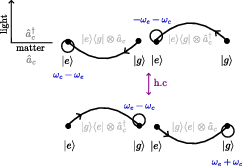
Figure 1: Four JLM transition operators depicted in a 2D representation, encoding both matter and photon sector detunings, and showing the assignment of resonant or off-resonant nature via diagram topology.
Graphically, this perspective is captured by representing elementary transitions (and their detunings) as vertices in a two-dimensional space. The directions and connections of these transitions immediately specify the operator content and physical process: resonant one-photon exchange, two-photon Raman processes, and higher-order nonlinearities are visualized directly.
Diagrammatic Perturbation Theory
Perturbative expansions are systematically organized as concatenations of these JLM transitions, each order corresponding to a sequence (diagram) of operator actions with explicit detuning structure:
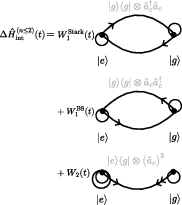
Figure 2: Second-order diagrammatic decomposition of the interaction Hamiltonian correction ΔH^int(n≤2)(t), with explicit weights for each process showing the scaling with coupling and detuning combinations.
Each n-th order process is encoded as a product of (n+1) zeroth-order transition operators, concatenated according to the diagram rules. The weights of these processes, Wn(t), are direct functions of the basic λ/δ ratios, making the scaling regime and the physical content (e.g., whether a process is off-resonant or nearly resonant) explicit. The diagrammatic expansion renders all virtual and physical pathways directly visible and tractable.
A key computational advantage is that the bookkeeping of multiphoton and non-RWA processes requires neither iterative commutators nor non-unique generator selection (as in Schrieffer-Wolff expansion), nor Hilbert-space truncation. For example, the challenging three-photon resonance in the dispersive Rabi model is recovered, including both co-rotating and counter-rotating paths, with dramatically reduced overhead.
Comparison to State-Centric Dynamics
A striking distinction between the frameworks is illustrated in Figure 3, contrasting the state-centric and transition-centric approaches. In the conventional state picture, the Hilbert space is large or infinite, and the interaction induces dynamics within fixed subspaces with complicated coupling structures leading to photon-number-dependent Rabi frequencies Ωn; in the transition picture, the space of JLM operators is finite and closed, and dynamics are governed by a unique, photon-number-independent frequency Ω.
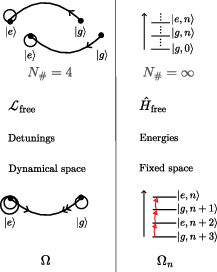
Figure 3: Schematic: state-centric dynamics restrict evolution to photon-number-labeled manifolds, while transition-centric dynamics operate in operator space with intrinsic, photon-number-independent frequency content.
The population operator ∣e⟩⟨g∣⊗a^c0, a joint entity not associated uniquely to either light or matter, emerges as the carrier of polaritonic hybridization, governing dynamics in both the resonant and dispersive regime. In the limit of large detuning, the same operator encapsulates the Stark shift (energy renormalization in the dispersive regime); on resonance, it encodes the enhanced Rabi splitting, revealing that dispersive physics is a reorganization—not the disappearance—of polaritonic hybridization.
Effective Hamiltonians and Multiphoton Processes
The formalism provides rules for constructing effective Hamiltonians to arbitrarily high order by diagrammatic tracing of operator concatenations. As an explicit example, the three-photon resonance in the Rabi model, typically accessible only through coordinated application of frame transformations, nested commutators, or large-scale matrix diagonalization, is recovered by retaining only the relevant JLM diagram (e.g., ∣e⟩⟨g∣⊗a^c1 and its Hermitian conjugate) and directly computing its weight. This approach highlights, stepwise and without ambiguity, the roles of counter-rotating terms and composite detuning conditions.
Further, it shows that the identification and regularization of degeneracies or near-degeneracies—i.e., vanishing partial detuning sums—become trivial at the diagrammatic level.
Theoretical and Practical Implications
The transition-centric framework carries significant implications:
- Operator-Space Clarity: Provides a parsimonious, physically motivated generator set for dispersive dynamics. The joint population operator is revealed as the carrier of intrinsic, photon-number-independent Rabi oscillations across all coupling regimes.
- Computational Efficiency: Diagrammatic construction of effective Hamiltonians at high order with reduced human and machine labor, supporting systematic multiphoton gate and squeezing engineering.
- Generalizability: Applies uniformly to discrete (cavity) and continuous (waveguide) photonic spectra, facilitating unified treatment of cavity and waveguide QED.
- Explicit Tracking of Hybridization: Surfaces the continuity of polaritonic character through resonant and dispersive domains, illuminating the nontrivial persistence of quantum correlations even where state-centric intuition would posit their absence.
- Facilitation of Advanced Protocol Engineering: Immediate application to the design of high-order squeezing, entanglement generation, non-Gaussian process engineering, and advanced quantum information protocols under dispersive nonlinearities.
Conclusion
The transition-operator-centric formalism developed here establishes a compact, transparent, and physically incisive foundation for the study and design of dispersive light-matter systems. By recasting the fundamental mathematical objects from states to transitions—fully specified by their detuning spectra, diagrammatic composition rules, and operator algebras—the approach (i) obviates the need for state truncations and complex frame analyses, (ii) exposes higher-order nonlinearities directly, and (iii) unifies the description of resonant and dispersive regimes through persistent polaritonic hybridization. Applications to multiphoton effective interactions, high-order gate engineering, and squeezing architectures are immediate, with extensions to waveguide QED and correlated many-body systems forthcoming.
References
For exhaustive references to the derivations, computational methodology, and application scenarios, refer to "Transitions as the Native Objects of Dispersive Light-Matter Dynamics" (2605.14096) and its companion article "Effective Hamiltonians in Cavity and Waveguide QED from Transition-Operator Diagrammatic Perturbation Theory."

