- The paper presents a hybrid quantum predicate classifier (QP-Head) that compresses high-dimensional embeddings for long-tailed scene graph generation.
- The methodology leverages amplitude embedding and strongly entangling PQC layers with weighted cross-entropy to significantly improve mean recall on rare classes.
- Experimental results demonstrate that the quantum module drastically reduces parameter count while maintaining robustness on noisy quantum hardware.
Hybrid Quantum Predicate Learning for Long-Tailed Scene Graph Generation
Introduction
The study addresses the challenge of long-tailed predicate distributions in Scene Graph Generation (SGG), proposing a hybrid quantum-classical predicate classifier—Quantum Predicate Head (QP-Head)—within a Causal Feature Enhancement Network (CFEN) backbone. Traditional SGG models struggle with class imbalance, favoring frequent predicates and underperforming on rare, semantically rich relationships. The QP-Head aims to replace the high-parameter classical predicate head with a compact, trainable parameterized quantum circuit operating on compressed relational embeddings.
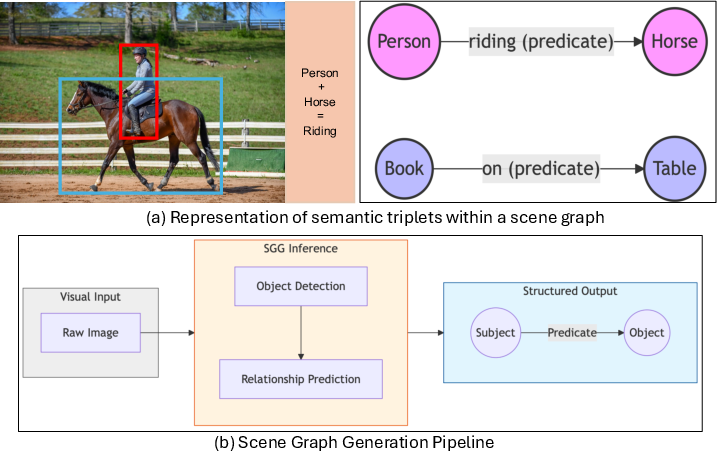
Figure 1: The SGG framework mapping visual input to graph-structured triplets, centralizing predicate classification and visual-relational reasoning.
Methodology
The pipeline follows four stages: 1) baseline CFEN predicate classifier establishment on Visual Genome, 2) systematic quantum architecture search (qubit count, encoding, entangling template, depth), 3) bias-aware, class-balanced (WCE) training across configurations, and 4) evaluation using semantic, quantum circuit, and computational metrics.
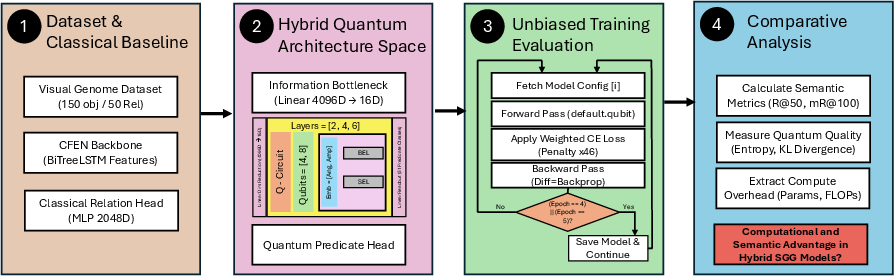
Figure 2: The four-stage experimental pipeline from dataset and classical baseline to quantum architecture search, class-balanced training, and multi-faceted evaluation.
Quantum Predicate Head (QP-Head) Architecture
The QP-Head compresses 4096-dimensional pairwise embeddings to a quantum-compatible vector, encodes them into a quantum system via angle or amplitude embedding, and processes them with variational parameterized quantum circuits (PQC) utilizing basic or strongly entangling layers. Measured expectation values are decoded by a lightweight classical readout, directly mapping quantum outputs to predicate logits.
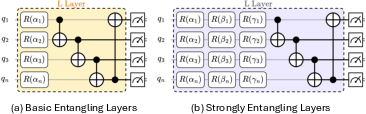
Figure 3: QP-Head circuit architectures, contrasting basic and strongly entangling paradigms for encoding predicate features into quantum states.
Bias-Aware Training and Class Imbalance
Given the severe predicate class skew in Visual Genome, Weighted Cross-Entropy (WCE) is adopted, using inverse-frequency class weights (up to 46× for rare classes) for loss computation. This class balancing substantially boosts mean recall (mR@K), the metric indicative of rare predicate recognition, outperforming standard Cross-Entropy (CE) in long-tail scenarios without sacrificing global recall (R@K).
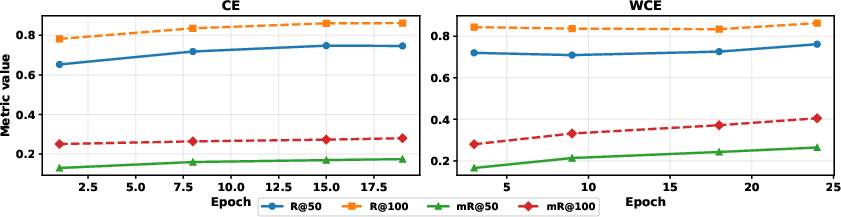
Figure 4: mR and R training dynamics for 4-qubit QP-Head under CE and WCE; WCE shows robust improvement on long-tail class metrics while maintaining global recall.
Quantum Architecture and Depth Analysis
Encoding and Entanglement Effects
Control experiments on 4-qubit PQCs indicate Amplitude Embedding combined with Strongly Entangling Layers provides the optimal trade-off between expressibility, entanglement, and performance. This setting achieves an mR@100 of 57.25% with only 96 quantum parameters—a 256× feature compression and significant parameter efficiency compared to the classical MLP.
Qubit and Depth Scaling
Scaling to 8 qubits (with 4 circuit layers) further increases state space expressiveness (from 16 to 256 dimensions), consistently raising mR@100 to 55.38% while maintaining competitive R metrics. Circuit depth analysis reveals diminishing returns beyond moderate depth: increases in layers boost expressibility (lower KL divergence from Haar distribution) but not necessarily entanglement or task performance, and significantly inflate runtime and kernel fragmentation.
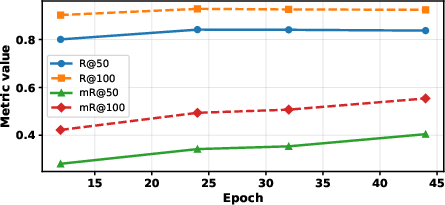
Figure 5: 8-qubit QP-Head training dynamics, showing simultaneous improvement in mean recall and maintenance of global recall over training epochs.
Computational and Hardware Feasibility
The most performant QP-Head models use a quantum parameter count (<0.001% of total model weights) orders of magnitude smaller than classical SGG heads, demonstrating practical parameter efficiency. However, simulation and hardware execution show circuit depth directly impacts inference latency and computation fragmentation. Physical execution on a 4-qubit superconducting QPU demonstrates that the trained QP-Head outputs non-collapsed, class-diverse predicate predictions at a batch accuracy of 66.67% over nine validation triplets, indicating robustness to device noise and feasibility of quantum deployment at this scale.
Compared to prior SGG benchmarks—Motifs, VCTree-TDE, and CFEN—a 4-qubit QP-Head improves mR@100 by 16.2 percentage points over CFEN with a negligible quantum parameter budget. The hybrid design decouples backbone relational representation from predicate decision, allowing aggressive parameter reduction at the head with no reliance on classical overparameterization.
In practice, these findings suggest that such quantum predicate modules can serve as drop-in, resource-efficient components for SGG architectures that must be deployed under strong memory and computation constraints or require improved long-tail semantic reasoning. However, gains are currently constrained to the predicate classification phase (PredCls); extension to upstream object detection and more complex SGG tasks remains necessary for broader adoption.
Theoretical Implications and Future Work
Systematic ablation of embedding, entangling, and depth confirms that quantum circuits can compactly encode and process relational semantics when properly matched with class-balanced objectives. However, the absence of monotonic improvement with circuit depth or entanglement indicates the expressibility threshold is quickly reached in practical hybrid-quantum SGG. Further, the demonstrated simulation-to-hardware transfer for compact PQC heads supports near-term NISQ applicability, but error mitigation and larger batch execution will be critical as quantum devices scale.
Potential research avenues include:
- Integration into SGG settings without ground-truth object labels (Scene Graph Classification, Detection)
- Exploration of backbone architectures and task transfer
- Hardware-efficient transpilation and noise-aware quantum training objectives
- Large-batch, low-latency QPU deployment
Conclusion
A hybrid quantum-classical predicate classifier (QP-Head) offers a parameter-efficient solution to long-tailed relationship classification in SGG, outperforming prior classical debiasing methods in mean recall with a compact quantum module. Amplitude embedding and strongly entangling structures, jointly with class-balanced learning, are necessary for extracting genuine quantum benefit. Early quantum hardware results support practical feasibility, and controlled ablation provides actionable insight into circuit design trade-offs. Quantum predicate heads thus emerge as promising, though not unconditionally superior, components for future parameter-constrained visual reasoning systems.