- The paper demonstrates a protocol for arbitrary nuclear spin manipulation using optimal in-plane fields, multi-tone RF drives, and Hahn echo sequences to target VB3N clusters in hBN.
- It achieves high-fidelity single-qubit gates (over 99% ideally and 96–97% with dephasing) and competitive multi-qubit operations by precisely engineering the hyperfine interactions.
- The protocol is supported by realistic experimental parameters, offering a scalable pathway for quantum processors and broader applications in solid-state spin qubit platforms.
Arbitrary Manipulation of Nuclear Spins in Hexagonal Boron Nitride
Introduction
The paper "Arbitrary Manipulation of Nuclear Spins in Hexagonal Boron Nitride" (2606.04497) targets the scalable quantum control of nuclear spins surrounding boron vacancy (VB) centers in hexagonal boron nitride (hBN), focusing on the triple-nitrogen (15N) cluster (VB3N). Despite extensive progress in initialization and readout of the electron spin associated with the VB-center, highly selective, high-fidelity manipulation of its coupled nuclear spins—critical to advanced quantum processing and quantum error correction—remains an open challenge. The inherent threefold lattice symmetry and strong, nearly isotropic hyperfine couplings hinder individual addressing, especially under fields aligned with the defect axis.
The authors propose and analyze a protocol for implementing arbitrary single- and multi-qubit gates on the nuclear spins within the VB3N cluster. Utilizing the electron spin as an ancillary qubit, the method combines optimal in-plane field orientation, multi-tone radiofrequency (RF) driving, and a Hahn echo sequence to dissect and engineer the effective hyperfine interaction landscape. This approach achieves selective control and suppresses parasitic dynamics, allowing for the realization of high-fidelity quantum operations within time windows short enough to evade electron spin dephasing.
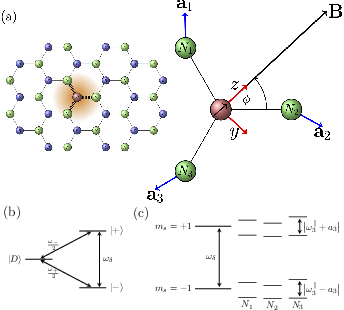
Figure 1: (a) Structure of the boron vacancy center in hBN showing the central electron spin (red) and three adjacent 15N nuclear spins (green) with an applied in-plane magnetic field; (b) Magnetic field splits the electron Hamiltonian, permitting a selective two-level subsystem; (c) Schematic for individually addressing nuclear spins using RF and multi-frequency control.
System Hamiltonian and Effective Dynamics
The total Hamiltonian encompasses the ground-state electron spin triplet at the VB-center (H^e), three nearest-neighbor 15N nuclear spins (H^n), and dominant isotropic Fermi-contact hyperfine interactions (H^i). The crucial geometric aspect is exploiting an in-plane magnetic field misaligned with principal bond directions, which, through the anisotropic hyperfine tensor Ak, lifts the symmetry-driven degeneracy of the nuclear spin transitions. After projecting the electron Hamiltonian onto a controllable two-level subspace using targeted MW driving, the authors derive an effective Hamiltonian permitting selective and conditional control over the nuclear cluster by tuning external fields and drive parameters.
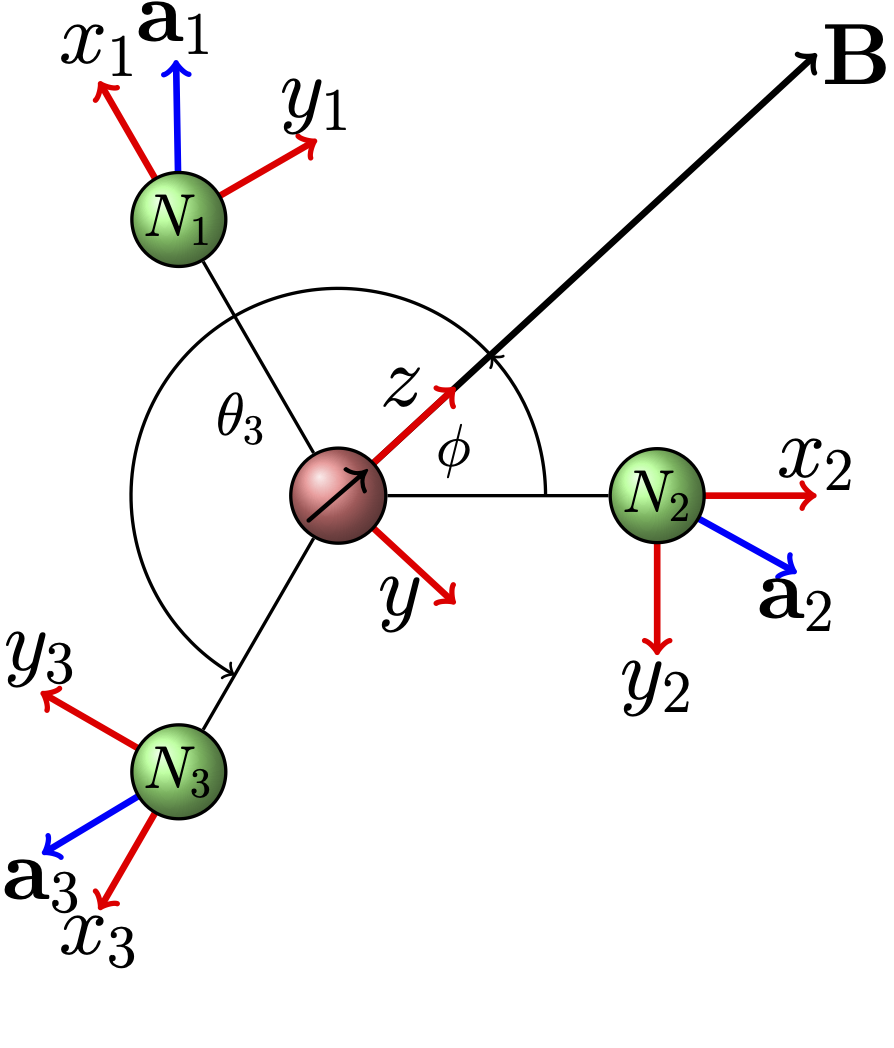
Figure 2: Spatial configuration and orientation definitions for the VB3N cluster, highlighting the in-plane magnetic field and the effective hyperfine fields ak for each nucleus.
Frequency-space analysis confirms that, for B∼0.1–$1$ T, the distinction between nuclear spin responses to engineered drives is sufficient for isolated gate operations within realistic experimental constraints.
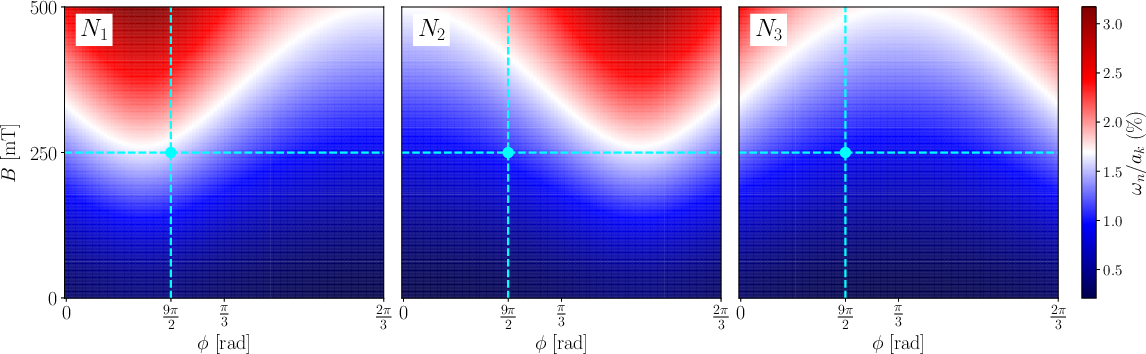
Figure 3: Ratio 150 distributions for the three nuclear spins as a function of in-plane magnetic field magnitude and orientation, demonstrating selectivity and constraints for field tuning.
Gate Protocol: Selective Control and Hahn Echo Sequencing
Central to the protocol are three sequential operations: (1) RF dressing to average out internal interactions, (2) a further modulation (controlled "shift") to imprint the target rotation, and (3) a Hahn echo-based disentanglement to map the engineered gate back to the computational frame. Analytical solutions, supported by time-dependent perturbation theory and verified through Lindblad master equation numerics, show that undesired cross-terms and phase errors are massively suppressed by choosing pulse durations (151) much longer than the inverse couplings but short compared to the electron dephasing time.
The protocol exploits the conditional structure of engineered gates, supporting both unconditional (152) and conditional (153) nuclear rotations, as well as custom combinations across the three nuclear spins. Fidelity is further optimized through appropriate field choices and drive phase assignments.
Numerical Results and Gate Fidelities
Numerical simulations utilize realistic experimental parameters (154 mT, 155, 156 MHz) for 157N-hBN. The protocol achieves single-qubit unconditional gate fidelities exceeding 99% (in absence of decoherence) and up to 96–97% under experimentally relevant electron dephasing rates, with gate times as short as 100–300 ns, well within the measured coherence envelope of the electron spin.
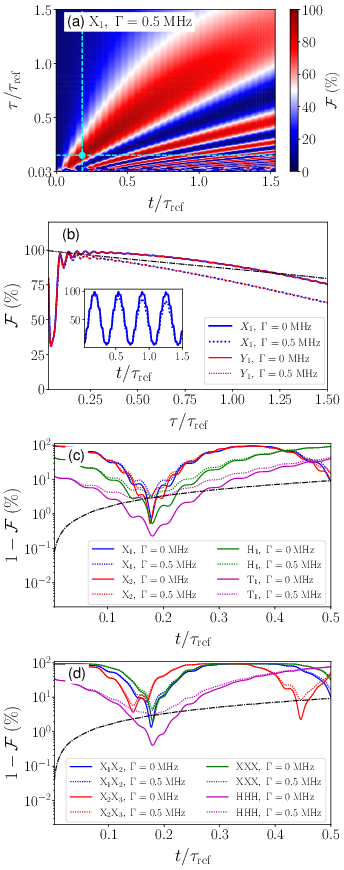
Figure 4: (a) Single-qubit X-gate fidelity as a function of control period and gate time with optimal point highlighted; (b) Fidelity comparison for X and Y gates with and without dephasing, and time evolution highlighting optimal gate operation.
Error analysis reveals the dominant infidelity sources as dephasing-induced leakage and accumulated phase errors from residual nonresonant terms. The protocol outperforms identity evolution and retains high fidelities under modest decoherence rates for both X, Y, Hadamard (H), and T gates.
Two- and three-qubit gate operations show a fidelity degradation, with two-qubit conditional X-X gates and three-qubit gates (e.g., triple-Hadamard or triple-X) exhibiting fidelities between 91–96%, reflecting the increased sensitivity of multi-qubit entangling gates to environment-induced errors.
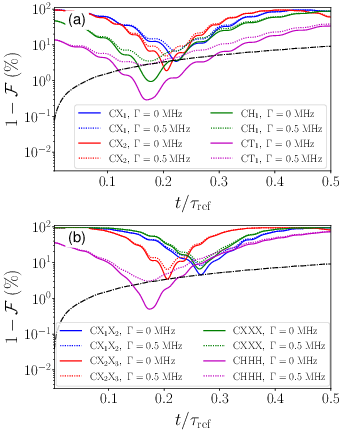
Figure 5: Gate infidelity profiles for (a) single-qubit and (b) multi-qubit (conditional and unconditional) gates, showing temporal evolution and identification of optimal gate times.
Conditional Gates and Composite Operations
By adapting the RF drive phase, the protocol enables conditional (electron-spin-dependent) operations, a prerequisite for universal gate sets and entanglement resource generation (e.g., GHZ state preparation). Conditional gates exhibit fidelity suppression relative to unconditional gates (typically 2–5% lower at given 158), as electron spin entanglement introduces additional error channels. The deviation from theoretical maxima can be mitigated by advanced pulse shaping or dynamical decoupling overlay.
The GHZ state protocol, based on compound controlled-Hadamard gates across the cluster, is highlighted as a practical application with significant implications for quantum communication benchmarks.
Experimental Feasibility and Electron Spin Initialization
A significant experimental consideration is the initialization fidelity under strong in-plane fields, where traditional optical pumping loses selectivity due to state mixing. The authors provide two pragmatic solutions: (a) pulsed magnetic fields enabling initialization in zero/low-field prior to gate operation at high field, and (b) engineered incoherent maser drives that selectively repopulate the computational basis under symmetry-broken conditions. Both approaches are compatible with current advances in high-field magnet control and GHz maser technology.
Implications and Future Directions
The demonstrated protocol closes a technical gap in practical, addressable nuclear spin manipulation in hBN color centers. By circumventing the symmetry-imposed indistinguishability using field orientation and dynamical control, the method outlines a path from single-defect experiments to scalable multi-qubit quantum processors based on hBN. The protocol's speed and flexibility make it robust against electron spin decoherence, a critical consideration as nuclear gate fidelities push toward quantum error correction thresholds.
The approach can be adapted for broader classes of solid-state spin qubit platforms that employ strong hyperfine couplings and ancillary electron spins. The combination with dynamical decoupling, pulse optimization (e.g., robust optimal control), and advanced initialization techniques offers prospects for further fidelity improvement and deeper integration into hybrid quantum processors.
Conclusion
This work establishes a theoretical and numerical foundation for high-fidelity arbitrary gate control of nuclear spin qubits in the VB3N cluster in hBN, leveraging anisotropic control via in-plane magnetic fields, multi-tone continuous RF driving, and echo-based refocusing. The protocol demonstrates strong single- and multi-qubit gate fidelities under realistic noise, providing a scalable path for nuclear-spin-based quantum computation and metrology within 2D solid-state platforms. Future work should focus on experimental benchmarks, integration with dynamical decoupling, and expansion to dense coupled qubit arrays.