- The paper introduces Reveal-IG, a method that shifts attribution from classical input-space paths to distributional paths, ensuring completeness of expected model responses.
- It unifies and extends Integrated Gradients and SHAP by employing controlled uncertainty probes and Monte Carlo estimation for multiscale, domain-adaptive feature attribution.
- The approach mitigates common attribution artifacts in image and tabular data, while offering insights for enhancing interpretability and addressing computational trade-offs in explainable AI.
Introduction
The paper "Attribution via Distributional Paths for Information Revelation" (2606.03885) introduces Reveal-IG, a method for feature attribution that operates in a lifted space of distributional probes rather than classical input-space paths. This framework unifies and extends path-integral attribution methods with an explicit focus on information revelation, leveraging the expected model response under parameterized distributional perturbations. Reveal-IG bridges conceptual gaps between methods like IG and SHAP, offering a complete, multiscale, and domain-adaptive mechanism for attributing model predictions to input features.
Motivation and Methodological Foundations
Path-based attribution methods, such as Integrated Gradients (IG) and SHAP, have established the completeness criterion as central to interpretable feature attribution. IG undertakes integration along an input-space path from a baseline to the datapoint of interest, while SHAP averages discrete feature reveals (coalitions), yielding attributions as feature marginal contributions. Both suffer from significant limitations: IG is sensitive to artifacts arising from the specific input-space path, risking attribution propagation through spurious or semantically meaningless regions, whereas SHAP's discrete and axis-aligned reveal steps ignore any notion of the gradual revelation, often producing stepwise artifacts and requiring combinatorial averaging.
Reveal-IG reframes the path not as a sequence of raw input states, but as a sequence of increasingly informative distributional probes around the datapoint being explained. The attribution integral is computed over a path in the space of probability distributions (structured probes). Each probe encodes a controlled level of uncertainty, transitioning from a broad, marginal reference toward a distribution highly concentrated at the target input. This approach retains completeness, but the attributions decompose the expected change in model response, rather than deterministic point-to-point differences, naturally accommodating feature-wise uncertainty and multiscale interrogation.

Figure 1: Reveal-IG implements a continuous path of information revelation, interpolating between the SHAP (discrete steps) and IG (pointwise path) paradigms.
Formally, for a model f and an input x⋆, Reveal-IG parameterizes a family of distributions qθ(z∣x⋆). The attribution objective is defined as
G(θ;x⋆)=Ez∼qθ(⋅∣x⋆)[f(z)]
with the path integral decomposing the change in expected model response as probe parameters θ move from a data-driven, high-entropy reference to a target-concentrated endpoint. This path is fully factorized over features, where each block of parameters θi (e.g., mean and log-variance for Gaussian probes) corresponds to feature i.
In the case of images, qθ is instantiated as a fully factorized Gaussian over pixel values, with the path beginning at the normalized image prior and ending at a selected residual uncertainty near x⋆. For tabular data, empirical marginals are used for initialization, with path trajectories defined through temperature-annealed kernels that progressively focus on the observed feature values. Expectations and gradients along this path are efficiently estimated by Monte Carlo methods and differentiation via automatic differentiation (image setting) or closed-form derivatives (tabular setting).
Synthetic Diagnostics for Attribution Artifacts
The two-dimensional synthetic benchmarks illustrate the essential geometric artifacts that motivate Reveal-IG. IG reveals susceptibility to "path shadows"—attributions propagate artifactually whenever the input-space path intersects localized function structure, even far from x⋆. SHAP introduces axis-aligned bias due to abrupt, per-feature reveals. Reveal-IG mitigates these failure modes by accumulating attribution in the late stages of information revelation, thus localizing sensitivity substantially closer to the explained point and reducing dependence on distant, irrelevant feature interactions.
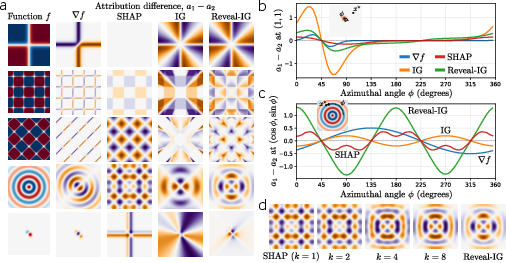
Figure 2: The comparison of attribution fields for various methods highlights path artifacts (shadows) in IG and axis alignment in SHAP, while Reveal-IG interpolates between these behaviors with reduced artifacts and better localization.
Notably, when SHAP's axis-aligned reveal is subdivided into x⋆0 uncertainty-reducing steps, the attribution field smoothly interpolates toward that of Reveal-IG, verifying the importance of the gradual reveal path.
Image Attribution: Quantitative and Qualitative Results
The empirical comparison spans IG, path-variant methods, and perturbation-based approaches on ImageNet with both ResNet-50 and ViT backbones. Reveal-IG is evaluated using both fixed and adaptive endpoint uncertainty scales, integrating over Monte Carlo samples for robust estimation.
Reveal-IG consistently outperforms or is competitive with state-of-the-art attribution methods on key metrics that interrogate the sign and spatial concentration of attributions. Specifically, when sign is considered—such as positive-evidence insertion/deletion and Sensitivity-x⋆1 regression—Reveal-IG demonstrates substantial margins over alternatives. This indicates superior discrimination between features that support versus suppress the target class.
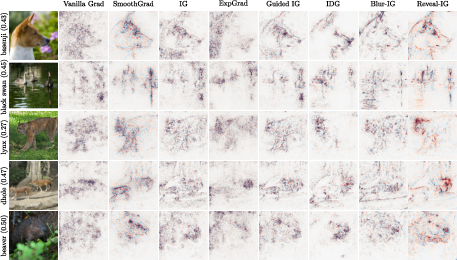
Figure 3: Saliency maps generated by Reveal-IG display clear separation between positively and negatively contributing features, with attributions localized to semantically salient regions.
Path-wise analysis of attribution accumulation further differentiates Reveal-IG: as opposed to IG, Guided IG, and Blur-IG, which concentrate attribution early in the input-space path, Reveal-IG assigns most attribution at late stages, closely matching the semantic onset of relevant feature information. IDG exhibits an even more sharply peaked early-attribution behavior, reflecting its decision-weighted integration.
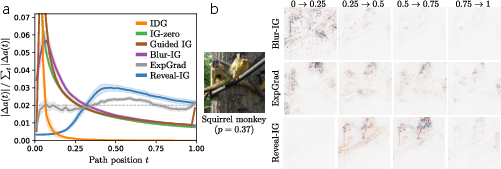
Figure 4: Reveal-IG predominantly accumulates attribution late along the reveal trajectory, whereas alternatives (e.g., IG, Blur-IG) show early-bias accumulation.
The method's completeness is empirically validated, with convergence of the sum of attributions to the change in expected model output under the endpoints of the distributional path.
Tabular Regression Attributions
Reveal-IG generalizes well to tabular domains, providing competitive performance on sufficiency, comprehensiveness, and directional insertion metrics versus KernelSHAP, feature ablation, and other baselines. It excels on sensitivity-max, indicating robust stability under small input perturbations—a notable advantage over gradient and input-path methods, whose explanations can be arbitrarily unstable in heterogeneous feature spaces.
Reveal-IG’s attribution path, operating over empirical marginals and feature-wise temperature annealing, avoids implausible input interpolations, thus better respecting the discrete nature of tabular variables. This methodological trait ensures more faithful explanations, particularly for black-box models that lack meaningful input-space differentiation.
Theoretical and Practical Implications
The conceptual advance provided by Reveal-IG reframes attribution path design as a choice of information revelation schedule rather than spatial/geometric interpolation. Completeness is maintained in the path-integral sense, but freedom is gained to adapt the nature, scale, and structure of probe distributions to domain specifics. This generalizes to both continuous (images) and discrete (tabular) data modalities, enables extension to other domains (e.g., sequential or graph-structured data), and directly connects attribution design to the nature of uncertainty and locality encoded by the analyst.
From a practical standpoint, Reveal-IG introduces higher computational costs relative to IG and single-gradient-based methods, due to the need for repeated expectation estimation across path steps and Monte Carlo samples. Nevertheless, this cost is controlled and can be traded off with sample efficiency or parallelization.
Limitations and Future Directions
The principal limitation of Reveal-IG is the selection of probe family and path, which becomes the main axis of domain-specific tuning. Factorized distributions, while tractable, do not capture structured correlations (e.g., spatial dependencies in images, feature co-occurrence in tabular data), suggesting a clear avenue for future research: employing correlated or structure-aware probes for more nuanced attributions.
Computation remains more demanding than single-path or gradient estimators, particularly in tabular settings. Research on variance reduction, sample-efficient estimators, and distributional probe design is required to broaden applicability. Moreover, completeness for Reveal-IG refers to the expected model response, which is subtly different than pointwise completeness, especially for models with pronounced non-linearities.
Conclusion
Reveal-IG constitutes a significant advance in path-based feature attribution by explicitly formalizing attribution in the space of information revelation. It retains completeness, provides interpretable and stable attributions, and unifies discrete and continuous-path methods within a single framework. Reveal-IG's performance on both image and tabular datasets, its mitigation of classical artifact failure modes, and its theoretical generality position it as a preferred approach for explainability in machine learning contexts where both reliability and interpretability are required. Future research should exploit the flexibility of distributional paths for domain-matched probe design and improve computational scalability.