Manifold-Aligned Guided Integrated Gradients for Reliable Feature Attribution
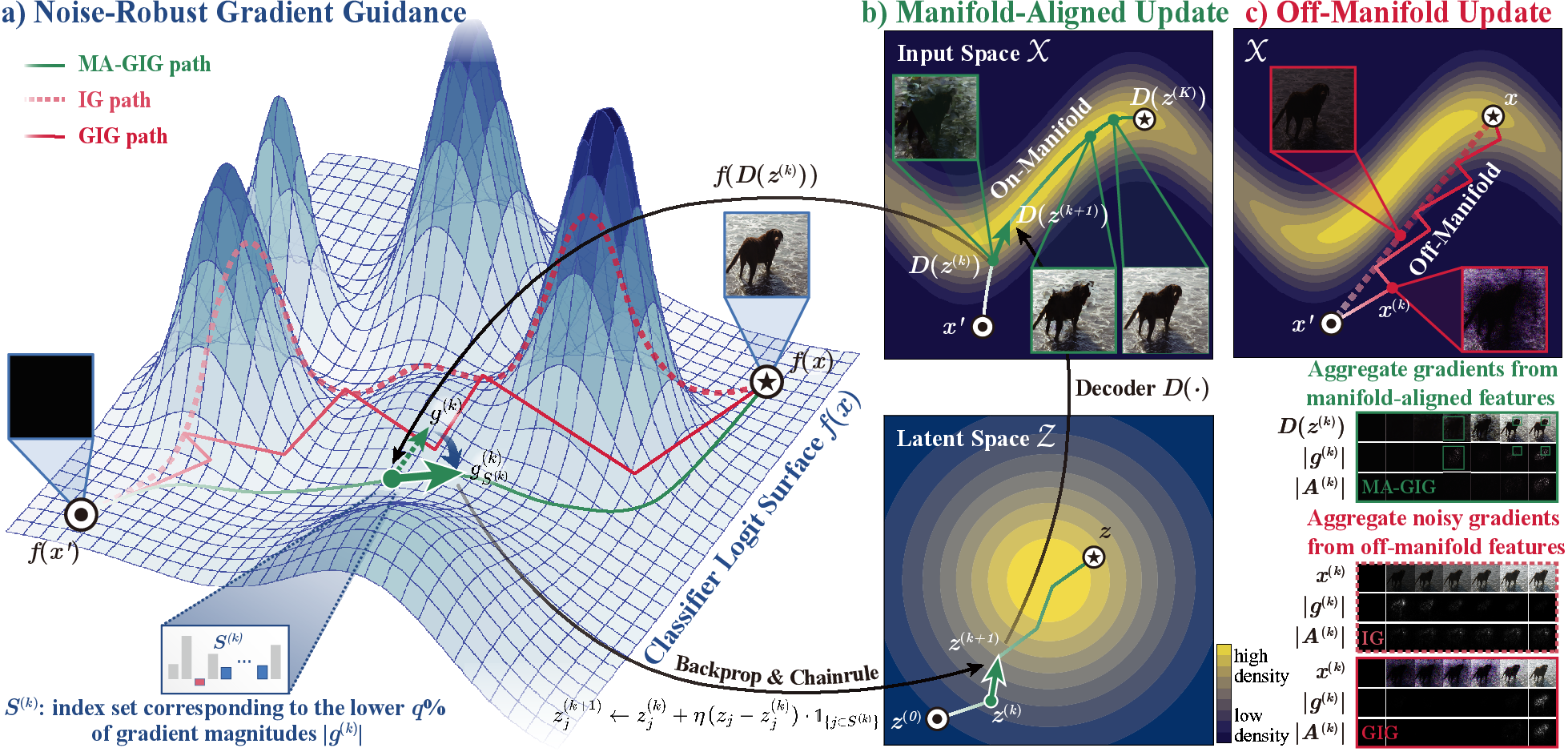
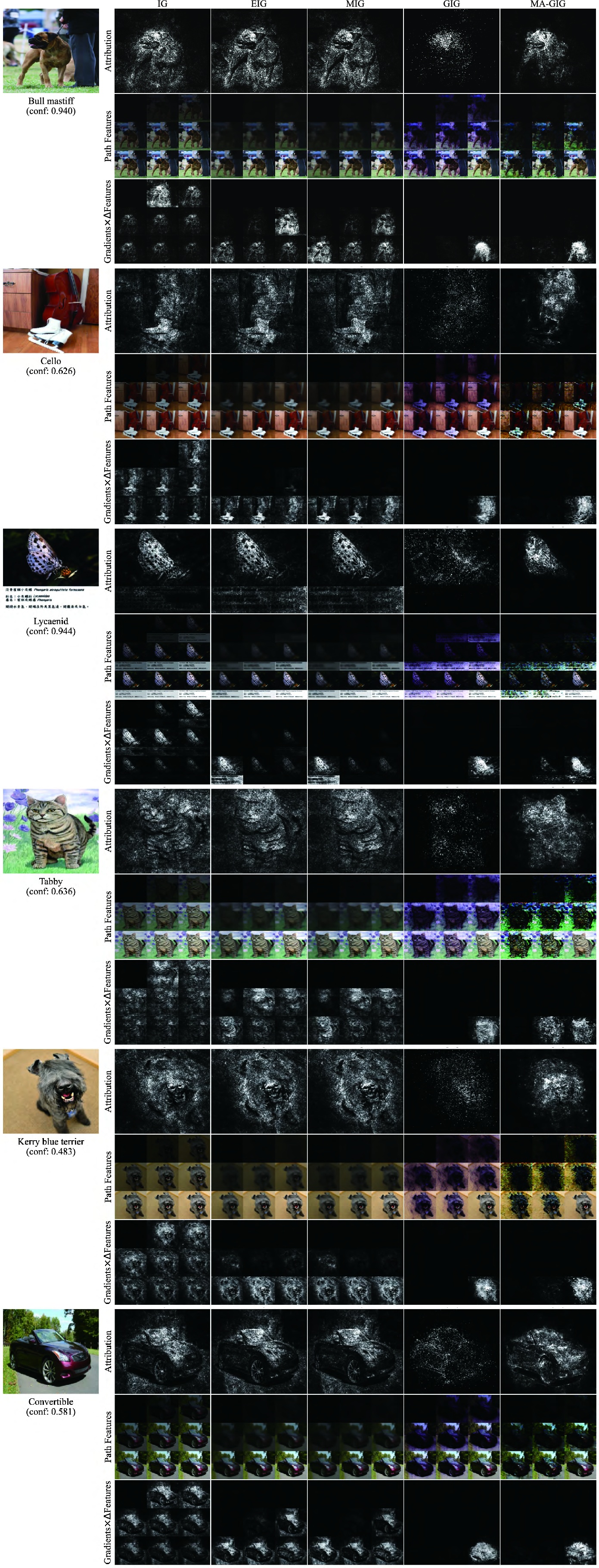
Abstract: Feature attribution is central to diagnosing and trusting deep neural networks, and Integrated Gradients (IG) is widely used due to its axiomatic properties. However, IG can yield unreliable explanations when the integration path between a baseline and the input passes through regions with noisy gradients. While Guided Integrated Gradients reduces this sensitivity by adaptively updating low-gradient-magnitude features, input-space guidance still produces intermediate inputs that deviate from the data manifold. To address this limitation, we propose \emph{Manifold-Aligned Guided Integrated Gradients} (MA-GIG), which constructs attribution paths in the latent space of a pre-trained variational autoencoder. By decoding intermediate latent states, MA-GIG biases the path toward the learned generative manifold and reduces exposure to implausible input-space regions. Through qualitative and quantitative evaluations, we demonstrate that MA-GIG produces faithful explanations by aggregating gradients on path features proximal to the input. Consequently, our method reduces off-manifold noise and outperforms prior path-based attribution methods across multiple datasets and classifiers. Our code is available at https://github.com/leekwoon/ma-gig/.
Paper Prompts
Sign up for free to create and run prompts on this paper using GPT-5.
Top Community Prompts
Explain it Like I'm 14
What is this paper about?
This paper is about making the “why” behind AI decisions clearer and more trustworthy. When a deep neural network (like an image classifier) makes a prediction, we often want to know which parts of the input (for example, which pixels in an image) mattered most. A popular way to do this is called Integrated Gradients (IG), but it can give messy or misleading explanations if it looks at unrealistic in-between images while doing its calculations. The authors introduce a new method, Manifold-Aligned Guided Integrated Gradients (MA-GIG), that keeps those in-between images realistic, so the explanations are cleaner and more reliable.
What questions are the authors asking?
In simple terms, the paper asks:
- How can we make feature attributions (the “importance map” over input features) more reliable?
- Why do existing methods like IG or Guided IG sometimes highlight the wrong areas?
- Can we design a better “path” from a simple baseline image to the real image so that the model only looks at realistic in-between images and avoids noise?
How does their method work?
Key ideas in simple terms
- Gradient: Think of “gradient” as “how much the prediction changes if I change this pixel a tiny bit.” Higher gradient means that pixel matters more right now.
- Baseline to input path: IG explains a prediction by slowly moving from a simple baseline image (like a black image) to the real image, adding up which pixels matter along the way.
- The problem with straight lines: If you just blend from baseline to the real image pixel-by-pixel, you pass through strange, unrealistic images. The model’s behavior in these unrealistic places can be noisy, which can lead to messy explanations.
- Data manifold: Imagine all “real-looking” images lie on a kind of “surface” inside the huge space of all possible images. This surface is called the data manifold. If you step off that surface, images look weird and the model’s gradients become unreliable.
- Latent space and VAE: A Variational Autoencoder (VAE) is a model that learns a compact “recipe” (latent code) for realistic images. The decoder turns a recipe back into an image. Moving along smooth paths in the recipe space tends to produce realistic in-between images when decoded.
What MA-GIG does
MA-GIG builds the explanation path in the VAE’s recipe (latent) space, not directly in pixel space. It also “guides” the path to avoid noisy areas the same way Guided IG does, but it does this in the recipe space so the decoded images stay realistic.
Here’s the idea as a short series of steps:
- Start with two recipes (latent codes): one for the baseline image and one for the real input image. These come from the VAE’s encoder.
- Decode the current recipe to get an in-between image.
- Look at the model’s gradients, but translate them into the recipe space (using the decoder’s Jacobian; think: “how changes in the recipe change the image”).
- Gently update only the recipe coordinates that currently have small gradients first (this helps avoid noisy regions), moving them toward the real image’s recipe.
- Repeat steps 2–4 to trace a path of realistic in-between images.
- Add up the gradients along this path to get the final attribution map (which pixels mattered).
By doing guidance in recipe space and decoding at each step, the path stays close to the data manifold (realistic images), reducing off-manifold noise.
What did they find?
The authors tested MA-GIG on several image datasets (ImageNet, Oxford-IIIT Pet, Oxford 102 Flowers) and with different classifiers (VGG16, ResNet18, InceptionV1). They compared against common attribution methods like IG, Guided IG (GIG), and other latent-space methods.
Highlights:
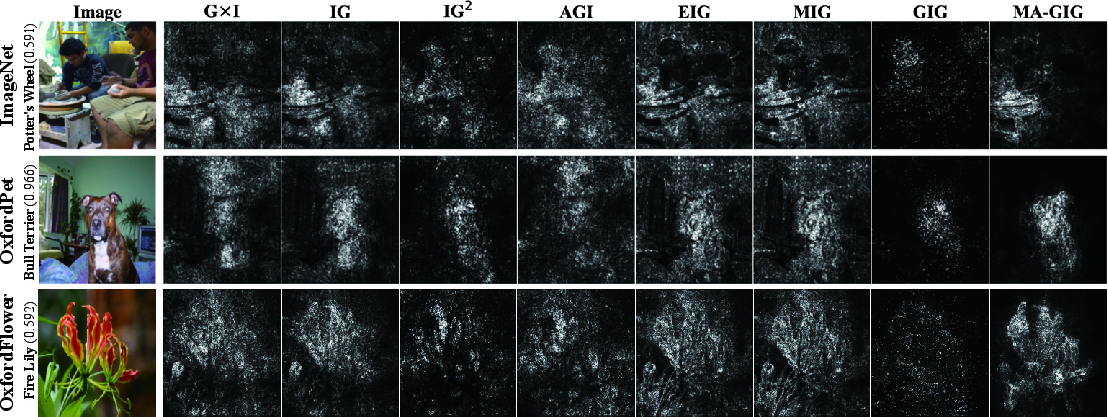
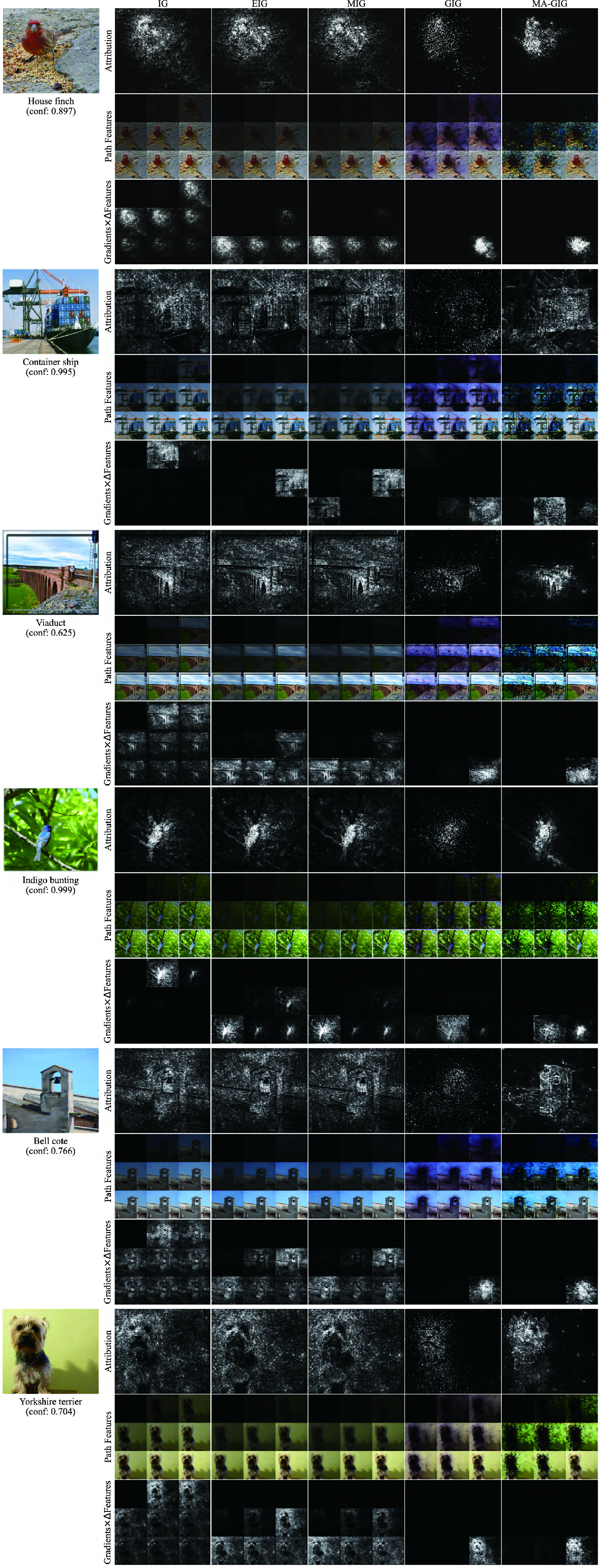
- Cleaner, more focused maps: Visually, MA-GIG highlights the important parts of the object with less background noise than other methods.
- Better scores: Using standard tests (like DiffID, Insertion, and Deletion, which measure how well the highlighted areas actually affect the model’s confidence), MA-GIG usually scores higher than IG, GIG, and other path-based baselines.
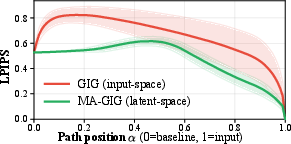
- More realistic in-between images: Using a perceptual distance measure (LPIPS), the in-between images along the MA-GIG path stay closer to the real image in a “looks realistic” sense, suggesting the method truly stays near the data manifold.
- Robust and flexible: MA-GIG works well across different choices for how aggressively it updates features (the selection fraction) and across different VAE backbones. Performance is best when the VAE is well-matched to the dataset (domain alignment matters more than just reconstruction error).
- No magic trick needed: Fancier recipe-space interpolation like “spherical interpolation” (Slerp) didn’t consistently beat simple linear interpolation in latent space, so the simple choice is good enough.
Why does this matter?
If we want to trust AI systems, especially in sensitive areas (like medical images or safety-related vision tasks), we need explanations that match how the model really made its choice. MA-GIG reduces a common cause of bad explanations: evaluating gradients on unrealistic images. By staying on the “real images” surface (the data manifold), MA-GIG tends to produce clearer and more faithful attributions. This can help developers debug models, auditors inspect fairness and safety, and users understand model behavior.
Limitations and future directions
- Depends on the VAE: If the VAE’s decoder isn’t well-suited to your data, the in-between images might still drift away from what’s realistic, and explanations may weaken.
- Focuses on path-based attribution: Some other methods that directly optimize masks (like Grad-CAM-style or iGOS) can sometimes score higher on certain tests (like Insertion) because they’re solving a different problem. MA-GIG keeps the strengths of Integrated Gradients (like its “completeness” principle) while reducing path noise, but it’s not a mask-optimization method.
- Future work: Combine manifold-aligned paths with ideas like averaging multiple paths, refining paths with optimization, or designing better, domain-adaptive VAEs to further boost reliability.
Knowledge Gaps
Knowledge gaps, limitations, and open questions
Below is a concise list of concrete gaps and open problems that remain unresolved and could guide future research:
- Theoretical guarantees without the Perfect Autoencoder assumption: no bounds on off-manifold deviation, attribution bias, or completeness error when the decoder has reconstruction error or is not a smooth immersion.
- Quantification of discretization error: no analysis of how the number of steps K and step size η affect attribution accuracy, stability, and completeness; no guidance for adaptive step sizing or error control.
- Latent metric mismatch: the selection of low-magnitude latent gradients is performed in coordinate space, ignoring the pullback Riemannian metric induced by the decoder; no investigation of metric-aware selection, whitening, or preconditioning to reduce bias from Jacobian scaling.
- Baseline dependence in latent space: the encoder applied to a potentially off-manifold baseline (e.g., zero image) may produce an invalid latent anchor; no study of baseline choices, latent priors for baseline z′, or baseline-specific diagnostics.
- Axiomatic properties under imperfect generators: completeness, sensitivity, and implementation invariance are not empirically verified when decoded points do not exactly lie on the data manifold; unclear when axioms degrade in practice.
- Endpoint consistency vs reconstruction: the algorithm forces endpoints to be x′ and x while intermediate points come from D(z); the effect of reconstruction gaps D(E(x)) ≠ x and D(E(x′)) ≠ x′ on the path semantics and completeness is unquantified.
- Computational cost and scalability: no runtime and memory analysis vs IG/GIG, especially the overhead of repeated decode passes and VJP/Jacobian-vector products; scalability to high-resolution inputs and large-batch settings remains untested.
- Sensitivity to hyperparameters beyond q: limited ablations on η, K, and latent update schedules (e.g., line search, momentum, adaptive q); absent robustness analysis across random seeds.
- Decoder gradient quality: the impact of decoder Jacobian noise/instability on latent gradient estimates and attribution fidelity is not analyzed; no regularization or smoothing strategies are proposed.
- Choice of generative backbone: while several VAEs are compared, there is no systematic study of how training data, architecture, or latent dimensionality affect manifold fidelity and attribution; no evaluation with non-VAE priors (normalizing flows, score models) that can provide likelihoods or exact geometry.
- Metric for manifold alignment: LPIPS is used as a proxy; there is no density- or likelihood-based assessment (e.g., VAE log-likelihood, flow likelihood) to verify on-manifold traversal; no class-consistency checks for decoded intermediates along the path.
- Adversarial and OOD robustness: effects on adversarially trained models, adversarial inputs, or out-of-distribution samples are unexplored; unclear whether manifold alignment helps or hurts attribution reliability under distribution shift.
- Task and modality generality: the method is only evaluated on image classification; applicability to detection/segmentation, vision-LLMs, audio/text/tabular domains with suitable generative priors is unknown.
- Comparison breadth and fairness: no evaluation against path-averaging baselines (e.g., SmoothGrad-IG, NoiseTunnel) or methods that combine manifold guidance with gradient smoothing; unclear if MIG/EIG comparisons used the same VAE and identical hyperparameters across datasets.
- Attribution faithfulness benchmarks: no ROAR/KAR (remove-and-retrain/keep-and-retrain), pointing game, or ground-truth-masks evaluations; reliance on DiffID/Insertion/Deletion may miss aspects of causal importance or human alignment.
- Class logit choice: only target-class logit is considered; behavior for difference-of-logits or multi-class objectives (e.g., target vs most confusing class) is not analyzed.
- Multi-path and stochastic latent sampling: VAE encoders are probabilistic; the method uses a single deterministic encoding and path; no study of sampling in latent space, multi-path aggregation, or uncertainty quantification of attributions.
- Path optimization strategy: latent guidance is greedy and axis-aligned; alternatives such as pullback-metric geodesics, trust-region updates, or energy-regularized path optimization are not explored.
- Normalization of latent coordinates: no analysis of coordinate scaling (e.g., per-dimension variance) or prior-informed normalization to prevent certain latent dimensions from dominating selection due to scale differences.
- Interaction with masking/localization methods: while complementary, no principled hybridization with Grad-CAM/I-GOS/iGOS++ or mask optimization is proposed to bridge the insertion performance gap.
- Baseline-agnostic or data-driven baselines: no investigation of learned or data-conditional baselines that better align with the generative manifold and reduce baseline-induced artifacts.
- Attribution sign and sparsity control: the method focuses on noise suppression but does not analyze sign correctness, sparsity/compactness regularization, or calibration of attribution magnitudes.
- Robustness to input preprocessing: the effect of standardization, resizing, or color transforms on latent guidance and attributions is not studied.
- Reproducibility and code availability: the code link (“magenta”) is incomplete; detailed implementation choices (e.g., autodiff settings for J_DT v) and seeds are not fully documented for exact replication.
- Theoretical connection to classifier curvature: no formal link between reduced off-manifold exposure and bounds on accumulated curvature/gradient variance along the path; missing curvature-based guarantees for noise suppression.
Practical Applications
Overview
Manifold-Aligned Guided Integrated Gradients (MA-GIG) is a path-based feature attribution method that builds attribution paths in the latent space of a pretrained generative model (e.g., VAE) and decodes intermediate states back to input space. By biasing integration paths toward the learned data manifold and guiding updates through low-gradient latent dimensions, MA-GIG reduces off-manifold noise and yields more faithful, less noisy saliency maps than prior path methods (e.g., IG, GIG). This enables practical improvements in model debugging, auditing, and deployment workflows where reliable explanations matter.
Below are concrete applications derived from the paper’s findings, organized by timeline and sector, with tools/workflows that could emerge and key assumptions/dependencies.
Immediate Applications
These can be deployed now with existing CV classifiers and available VAEs (e.g., MAR, Stable Diffusion VAEs), assuming white-box gradient access.
- Improved saliency for model debugging in vision pipelines
- Sector: Software, Robotics, Retail, Manufacturing
- Use case: Diagnose spurious correlations (e.g., backgrounds, watermarks) by comparing IG/GIG vs. MA-GIG attribution maps on misclassifications; prioritize data fixes or model retraining.
- Tools/workflows: Add “MA-GIG” to Captum/TF-Explain-style toolkits; CI “explanation regression tests” using DiffID/Insertion/Deletion; explanation-consistency dashboards.
- Assumptions/dependencies: Gradient access to the classifier; a domain-aligned VAE; compute for Jacobian-vector products.
- Audit-ready explanations for regulated CV models
- Sector: Healthcare imaging, Autonomous driving, Public sector procurement
- Use case: Provide more stable, plausibly in-distribution attribution evidence for model risk reviews and documentation (model cards, FactSheets).
- Tools/workflows: Audit bundles that include MA-GIG maps, path LPIPS profiles, DiffID metrics; governance gates requiring minimum faithfulness scores.
- Assumptions/dependencies: Explanations are supportive evidence, not sole decision criteria; domain-appropriate baseline and VAE.
- Safety case support for perception modules
- Sector: Autonomous driving, Robotics, Industrial inspection
- Use case: Validate that attributions concentrate on task-relevant objects (pedestrians, defects) rather than background; triage failures where attributions drift.
- Tools/workflows: Offline test suites with MA-GIG overlays and path plausibility plots; scenario-specific review checklists.
- Assumptions/dependencies: Offline analysis (current MA-GIG may be too slow for strict real-time); high-quality VAE for the target domain.
- Data curation and dataset debugging via saliency
- Sector: Data operations, ML platform teams
- Use case: Identify mislabeled or low-quality samples where attributions highlight irrelevant regions; detect spurious dataset artifacts.
- Tools/workflows: Batch runs of MA-GIG on training/validation samples; flagging heuristics based on attribution sparsity and background overlap.
- Assumptions/dependencies: Storage and compute for large-scale explanation runs.
- Human-in-the-loop labeling assistance
- Sector: Annotation services, Medical imaging pre-reads
- Use case: Use MA-GIG maps as weak priors/region proposals to speed up segmentation or bounding box annotation.
- Tools/workflows: Annotation UIs with MA-GIG overlays and brush-in/brush-out workflows; active-learning loops that request human confirmation.
- Assumptions/dependencies: Humans remain in control; explanations are suggestions, not ground truth.
- Model selection and hyperparameter tuning with explanation metrics
- Sector: MLOps, AutoML
- Use case: Rank models not only by accuracy but also by MA-GIG DiffID/Insertion/Deletion; select architectures with better explanation faithfulness.
- Tools/workflows: AutoML hooks to compute MA-GIG metrics; Pareto frontiers (accuracy vs. faithfulness).
- Assumptions/dependencies: Comparable baselines and consistent VAE across candidates.
- Explanation drift monitoring in production
- Sector: MLOps
- Use case: Track whether saliency shifts to irrelevant regions over time (data drift, model updates).
- Tools/workflows: Nightly MA-GIG on canary batches; alerting if attribution concentration or DiffID drops beyond thresholds.
- Assumptions/dependencies: Stored reference distributions; compute budgets for periodic runs.
- Comparative explainability panels for stakeholders
- Sector: Responsible AI, Product management
- Use case: Present side-by-side IG/GIG/MA-GIG maps to communicate model behavior to non-technical stakeholders more reliably.
- Tools/workflows: Reporting templates; interactive notebooks with qualitative and quantitative panels.
- Assumptions/dependencies: Careful curation of representative examples; stakeholder training on limits of saliency.
- Weak supervision for foreground detection
- Sector: Retail search, Manufacturing QA, Agriculture (plant/flower detection)
- Use case: Use MA-GIG saliency hotspots to create pseudo-labels for foreground/background masks, improving downstream detectors.
- Tools/workflows: Mask post-processing (thresholding, CRF refinement); iterative self-training using MA-GIG-derived masks.
- Assumptions/dependencies: Proper thresholds and post-hoc denoising; validation on a labeled subset.
- Curriculum design for explainability education
- Sector: Academia, Professional training
- Use case: Teach manifold-aware attribution pitfalls (off-manifold paths) using MA-GIG vs. IG case studies and LPIPS path analysis.
- Tools/workflows: Course labs; public datasets with packaged notebooks and VAEs.
- Assumptions/dependencies: Availability of pre-trained VAEs and open-source code.
Long-Term Applications
These require further R&D, broader modality support, or performance engineering (e.g., for real-time constraints) before routine deployment.
- Cross-modality manifold-aligned attribution
- Sector: NLP, Speech, Multimodal
- Use case: Extend MA-GIG principles to text/audio with appropriate generative latents (e.g., language VAEs, flow/diffusion latents) for in-distribution path sampling.
- Tools/workflows: Token/phoneme-level attributions decoded from latent paths; modality-specific plausibility metrics (beyond LPIPS).
- Assumptions/dependencies: Strong generative models with smooth, task-relevant latents; differentiability and gradient access.
- Attribution-regularized training
- Sector: Software/ML platforms
- Use case: Add losses that penalize off-manifold attribution or reward MA-GIG concentration on ground-truth regions, improving robustness and trust.
- Tools/workflows: Training hooks that compute MA-GIG on minibatches; auxiliary objectives shaping decision boundaries.
- Assumptions/dependencies: Training-time compute overhead; risk of optimizing to the metric rather than the underlying causal signal.
- Real-time or near-real-time deployable explanations
- Sector: Edge AI, Autonomous systems
- Use case: Latency-optimized MA-GIG variants (e.g., low-rank Jacobian approximations, distilled VAEs) for interactive or on-robot explanations.
- Tools/workflows: Compiler-level graph optimizations; Jacobian caching; subspace projections reduced to a few latent directions.
- Assumptions/dependencies: Engineering investment; accuracy-latency trade-offs.
- Standardized audit protocols using manifold-aligned metrics
- Sector: Policy/regulation (e.g., EU AI Act), Model risk management
- Use case: Define acceptable ranges for explanation faithfulness and path plausibility (DiffID thresholds, LPIPS path bounds) as part of audit checklists.
- Tools/workflows: Compliance toolkits; third-party testing services issuing “explanation conformance” badges.
- Assumptions/dependencies: Consensus on metrics and thresholds; sector-specific guidance; reproducibility requirements.
- Domain-adaptive generative priors for explanations
- Sector: Healthcare, Remote sensing, Industrial vision
- Use case: Train/finetune VAEs specific to the target domain so attribution paths stay on-manifold even for niche imagery.
- Tools/workflows: VAE selection/finetuning pipelines; “VAE alignment scorecards” tracking reconstruction, DiffID, and task alignment.
- Assumptions/dependencies: Access to domain data; privacy and licensing constraints; potential for data leakage if not handled properly.
- Explanation-based data governance and curation at scale
- Sector: Enterprise data platforms
- Use case: Systematically surface and remove spurious correlations from large corpora using MA-GIG signals; enforce “saliency hygiene” in training sets.
- Tools/workflows: Data lake scanners with MA-GIG heuristics; auto-suggested rebalancing/augmentation recipes.
- Assumptions/dependencies: Compute budgets; robust heuristics to minimize false positives.
- OOD and adversarial behavior diagnostics via path plausibility
- Sector: Security, Safety engineering
- Use case: Use off-manifold drift indicators (e.g., elevated LPIPS along path) as signals of distribution shift or adversarial sensitivity.
- Tools/workflows: Monitoring that correlates path plausibility with OOD detectors; red-teaming suites comparing IG/GIG/MA-GIG stability.
- Assumptions/dependencies: Calibrated thresholds; validation that signals correlate with real risk.
- Multi-model consensus explainability
- Sector: Responsible AI
- Use case: Combine MA-GIG with Grad-CAM, mask-optimizing methods, and counterfactuals to produce consensus maps for higher confidence decisions.
- Tools/workflows: Ensemble explanation orchestrators; discrepancy measures that flag contentious cases for human review.
- Assumptions/dependencies: Harmonized baselines; UI to present and reconcile differences; human oversight.
- Semi-automated counterfactual analysis
- Sector: Product safety, Fairness research
- Use case: Use manifold-aligned latent paths to inform counterfactual edits that remain plausible, complementing counterfactual generation methods.
- Tools/workflows: “Attribution-to-edit” assistants that translate MA-GIG saliency into suggested latent manipulations.
- Assumptions/dependencies: Strong generative priors; safeguards against introducing bias; careful interpretation.
- Benchmarks and theory for manifold-aware explainability
- Sector: Academia
- Use case: New benchmarks that quantify on-/off-manifold attribution errors and their impact on trust; theoretical work linking decoder geometry and attribution fidelity.
- Tools/workflows: Public leaderboards with manifold-aware metrics; reference VAEs/flows for standard datasets.
- Assumptions/dependencies: Community uptake; standardized baselines and compute seeds for reproducibility.
Key Assumptions and Dependencies
- Generative prior quality and domain alignment: Performance depends on a VAE (or equivalent) whose decoder captures the target domain’s manifold. Poor alignment degrades attribution quality.
- White-box, differentiable access: Requires gradients through the classifier and decoder Jacobian-vector products; not suited to black-box models without adaptation.
- Baseline choice and hyperparameters: As with IG, baseline selection matters; MA-GIG is relatively robust to selection fraction q (e.g., 0.05–0.2), but tuning may help.
- Compute cost: Latent guidance and Jacobian operations add overhead; real-time use needs engineering optimization.
- Modality scope: Current evidence is strongest for images; other modalities need appropriate generative latents and plausibility metrics.
- Explanations are supportive, not causal proof: Do not rely on MA-GIG as the sole basis for high-stakes decisions; pair with domain validation and human oversight.
- Licensing and privacy: Using third-party VAEs (e.g., from Stable Diffusion) must respect licenses; domain VAEs require careful handling of sensitive data.
These applications leverage MA-GIG’s core innovation—manifold-aligned, noise-robust attribution paths—to improve the reliability and utility of explanations across the ML lifecycle, from model development and debugging to governance and education.
Glossary
- Area Under the Curve (AUC): A scalar summary of a curve used to evaluate performance; here it measures confidence changes during pixel insertion/removal. "We compute Insertion and Deletion scores~\citep{petsiuk2018rise} as the Area Under the Curve (AUC) of model confidence as pixels are progressively revealed or removed by importance."
- Axiomatic properties: Formal guarantees derived from axioms (e.g., completeness, sensitivity) that attribution methods aim to satisfy. "Integrated Gradients (IG) is widely used due to its axiomatic properties."
- Baseline: A neutral reference input against which feature contributions are measured. "The baseline serves as a neutral reference, such as a zero vector representing absent information."
- Completeness: An axiom stating that attributions sum to the output difference between input and baseline. "Completeness \citep{sundararajan2017axiomatic}, which guarantees that the sum of attributions equals the difference in model output:"
- Data manifold: A lower-dimensional subset of input space where natural data lie. "input-space guidance still produces intermediate inputs that deviate from the data manifold."
- Decoder: The generative mapping from latent space to data space in autoencoder models. "Let be a decoder of a generative model (e.g., VAE)"
- DiffID score: A metric comparing insertion and deletion curves to assess attribution faithfulness while mitigating distribution shift. "To assess attribution faithfulness, we employ the DiffID score~\citep{yang2023local}."
- Encoder: The mapping from data space to latent space in autoencoder models. "an encoder "
- Geodesic: The shortest path under a given geometry; used for constructing latent paths with minimal length. "MIG integrates gradients along a geodesic shortest path."
- Generative manifold: The subset of data space parameterized by a generative model’s decoder. "By decoding intermediate latent states, MA-GIG biases the path toward the learned generative manifold and reduces exposure to implausible input-space regions."
- Gradient magnitude filter: A selection mechanism that prioritizes features with lower gradient magnitudes to reduce noise. "This is achieved by a gradient magnitude filter based on that selects the lower \% of gradients to suppress noise."
- Guided Integrated Gradients (GIG): An attribution method that adaptively orders feature updates to avoid high-gradient regions. "Guided Integrated Gradients reduces this sensitivity by adaptively updating low-gradient-magnitude features,"
- Image (Im) of a matrix: The column space (range) of a matrix; here, the span of decoder Jacobian columns equals the manifold’s tangent space. "\text{Im}(J_D(z)) = T_{D(z)}\mathcal{M},"
- Integrated Gradients (IG): A path-based attribution method integrating gradients from a baseline to the input along a path. "Integrated Gradients (IG) \cite{sundararajan2017axiomatic} is a canonical path-based attribution method that computes feature contributions by integrating input gradients along a path from a baseline to the input."
- Insertion and Deletion scores: Perturbation-based metrics evaluating how model confidence changes when salient pixels are added or removed. "We compute Insertion and Deletion scores~\citep{petsiuk2018rise} as the Area Under the Curve (AUC) of model confidence as pixels are progressively revealed or removed by importance."
- Jacobian: The matrix of partial derivatives of a vector-valued function; here, the decoder’s Jacobian maps latent changes to data-space directions. "the decoder is a Smooth Immersion, meaning its Jacobian has full column rank for all ."
- Latent space: A lower-dimensional representation space used by generative models. "constructs attribution paths in the latent space of a pre-trained variational autoencoder."
- Logit surface: The scalar output surface (pre-softmax or class score) of a classifier over input space. "on the classifier's logit surface ."
- LPIPS (Learned Perceptual Image Patch Similarity): A perceptual metric measuring visual similarity using deep features. "we measure the LPIPS distance~\citep{zhang2018unreasonable}"
- Manifold hypothesis: The assumption that high-dimensional data lie near a low-dimensional manifold in ambient space. "We formalize this via the manifold hypothesis~\citep{dombrowski2023diffeomorphic, he2024manifold},"
- Off-Manifold Drift: The phenomenon of updates pushing intermediate points away from the data manifold. "Off-Manifold Drift"
- Path-based attribution: Methods defining feature importance by integrating gradients along a path from baseline to input. "Path-based attribution methods define feature importance by accumulating gradients along a continuous curve "
- Path integral: An integral computed along a path, used here to aggregate gradients into attributions. "The attribution for the -th feature is defined as the path integral of the gradient with respect to that feature:"
- Perfect Autoencoder: An idealized assumption where the encoder–decoder exactly parameterizes the data manifold with full-rank Jacobian. "we adopt the Perfect Autoencoder assumption for rigorous geometric analysis."
- Reach (of a manifold): A geometric measure of how curved a manifold is, controlling how far the tangent approximation remains valid. "be a submanifold with positive reach ."
- Riemann sum: A numerical method to approximate integrals by summing function values at discrete points. "the integral is approximated using a Riemann sum by averaging gradients computed at discrete points uniformly spaced along the linear interpolation."
- Smooth immersion: A smooth mapping with full-rank Jacobian, embedding a lower-dimensional space into a higher-dimensional one without self-intersections locally. "the decoder is a Smooth Immersion, meaning its Jacobian has full column rank"
- Spherical Linear Interpolation (Slerp): Interpolation along great arcs on a hypersphere, often used for latent variables with spherical priors. "We investigate whether Spherical Linear Interpolation (Slerp)~\citep{shoemake1985animating}, a common alternative for latent interpolation under approximately spherical priors, improves performance."
- Surjectivity: A property of mappings where every point in the target set is the image of some point in the domain. "the decoder satisfies Surjectivity onto the data manifold, ensuring its image coincides with the manifold"
- Tangent space: The linear space of directions that locally approximate the manifold at a point. "each point has an associated tangent space "
- Variational Autoencoder (VAE): A generative model with stochastic encoder–decoder trained via variational inference. "the latent space of a pre-trained variational autoencoder (VAE) \cite{kingma2013auto, higgins2017beta}"
Collections
Sign up for free to add this paper to one or more collections.