- The paper demonstrates robust Majorana qubits in a scalable InAs-Pb tetron architecture achieving 22-second parity lifetimes, over three orders magnitude improvement for fault tolerance.
- It employs an epitaxial Pb integration with InAs nanowires to generate a high superconducting gap (≈1.3 meV) which effectively suppresses quasiparticle poisoning and Majorana hybridization errors.
- Advanced rf spectroscopy and interferometric techniques enable precise low-energy state measurements and identification of optimal operational regimes for topological qubit stability.
20-Second Parity Lifetime in InAs–Pb Tetron Devices: Majorana Robustness via High-Gap Integration
Introduction
This work reports the realization of robust Majorana-based qubits with ∼20-second parity lifetimes in a multi-tetron architecture employing InAs nanowires proximitized by epitaxial Pb. The study addresses the critical challenge of suppressing both quasiparticle poisoning and Majorana hybridization errors, which are dominant decoherence channels in topological quantum systems. By integrating a high-gap parent superconductor (Pb, gap of approximately $1.3$ meV) with low-disorder, high spin-orbit coupling InAs-based heterostructures, the authors engineer nanowires that exhibit both large topological gaps and extended regimes of topological protection. The reported parity lifetimes exceed by over three orders of magnitude those in Al-based devices, achieving operational stability compatible with fault-tolerant quantum information processing.
The core of the device is a scalable tetron unit cell in an H-shaped geometry, composed of two parallel proximitized InAs nanowires linked by a Pb backbone. This supports four MZMs in the topological regime, facilitating both single- and two-qubit parity measurements through local gate-defined quantum dots (QDs). The layered gate architecture enables independent control over nanowire density, tunnel barriers, and measurement functionality, allowing natural tiling into multi-qubit arrays.
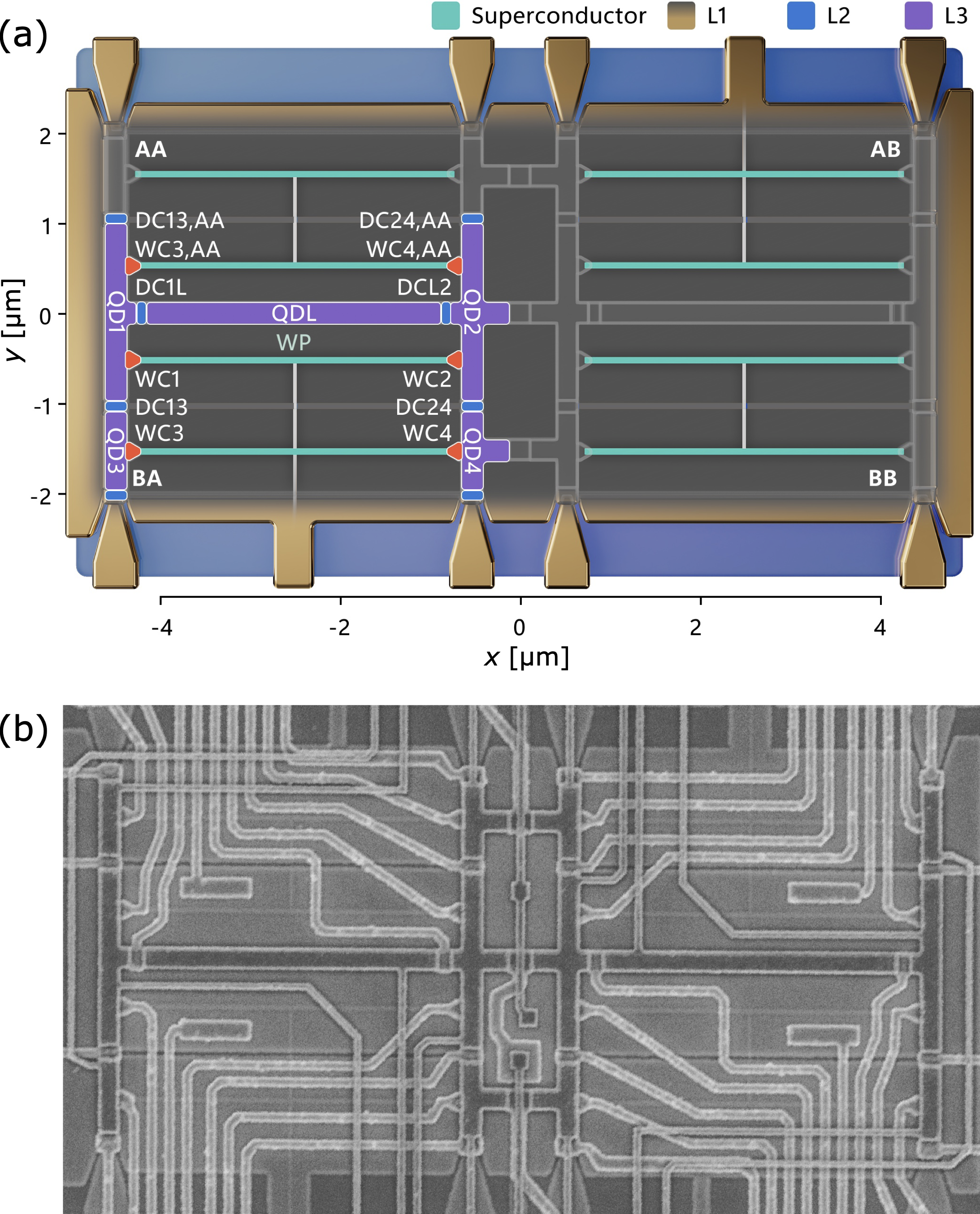
Figure 1: Scalable tetron unit cell with layered gates for density tuning, tunnel barrier definition, reconfigurable interferometric loops, and high-fidelity QD-based parity measurement.
The epitaxial Pb–InAs/GaSb stack provides a hard, large induced gap (∼ 570 μeV in the nanowire geometry) and high spin-orbit coupling (α∼12−16 meV⋅nm), optimized further via composite quantum well design and substrate engineering to minimize disorder. Cross-sectional TEM confirms abrupt interfaces, and mobility values above 3.5×105 cm2/Vs were measured, substantiating the low disorder and long quantum coherent transport.
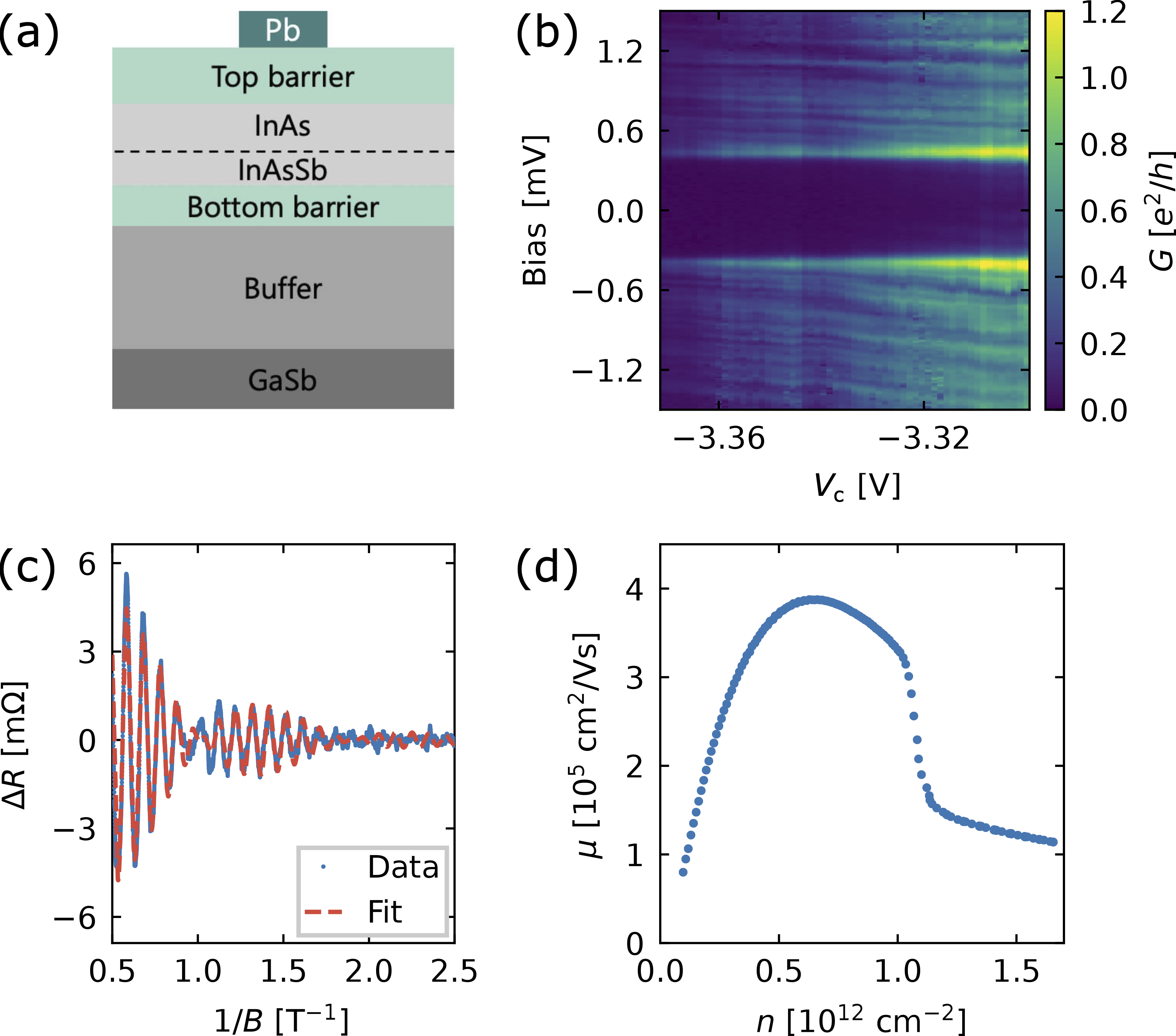
Figure 2: Schematic hybrid stack, induced gap measurement from a QPC device, Shubnikov-de Haas analysis confirming high spin-orbit and quantum lifetime, and mobility vs. carrier density.
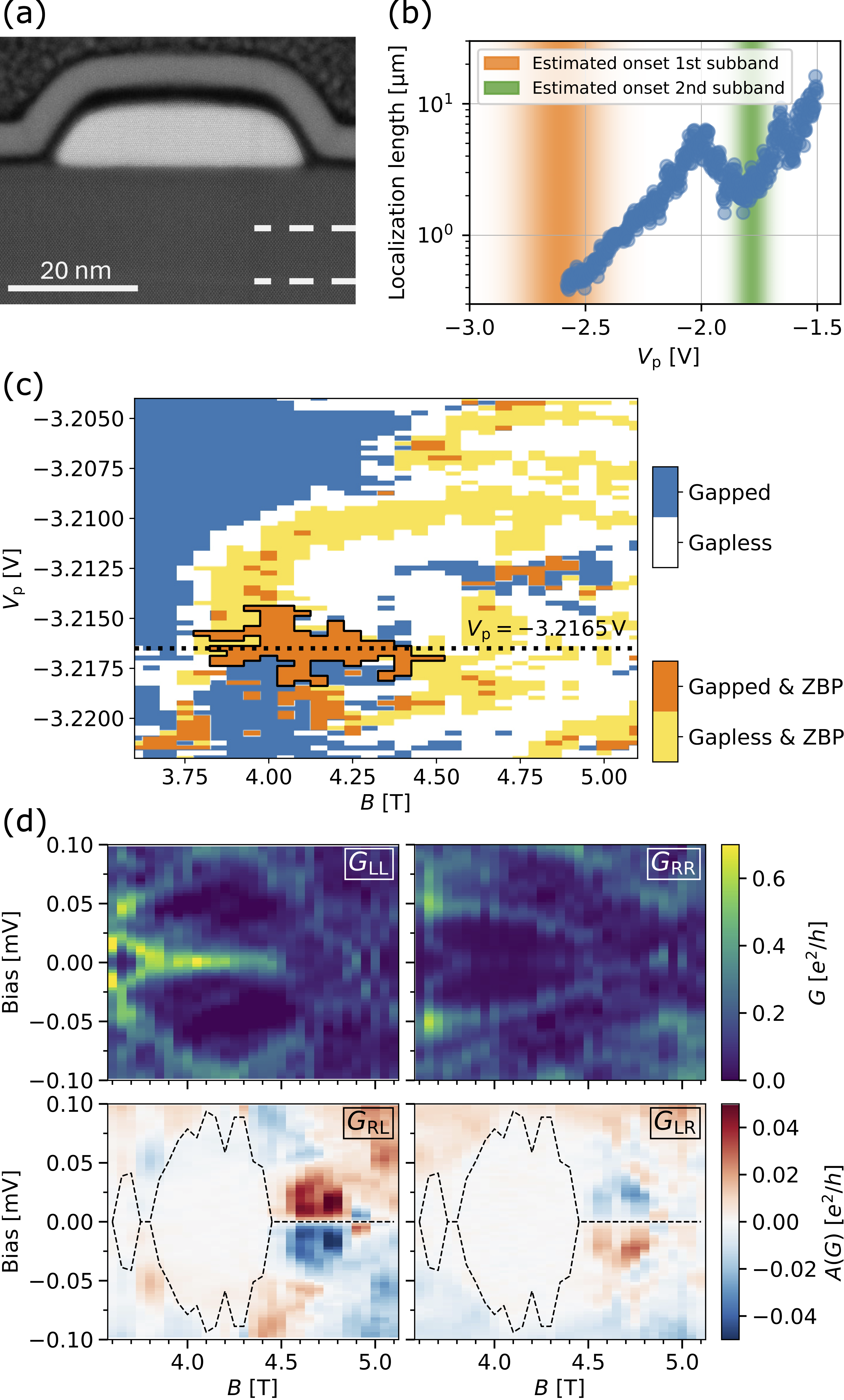
Figure 3: TEM of Pb wire on InAs quantum well and wire localization length exceeding 1 μm, indicating disorder below the topological-coherence-length threshold.
Topological phase stability is mapped via the Topological Gap Protocol (TGP), showing an extended regime in wire-plunger and in-plane field parameter space, more than twice as large as obtained with the previous Al–InAs platform.
Dispersive rf Spectroscopy and Majorana Splitting
Conventional DC transport-based tuning is incompatible with large-scale floating island arrays. The authors develop a fully rf QD-based spectroscopy protocol, enabling local, automatable, high-resolution measurement of low-energy states and Majorana hybridization energies (ϵM) down to ∼1 μeV.
Parity-resolved capacity response is engineered by injecting and measuring parity across both nanowire ends, implementing a two-QD configuration where one acts as an injector and the other as a dispersive sensor. The extracted splitting $1.3$0 is consistently below $1.3$1 μeV in optimized regimes, far superior to temperature-limited resolution in DC scenarios.
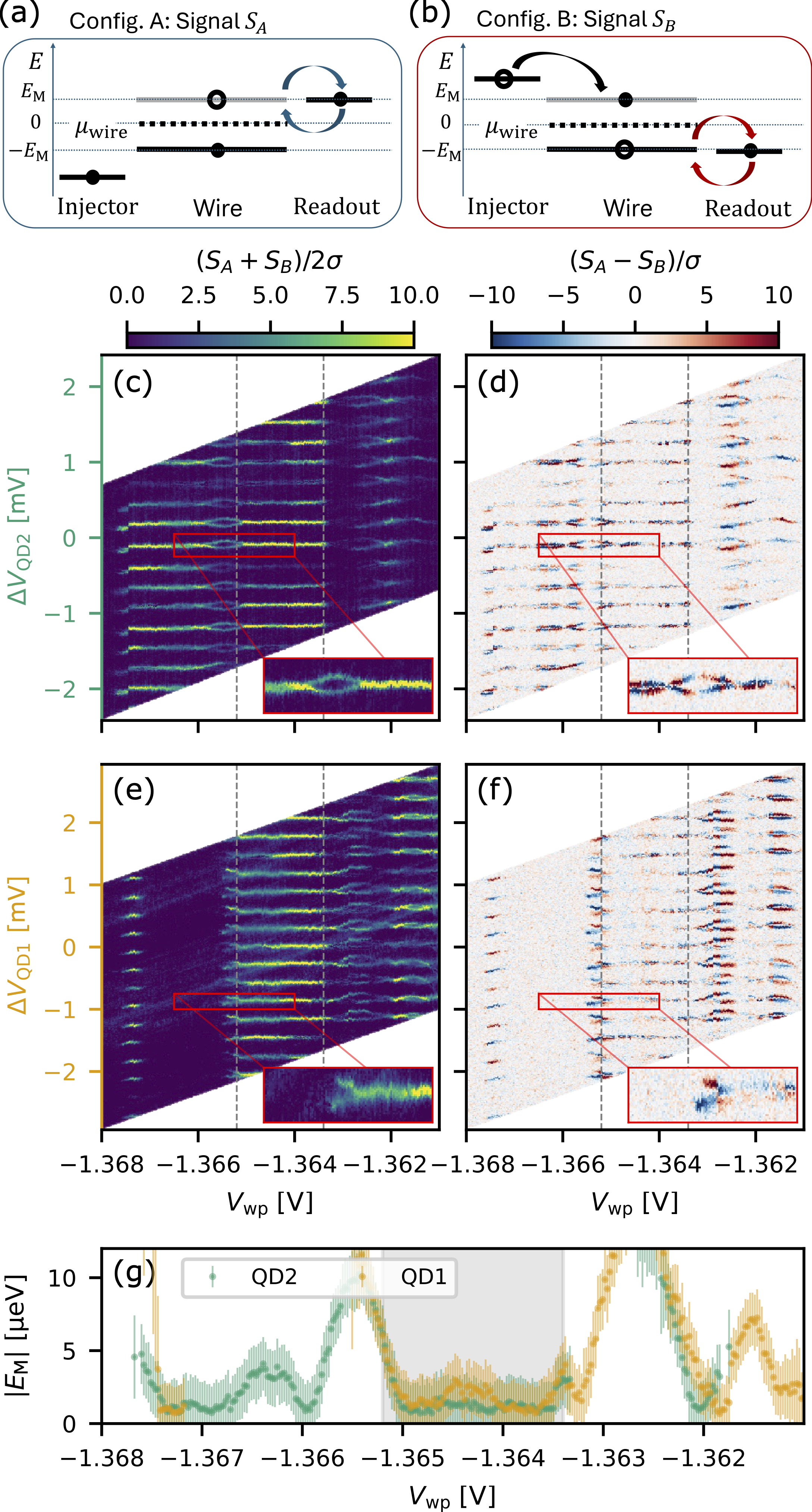
Figure 4: Parity-injection–based rf spectroscopy protocol, response traces from each QD, and extraction of parity-dependent energy shifts to resolve $1.3$2.
Parameter sweeps reveal extended regions in the wire-plunger and magnetic field space where correlated conductance signatures from both ends confirm the existence of stable, non-split Majorana states. This identifies "sweet spots" for robust qubit operation.
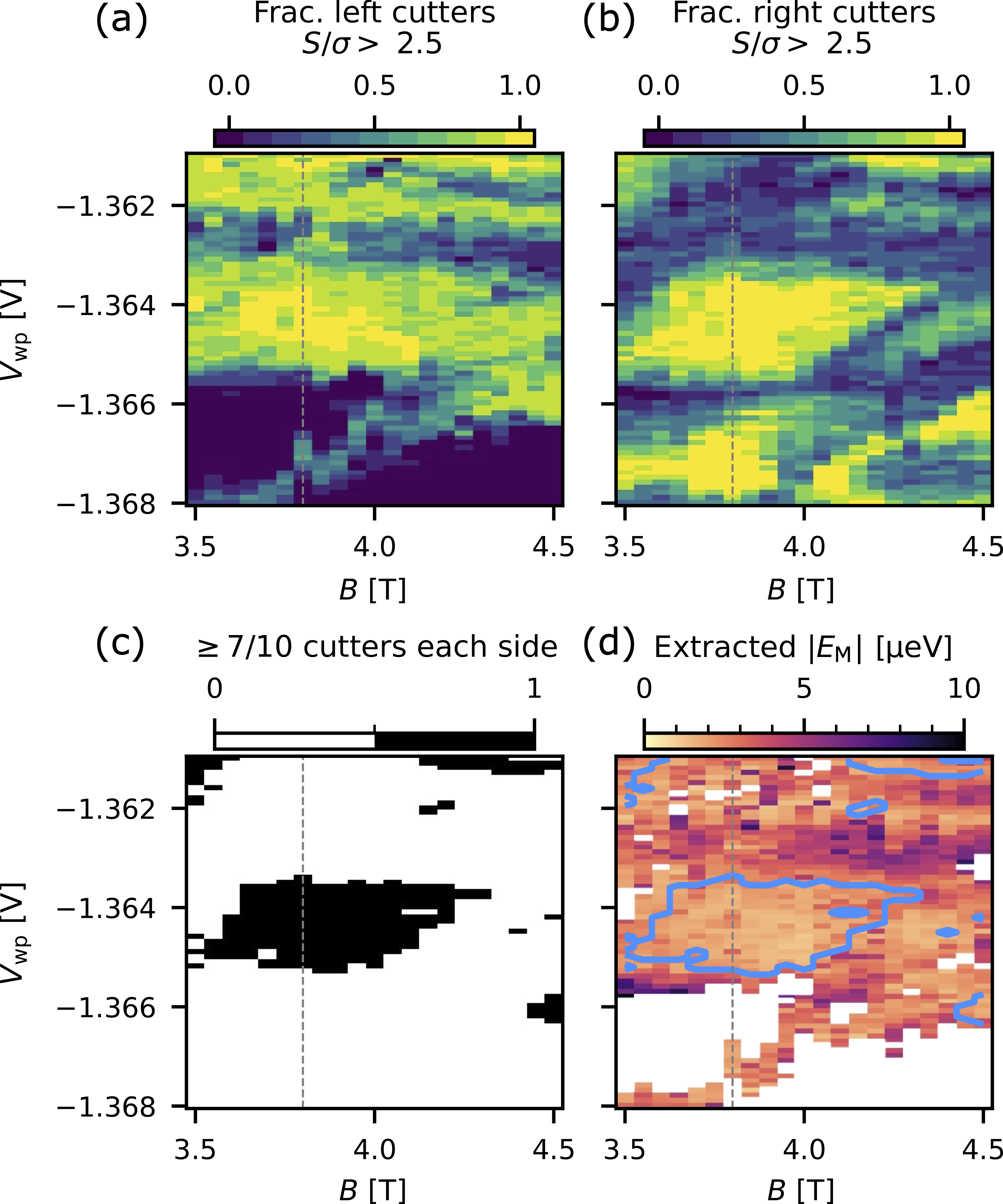
Figure 5: Identification of regions in parameter space with stable, low-energy states on both ends, with quantitative $1.3$3 mapping well below the measurement threshold.
Parity Measurement, Interferometry, and Parity Lifetime
A loop-based interferometric protocol is used to implement projective Pauli-$1.3$4 measurements via quantum capacitance oscillations, induced by magnetic flux through the interferometry loop and parity control by electron injection.
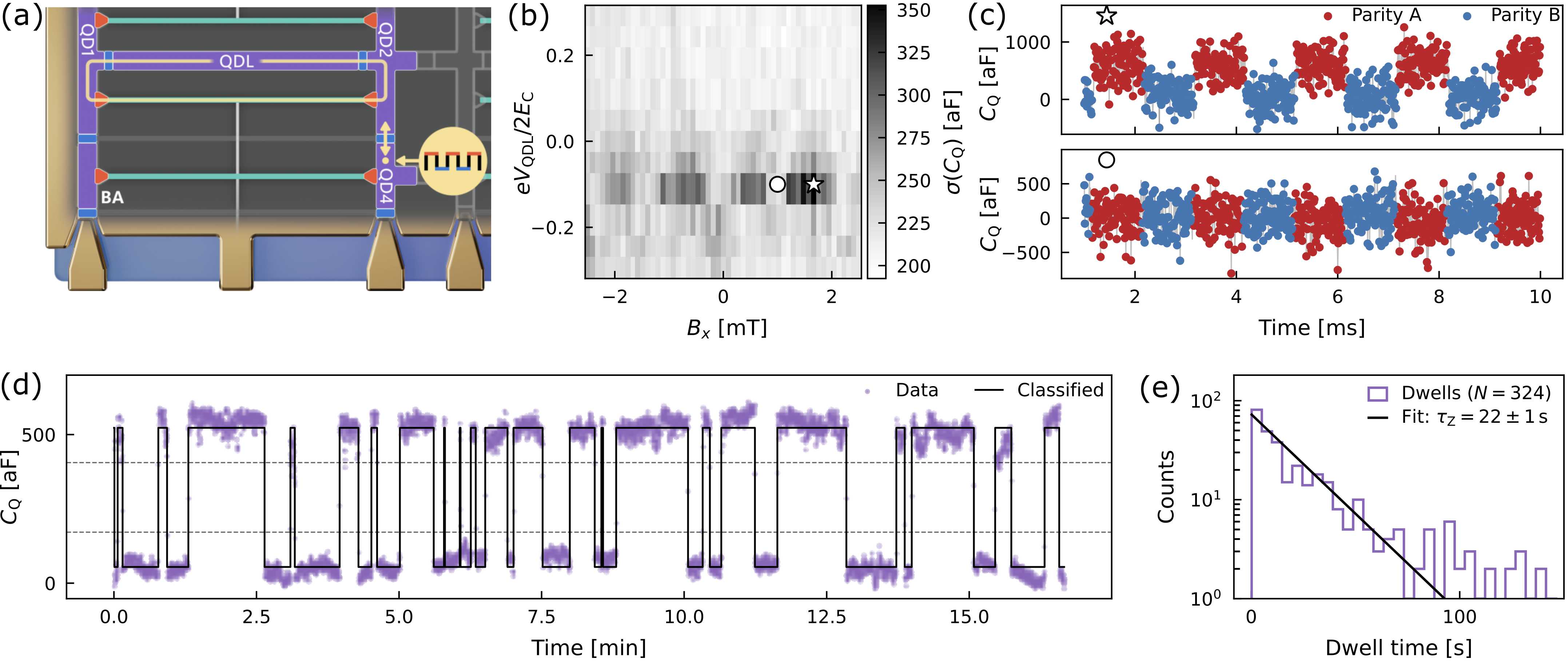
Figure 6: Pauli-$1.3$5 measurement via interferometry, standard deviation maps of the time-trace response under periodic parity injection, and long time traces demonstrating telegraphic parity switching with and without injection pulses. Dwell time histograms reveal exponential lifetimes.
Direct time-resolved measurements yield parity lifetimes $1.3$6 seconds, with dwell times following a single-exponential distribution, indicating homogeneous Poissonian quasiparticle poisoning. This represents over three orders of magnitude enhancement compared to the best Al-based Majorana devices, which exhibit typical parity lifetimes in the 1–12 ms range.
The improvement is attributed predominantly to the larger superconducting gap of Pb, which both suppresses pair-breaking and enhances the electron-phonon recombination rate, leading to negligible parity-flip probability during standard qubit operation windows (in the μs regime).
Implications and Future Directions
The results provide quantitative experimental validation that increasing quasiparticle excitation gap directly improves the operational robustness of topological qubits—manifested here in record parity lifetimes and sub-μeV Majorana splitting. Both key error channels, quasiparticle poisoning and hybridization, are strongly suppressed, enabling multi-qubit system scaling without loss of protection.
The scalable rf-based tuning protocol, compatible with parallel operation in large arrays, marks significant progress toward the practical realization of modular, fault-tolerant Majorana-based quantum processors. The parity lifetimes demonstrated here, exceeding those required for all leading error correction protocols, essentially render one error channel negligible for foreseeable architectures.
Theoretical extrapolation from the Majorana hybridization scaling ($1.3$7) suggests further device performance improvements are possible via length extensions and gap maximization. Pauli-$1.3$8 measurement error rates, which scale as $1.3$9, should also benefit, and their scaling in this regime remains an important topic for follow-up work.
Conclusion
By combining a high-gap lead superconductor, optimal quantum well design, and advanced parity measurement protocols, this work achieves unprecedented parity stability in a multi-tetron array. The parity lifetimes observed fundamentally change the landscape for topological quantum computing by strongly suppressing a dominant error source, opening a clear path to scaling up Majorana-based quantum architectures with robust error suppression for large qubit arrays.

