- The paper demonstrates a high-fidelity charge-parity detection method using a spin-echo-based EchoCPM protocol with mapping fidelity up to 99.37%.
- The study employs an offset-charge-tunable transmon qubit and randomized benchmarking to quantify gate and parity mapping errors with accuracies above 99%.
- Real-time monitoring at 4 µs intervals shows over 93.4% detection fidelity, highlighting the protocol's resilience to low-frequency noise.
High-Fidelity Charge-Parity Detection with Offset-Charge-Tunable Transmon Qubits
Introduction
Charge-parity detection in superconducting circuits provides a critical interface between quantum information processing and precision sensing of low-energy events, promising new paradigms for rare event searches with meV-scale sensitivity. This paper presents an experimental investigation of charge-parity detection leveraging an offset-charge-tunable transmon qubit. The authors introduce robust protocols for mapping charge-parity onto the qubit state, and provide an extensive fidelity assessment using randomized benchmarking (RB), enabling rigorous error analysis for charge-parity detection and continuous monitoring. The results reveal notable improvements over existing protocols, both in the absolute detection fidelity and the ability to decouple parity mapping performance from dispersive readout constraints.
Device Architecture and Control Methodology
The experimental platform utilizes an offset-charge-tunable transmon qubit fabricated in a flip-chip architecture. The top chip hosts the transmon, while the carrier chip integrates a λ/4 readout resonator, control lines, and a dedicated gate line enabling fast offset charge manipulation. The microwave/flux control line allows standard XY gate operations and frequency tuning, while the gate control line capacitively couples to the qubit for precise modulation of the offset charge—an essential feature for charge-parity mapping.
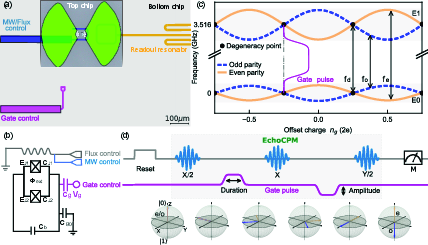
Figure 1: Device architecture, energy dispersion with offset charge for both charge parity sectors, and schematic of the EchoCPM measurement sequence for charge-parity mapping.
Charge-parity mapping is achieved using a spin-echo protocol (EchoCPM) with a net-zero gate pulse on the gate line. Two gate pulses of opposite polarity sandwich a central X rotation, creating a phase accumulation between the even and odd parity manifolds. By calibrating the amplitude and duration of the offset-charge excursions, a π phase difference is achieved, providing robust mapping of charge-parity onto the qubit state. This protocol exhibits resilience to low-frequency noise compared to traditional Ramsey-based schemes.
Spectroscopy, Fast Calibration, and Charge-Parity Mapping
The qubit is operated at a flux-insensitive sweet spot to maximize coherence. Spectral analysis as a function of offset charge reveals the characteristic cosinoidal dispersion of transmon energy levels, with clear crossings indicating parity degeneracy points.
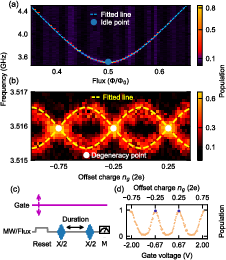
Figure 2: Qubit spectroscopy vs. flux and offset charge, and rapid Ramsey-based degeneracy point identification enabling precise experimental calibration.
A Ramsey-based sequence is used for fast and precise calibration of the degeneracy point, where the qubit transition frequencies for even and odd parity states converge. Maximal readout contrast is achieved at the degeneracy, which is recalibrated every few minutes to maintain high-fidelity operations against slow offset charge drift. The charging energy difference measured at the degeneracy crossing was approximately −1.192 MHz.
Charge-parity mapping fidelity is characterized by decomposing the protocol into Clifford-equivalent gates for RB. The pulse amplitude is set to achieve fast phase accumulation, with the total pulse duration calibrated for a π phase difference. The EchoCPM (spin-echo+net-zero) approach provides substantial immunity to both charge and flux noise relative to conventional Ramsey mapping. Detailed numerical simulations, including decoherence channels, corroborate experimental fidelities.
Randomized Benchmarking and Gate Fidelity Analysis
Single-qubit RB at the offset-charge degeneracy point yields an average Clifford gate fidelity of 99.96%, surpassing the value at the charge sweet point (99.80%) by almost an order of magnitude in error rate.
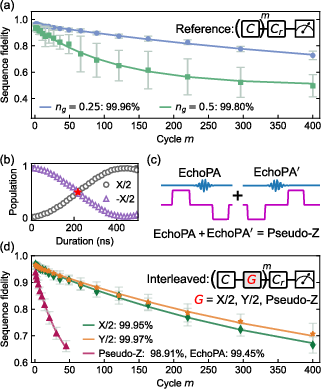
Figure 3: Randomized benchmarking (RB) traces and pulse calibration for high-fidelity Clifford, X/2, Y/2, and pseudo-Z (charge-parity mapping) gates.
To evaluate the effective fidelity of the charge-parity mapping operation, a pseudo-Z gate sequence—constructed via sequential echo-based phase accumulations—was interleaved and benchmarked. The pseudo-Z gate exhibits a fidelity of 98.91%. Decomposing the charge-parity mapping protocol yields a constituent mapping fidelity of 99.37%, limited predominantly by decoherence, as confirmed by master equation simulations.
Real-Time Charge-Parity Detection
Continuous real-time monitoring of the charge-parity state is demonstrated, with sampling intervals of 4 μs over 30-s experimental runs. Time traces exhibit random telegraph signal (RTS) statistics characteristic of quasiparticle-induced parity switches. Power spectral density analysis of the RTS confirms the underlying Poissonian switching process, with the measured switching rates and effective detection fidelities extracted via Lorentzian fits.
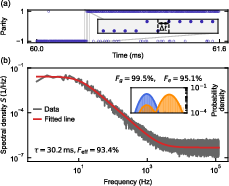
Figure 4: Time trace and power spectral density of continuous charge-parity detection, illustrating effective state distinguishability and Lorentzian noise profile.
The effective detection fidelity at 4 μs sampling intervals surpasses π0, with error analysis identifying qubit readout as the dominant limitation. State-of-the-art readout with π1 fidelity is anticipated to further improve time-resolved parity detection.
Experimental Setup and Fabrication
The experimental setup incorporates filtered control and readout lines, a Josephson parametric amplifier, and advanced readout electronics for low-noise, high-bandwidth measurement. Device fabrication leverages multilayer techniques, indium bump bonding, and process optimizations to minimize quasiparticle background and environmental photon leakage.
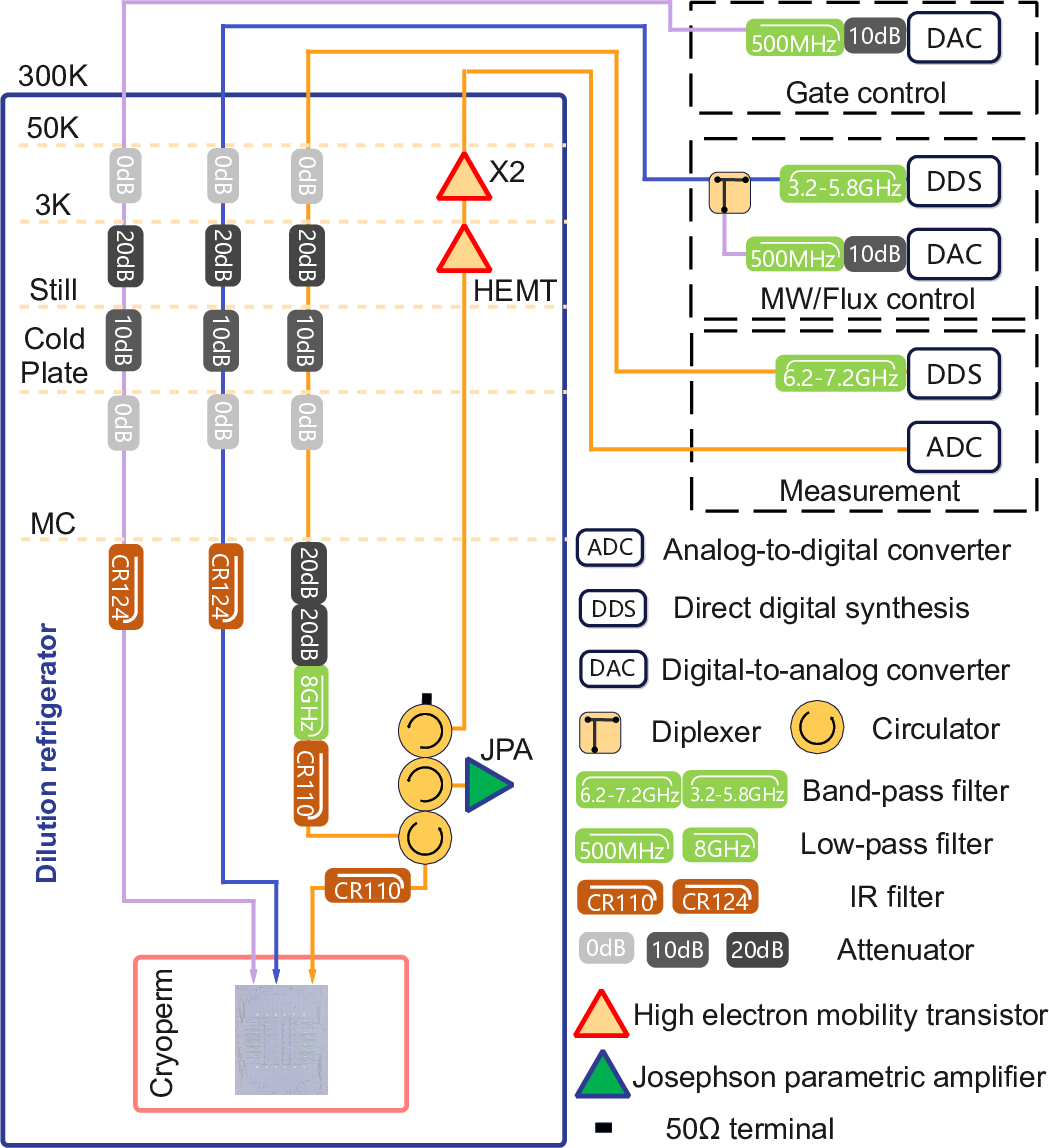
Figure 5: Schematic of the full measurement and control configuration utilized for high-fidelity experiments.
Implications and Outlook
The demonstrated charge-parity detection protocol establishes a robust, high-fidelity foundation for using superconducting qubits as sensors for ultra-low energy physics, including rare-event and dark matter searches. The integration of fast, robust charge-parity mapping with randomized benchmarking offers quantitative performance metrics suitable for scalability studies and the inclusion in multi-qubit quantum parity detector (QPD) arrays.
Improving dispersive readout fidelity is the primary lever for further enhancing detection performance. The methodology is directly extendable to multi-qubit architectures, enabling event localization, noise correlation mapping, and enhanced background discrimination in large-scale sensing deployments. The protocol’s resilience to slow noise and environmental drift supports long-duration monitoring—critical for rare-event detection tasks.
Integration with advanced error mitigation, shielding, and clean surface engineering, as suggested by recent literature, will likely further suppress background quasiparticle tunneling, thus extending qubit coherence and parity detection longevity. Future work can also focus on optimizing the trade-offs between dispersive coupling strength, mapping fidelity, and readout cross-talk in larger detector arrays.
Conclusion
This study provides a comprehensive experimental and theoretical characterization of charge-parity detection using an offset-charge-tunable transmon, leveraging a spin-echo-based EchoCPM protocol and rigorous RB-based fidelity quantification. The achieved detection and mapping fidelities represent a benchmark for parity-based sensing with superconducting circuits, and the error analysis isolates qubit readout as the primary avenue for immediate improvement. The methodology, robustness, and performance metrics position this approach as a practical candidate for scalable rare-event detection at the quantum limit (2604.02809).