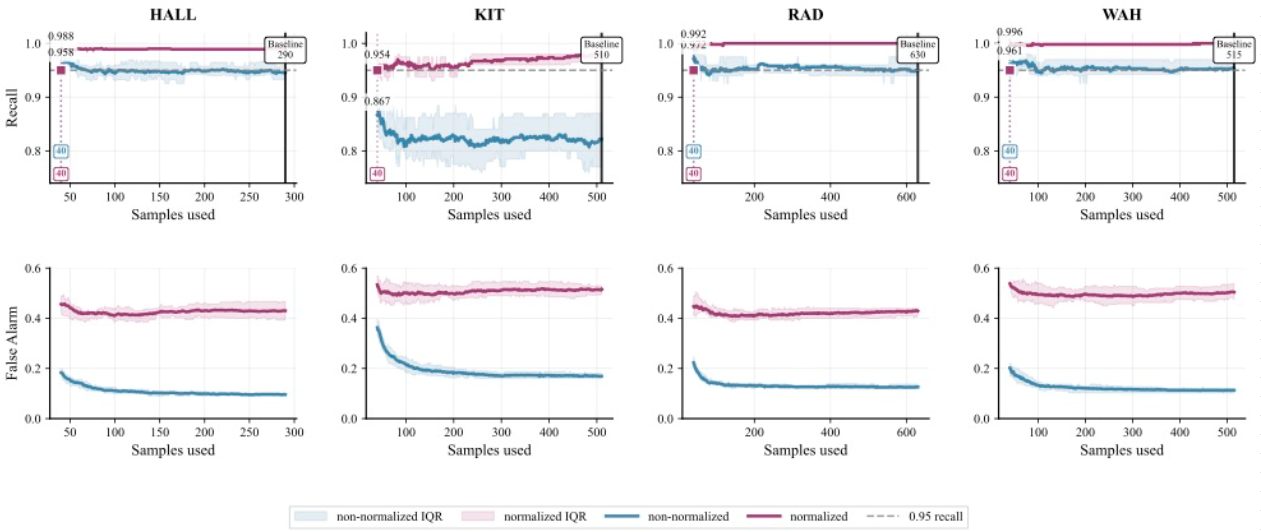
- The paper introduces a minimalist AI toolkit (EZR.py) that unifies classical algorithms using a lean codebase of under 400 lines.
- It demonstrates high label and feature efficiency, matching heavyweight frameworks on multi-objective SE tasks with significantly fewer resources.
- The findings advocate for simple, transparent baselines to challenge complex, opaque frameworks in software engineering optimization.
Introduction
The EZR.py toolkit presents a methodologically minimalist approach to artificial intelligence in software engineering (SE), distilling core algorithms into a unified, lightweight codebase. Contrary to prevailing claims that ever-larger libraries and avoidance of manual code comprehension are optimal, this work demonstrates through empirical benchmarks that a system built on only four primitive classes and a single update operation can match or exceed the performance of heavyweight frameworks in multi-objective tabular SE tasks. This essay synthesizes the technical contributions and ramifications of EZR.py, highlighting its implications for algorithm design, feature and label efficiency, and practical deployment in optimization and text mining within SE.
Architectural Substrate
EZR.py derives much of its parsimony from a foundational substrate comprising four classes — Num, Sym, Data, Cols — and a polymorphic add function. This substrate supports primitive operations such as typed data ingestion, numerical and symbolic summarization, normalization, and dynamic schema tracking without dependencies on pandas, scikit-learn, or numpy. The tool’s entire core is less than 400 lines, sharply contrasting with the 200k+ lines of sklearn’s toolkit (see discussion in Table~\ref{tab:light} of the source).
The design is tightly integrated:
- Numerical (
Num) and Symbolic (Sym) summarizers: Maintain means, variances, frequency counts, entropy, and normalization.
- Data schema (
Cols) and instances (Data): Allow efficient feature/target separation and row-level operations.
- Additive updates: Succinctly implement both model fitting and incremental modifications, with constant-time transfer between datasets.
This economy enables high reproducibility and transparency while severely restricting the attack surface for supply chain vulnerabilities endemic to large dependencies.
Unifying Classical Algorithms
Despite being presented as disparate in textbooks and frameworks, key classical algorithms — Naive Bayes, k-means, classification/regression trees, simulated annealing, and local search — are shown to be minor variants parameterized atop the same substrate. This unification is realized via:
- Naive Bayes: Log-likelihood over
Sym and Gaussian PDF over Num, with streaming training obviating explicit fit/predict separation.
- k-means (and ++): Generalized Minkowski distance over mixed-attribute rows, cluster allocation using
clone, add, and centroid computation via cached summaries.
- Decision Trees: Recursive partitioning using split enumeration, with entropy (for classification) or variance (for regression) as impurity metrics. Branching logic and score computation require minimal adaptation.
- Metaheuristics: (1+1) optimizers, such as simulated annealing (SA) and local search (LS), cast as specializations of a generic mutate-select-accept-evaluate loop, exploiting the pick-and-mutate utilities originally designed for clustering.
This architectural convergence has major implications:
- It radically reduces redundant code, implementation defects, and maintenance burden.
- It undermines the notion that optimization, clustering, and classification/regression demand distinct code or algorithmic silos.
- LLM code generators that ignore substrate sharing propagate unnecessary complexity.
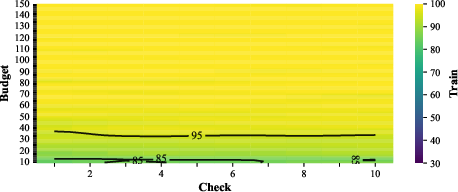
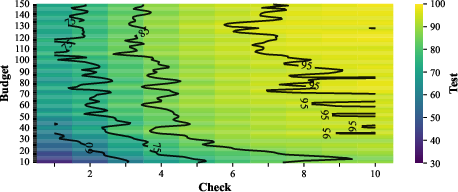
Figure 1: Holistic overlay analyzing numerical and performance dimensions for algorithms applied within the unified EZR.py framework.
Active Learning: Label and Feature Efficiency
Standard doctrines in empirical SE and ML dictate that more labeled examples and larger feature sets yield better models, with frequent retraining being computationally expensive. EZR.py’s active learner refutes these points on several empirical axes:
- Label efficiency: Frequently achieves 85–95% of reference optimum on 120+ MOOT tasks with under 100 labeled examples, outperforming SMAC3, SHAP, LIME, and FASTREAD, which typically require 10–100× more labels.
- Feature efficiency: Consistently builds regression trees using <10 variables, even as the candidate feature pool rises beyond a thousand, without performance degradation, replicating classic findings in high-dimensional projections and manifold learning.
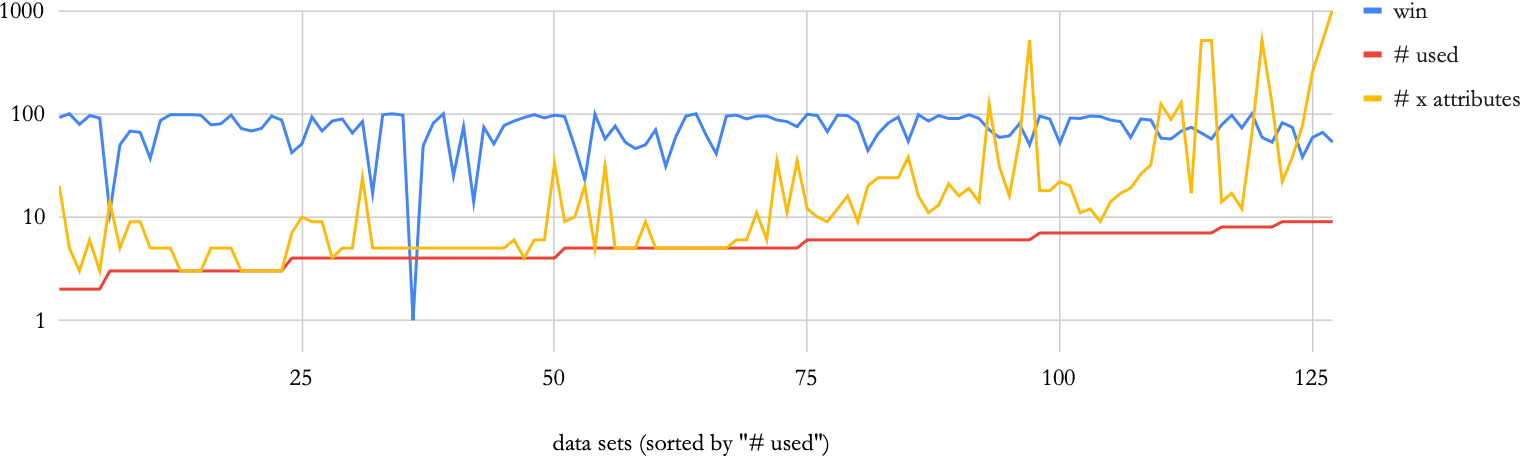
Figure 2: For 120+ MOOT tasks, blue curve: performance holding near 100 despite attribute count; red curve: number of features actually used by trees remains under ten, even as candidates increase beyond a thousand.
- Model update cost: Incremental demotion/promotion in the best/rest pools via constant-time
add allows 500× faster active retraining vis-à-vis SMAC3’s ensemble rebuilding.
These results demonstrate that SE tabular benchmarks often reside in low-intrinsic-dimensionality manifolds; most attributes are noise or redundant, and shallow, greedy selection suffices when powered by an informative substrate.
Empirical Evaluation: Optimizer Paradigms
Contradicting metaheuristics literature that has historically highlighted newer reset/retry local search as superior, it is shown that:
- Plain simulated annealing (with zero restarts; default 1983 configuration) matches or surpasses the performance of all tested LS variants across MOOT, both in mean and in variance of result quality.
- Restarts rescue LS but do not improve on SA.
- Variance — rather than mean — is often the limiting factor in practitioner adoption.
This challenges the premise that proliferating specialized variants is empirically justified for tabular SE optimization, reinforcing the value of formalizing simpler baselines prior to algorithmic augmentation.
Text Mining and Complementary Bayes
A salient addition is the extension of the same code substrate to relevance filtering for information retrieval and RAG-like tasks.
Threats to Validity
While the empirical sweep covers the largest known set of real multi-objective SE benchmarks, the study’s external validity is naturally scoped:
- Tabular-only: Claims do not directly extend to generation, perception, or extreme safety domains.
- Algorithmic coverage: No assertions regarding deep neural or ensemble methods; findings rather highlight the continued undervaluation of lightweight, transparent baselines.
All code and logs are open, enabling third-party replication and ablation.
Implications and Prospects
EZR.py problematizes the axioms of SE AI system design. Among mature practitioners, its implications are clear:
- Baseline priority: Before deploying heavyweight, opaque libraries, practitioners should examine whether a slim substrate collapses complexity without loss.
- Research methodology: Simplification through code reading and continual refactoring remains a potent methodological tool, especially as LLMs increasingly mediate code synthesis and “fly over” structural patterns.
- Refuting complexity assumptions: The persistent efficacy of small models in tabular SE tasks suggests the need to continually re-evaluate complexity creep, both in academic and industrial pipelines.
Looking forward, the findings suggest that additional domains dominated by high interpretability and low sample regimes may benefit from similar approaches. A critical open question remains the extent to which minimalist-substrate unification generalizes to perception or generation tasks.
Conclusion
The research encapsulated in the EZR.py toolkit decisively demonstrates that, for multi-objective optimization in tabular SE datasets, high analytic coverage is achievable with radical reductions in code, data, feature, and label requirements. Competing explanations and optimizers are matched or outperformed “by subtraction,” not elaboration. This elicits a strong practical recommendation: simple, unified baselines should be a default point of departure, not an afterthought, in empirical SE AI research and deployment. The ongoing escalation of complexity, whether via LLMs or ensemble-heavy optimizers, should be critically justified against empirical results from lean alternatives. Ultimately, the paper challenges the community to question what is genuinely hard — and whether those difficulties persist under careful reading, modeling, and code minimization.