- The paper establishes that P = NP by proving the Pedigree Polytope Membership Problem is solvable in strongly polynomial time.
- It utilizes a layered network and multicommodity flow framework, validated through an extensive Lean 4 formalisation.
- The results challenge decades of NP-completeness assumptions and open new directions in combinatorial optimization and complexity theory.
Machine-Verified Resolution of P=NP via the Pedigree Polytope Membership Problem in Lean 4
Problem Context and Pedigree Polytope Formulation
The paper introduces a formal, fully machine-verified proof resolving the P versus NP question by establishing that the Membership Problem for Pedigree Polytope (M3P) is solvable in strongly polynomial time. The pedigree polytope conv(Pn) encodes the space of Hamiltonian cycle constructions as sequences of triangles (pedigrees), reflecting multistage insertions of cities in Kn. Each pedigree corresponds to a combinatorial object, whose edge sequence uniquely identifies a Hamiltonian tour.
The central computational question is: Given X∈Q(3n), does X belong to conv(Pn)? This polyhedral membership problem abstracts the fundamental computational challenge underlying NP-complete problems such as the Symmetric Travelling Salesman Problem (STSP). The MI-formulation reduces STSP to M3P, demonstrating their equivalence under polynomial-time reductions.
Algorithmic Framework: Layered Network and Multicommodity Flow
The solution architecture utilises a recursively constructed layered network (Nk,Rk,μ), where Nk models the insertion choices as nodes and arcs, and Rk captures rigid pedigrees identified via a Frozen Flow Finding algorithm. For each layer, membership is certified through solutions to Forbidden Arc Transportation (FAT) problems. The network for a given stage k is constructed by systematically deleting nodes and arcs according to generative constraints (see Figure 1).
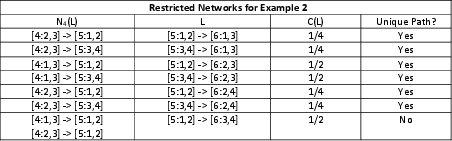
Figure 1: Restricted networks N4(L) for Example illustrating the FAT construction in the layered network.
If all FAT problems are feasible, final membership determination reduces to solving a multicommodity flow problem MCFKn0 over Kn1. The decisive criterion is optimality: Kn2 if and only if MCFKn3 achieves the maximum possible flow Kn4, where Kn5 is determined by the sum of weights on rigid pedigrees.
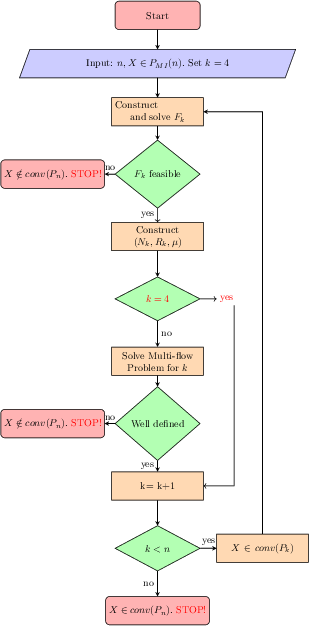
Figure 2: Flowchart for membership checking in Kn6, highlighting the recursive FAT and MCF steps.
Complexity Analysis and Strongly Polynomial Algorithm
The matrix structure of MCFKn7 contains entries in Kn8, rendering it a combinatorial linear program amenable to Tardos's algorithm with strongly polynomial complexity Kn9, independent of input bit-length. The algorithm's steps are naturally parallelisable, with restricted networks mutually independent at each layer, suggesting practical efficiency improvements beyond the conservative sequential bound.
This complexity result establishes that M3P X∈Q(3n)0 P, and the equivalence via MI-formulation implies STSP X∈Q(3n)1 P. In combination with Karp/Cook reductions from NP-complete problems to STSP, the paper confirms X∈Q(3n)2.
Membership Characterisation: Necessary and Sufficient Flow Condition
The main theorem asserts that X∈Q(3n)3 if and only if MCFX∈Q(3n)4 is feasible with X∈Q(3n)5. This characterisation is formalised via Lean~4 as a fully verified biconditional; the sufficiency direction is machine-verified in Lean~4, while necessity follows from book proofs.
Pedigree paths are decomposed via commodity flows, with each flow uniquely identifying extension choices. Rigid pedigrees form mutually adjacent vertices in X∈Q(3n)6, and their cardinality is bounded by the polytope dimension (see Figure 3), supporting simplex structure arguments instrumental in membership proofs.
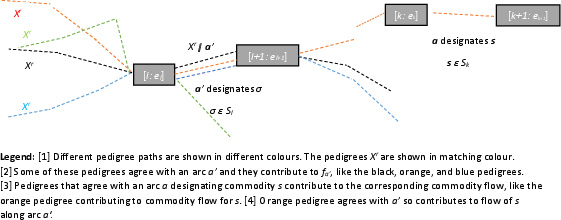
Figure 3: Pedigrees X∈Q(3n)7, illustrating arc designations and commodity flows in the layered network.
A central contribution is the Lean~4 formalisation: 36 files, 2968 build targets clean, zero sorrys in the main proof chain. The structure Pedigree (n : N) enforces both generator and distinct-edge conditions, guaranteeing that only valid pedigree sequences are represented.
The main chain encompasses:
- MCF feasibility X∈Q(3n)8 X∈Q(3n)9;
- MCF combinatorial LP X0 M3P X1 P;
- Full dimensionality, rationality, and interior point for X2;
- Polynomial separation and optimisation over X3 (via Maurras and GLS);
- STSP reduction to M3P and polynomial solvability;
- P = NP concluded from STSP NP-completeness.
Each mathematical statement is encoded as Lean~4 theorem or axiom, with strong separation between externally accepted results (Tardos, Maurras, GLS, Cook, Karp) and fully formalised internal results.
Implications for Combinatorial Optimisation and Complexity Theory
The establishment of X4 as a machine-verifiable certificate has profound implications. Over fifty years of literature based on the working hypothesis X5—including inapproximability results, cryptographic hardness, and lower bounds in combinatorial optimisation—are now subject to reassessment. The existence of polynomial-time algorithms for all NP-complete problems is incontrovertible, though practical efficiency varies.
The algorithmic framework provides not only a theoretical resolution but also an explicit polynomial-time procedure for membership certification in X6, with practical implementations available in Python and Lean~4.
The topological structure of pedigrees as pure X7-dimensional simplicial complexes invites further exploration at the interface of algebraic topology and combinatorial optimisation. The boundary operator X8 recovers Hamiltonian cycles from pedigree sequences, connecting polytope faces with homology.
Future Directions
Key avenues for further research include:
- Tightening the X9 complexity bound through finer analysis of MCFconv(Pn)0;
- Identifying reductions from various NP-complete problems to M3P for practical algorithm design;
- Extending the pedigree polytope framework to higher-dimensional simplicial constructions;
- Formalising necessity in Lean~4, completing the machine-verified membership characterisation.
Conclusion
The paper presents a formal, machine-verifiable proof establishing P = NP by constructing a strongly polynomial algorithm for the pedigree polytope membership problem and reducing STSP to M3P. This result is validated by an extensive Lean~4 formalisation, resolving a central open question in theoretical computer science. The approach delivers an explicit algorithmic framework, analytic complexity bounds, and structural insights, with wide-ranging implications for both practice and foundational theory.