- The paper introduces Loss-Guided Neural Densification (LG-ND) to determine the minimal neural width required for accurate ACOPF approximation.
- It achieves a 10× reduction in hidden neurons while ensuring an optimality gap below 0.052% and significantly improved feasibility.
- The compact architecture enhances formal verification and reduces computational complexity for real-time grid operations.
Rethinking Neural Width for ACOPF Proxies: Compact Architectures via Loss-Guided Neural Densification
Problem Motivation and Context
Alternating Current Optimal Power Flow (ACOPF) is a cornerstone optimization task in power system operation, enabling economic dispatch and real-time stability while enforcing complex equality and inequality constraints dictated by grid physics. The deployment of deep learning proxies for ACOPF has facilitated rapid inference, essential for real-time contingency analysis and operational feasibility. However, the trend towards architectural over-parameterization (i.e., unnecessarily wide and deep networks) creates substantial barriers to formal verification in safety-critical grid applications, while increasing inference costs and reducing interpretability. This paper interrogates the canonical assumption that wider networks are inherently beneficial for ACOPF, instead proposing a constructive methodology to empirically determine the minimal neural width necessary for high-fidelity physical approximation.
Loss-Guided Neural Densification (LG-ND): Methodology
The core contribution is the Loss-Guided Neural Densification (LG-ND) algorithm, a dynamic constructive process that expands network width only as demanded by validation loss improvement, thereby mapping network capacity to the intrinsic complexity of the ACOPF manifold and constraints. The approach operates as follows: Initialization begins with an intentionally small multi-layer perceptron (MLP), which is iteratively trained to predict all ACOPF decision variables—including bus voltage magnitudes, angles, and generator setpoints—given load vectors. After convergence at each iteration, validation loss is assessed; if improving, hidden layers are densified by a fixed increment until further expansion yields negligible gains. This process halts at either loss saturation or a predefined maximal neuron cap, ensuring the final architecture is strictly no wider than necessary for constraint satisfaction and manifold approximation.
Architectural Minimalism and Comparison to Baselines
Empirical analysis across IEEE standard systems demonstrates the efficacy of LG-ND in producing lean architectures that maintain, or even surpass, the accuracy and feasibility of conventional ACOPF proxies, which generally employ fixed-width hidden layers with hundreds to over a thousand neurons. In the IEEE 118-bus system, the LG-ND model achieves performance parity with baselines using only 50 neurons per hidden layer—an order-of-magnitude reduction (10×) compared to the typical 472–1024 neurons. Numerical results show a relative optimality gap below 0.052%, with equality residuals (mean) reduced nearly fivefold compared to wider baselines. Furthermore, computational complexity decreases by approximately 15×, as measured by trainable parameters and surrogate FLOPs.
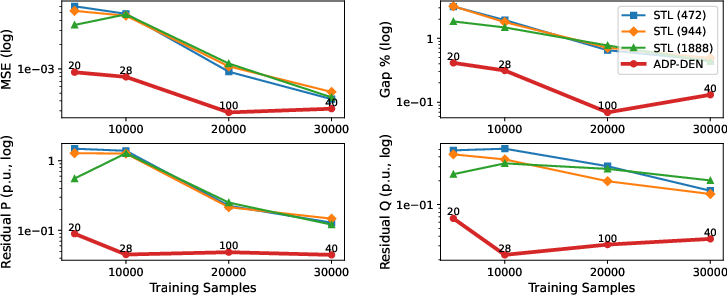
Figure 1: Comparison of LG-ND and standard MSE models on IEEE 118-bus, demonstrating superior performance of LG-ND at drastically reduced network sizes.
Constraint Clipping and Feasibility Analysis
The authors further introduce coordinate-wise output clipping during inference to enforce operational inequalities (e.g., generator and voltage bounds), examining the tradeoff between feasibility and cost sub-optimality. Clipped LG-ND architectures exhibit zero inequality violations with minimal increases in the optimality gap (from 0.0517% to 0.0691%), and the mean equality residual improves, highlighting an advantageous feasibility–optimality tradeoff. In contrast, wider baselines rely heavily on post hoc clipping to correct infeasibilities, often suffering elevated cost gaps and residuals. Figure 2 illustrates the convergence characteristics of LG-ND on the IEEE 57-bus system, confirming robustness and rapid decay in constraint residuals with increasing training volumes.
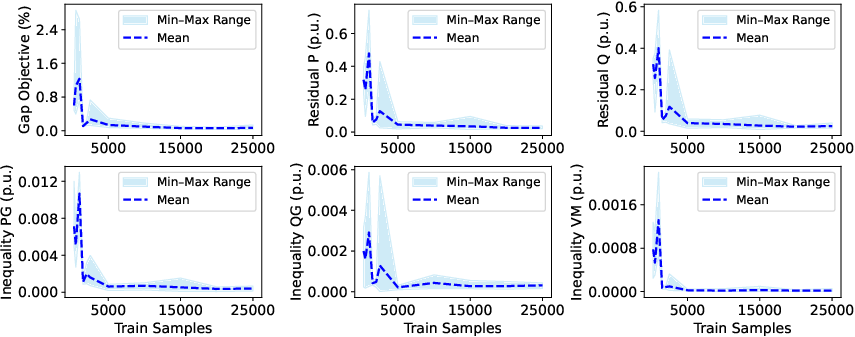
Figure 2: Robustness and feasibility analysis for LG-ND on IEEE 57-bus, highlighting convergence and high-fidelity physical approximation as network width grows adaptively.
The architectural minimalism achieved via LG-ND directly addresses the scalability bottleneck in formal verification frameworks, such as α-CROWN and β-CROWN, which use branch-and-bound schemes whose computational cost escalates rapidly with network width. Smaller, lean proxies render safety certificates tractable, supporting deployment in real-time grid operations where rigorous verification is mandatory. The empirical results underpin the claim that the physical complexity of ACOPF manifolds does not mandate massive over-parametrization; rather, adaptive, loss-guided expansion suffices to capture all relevant nonlinearities while ensuring verifiable feasibility.
Theoretical and Practical Impact, Future Directions
The constructive approach reshapes proxy modeling for power systems, establishing a principled capacity-guided technique that mitigates overfitting, improves interpretability, and reduces verification burden. The demonstrated feasibility–optimality tradeoff enhances operational reliability, suggesting that constraint-consistent proxies are practical for automated grid operations, including contingency screening and neural control loops. The framework serves as a foundation for future research on topological robustness—probing lean architectures under grid perturbations—and integration into certified neural system architectures. Furthermore, LG-ND can be extended to other safety-critical domains requiring compact, verifiable neural approximations of constrained optimization tasks.
Conclusion
This work provides strong evidence that prudent, empirically guided architectural minimalism via Loss-Guided Neural Densification is sufficient for accurate ACOPF proxies, yielding tenfold reductions in neural width with superior feasibility and optimality. These lean networks lower inference complexity, facilitate formal verification, and foster trustworthy machine-learning integration into power system operations. This paradigm is likely to influence neural proxy design in broader safety-critical optimization contexts.