- The paper introduces FPL-OPF, a novel unsupervised method embedding fixed-point FDPF iterations with a fast physics-aware refinement to efficiently solve the AC-OPF problem.
- It achieves optimality gaps below 3% and near-zero constraint violations across multiple benchmarks, offering substantial speed-ups over traditional solvers.
- The framework provides theoretical guarantees and empirical ablation results that balance computational efficiency with strict physical feasibility in real-world grid operations.
Unsupervised Learning for AC Optimal Power Flow with Fast Physics-Aware Layer
Introduction and Background
The Alternating Current Optimal Power Flow (AC-OPF) presents a highly non-convex, NP-hard constrained optimization challenge fundamental to secure and economic power system dispatch. Traditional deterministic solvers struggle to match the stringent latency requirements of real-time grid operations, motivating the application of neural approximators for accelerated inference. However, naively applying neural networks (NNs) often produces physically infeasible solutions—a critical deficiency for safety and stability in power systems. Thus, recent methods increasingly embed power flow (PF) solvers as differentiable implicit layers to enforce strict constraint satisfaction. While these approaches deliver physical fidelity, their reliance on implicit differentiation leads to expensive Jacobian computations and custom backward implementations, which hinder scalability and integration with modern automatic differentiation (AD) frameworks.
Contributions of FPL-OPF
This work introduces FPL-OPF, an unsupervised learning framework leveraging a Fast Physics-Aware Layer for AC-OPF. The core architectural innovation is the embedding of a fixed-point FDPF (Fast Decoupled Power Flow) iterative solver, where only the last few, or even the terminal, iterations are included in the AD computation graph. The guide iterations are performed outside gradient tracking to rapidly drive the solution towards feasibility, while the final differentiable refinement achieves high-fidelity gradients at orders of magnitude lower cost compared to prior implicit layers. Critically, the authors provide theoretical guarantees that the resulting gradients closely align with the true implicit gradients under mild contraction and Lipschitz conditions, ensuring that the approximate descent direction remains reliable for training convergence.
Fast Differentiable Physics-Aware Layer Design
The system variables are partitioned into prediction, completion, and post-completion subsets. The NN predicts independent controls (e.g., generator active power and bus voltages), while the dependent variables are solved via a fixed-point FDPF block:
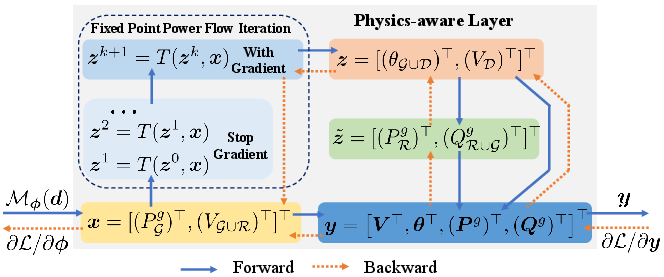
Figure 2: The Fast Differentiable Physics-Aware Layer embeds a fixed-point PF solver with a non-differentiable guide phase followed by a differentiable refinement for gradient computation.
The iterative structure exploits the linear structure and decoupling properties of the FDPF Jacobian, ensuring each iteration remains O(n2), as opposed to the O(n3) complexity of full Newton-Raphson steps. The backward pass only differentiates through the refinement phase, avoiding large-scale linear system solutions and direct Jacobian inversion.
The theoretical analysis shows that the one-step (or few-step) gradient obtained from the final refinement approximates the exact implicit gradient with bounded error. Empirical investigation confirms the contraction and Lipschitz constants required for the bound, and ablations determine the optimal refinement depth to ensure alignment between the approximate and true gradients, even on complex grids.
Empirical Evaluation
The framework is validated across four benchmarks: IEEE 57-bus, PEGASE 89-bus, IEEE 118-bus, and NESTA 189-bus. Comparisons include traditional solvers (MIPS), penalty-based unsupervised learning (OPF-DNN), and physics-informed baselines utilizing implicit differentiation (DC3, DeepLDE).
Optimality and Feasibility
FPL-OPF achieves optimality gaps consistently below 3% on all systems, with feasible constraint violations near zero. On challenging benchmarks such as the NESTA 189-bus, the K-Decoupling variant of FPL-OPF exhibits both tighter constraint satisfaction and lower optimality gaps than DeepLDE and DC3:
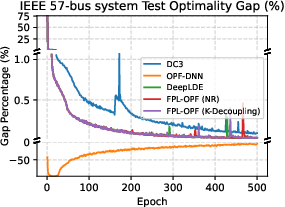
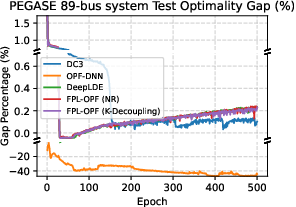
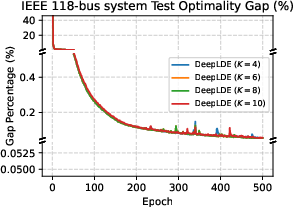
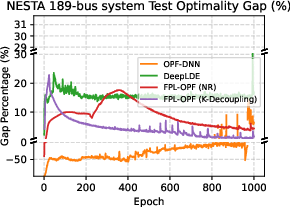
Figure 1: Optimality comparison at IEEE 57-bus system.
Computational Efficiency
The computational analysis, corroborated by empirical timing results, demonstrates that the K-Decoupling FPL-OPF variant achieves order-of-magnitude faster training and inference versus traditional implicit-layer-based baselines.
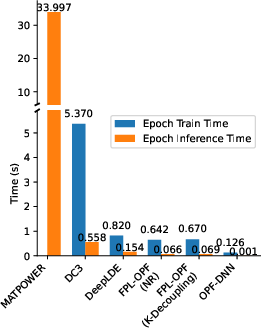
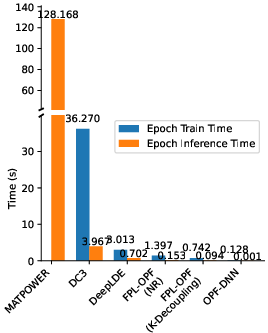
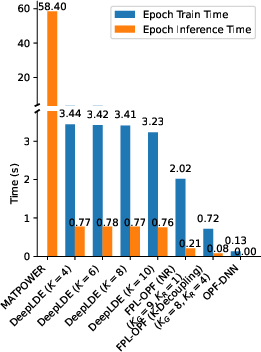
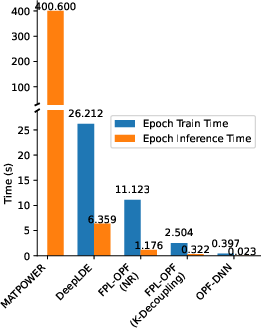
Figure 3: Time comparison at IEEE 57-bus system.
For instance, FPL-OPF delivers >700× speedup in inference on IEEE 118-bus and >1200× on NESTA 189-bus over MIPS, while maintaining strict physical feasibility.
Training Convergence and Ablation Results
The ablation study on refinement iterations (KR) reveals rapid geometric contraction of the composite operator—empirically, KR≥4 suffices on PEGASE 89-bus, with cosine similarity between the true and approximate gradients saturating above 0.98. Increasing KR consistently reduces inequality mismatches and violation counts while achieving sharp loss decreases and stable optimality convergence.
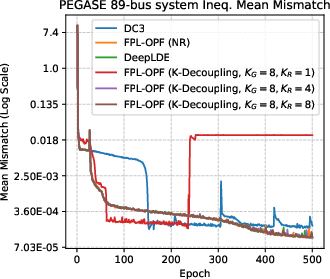
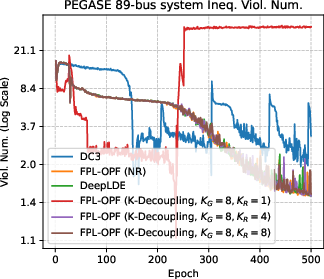
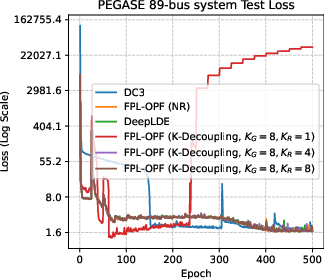
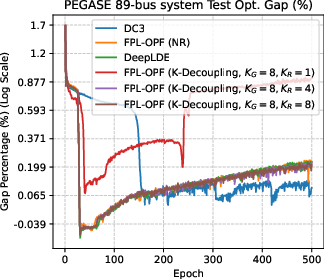
Figure 4: Inequality Mean Mismatch during training.
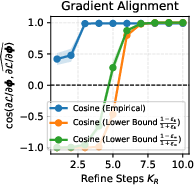
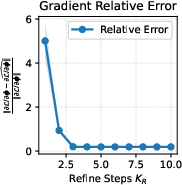
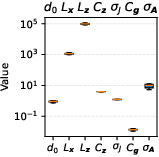
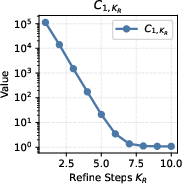
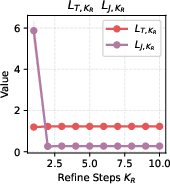
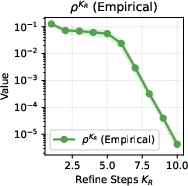
Figure 5: Gradient cosine similarity and theorem lower bounds.
Implications and Future Directions
Practical Implications:
The FPL-OPF architecture, by exploiting domain structure in PF computation and minimal backward differentiation, achieves both mathematical rigor in constraint handling and computational scalability suitable for online OPF deployment. Its strict O(n2) complexity supports extension to extremely large grids, as validated by additional results on PGLib 500-bus systems where conventional implicit layers encounter catastrophic memory bottlenecks.
Theoretical Implications:
The work advances understanding of differentiability in physics-aware learning, specifically for fixed-point iterative layers, by providing analytic bounds on gradient misalignment and convergence rates. This provides a reproducible methodology for analyzing other physical optimization layers where classical implicit differentiation is intractable.
Research Directions:
Future research should further formalize criteria for selecting refinement depth (KR) based on system-level constants, generalize the approach to dynamic (time-varying or topology-changing) OPF, and develop distributed or federated learning architectures to accommodate multi-area power systems.
Conclusion
FPL-OPF offers a principled, efficient, and empirically validated solution for unsupervised learning in AC-OPF, unifying strict physical feasibility with scalable computation. The framework demonstrates that low-complexity, physics-informed implicit layers suffice to achieve both optimality and operational constraint satisfaction in high-dimensional, real-world grid environments. The theoretical insights and architectural innovations are generalizable to a broad class of physics-constrained learning problems, promoting practical adoption in energy system applications.
Reference:
"Unsupervised Learning for AC Optimal Power Flow with Fast Physics-Aware Layer" (2604.23548)