- The paper demonstrates that CV and CV2.0 complexities exhibit robust linear late-time growth, while CA complexity saturates with zero growth.
- It employs both analytic and numerical methods, using SdS parameters (d=3, r_h=1, r_c=3) to validate the independence of complexity growth rates from stretched horizon choices.
- Findings challenge the CA conjecture’s applicability in de-Sitter contexts, suggesting modifications may be necessary for consistent holographic complexity measures.
Holographic Complexity of de-Sitter Black Holes: A Technical Analysis
Introduction and Motivation
Holographic dualities, most prominently the AdS/CFT correspondence, form the theoretical backbone for linking gravitational systems and quantum field theories by positing that a (d+1)-dimensional bulk geometry can be described by a lower-dimensional boundary theory. Extending these correspondences to asymptotically de Sitter (dS) backgrounds has proven challenging due to the fundamentally distinct global and causal structures associated with positive cosmological constant spacetimes.
A central development in the information-theoretic perspective on gravity is the concept of holographic complexity—measures of computational complexity for quantum states dual to spacetime quantities. Several conjectures have been proposed, each relating the complexity of a boundary state to different bulk geometric objects:
- Complexity=Volume (CV): Complexity is dual to the maximal volume of a codimension-one surface (CV).
- Complexity=Action (CA): Complexity relates to the action of the Wheeler-DeWitt (WDW) patch (CA).
- Complexity=Spacetime Volume (CV2.0): Complexity is captured by the spacetime volume of the WDW patch (C2.0V).
While these conjectures have been extensively studied in anti-de Sitter (AdS) backgrounds, their behavior in de Sitter black hole spacetimes—specifically Schwarzschild-de Sitter (SdS)—has not been systematically explored, especially in conjunction with modern dS holography approaches such as static patch holography and the dS/CFT correspondence. This work fills that gap by investigating each complexity conjecture under both holographic paradigms.
Complexity Proposals in Static Patch Holography
CV Proposal
The static patch of an SdS black hole, bounded by cosmological and black hole horizons, motivates anchoring codimension-one extremal surfaces within this causally defined region. The setup considers a "stretched horizon" parameterized by rst interpolating between rh and rc. Complexity is computed as
CV=GNLrV,
where V is the (in general, imaginary) maximal volume of a timelike hypersurface.
Key findings show that the extremal surface's volume profile admits a classical potential interpretation (see the effective potential U(r)), with late-time growth dominated by the geometry near the "accumulation surface" at r=ra (maximum of CA0).
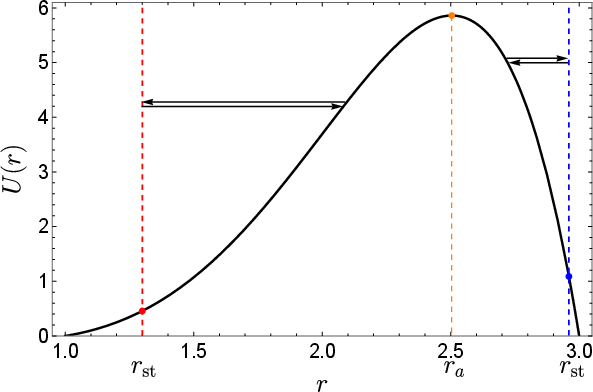
Figure 1: Variation of the effective potential CA1, exhibiting a maximum at the accumulation surface CA2, relevant for extremal surface behavior in CV calculations.
Strong numerical integration results confirm:
- The CV complexity exhibits robust linear growth at late times.
- The late-time growth rate is set by the properties of the accumulation surface, independent of observer position within the static patch.
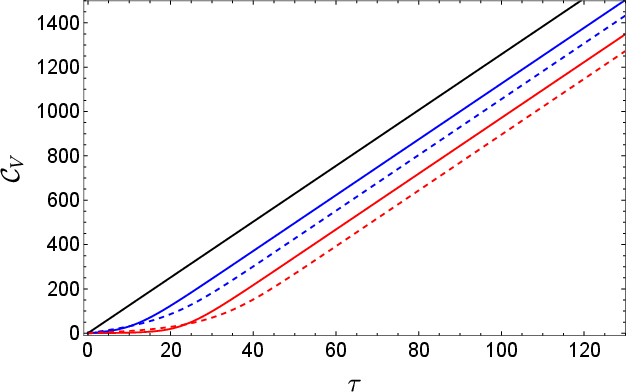
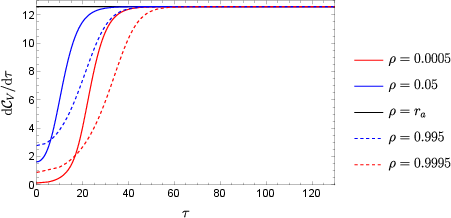
Figure 2: Time evolution of CV complexity and its growth rate in static patch holography for SdS, indicating approach to stable linear growth.
CV2.0 and CA Proposals
The codimension-zero (CV2.0 and CA) prescriptions require construction of a WDW patch, now anchored at two times on the stretched horizon. The CV2.0 proposal assigns complexity as
CA3
with CA4 the spacetime volume of the WDW patch, and the sign convention chosen for positivity.
CA complexity is identified (up to a sign convention) with the action integral over the same WDW patch:
CA5
Key findings:
- CV2.0 complexity grows linearly at late times, saturating to a rate governed by the (finite) extent between CA6 and CA7.
- CA complexity does not grow at late times; the growth rate vanishes. This is attributed to the WDW patch covering a finite region with bounded (renormalized) action.
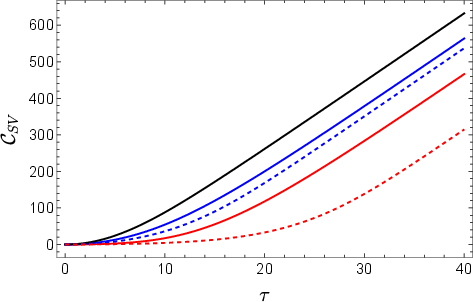
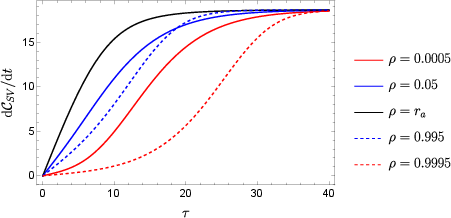
Figure 3: CV2.0 complexity (left) and growth rate (right) in the static patch, illustrating linear behavior at late times independent of observer position.
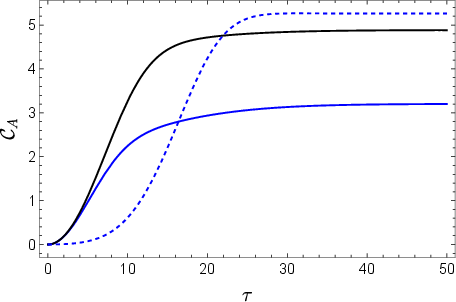
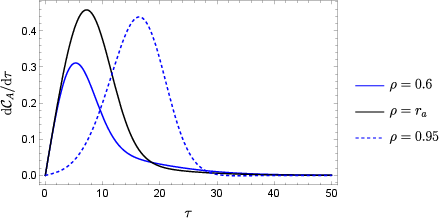
Figure 4: CA complexity and its growth rate in the static patch, showing CA saturates with growth rate vanishing for large times.
Complexity in dS/CFT Correspondence
CV Proposal
In the dS/CFT-inspired prescription, codimension-one extremal surfaces are anchored on the spacelike boundaries at future and past infinity, parameterized by spacelike coordinate CA8. The formulation involves complexifying the surface definition, with an CA9 factor introduced for positivity.
The analysis yields:
- CV complexity under dS/CFT grows linearly as C2.0V0, with rate identical to that in static patch holography.
- The divergence of the complexity for large C2.0V1 can be regularized via finite differences, leaving growth rates unaffected.
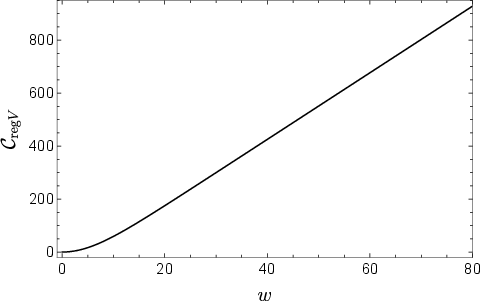
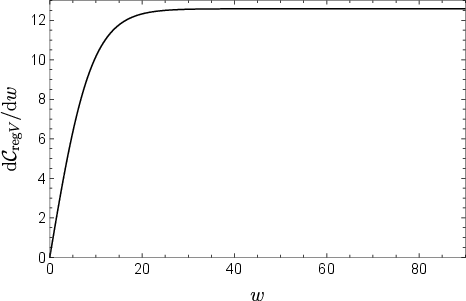
Figure 5: Linear growth of CV complexity and its growth rate under dS/CFT correspondence as C2.0V2.
CV2.0 and CA Proposals
A WDW patch is constructed with joints at C2.0V3 on both future and past boundaries. The CV2.0 complexity shows the same qualitative behavior:
- Linear growth with rate matching that in the static patch setup as C2.0V4.
- CA complexity growth rate again vanishes as C2.0V5.
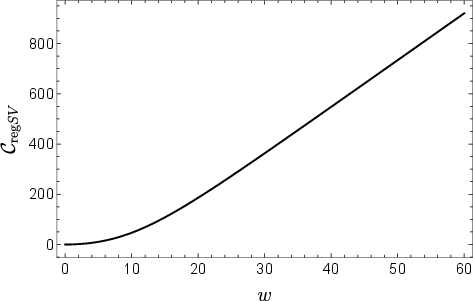
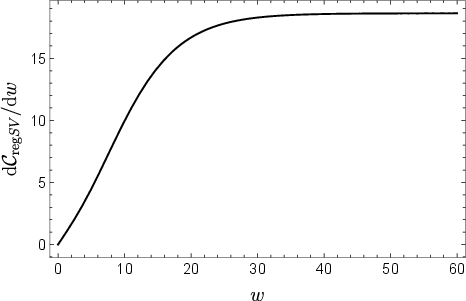
Figure 6: CV2.0 complexity in dS/CFT and its growth rate, showing linear asymptotics identical with the static patch realization.
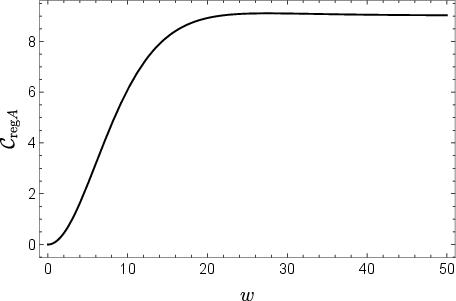
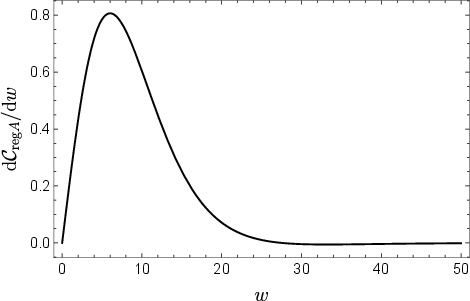
Figure 7: CA complexity in the dS/CFT prescription saturates; its growth rate vanishes for large boundary separations.
Comparative Synthesis and Theoretical Implications
A profound result is that, despite different anchoring prescriptions and global causal structures, CV and CV2.0 complexity exhibit identical late-time growth rates in both static patch and dS/CFT schemes. This points to a possible universal behavior of complexity growth in dS holography when computed using bulk objects with timelike boundaries.
In contrast, CA complexity fundamentally disagrees with known circuit complexity behavior: its late-time growth vanishes rather than scaling linearly. This persists in both static patch and dS/CFT realizations, and even in the pure dS limit. The persistence of this feature, even after accounting for ambiguities or cutoff choices, underscores a critical limitation of the CA proposal in de Sitter settings.
Numerical Results and Quantitative Claims
Strong numerical integration results for SdS with representative parameters C2.0V6, C2.0V7, C2.0V8 demonstrate:
- Linear regime for CV and CV2.0 growth initiates well before C2.0V9, with final rates independent of how the stretched horizon is specified.
- CA complexity saturates rapidly; the growth rate drops sharply and asymptotes to zero.
These numerical findings, buttressed by analytic arguments concerning extremal surfaces and action regularization, validate the general statements about late-time complexity growth across both holographic scenarios.
Theoretical and Practical Implications
- Interplay with Finite State Space and dS Entropy: Linear complexity growth is consistent with the idea that quantum evolution across a finite-dimensional Hilbert space (as suggested for dS static patches) scrambles up to the limit of combinatorial complexity. The matching of rates in both schemes suggests a deep link to horizon entropy.
- Bulk Dynamical Equivalence: The matching late-time growth in both static patch and dS/CFT can be viewed as evidence for a unified ("bulk-dynamical") description in dS holography, potentially simplifying future explorations of de Sitter/CFT dualities.
- Caution for CA in dS Contexts: The evidence for non-growing CA complexity (contradicting circuit complexity expectations) highlights potential inadequacies in naively applying the CA conjecture to de Sitter geometries. The result points either to necessary alterations of the CA definition (e.g., modifying the WDW region or action principle) or to a fundamental restriction on the applicability of CA in dS holography.
- Robustness to Black Hole Microphysics: The findings persist from pure dS to the more intricate causal and thermodynamic structure of SdS, suggesting that the linear complexity scaling is universal for de Sitter-like spacetimes under the timelike prescription.
Future Directions
- Switchback Effect and Scrambling: Whether the static patch and dS/CFT proposals manifest switchback effects under shockwave perturbations (as in AdS) is an open question.
- Extension to Charged and Rotating dS Black Holes: The methodology is directly extendable to more general horizon structures.
- Refinement of Holographic Complexity Conjectures: The breakdown of CA invites exploration of alternative or modified conjectures satisfying boundary quantum information criteria in dS.
Conclusion
This work provides a detailed, quantitative, and comparative study of holographic complexity in the SdS spacetime under two prominent dS holography prescriptions. Both CV and CV2.0 conjectures yield late-time linear growth of complexity in both static patch and dS/CFT frameworks, with growth rates set by geometric data at the accumulation surface and cosmological horizon, respectively. In contrast, the CA conjecture leads to vanishing complexity growth at late times, indicating its unsuitability (as currently formulated) for de Sitter holography. These results illuminate universal features of complexity growth in quantum gravity with positive cosmological constant and set the stage for further theoretical exploration and refinement of holographic dualities in cosmological settings.