- The paper establishes that holographic complexity scales exponentially with the UV cutoff and cosmological time in dS-foliated AdS setups.
- It employs both volume and action prescriptions, using analytic and numerical methods to detail scaling relations and divergence structures.
- It demonstrates that introducing brane-induced gravity merely doubles the complexity while preserving its fundamental divergence and time-dependence.
Introduction
This essay engages with the detailed analysis of quantum computational complexity for conformal field theories (CFTs) in global de Sitter (dS) spacetime, as advanced in "Holographic complexity of conformal fields in global de Sitter spacetime" (2604.21408). The focus is on computation and characterization of holographic complexity via the complexity=volume (CV) and complexity=action (CA) prescriptions in a controlled gravitational setup, leveraging the AdS/CFT correspondence with AdS geometries foliated by global dS slices. Both the standard case and the presence of brane-induced gravity (braneworld/double holography) are systematically addressed. The analysis is both analytic (when possible) and numeric, with an emphasis on scaling relations, UV/IR structure, and the implications for quantum information-theoretic measures in non-stationary geometries.
Holographic Setup: AdS with dS Foliations
The (d+1)-dimensional AdS spacetime is recast so that the metric admits global dSd slices:
ds2=dr2+sinh2r(−dt2+cosh2tdΩd−12)
Here, UV cutoff (r→Λ) surfaces near the AdS boundary correspond to global dSd. The boundary CFT resides on this explicitly time-dependent geometry.
This foliation differs crucially from analyses in static or planar patches and is significant because it enables direct investigation of CFT complexity on a truly time-dependent cosmological background. Unlike static patch holography—which is observer-dependent and admits a single causal region—the global dS target makes the results sensitive to cosmological expansion, capturing the inflationary features of dS.
Volume Complexity in Global de Sitter
The volume complexity CV is defined as:
CV=lGNVΣ
where VΣ is the maximal spatial volume of a bulk slice anchored at boundary time t⋆. The extremal surface equations for generic t⋆ do not admit a closed-form solution due to explicit time dependence and lack of killing symmetries. Analytic expressions are possible only at d0, where reflection symmetry persists. For general d1, the computation proceeds numerically.
The key scaling result, substantiated both numerically and analytically, is
d2
where d3 is the UV cutoff (related to the CFT lattice spacing d4 as d5) and d6 is the anchoring time at the boundary. The complexity is therefore:
d7
This result identifies the complexity with the extensive spatial volume, with an exponential enhancement due to the inflationary scale factor in dS. For odd d8, an additional universal logarithmic divergence is present.
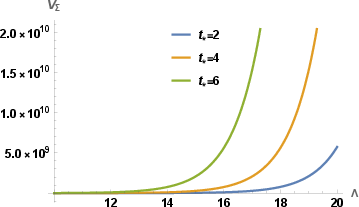
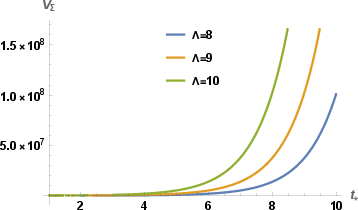
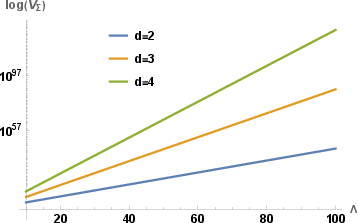
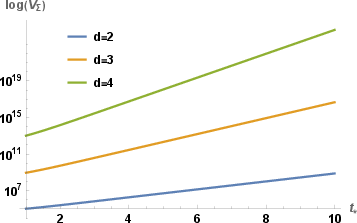
Figure 2: Maximal volume as a function of d9 for ds2=dr2+sinh2r(−dt2+cosh2tdΩd−12)0, exhibiting the scaling ds2=dr2+sinh2r(−dt2+cosh2tdΩd−12)1.
These strong numerical results are consistent with the expectation from holography and field theory: the growth of spatial volume under cosmological expansion leads to a concomitant exponential growth in holographic complexity, unrelated to intrinsic entanglement growth but rather to the increase in the number of degrees of freedom due to inflation.
Notably, the volume-based complexity does not display hyperfast (finite-time divergent) scaling, distinguishing the global dS context from the hyperfast growth observed in static patch setups [cf. Jorstad et al.].
Action Complexity: Wheeler-DeWitt Patch Evaluation
In the CA proposal, complexity is equated with the on-shell action ds2=dr2+sinh2r(−dt2+cosh2tdΩd−12)2 on the Wheeler-DeWitt patch. For dS-foliated AdS, analytic expressions can be derived for even and odd ds2=dr2+sinh2r(−dt2+cosh2tdΩd−12)3 (details involve intricate evaluation of bulk, boundary, joint, and LMPS terms; see the original for explicit integral expressions and series expansions).
The leading divergence is
ds2=dr2+sinh2r(−dt2+cosh2tdΩd−12)4
with the same time dependence ds2=dr2+sinh2r(−dt2+cosh2tdΩd−12)5 as the volume complexity. For ds2=dr2+sinh2r(−dt2+cosh2tdΩd−12)6, the CA complexity schematic reads:
ds2=dr2+sinh2r(−dt2+cosh2tdΩd−12)7
The presence of a universal logarithmic divergence in odd ds2=dr2+sinh2r(−dt2+cosh2tdΩd−12)8 matches earlier AdS results, as found in e.g. [Reynolds & Ross].
In both CA and CV, the complexity tracks the exponential growth of the spatial volume under cosmological expansion. There is no evidence for observer-dependent hyperfast scaling.
dS Braneworld: Effect of Brane Tension
Placing a brane with nonzero tension ds2=dr2+sinh2r(−dt2+cosh2tdΩd−12)9 near the AdS boundary induces gravity on the brane, with the effective Newton constant:
r→Λ0
In this braneworld (double holographic) scenario, the leading effect is a doubling of the complexity (both CA and CV), consistent with gluing two copies of AdS at the brane. All UV divergence and time dependence structures are preserved; there is no qualitative change from the insertion of a brane except a factor of two.
Subtle modifications to the complexity are expected only if genuine intrinsic brane gravity terms (e.g., Einstein-Hilbert terms) are included, a direction deferred for future investigation.
Theoretical and Practical Implications
The results have significant implications:
- Universality: Holographic complexity in global dS admits the same scaling structure as local measures in AdS/CFT, indicating substantial universality across static and inflationary geometries.
- No Hyperfast Growth: The absence of hyperfast complexity growth in global dS (contrast with the static patch horizon-centric setups) indicates sensitivity of holographic complexity to cosmic slicing and the physical localization of the CFT degrees of freedom.
- Inflation and Complexity: Exponential complexity growth is an immediate consequence of cosmological inflation, reflecting both quantum information-theoretic extensivity and cosmological dynamics.
- UV/IR Interplay: The intricate divergence structure includes both leading power law and, for odd dimensions, logarithmic terms, mirroring the expectations from CFT UV structure and the AdS/CFT dictionary.
- Robustness under Braneworld Embedding: The insertion of a tensional brane leaves complexity structure unchanged except for a trivial doubling, suggesting that, at least in this setup, complexity is not dominantly sensitive to simple brane-induced backreaction.
Prospects for Future Research
Open directions include:
- Full inclusion of dynamical brane gravity (e.g., brane Einstein-Hilbert terms) and analysis of the resulting modifications to complexity.
- Evaluation of complexity for non-equilibrium (e.g., black hole) configurations or in more general FLRW spacetimes, relevant for cosmological applications.
- Detailed field-theoretic calculation of complexity beyond the holographic regime, potentially via direct evaluation of circuit complexity or via the dS/Wheeler-deWitt correspondence.
- Investigation of the role of quantum information bounds like the Lloyd bound in scenarios with exponentially increasing degrees of freedom.
Conclusion
The paper delivers a comprehensive and rigorous characterization of holographic complexity for conformal fields on global de Sitter, leveraging both volume and action proposals. Key results include exponential scaling with both UV cutoff and cosmological time, universal divergence structures, and manifest insensitivity to the introduction of brane-induced gravity (modulo overall multiplicity). The findings provide new benchmarks for holographic complexity in genuine cosmological (inflationary) backgrounds and highlight several directions for future foundational research in quantum gravity and quantum information in curved spacetime.