Resonant delay in a stationary quantum clock: Lifting the threshold mask
Published 1 Jun 2026 in quant-ph, hep-th, and math-ph | (2606.02718v1)
Abstract: Quantum transit times have a long history of inequivalent definitions, including phase times, dwell times, and quantum-clock constructions. In this context we revisit the Salecker--Wigner--Peres stationary quantum clock as a phase-sensitive scattering observable, with clock time defined by the energy derivative of the transmission phase shift across the interaction region. For real compactly supported one-dimensional potentials, we show that the raw stationary Peres clock generically contains a universal (1/\sqrt{E}) continuum-edge term whose coefficient is fixed by low-energy scattering data. For the attractive square well, this threshold singularity is inherited from the vanishing exterior momentum and the associated scattering matching, rather than from resonant delay itself. We derive the exact stationary clock time for the square well and introduce a new threshold-subtracted clock observable. Away from exceptional zero-energy tuning, the subtraction removes the universal low-energy term and isolates the resonant contribution. Comparison with the dwell time and the transmission Wigner phase delay shows that the threshold-subtracted clock acquires the expected local Lorentzian form near isolated transmission resonances. Near the continuum edge, if (\varepsilon) denotes the detuning from threshold, the resonant peak grows only as (\varepsilon{-1/2}), whereas the unsubtracted threshold background grows as (\varepsilon{-3/2}). A symmetric barrier--well--barrier cavity and a numerical asymmetric two-step attractive well provide complementary controls. The result is a new threshold-subtracted stationary-clock candidate that separates universal threshold kinematics from pole-sensitive resonant delay.
The paper identifies a universal 1/√E divergence in the SWP clock that obscures resonant delays in one-dimensional quantum scattering.
Analytic and numerical transfer-matrix analysis in models such as the attractive square well validates a subtraction mechanism that removes the non-resonant threshold background.
Removal of the threshold divergence reveals pure Lorentzian resonant delay profiles, providing a robust method for isolating physically meaningful time delays.
Resonant Delay in a Stationary Quantum Clock: Lifting the Threshold Mask
Introduction and Context
The quantum traversal time problem—how long a particle spends in a scattering region—has no unique answer within quantum mechanics, with operational definitions producing distinct observables such as phase times, dwell times, and various quantum-clock constructions. Among these, the Salecker–Wigner–Peres (SWP) stationary quantum clock instrumentally defines clock time as the energy derivative of the transmission phase shift. Despite its phase sensitivity and convenience, the SWP stationary clock exhibits a universal, non-resonant low-energy divergence that can obscure genuine resonant delays, particularly in one-dimensional compactly supported potentials.
The paper "Resonant delay in a stationary quantum clock: Lifting the threshold mask" (2606.02718) characterizes this universal threshold background and introduces an explicit subtraction mechanism that isolates the resonant signal from the non-resonant continuum-edge effect in stationary quantum-clock readings. The analysis utilizes analytic and numerical settings, specifically the solvable attractive square well, symmetric barrier–well–barrier structures, and generic non-square configurations. The approach highlights both the ubiquity of the threshold divergence and a protocol for extracting a physically meaningful, pole-sensitive resonant delay observable.
Universal Threshold Divergence and Subtraction Mechanism
The authors establish by general transfer-matrix analysis that the SWP clock time for real, compactly supported one-dimensional potentials generically acquires a 1/E non-resonant divergence in the low-energy limit, controlled solely by zero-energy scattering data. This term is universal and is not associated with actual resonant delay. Concretely, for non-exceptional (non-half-bound) parameter regimes, the stationary clock time is shown to asymptote as
τP(E)=−Eℓthr+O(E),
where ℓthr is a non-resonant kinematic coefficient determined by low-energy expansion of the transfer matrix.
Subtracting this term yields a threshold-subtracted clock observable τsub(E) that is finite at threshold. The subtraction applies broadly, not just within the square-well model, and efficiently removes the universal background even in more general potential configurations, as confirmed by numerical examples.
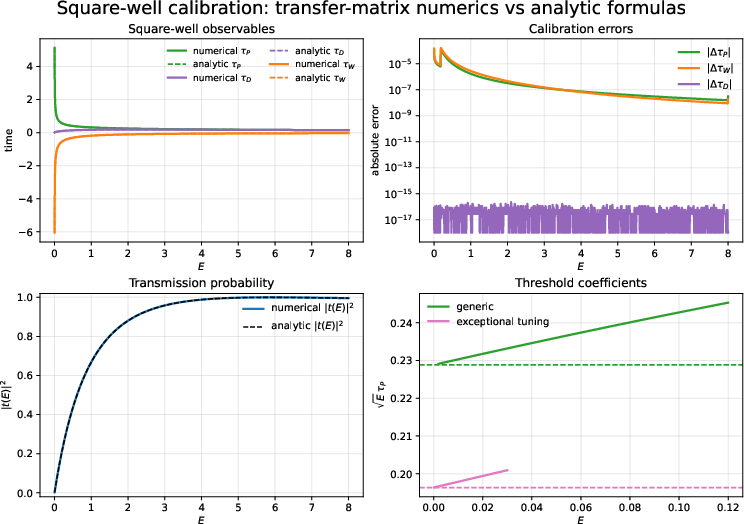
Figure 1: Square-well calibration of the transfer-matrix numerics against the exact analytic formulas. The upper-left panel compares the stationary observables τP, τW, and τD, the upper-right panel shows the absolute numerical--analytic errors, the lower-left panel shows the transmission probability, and the lower-right panel shows the extraction of the generic and exceptionally tuned threshold coefficients.
Analytic Laboratory: The Attractive Square Well
For explicit demonstration, the square-well serves as an analytically tractable model, enabling closed-form expressions for the transmission amplitude, the SWP clock, threshold coefficient, and the subtracted clock. The resulting formulas allow direct comparison between:
The raw SWP clock time τP(E),
The dwell time τD(E),
The transmission Wigner phase delay τW(E),
The threshold-subtracted observable τP(E)=−Eℓthr+O(E),0.
The analysis reveals:
In generic settings (τP(E)=−Eℓthr+O(E),1), τP(E)=−Eℓthr+O(E),2 diverges as τP(E)=−Eℓthr+O(E),3 for τP(E)=−Eℓthr+O(E),4. The subtraction yields a vanishing result at threshold, cleanly exposing purely resonant delays.
In threshold-resonant/half-bound settings (τP(E)=−Eℓthr+O(E),5), the leading divergence is still present but with altered coefficient.
Comparative analysis also demonstrates that the dwell time and the threshold-subtracted clock exhibit consistent Lorentzian resonant profiles near isolated transmission resonances—both the peak heights and the near-threshold scaling, up to smooth background terms, are quantitatively matched.
Local Resonant Structure and Threshold Masking
Near isolated transmission resonances, the subtracted clock time acquires the expected Lorentzian (Breit–Wigner-like) form, precisely localizing resonant delay without threshold contamination: τP(E)=−Eℓthr+O(E),6
with τP(E)=−Eℓthr+O(E),7 the resonance height parameter.
In contrast, as a transmission resonance approaches threshold, although the resonant peak grows only as τP(E)=−Eℓthr+O(E),8 with respect to the detuning τP(E)=−Eℓthr+O(E),9 from threshold, the unsubtracted threshold background diverges more strongly as ℓthr0. The result is that, for resonances near zero energy, the SWP clock without subtraction is dominated by the universal (non-resonant) threshold background—masking the physical resonant feature.
Control Geometries and Numerical Extensions
A symmetric barrier–well–barrier cavity provides an independent analytic testbed for the subtraction protocol and confirms the persistence of the local Breit–Wigner structure when the universal threshold background is removed. Full analytic transfer-matrix analysis for this configuration verifies that the generic threshold coefficient is again fixed by the zero-energy Cauchy data and can be explicitly separated.
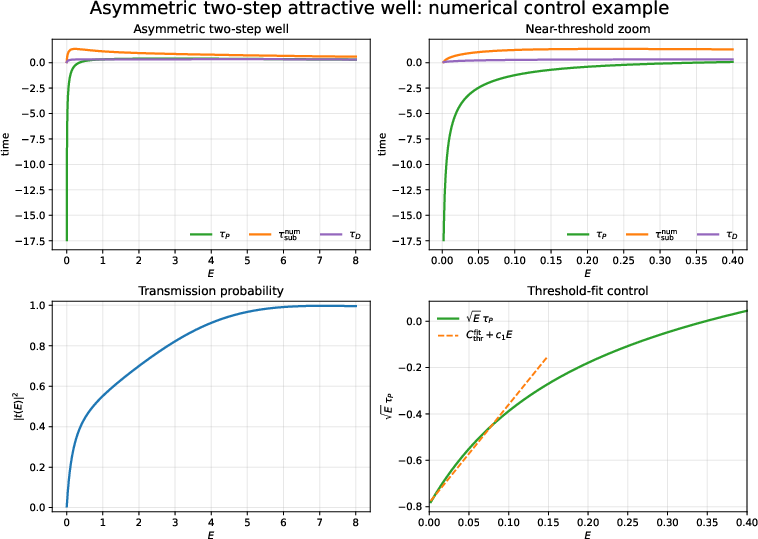
To gauge the universality of the threshold-subtraction method, the authors analyze a non-square, asymmetric two-step attractive well using numerical transfer-matrix computations. Calibration against exact results ensures negligible numerical error. Subtracting the fitted threshold term from numerically computed clock times once more yields a finite, background-free observable near threshold.
Figure 2: Asymmetric two-step attractive well used as a numerical control example. The raw stationary clock ℓthr1 exhibits a strong threshold background, while the fitted subtraction produces a much milder ℓthr2.
Implications and Outlook
The separation of universal threshold effects from pole-sensitive resonant delays in stationary quantum clocks has foundational implications for the practical and theoretical interpretation of quantum traversal times. In one-dimensional quantum scattering, this approach cleanly disentangles global kinematic artifacts from physically meaningful resonance-induced delays, crucial for interferometrically resolving transmission resonances and in settings where dwell time is not operationally accessible.
The threshold-subtraction framework is fundamentally kinematic, implying that any stationary observable derived from energy-derivative phase information (including the Wigner delay) is subject to analogous universal background effects in low-energy scattering. The authors suggest, based on threshold logic, that analogous mechanisms and subtraction schemes should generalize to the ℓthr3-wave sector in three-dimensional short-range potentials, motivating further extensions to higher-dimensional and multi-channel quantum systems.
Conclusion
This work rigorously demonstrates that the SWP stationary quantum clock in the one-dimensional compact-support setting generically bears a universal, non-resonant threshold divergence, whose explicit subtraction is both theoretically justified and operationally implementable. The resulting threshold-subtracted clock exposes clean, Lorentzian resonant delay profiles, robustly demarcating genuine resonance effects from continuum-edge backgrounds. Extension to general potential classes and higher-dimensional scattering appears natural and remains a promising direction for future investigation.
“Emergent Mind helps me see which AI papers have caught fire online.”
Philip
Creator, AI Explained on YouTube
Sign up for free to explore the frontiers of research
Discover trending papers, chat with arXiv, and track the latest research shaping the future of science and technology.Discover trending papers, chat with arXiv, and more.