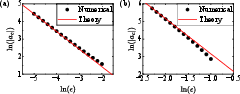
- The paper demonstrates that infinitesimal non-positive near-horizon deformations induce a new purely imaginary quasi-normal mode signaling black hole instability.
- It employs analytical scaling laws and numerical simulations of double-delta, Pöschl-Teller, and Regge-Wheeler potentials to characterize the instability onset.
- The analysis reveals that even stochastic deformations with zero mean trigger exponential instability, emphasizing the sensitivity of black hole spectroscopy to near-horizon perturbations.
Introduction: Instability Mechanisms in Black Hole Spectroscopy
The paper "Near-Horizon Deformation of Metric and the Black Hole Instability" (2606.02066) presents a comprehensive spectral investigation of black hole (BH) stability under localized, non-positive near-horizon metric deformations. Within the context of BH spectroscopy, where quasi-normal modes (QNMs) encode details of spacetime geometry, this work examines the effect of perturbations—both deterministic negative and stochastic (zero-mean)—on the spectral domain. Previous studies on QNM instability focused primarily on positive barrier deformations, but physical environments admit non-positive localized perturbations, potentially arising from quantum or classical fluctuations, environmental effects, or modified gravity.
The central claim is that even infinitesimal non-positive perturbations, positioned sufficiently close to the horizon, generically induce a new purely imaginary QNM whose migration in the complex frequency plane signals BH instability. The authors establish analytical scaling laws relating the critical horizon distance for instability onset to deformation strength and provide rigorous frequency-domain proofs for these phenomena.
The study operationalizes near-horizon geometric fluctuations via localized deformations in the tortoise coordinate representation of the metric. In the regime where perturbations are static and spatially localized, they are introduced through variations in the radial metric component r(x), producing an induced effective potential deformation in the master equation governing scalar perturbations. The critical insight is that stochastic deformations naturally give rise to sign-indefinite effective potential perturbations with zero spatial average, requiring inclusion of both negative and positive potential components in the analysis.
Frequency-Domain Analysis: Deterministic Negative Bumps
Three archetypal potential models are considered: the double-δ, Pöschl-Teller (PT), and Regge-Wheeler (RW) potentials. The effect of localized negative bumps on QNM spectra is investigated analytically and numerically.
The frequency-domain evolution under negative perturbation reveals several consistent features:
- Emergence of a new purely imaginary mode, ϖ0, in addition to standard QNMs.
- As the negative bump approaches the horizon (increasing ∣a∣), ϖ0 ascends the imaginary axis, and at a critical distance ac, crosses into the upper half-plane—signifying instability.
- For all models, ℑ(ϖ0) approaches the isolated bump frequency (e.g., iϵ/2 for the double-δ) in the near-horizon limit.
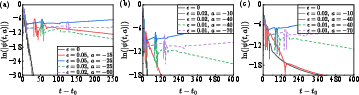
Figure 1: Time evolution of the deformation field for the double-δ, PT, and RW models, illustrating exponential growth or decay contingent on bump proximity.
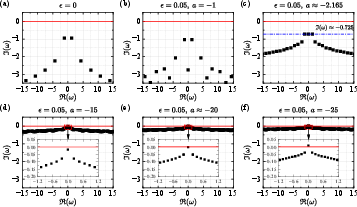
Figure 2: QNM spectra for the double-δ0 potential under negative bump perturbations, showing branch migration and the dominance of the purely imaginary mode.
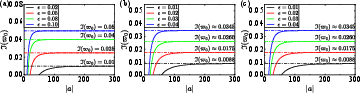
Figure 3: Imaginary part of δ1 as a function of δ2 and δ3 for all potential models, revealing the universal scaling and rapid growth near the horizon.
These results are robust across smooth potentials (PT, RW), providing evidence that the spectral instability mechanism is not model-specific but arises from the generic interplay between the positive background and negative localized deformations.
Stochastic Perturbations and Zero-Mean Instabilities
Extending the analysis to stochastic perturbations with vanishing spatial average, the authors demonstrate:
- Spectral evolution is qualitatively identical to the negative bump case for both PT and RW backgrounds.
- The critical distance for instability onset now scales as δ4 with deformation strength, contrasting with δ5 for purely negative bumps.
- The instability is revealed through the migration of δ6 and its eventual entry into the upper half-plane.
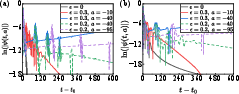
Figure 4: Time evolution for stochastic perturbations in PT and RW potentials shows exponential instability for sufficiently near-horizon perturbations.
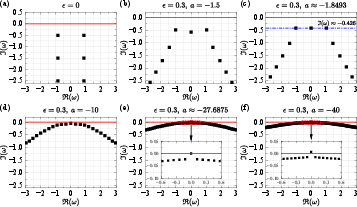
Figure 5: QNM spectra for stochastic deformations in the PT potential, evidencing formation and migration of the purely imaginary instability mode.
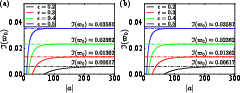
Figure 6: Growth of δ7 under stochastic perturbation, as a function of δ8 and δ9, verifying predicted scaling behavior.
Analytical and Variational Proofs: Instability Conditions and Scaling Laws
The theoretical underpinning rests on a variational analysis analogous to the spectral properties of a Schrödinger operator:
These results establish the universal spectral framework for instability under long-wavelength non-positive perturbations and are applicable across the spectrum of black hole spacetime models.
Practical and Theoretical Implications
The work demonstrates that BH stability is not universally robust to small, localized, sign-indefinite perturbations near the horizon. Even infinitesimal negative or stochastic deformations can trigger exponential instability on long timescales, raising implications for:
- The interpretation of ringdown and QNM signals in gravitational wave observations, particularly in environments where near-horizon fluctuations or non-trivial matter effects are non-negligible.
- Theoretical analysis of modified gravity models and quantum metric fluctuations, which can induce localized negative regions in the effective potential (see recent results in Einstein-Gauss-Bonnet gravity [cao_stability_2025]).
- The importance of boundary layer and near-horizon physics in determining global stability, and the sensitivity of spectral modes to localized geometric changes.
Observation of such instability modes—purely imaginary QNMs with positive imaginary part—requires satisfying both proximity and persistence conditions: perturbations must remain near the event horizon for timescales determined by ϖ09 or ∣a∣0. The practical detectability of these modes depends on astrophysical context and instrument sensitivity, but the theoretical possibility is robustly established.
Conclusion
This paper delivers a rigorous spectral and variational characterization of black hole instability under localized non-positive near-horizon metric deformations. Through careful analytic and numerical investigation, it highlights the emergence and migration of a purely imaginary instability mode, quantifies the critical distance-strength scaling, and provides a general variational criterion for instability occurrence. The results emphasize the conditional sensitivity of BH stability to micro-structural metric fluctuations near the event horizon and call for further investigation into the role of global versus local perturbations. This unified spectral framework advances the theoretical understanding of BH stability and instability across classical and quantum-deformed settings.