Coherent Exchange and Decoherence in Dirac-Spin-Liquid Quantum Interconnects
Published 1 Jun 2026 in quant-ph and cond-mat.str-el | (2606.01807v1)
Abstract: We develop a susceptibility-based open-system theory for two localized qubits coupled through a candidate two-dimensional $\mathrm{U}(1)$ Dirac-spin-liquid-like bath. The central input is the gauge-invariant retarded physical spin susceptibility $\ChiR(q,ω)$ of the bath. We show that this single response kernel controls both coherent and dissipative qubit dynamics: its real part generates the nonlocal mediated exchange, while its absorptive part determines relaxation and dephasing through the equilibrium noise spectrum. This gives a unified reduced two-qubit description in which the usefulness of the bath as an entanglement bus is governed by the competition between susceptibility-mediated exchange and bath-induced decoherence. As an analytically transparent benchmark, we evaluate the spinon mean-field Dirac susceptibility and recover the static algebraic exchange $J_{\mathrm{eff}}(R)\propto J_{\rm local}2/(v_F R3)$, together with pseudogap-suppressed relaxation $Γ1\propto J{\rm local}2ω_03/v_F4$. We then formulate a beyond-mean-field extension in which gauge-field dressing and other interaction effects are absorbed into a dressed physical susceptibility, without changing the reduced qubit-sector mapping. The resulting framework provides a direct route from the many-body spin response of a correlated two-dimensional bath to reduced-dynamics simulations of entanglement generation, coherence loss, and the operational phase space of a candidate Dirac spin-liquid quantum interconnect.
The paper introduces a unified open-system framework for analyzing both coherent exchange and decoherence among qubits coupled via a Dirac spin liquid.
It employs Born–Markov reduction and analytic benchmarks to derive a Heisenberg-like exchange interaction and predict pseudogap-protected qubit relaxation rates.
Numerical simulations confirm an operational window where gauge-invariant bath response enables robust entanglement and effective distributed quantum operations.
Coherent Exchange and Decoherence in Dirac-Spin-Liquid Quantum Interconnects
Introduction and Theoretical Framework
This work introduces a systematic open-system theory for two localized qubits coupled via a two-dimensional U(1) Dirac spin liquid (DSL), focusing on the mediated entanglement and induced decoherence governed by the bath’s gauge-invariant retarded spin susceptibility. The approach is formalized by expressing the qubit-bath interaction entirely in terms of the bath’s physical susceptibility. Both coherent exchange (arising from the real part) and qubit decoherence channels (from the imaginary part, via the fluctuation-dissipation theorem) are unified under this framework.
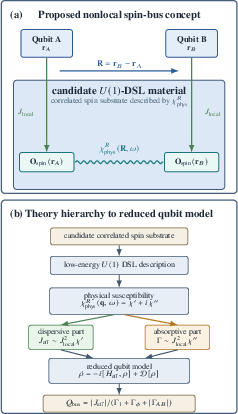
The device concept involves two qubits locally coupled to spin operators in the correlated substrate, where spin correlations propagate nonlocally through the bath. This construction enables analysis of the DSL as a spin bus for distributed quantum operations, with explicit focus on the competition between mediated exchange and bath-induced noise.
Figure 1: Device and theory hierarchy: two qubits locally couple to spin operators in a candidate U(1) DSL substrate; the gauge-invariant susceptibility encodes the nonlocal physical response propagating between qubit sites.
Open-System Reduction and Dynamics
The reduction from the full qubit-bath Hamiltonian to an effective two-qubit dynamical system is achieved in the weak-coupling regime via standard Born–Markov–secular approaches. The reduced Lindblad-form master equation incorporates both coherent and dissipative effects, each parameterized directly by the retarded susceptibility kernel. The nonlocal exchange Hamiltonian admits a compact form,
Jeff(R,ω0)∼Jlocal2χphys′(R,ω0),
whereas the dissipation rates are governed by
Γmn(ω)∼Jlocal2χphys′′(rm−rn,ω).
In the static, long-wavelength limit and assuming SU(2)-symmetric DSL response, the effective interaction reduces to a Heisenberg-like form with an exchange coupling that directly reflects the static susceptibility properties.
As a tractable reference, the spinon mean-field susceptibility—analogous to a massless 2D Dirac polarization bubble—is evaluated. The analytic expression reads
χ0R(q,ω)=−AχvF2q2−(ω+i0+)2q2,
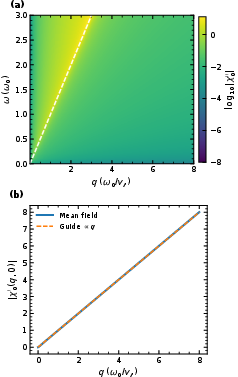
where Aχ encodes normalization, spin/flavor counting, and projection details. This response features:
Nonanalytic static momentum dependence (∼∣q∣)
Absorptive spectral weight bounded by the Dirac continuum edge (ω=vFq), leading to a pseudogap at low frequencies
Figure 2: Frequency- and momentum-resolved benchmark bath response: the absorptive spectral weight is suppressed below the Dirac continuum threshold (ω<vFq); the static susceptibility exhibits nonanalytic U(1)0 scaling.
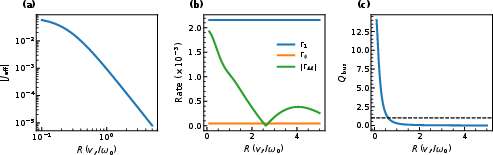
Fourier transforming to real space, the static exchange mediated by the bath scales as U(1)1, mirroring the classic U(1)2 decay observed in undoped Dirac systems and RKKY interactions.
The local relaxation (T1) rate is strongly suppressed at low energies:
U(1)3
demonstrating pseudogap-protected coherence of the qubits at low splitting.
Figure 3: (a) Algebraic mediated exchange as a function of separation. (b) Local relaxation and dephasing rates; the cross-damping term exhibits nontrivial distance dependence. (c) The bus quality metric U(1)4 quantifies the regime where exchange dominates over relaxation/decoherence.
Operating Window and Practical Criteria
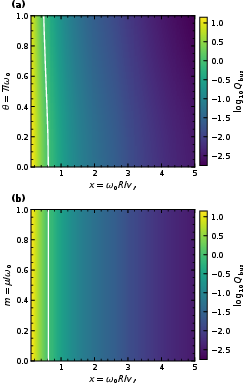
An operational figure of merit, U(1)5, benchmarks the viable regime for bus operation, with U(1)6 denoting coherence-favored exchange. The scaling reveals a critical dynamical length U(1)7: for qubit separations U(1)8, coherent mediated interaction outpaces relaxation, whereas at larger U(1)9, decoherence dominates.
Operating maps illustrate the boundaries of the coherence-dominated zone as a function of distance, temperature, and chemical potential. These define the "window of viability" for quantum networking via the DSL-mediated bus.
Figure 4: Baseline operating window for the benchmark bath. Viable regimes (Jeff(R,ω0)∼Jlocal2χphys′(R,ω0),0) persist at low temperature, near charge neutrality, and for sub-dynamical-length qubit separations.
Effects of Interactions: Gauge-Field Dressing
True DSLs are governed by an interacting gauge theory; the mean-field bubble is renormalized by gauge fluctuations and criticality, captured by dressing the susceptibility kernel:
Jeff(R,ω0)∼Jlocal2χphys′(R,ω0),1
where the anomalous dimension Jeff(R,ω0)∼Jlocal2χphys′(R,ω0),2 alters the decay of the exchange and the structure of the dissipative channels.
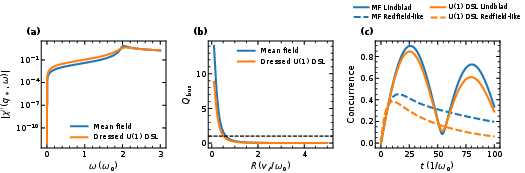
Numerical studies using a DSL-inspired dressed kernel demonstrate that the fundamental algebraic structure of the bus is preserved; however, the range of the viable window (i.e., maximal Jeff(R,ω0)∼Jlocal2χphys′(R,ω0),3 for which Jeff(R,ω0)∼Jlocal2χphys′(R,ω0),4) is systematically reduced.
Figure 5: (a) Absorptive spectral density for benchmark and dressed bath, showing broadened/shifted continua. (b) Bus quality metric Jeff(R,ω0)∼Jlocal2χphys′(R,ω0),5 for both cases; the viable window contracts for stronger interactions. (c) Time-domain concurrence: robust entanglement persists in the exchange-favored sector but is damped compared to mean-field theory.
Reduced-Dynamics Simulations
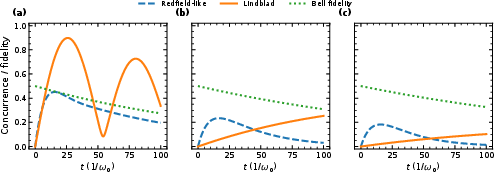
The effective master equation, parameterized by susceptibility-derived values for exchange and all dissipative rates, is numerically solved for representative operating points. Results include:
In the deep-viable regime, clear exchange-driven entanglement generation and persistent Bell-state fidelity are observed.
Near the Jeff(R,ω0)∼Jlocal2χphys′(R,ω0),6 boundary, coherent and dissipative processes compete, leading to transient or weak entanglement.
Far outside the operating window, rapid decoherence dominates and entanglement is short-lived.
Both direct Lindblad and Redfield-like master equation implementations (the latter retaining spectral/non-secular features) agree on the viability window and the qualitative structure of entanglement dynamics.
Figure 6: Ensemble of reduced-dynamics simulations showing concurrence, Bell-state fidelity, and coherence in different operating points, confirming the exchange-dominated, threshold, and dissipation-dominated regimes.
Conclusion
This formalism provides a unified, susceptibility-based framework for analyzing mediated quantum gates and decoherence in qubits coupled via a DSL substrate. Coherent exchange and all dissipation derive from the same gauge-invariant bath response kernel, enabling both analytic scaling estimates and systematic reduced-dynamics simulation. The primary results establish:
Coherent exchange is governed by a universal algebraic law, subject to pseudogap-protection against low-frequency bath noise.
An explicit, finite operating window exists where this many-body spin bus can function effectively—the window's size set by qubit-bath coupling, bath bandwidth, and susceptibility renormalizations.
Gauge-field and criticality-induced modifications to the susceptibility contract, but do not eliminate, this window.
These findings offer practical and theoretical guidance for the design of solid-state quantum network architectures based on correlated two-dimensional materials and chart a concrete route for incorporating detailed bath physics into scalable quantum technologies.
Reference: "Coherent Exchange and Decoherence in Dirac-Spin-Liquid Quantum Interconnects" (2606.01807)