- The paper develops a unified Lindblad master equation framework that captures both coherent (FLT) and dissipative (DLT) spin torques in quantum dots.
- It quantitatively models DC and AC transport regimes, elucidating phenomena such as the Hanle effect, spin blockade, and resonance features.
- The approach bridges quantum spin dynamics with classical torque concepts, providing insights for STM-EPR experiments, spintronics, and quantum metrology applications.
Unified Quantum Framework for Spin Torques in Quantum Dots
Introduction
The paper "Coherent and Dissipative Spin Torques in Quantum Dots: A Unified Framework for Quantum Spin Dynamics" (2605.30173) develops a comprehensive open quantum system theory of spin torques in quantum dots (QDs) actively coupled to spin-polarized and nonmagnetic electrodes. By deriving a Lindblad-type master equation from microscopic tunnel Hamiltonians, the approach encapsulates both coherent exchange interactions (field-like torques, FLT) and dissipative spin-transfer effects (damping-like torques, DLT), clarifying their interplay and experimental signatures. The work systematically addresses DC and AC transport regimes, including time-modulated rates that drive electron paramagnetic resonance (EPR), and extends to coupled spin systems, enabling the analysis of spin coherence, entanglement, and transport-induced decoherence.
Microscopic Modeling of Quantum Dot Spin Dynamics
The model system consists of a two-level QD fabricated from, e.g., a radical molecule (anionic pentacene), weakly coupled via tunnel barriers to two electrodes—one spin-polarized (e.g., STM tip) and the other nonmagnetic (substrate) (see Figure 1).
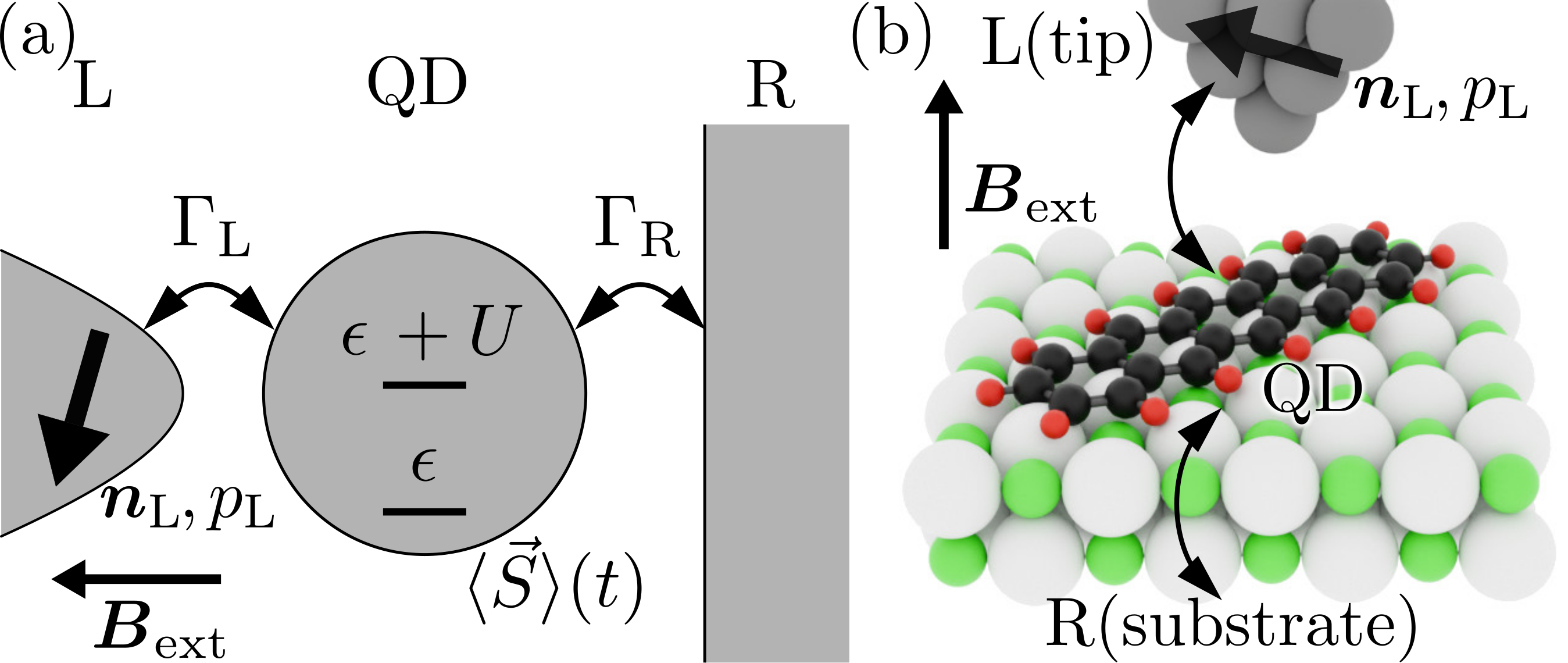
Figure 1: Schematic of a molecular quantum dot in scanning tunneling microscopy, with the left electrode spin-polarized and the right electrode nonmagnetic.
The Hamiltonian extends the Anderson impurity model by incorporating Zeeman and exchange interactions. The relevant Fock states include singly charged (∣↑⟩, ∣↓⟩), uncharged, and doubly charged singlet configurations. Tunnel coupling parameters (ΓL, ΓR), electrode polarization vectors (nL), and external field orientation (Bext) are systematically included.
The framework treats the reduced density matrix in a 4×4 representation, restricting to charge-diagonal coherences due to dominant dephasing and energy separation between spin and charge. The real-time dynamical evolution is governed by a master equation formulated in Lindblad form, enabling clear partitioning of coherent and dissipative torque terms.
Coherent (FLT) and Dissipative (DLT) Torque Decomposition
The framework explicitly distinguishes torque components:
- FLT: Coherent, Hamiltonian-like torque, represented by exchange fields and unitary spin precession (Larmor precession about effective fields).
- DLT: Dissipative, arising from spin-polarized electron transfer, aligning QD spin with the electrode polarization through stochastic quantum jumps, resulting in spin accumulation and relaxation.
These distinctions are rigorously mapped onto Lindblad operators for all allowed charge and spin transitions.
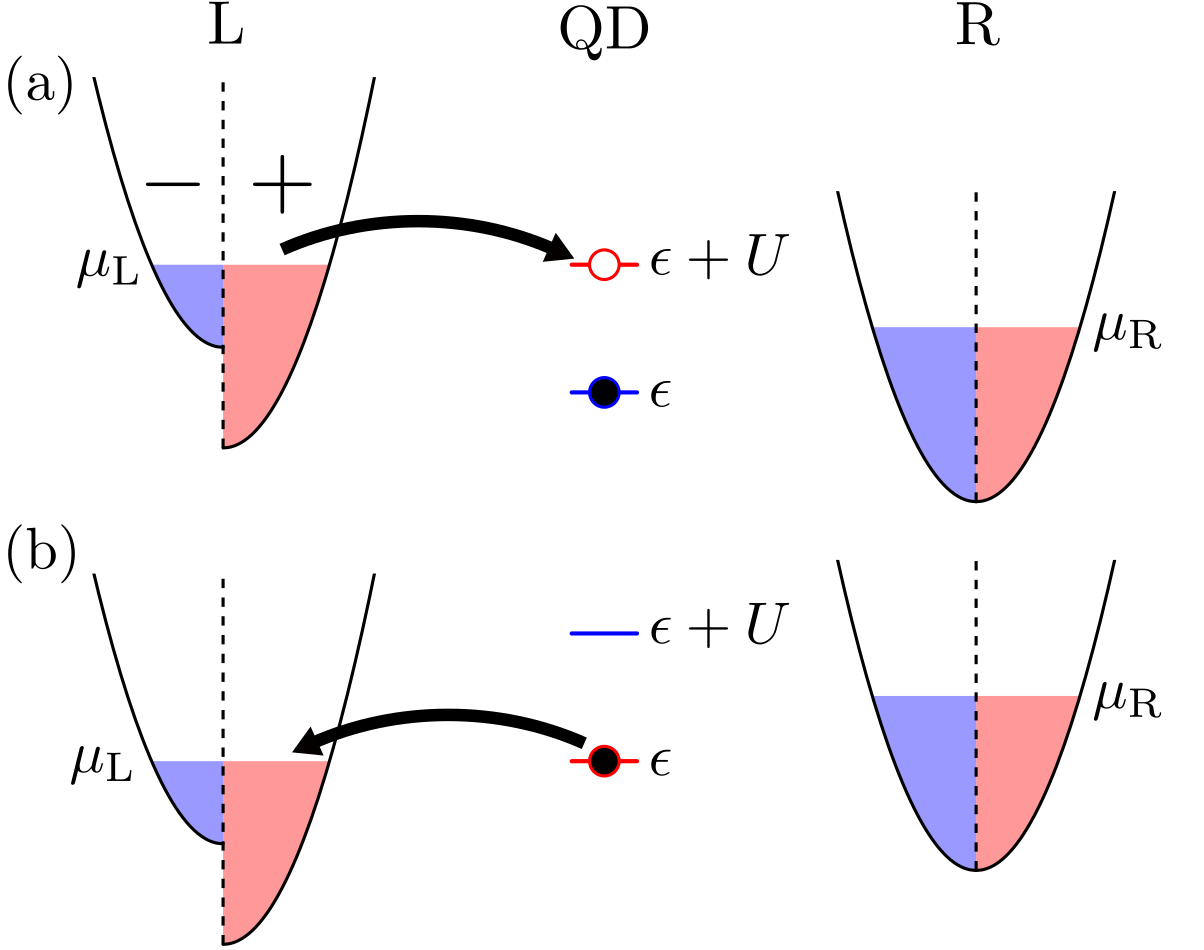
Figure 2: Density of states and spin-selective tunneling in a QD coupled to magnetic/nonmagnetic electrodes.
Lowest-order tunnel processes (real and virtual) are classified via Keldysh diagrams and their contributions to FLT (purely virtual, exchange-driven) or DLT (real, spin-selective tunneling). Second-order cotunneling and mixed processes are discussed for the Coulomb blockade regime.
Phenomenology and Numerical Results
Steady-State DC Transport
In the DC bias regime, DLT dominates spin dynamics. The DLT aligns the QD spin with the electrode polarization and produces spin blockade: if the injected electron spin aligns with the QD, subsequent transport is Pauli-blocked, resulting in a zero-current conductance peak at zero field (Hanle effect). FLT, arising from exchange fields, produces purely coherent precession, visible only when sequential tunneling is suppressed.
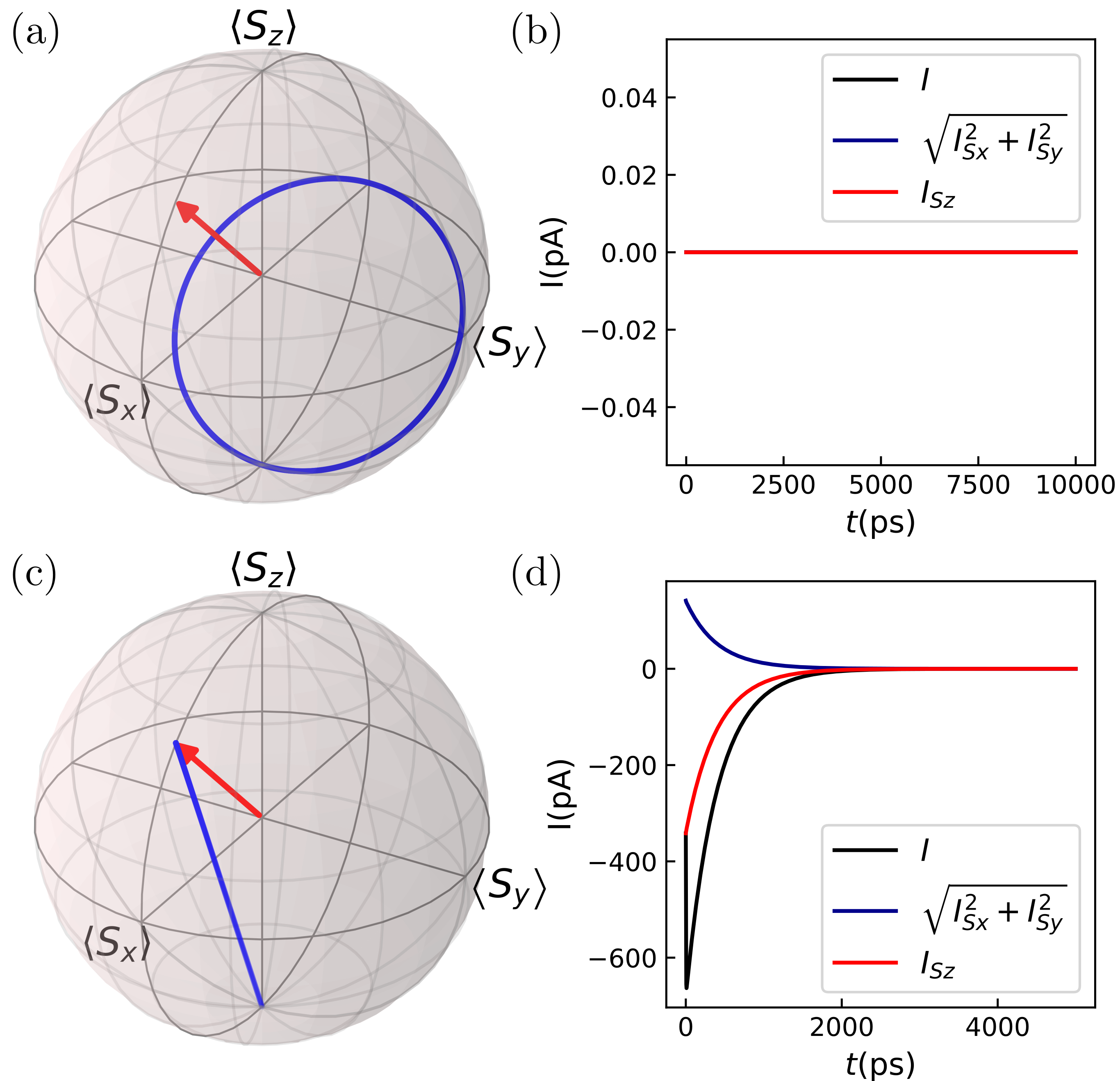
Figure 3: Comparison of FLT-driven precession and DLT-driven spin alignment in real-time quantum dot dynamics.
The paper provides quantitative current-field characteristics showing the Hanle Lorentzian lineshape and its dependence on spin-relaxation rates (ΓL), with the FWHM directly proportional to τS−1. Strong numerical agreement with experimental spectroscopy is demonstrated.
Coupled Spin Systems
The extension to sensor-spectator scenarios—where the sensor QD is transport-active and coupled to a secondary (spectator) spin—shows splitting of Hanle dips due to internal exchange fields. Full quantum treatment with Heisenberg coupling yields a triplet ground state and sidebands at ±2J/(gsμB), consistent with previous predictions and experiments.
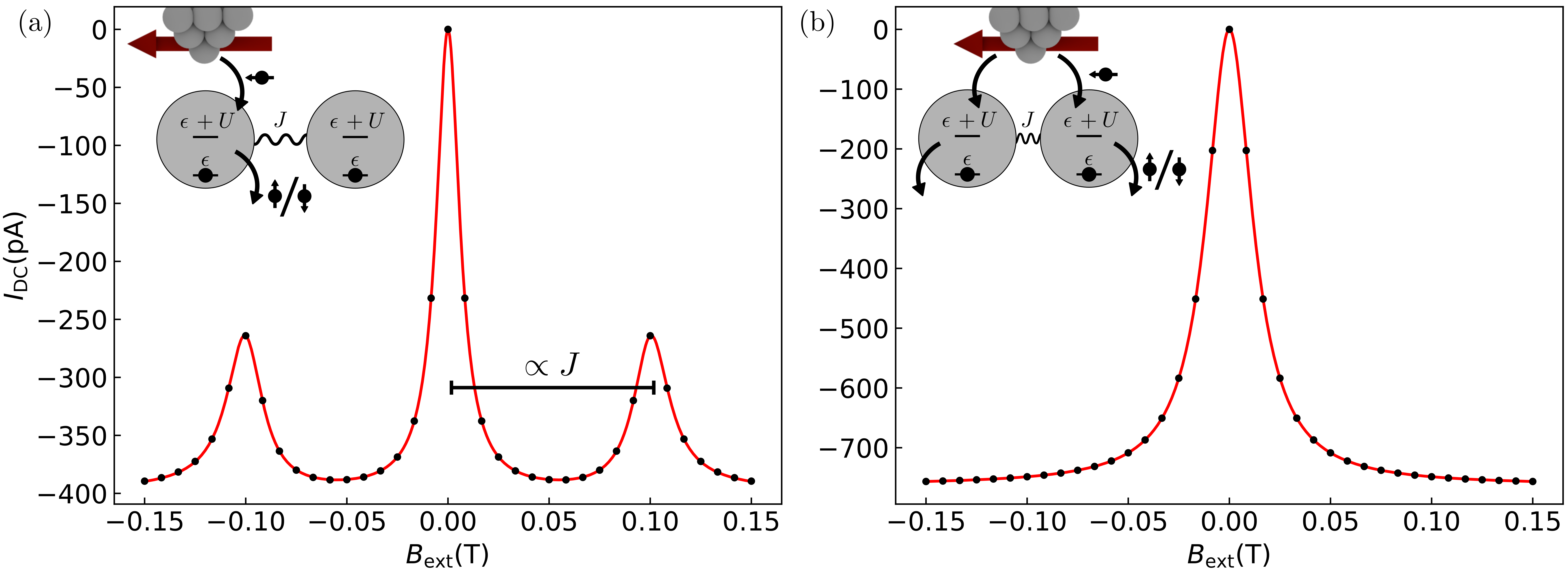
Figure 4: DC Hanle effect in coupled QDs, showing central dip and symmetry-broken sidebands due to coherent spin coupling and blockade.
Simultaneous transport through both dots results in decoherence-induced collapse of the sideband structure, demonstrating the sensitivity of quantum transport pathways to environmental correlations.
AC Transport and Spin Resonance
Time-dependent modulation (AC), formalized via periodic driving in Lindblad rates and exchange Hamiltonians, generalizes the framework to EPR spectroscopy:
- AC-FLT: Oscillating exchange fields drive coherent Rabi oscillations and resonance at ∣↓⟩0.
- AC-DLT: Periodic modulation of tunneling rates drives dissipative resonance at Larmor frequencies (AC Hanle effect), producing conductance dips at resonance.
Numerical simulations resolve distinct resonance features for DC Hanle, AC Hanle, and high-harmonic EPR sidebands as a function of field, spin polarization angle, and drive strength.
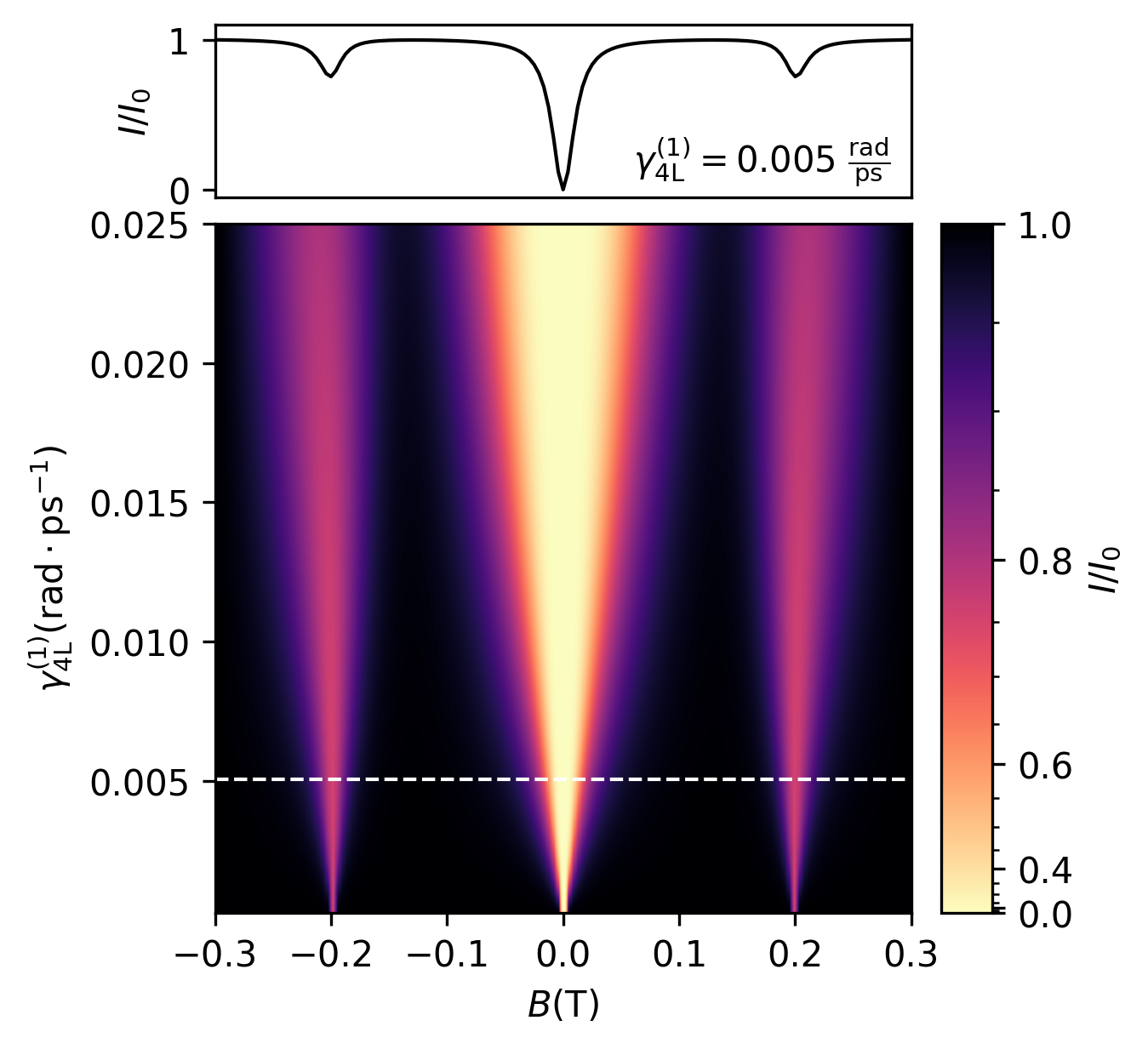
Figure 5: Current-field characteristic: broadening of DC and AC Hanle features with increasing AC-DLT amplitude.
The conductance spectra exhibit Lorentzian peaks whose linewidths encode spin-relaxation rates, and asymmetries characteristic of homodyne detection schemes. Angle-resolved spectra demonstrate distinct signatures for FLT- and DLT-driven resonance, with opposite signs and polarization dependence.
Implications and Outlook
The formalism provides a robust quantum foundation for interpreting spin-resolved STM experiments, EPR in single molecules, and transport spectroscopy in nanostructures and quantum devices. It unifies classical spin torque concepts (STT, SOT) with quantum open system dynamics via explicit mapping to Lindblad terms and exchange Hamiltonians.
The inclusion of higher harmonics and time-domain protocols opens avenues for quantum metrology, nonlinear spin control, and dynamic entanglement manipulation in QDs and molecular junctions. Direct electrical readout of spin state probabilities, thermometry applications, and strong coupling effects are accessible within this framework.
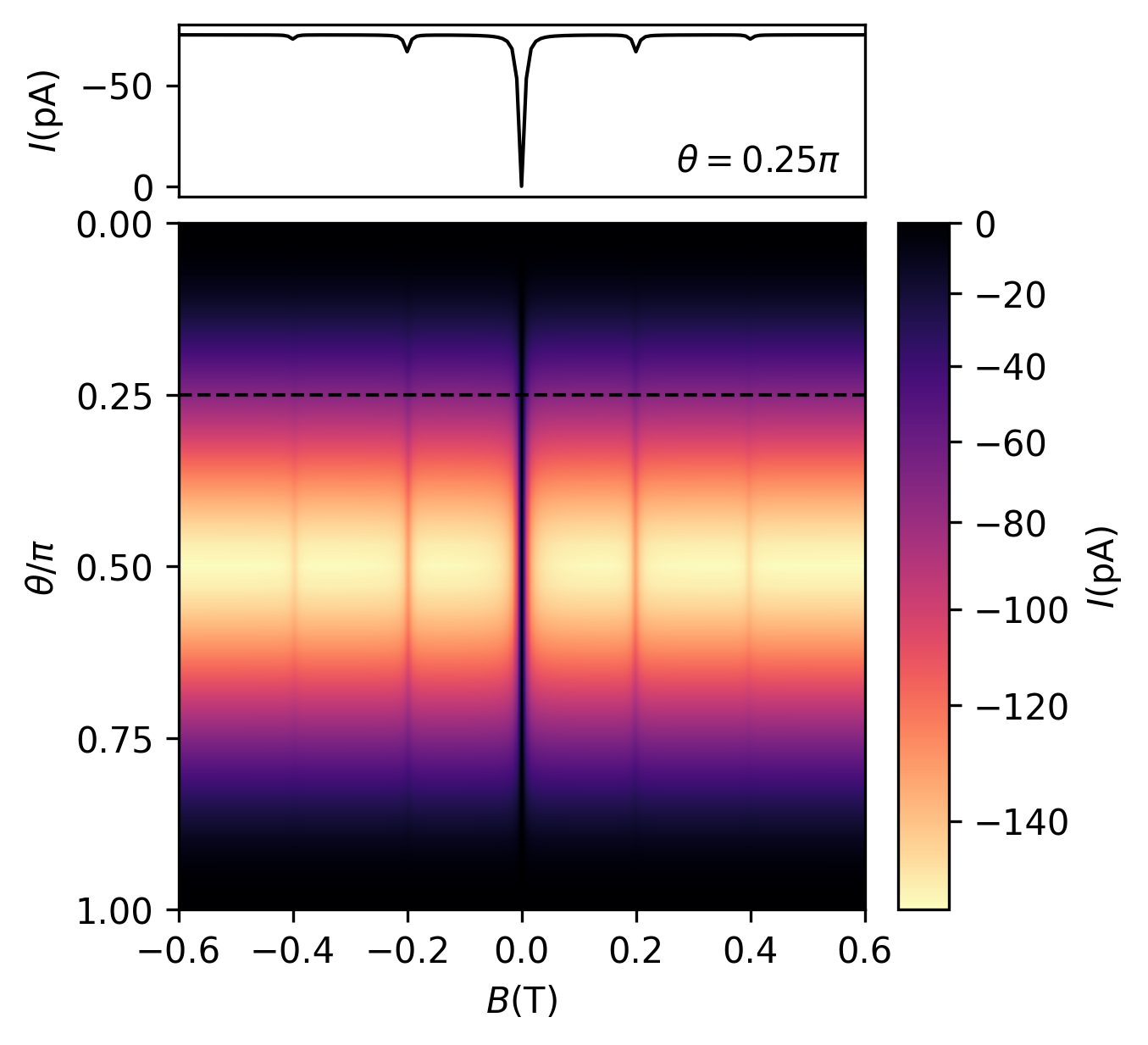
Figure 6: ZFF and EPR sidebands in sensor-spectator systems under AC-FLT and DLT driving; interplay of coherent and dissipative dynamics.
Conclusion
The paper establishes a unified density matrix approach to spin torques in QDs, rigorously separating coherent exchange field effects from dissipative spin-transfer torque via Lindblad master equations. Strong numerical evidence is presented, including real-time spin and charge dynamics, conductance spectra, and coupled spin scenarios. The theoretical structure is highly adaptable and relevant for contemporary experiments in quantum transport, STM-EPR, and QD-based spintronics, supporting future work on quantum-driven spin manipulation, decoherence, and entanglement control.