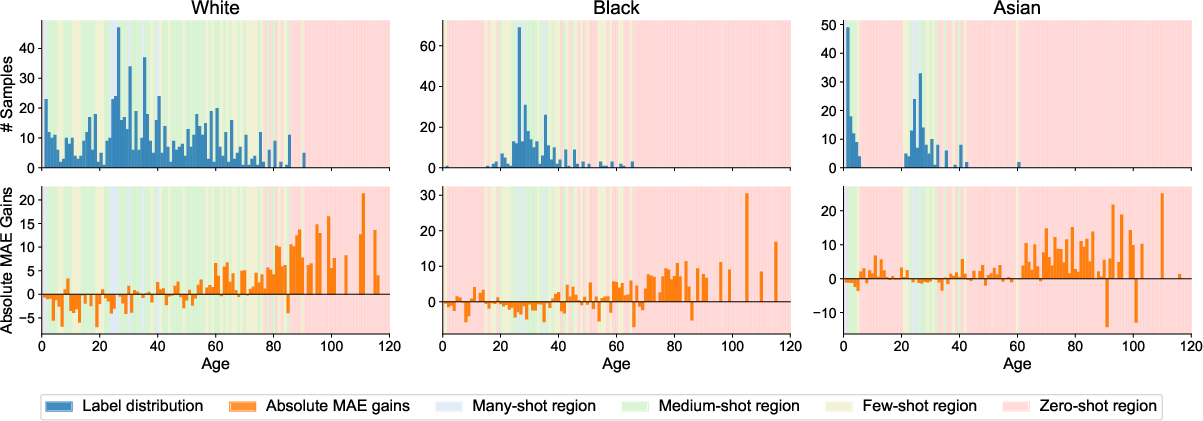
- The paper presents MDS-based smoothing techniques (L-MDS and F-MDS) that effectively address spurious correlations in continuous regression tasks.
- It demonstrates enhanced performance with cross-target and cross-attribute affinity modeling, especially in few-shot and zero-shot scenarios.
- Extensive experiments across vision, environmental sensing, and satellite data validate the robustness and practicality of continuous error smoothing over traditional methods.
Demystifying Deep Spurious Regression: A Structured Analysis of Attribute-Label Confounding in Continuous Prediction
The paper "Shortcut to Nowhere: Demystifying Deep Spurious Regression" (2606.01723) systematically analyzes deep regression tasks in the presence of spurious attribute-target correlations—a regime designated as Deep Spurious Regression (DSR). While prior literature largely restricts itself to classification with categorical labels and well-defined groups, this work rigorously formalizes and addresses spurious correlation challenges unique to continuous-valued targets, where the space of (y,a) combinations is dense, high-dimensional, and often sparsely sampled or missing in regions.
Unlike classification, where shortcut reliance is often diagnosed and combated by discrete group metrics and reweighting, regression models trained by ERM manifest attribute-dependent and highly non-uniform test error curves across the target axis. These failures cannot be captured by coarse group statistics, as made evident by the constructed ColoredRotatedMNIST experiment, in which low-data regimes do not always yield high error, and test performance can fail sharply at spurious attribute/target interface regions.
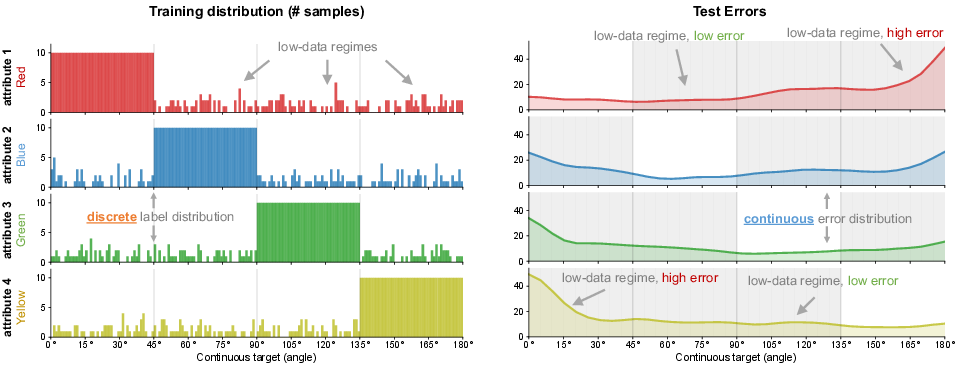
Figure 1: In DSR, spurious shortcuts manifest as attribute and target range-specific failures, highlighting continuous structure in test error that defies traditional discrete group analysis.
Structural Properties: Beyond Discrete Groups
The authors identify two foundational properties for DSR:
- Target Continuity: Regression targets possess inherent ordering and proximity not present in classification. Thus, error should be viewed as a smooth and structured function of target distance, motivating label-axis smoothing rather than hard binning.
- Attribute Similarity: Spurious attributes may be highly correlated, partially aligned, or disjoint in their marginal target distributions. This continuity motivates attribute-axis smoothing, recognizing shared statistical strength among similar attribute groups, particularly in sparse or zero-shot target regions.
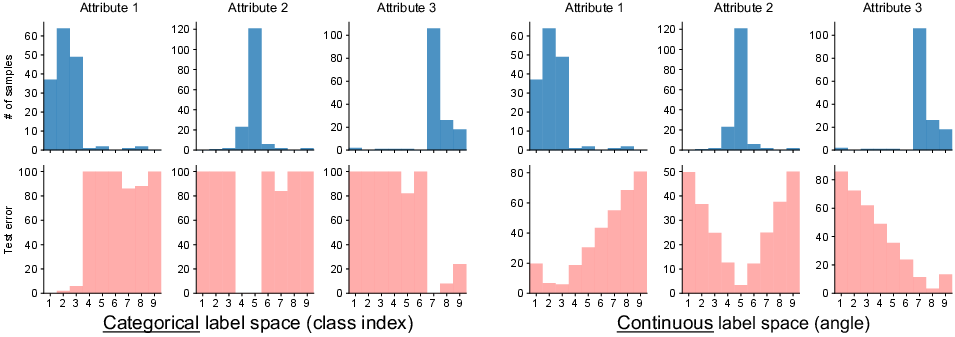
Figure 2: In classification, off-diagonal errors display group-wise collapse, while regression exhibits smooth error transitions as a function of target proximity.
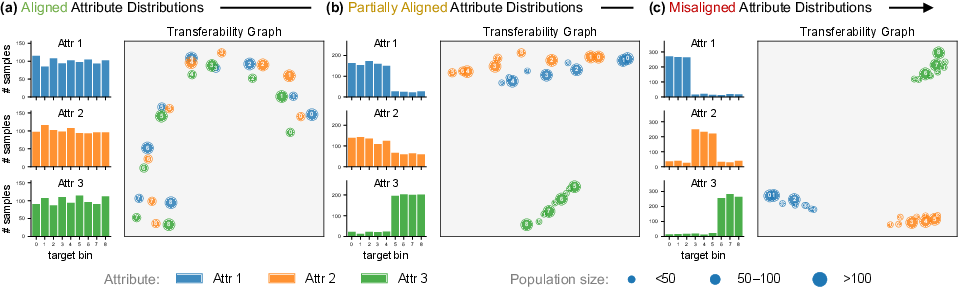
Figure 3: The learned embedding structure of spurious attributes reflects cross-attribute distributional similarity, motivating MDS-based information sharing for robust regression.
Methodological Contributions: MDS-based Smoothing
The central methodological advances are two kernel smoothing regimes exploiting Multi-Dimensional Scaling (MDS):
Label-MDS (L-MDS)
L-MDS constructs an attribute affinity matrix K based on Wasserstein-1 distances between empirical per-attribute target label distributions. This provides a natural and geometry-aware measure for cross-attribute smoothing. L-MDS thus enables attribute-aware density estimation and inverse-frequency reweighting for loss calibration.
Feature-MDS (F-MDS)
F-MDS measures similarity in the learned feature (embedding) space of the model, dynamically tracking the encoder’s representation geometry via periodic centroid re-computation and MDS. It adapts the affinity structure during training, enabling representation-driven attribute interaction. This addresses the potential misalignment of attribute and label distributions over the course of optimization.
Both variants combine attribute- and target-axis kernel smoothing, assigning sample weights that de-bias both marginal and joint {(y,a)} data sparsity.
Empirical Results and Robustness
Extensive experiments are performed on regimes ranging from vision (UTKFace for age regression with race as spurious attribute), environmental sensing (SkyFinder for temperature with camera ID), satellite-based poverty estimation (PovertyMap with country), and LLM regression for execution time prediction in code (CodeNet with programming language as spurious attribute).
Key empirical observations:
Abalations and Theoretical Implications
The authors conduct careful ablations on kernel type, weight functions, and regression objectives, supporting the claim that the observed gains are not tied to arbitrary hyperparameter choices or overfitting to a particular regression loss. Rather, they stem from the structural prior imposed by smooth affinity modeling.
Theoretically, this work exposes the inadequacy of discrete group-based worst-case analysis for regression under real-world spurious correlation, and positions structured distribution smoothing—grounded in continuous geometry—as a principled necessity for modern regression models.
Limitations and Broader Impact
The presented methods depend on the availability (and reliability) of explicit spurious attribute annotation. The generalizability of the approach to scenarios with partially observed, missing, or highly entangled attributes remains an open frontier. While L-MDS and F-MDS raise the floor of worst-group performance, in some dense regions there exists a potential minor trade-off in many-shot error versus extreme robustification.
The societal implications are substantial: improved DSR directly enhances the safety and reliability of predictive models in critical domains (medicine, environmental monitoring, social science). It also calls for careful consideration around transparency, subgroup evaluation, and responsible deployment, given that attribute-target confounding often intersects with fairness, privacy, and discrimination risks.
Conclusion
This work establishes a rigorous foundation for the study of spurious correlations in regression, introduces benchmark datasets and protocols, and demonstrates that multi-dimensional distribution smoothing in both label and feature space—especially when driven by MDS-based attribute affinity—substantially increases robustness to data sparsity and distribution shift. It advances the field toward principled, theoretically motivated tools for robust continuous-valued prediction and should serve as a touchstone for subsequent research in distributionally robust regression, subgroup auditing, and foundation model deployment in real-world environments.