- The paper demonstrates that the Ellis-Bronnikov wormhole produces brighter shadow regions and photon rings than Schwarzschild black holes due to extended photon paths and increased redshift factors.
- It employs GRRT simulations of spherically symmetric transonic accretion flows to generate synthetic images and intensity profiles for comparative analysis.
- The study implies that distinguishing horizonless objects from black holes will require future high-resolution VLBI observations to resolve near-horizon emission differences.
Ellis-Bronnikov Wormhole Shadows with Spherically Symmetric Accretion Flow: A Technical Review
Introduction and Motivation
The imaging of supermassive compact objects by the Event Horizon Telescope (EHT), particularly in M87*, has catalyzed renewed efforts to probe the strong-field regime of gravity via electromagnetic signatures. Beyond the canonical Kerr and Schwarzschild black holes (BHs), a variety of horizonless compact objects, including wormholes, remain phenomenologically viable as black hole mimickers. The Ellis-Bronnikov (EB) wormhole, a spherically symmetric solution in General Relativity (GR) supported by a phantom scalar field, serves as a prototypical theoretical framework for studying traversable wormholes. This paper performs a systematic comparison of synthetic shadow images generated via General Relativistic Radiative Transfer (GRRT) simulations for spherically symmetric accretion onto the EB wormhole and the Schwarzschild BH, with particular focus on observational degeneracies and distinctions accessible to current and near-future VLBI experiments.
Theoretical Framework: EB Wormhole and Geodesic Structure
The EB wormhole spacetime arises from the Einstein equations sourced by a massless phantom scalar and possesses two asymptotically flat regions joined by a throat at R=M. For M=0, the solution reduces to the symmetric Ellis wormhole; M=0 yields the generic EB wormhole with asymmetric ADM masses. Both massive and massless particle geodesics were analyzed to determine the effective potential structures, including the location of the innermost stable circular orbit (ISCO) and the photon sphere, critical for shadow formation. Unlike black holes, the absence of an event horizon enables photon trajectories that traverse the throat and return, and matter accretion can persist beyond what in the BH case would be the horizon.
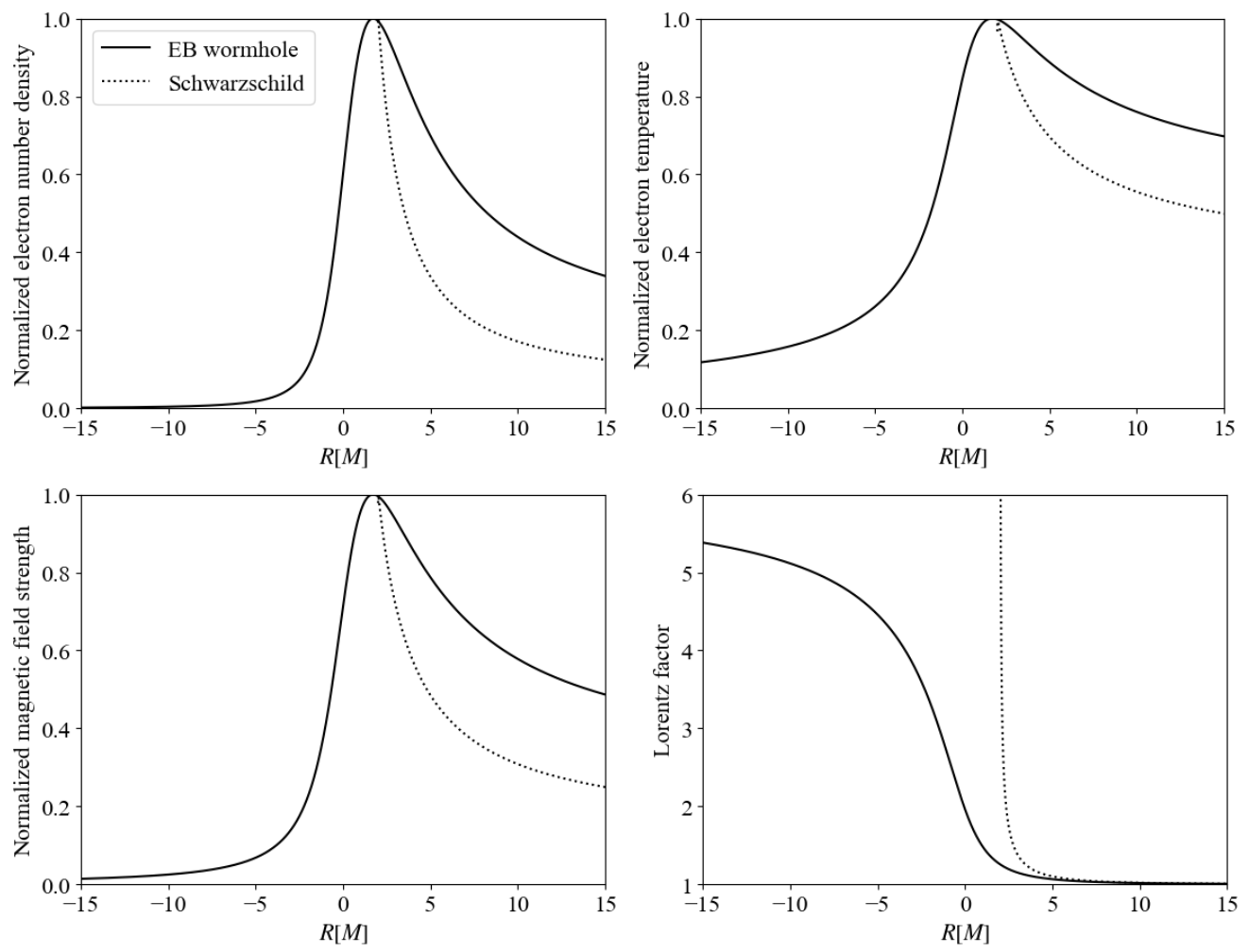
Figure 1: Distributions of the electron number density (top left), electron temperature (top right), magnetic field strength (bottom left), and Lorentz factor (bottom right) for fiducial-mass EB wormhole (solid) and Schwarzschild BH (dotted), normalized.
GRRT Methodology and Accretion Flow Models
To simulate observational signatures, spherically symmetric steady-state transonic accretion flows composed of polytropic fluid (Γ=4/3) were constructed for both EB wormhole and Schwarzschild geometries. The fluid profiles—electron number density, temperature, magnetic field strength (set by βp=0.1), and Lorentz factor—are normalized to achieve consistent total image fluxes (approximately $0.5$ Jy at 230 GHz, matching EHT M87* constraints). Synchrotron emission dominates, and synchrotron self-absorption is neglected under the optically thin assumption. The GRRT calculations, performed with Cartesian backward ray-tracing, capture frequency-dependent radiative transport along null geodesics originating from a 512×512 pixel observer screen.
Synthetic Images and Intensity Profiles
Simulations yield central shadow regions encircled by bright photon rings for both object classes. The fiducial-mass EB wormhole displays a photon ring of larger angular size than the Schwarzschild BH, while a "low-mass" EB wormhole (with M adjusted to match the BH's shadow size) facilitates a direct comparison of internal intensity structures.
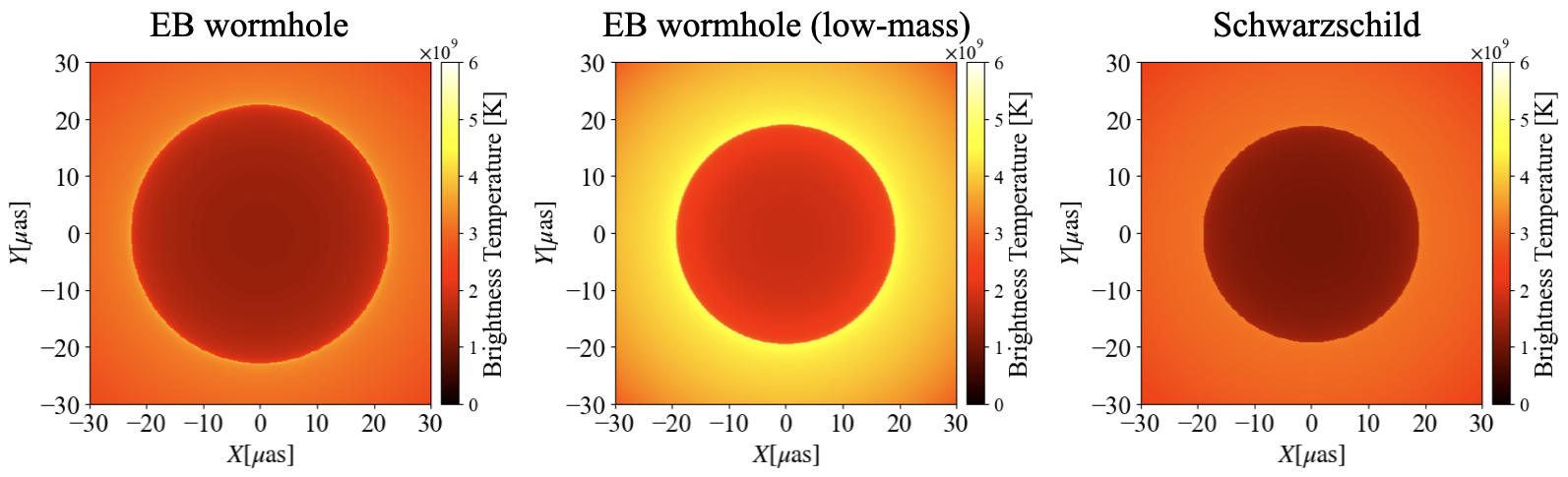
Figure 2: Simulated images of EB wormhole (left), low-mass EB wormhole (center), and Schwarzschild BH (right); color encodes brightness temperature Tb.
Notably, both the shadow regions and photon rings of the EB wormhole are systematically brighter than their black hole counterparts for matched accretion model parameters. Radial intensity profiles along the equatorial cut (Y=0) reveal the quantitative enhancement in the central brightness and photon ring flux for both EB wormhole cases compared to the BH.
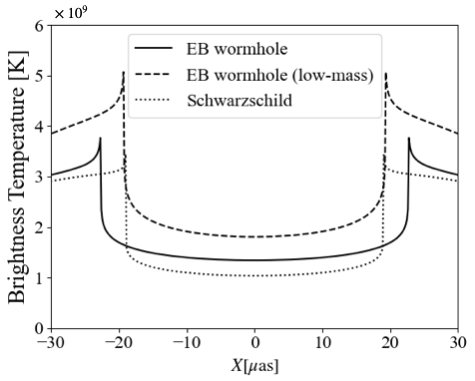
Figure 3: Intensity profiles along M=00 for EB wormhole (solid), low-mass EB wormhole (dashed), and Schwarzschild BH (dotted).
Physical Origin of Brightness Diskrepancies
The increased central intensity of the EB wormhole shadow directly results from the absence of an event horizon: photons emitted by accreting matter both around and inside the throat can reach the observer. In contrast, for the Schwarzschild BH, the event horizon causally disconnects interior emission. This is illustrated by profiles of the observed intensity, fluid rest-frame emissivity, and redshift factor along central geodesics.
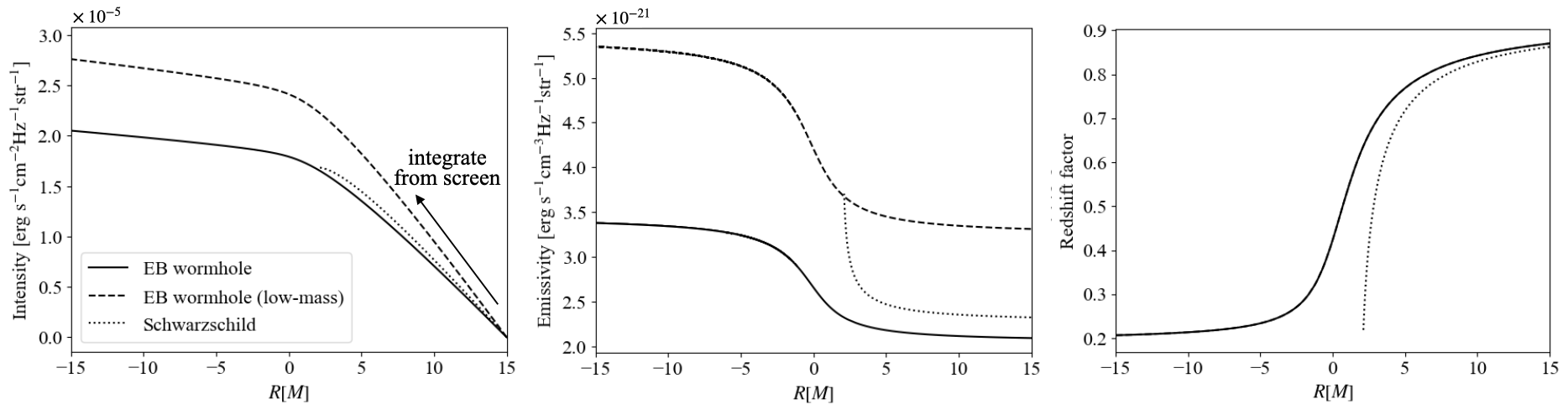
Figure 4: Observed intensity (left), fluid rest frame emissivity (center), and redshift factor (right) along the central geodesic for EB wormhole (solid), low-mass EB wormhole (dashed), and Schwarzschild BH (dotted).
For the photon ring, two effects amplify EB wormhole brightness compared to the BH:
- Longer Photon Trajectories: In the EB wormhole spacetime, the length of the geodesic segment producing the ring is larger (M=01 greater for the fiducial-mass case), thus integrating more emission.
- Redshift Factor Scaling: The redshift factor M=02 is consistently larger in the EB wormhole, increasing the observed intensity as M=03 in the GRRT formalism.
These effects are apparent along the ring-producing geodesics:
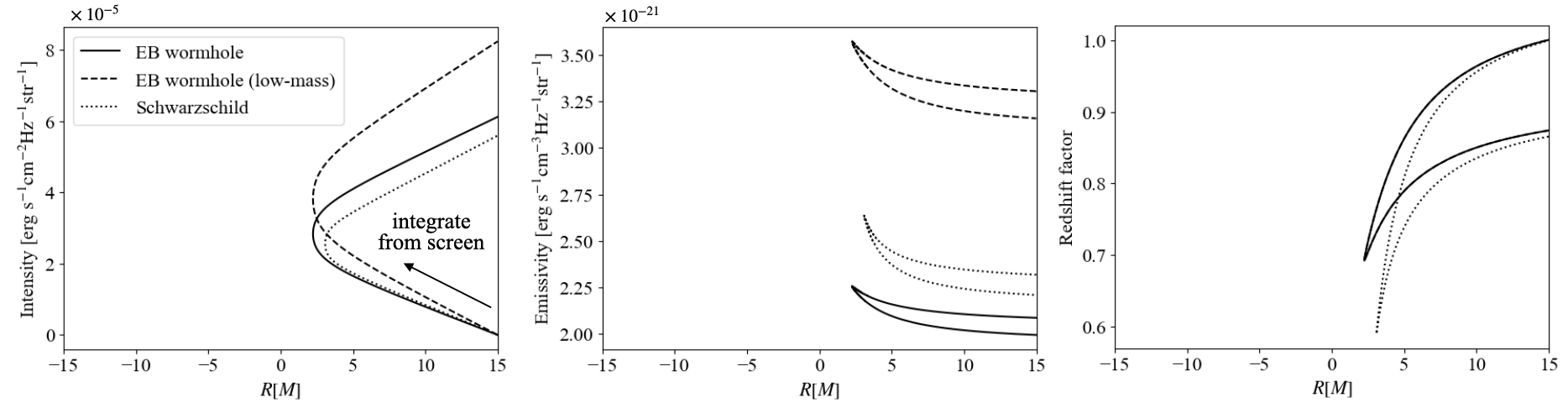
Figure 5: Observed intensity, emissivity, and redshift factor along the photon ring geodesic for all models.
The dominance of these two factors exceeds the enhancement of local emissivity found in the Schwarzschild region immediately outside the horizon, establishing a robust signature for wormhole spacetimes with accretion.
Imaging the Ellis Wormhole
A comparative simulation for the symmetric (M=04) Ellis wormhole demonstrates the same trend: the region inside the photon ring exhibits elevated intensity relative to the outer region. This is primarily because the redshift and emissivity are near-constant across the accretion flow in this configuration, making the intensity essentially path-length limited.
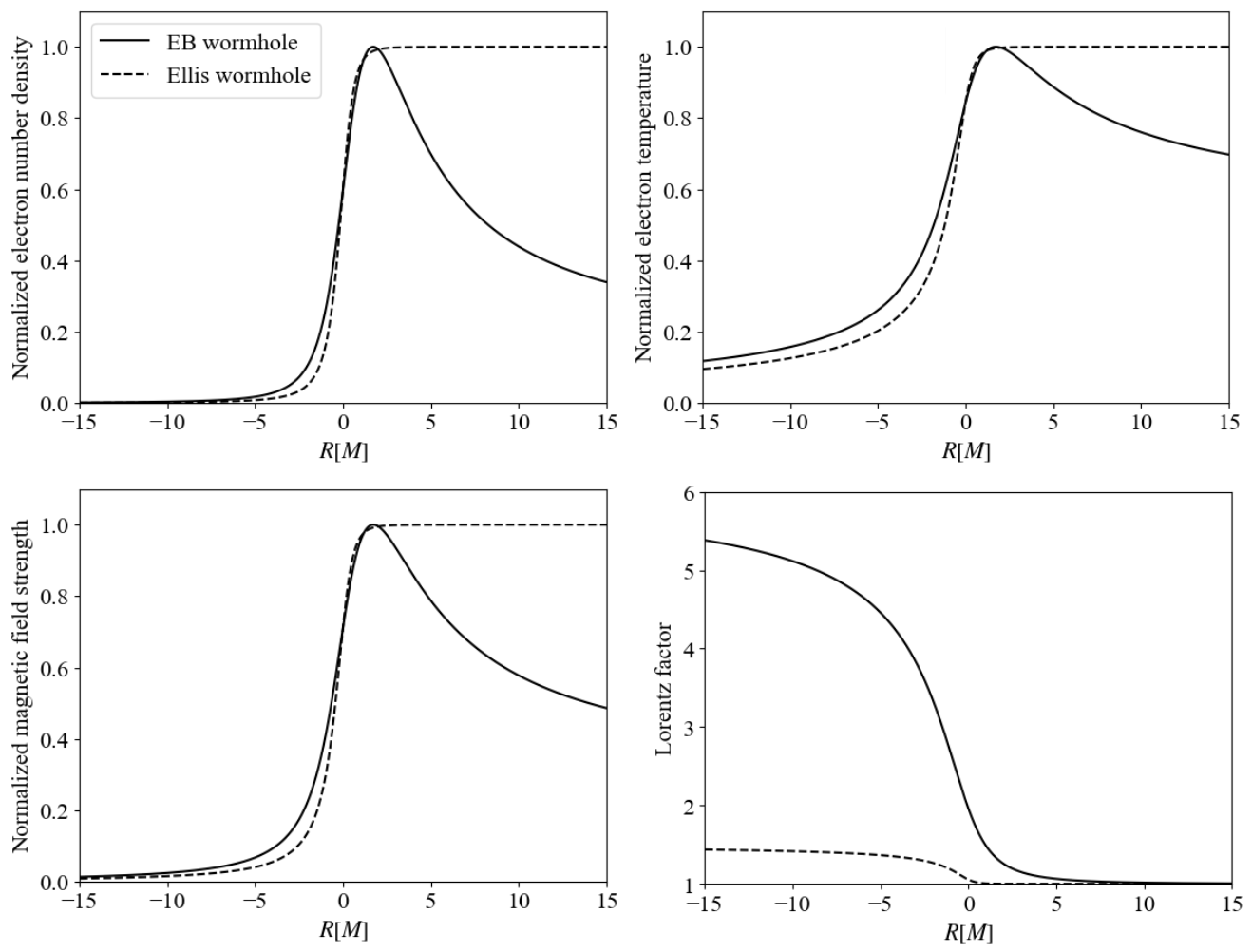
Figure 6: Fluid property distributions for EB (solid) and Ellis (dashed) wormhole.
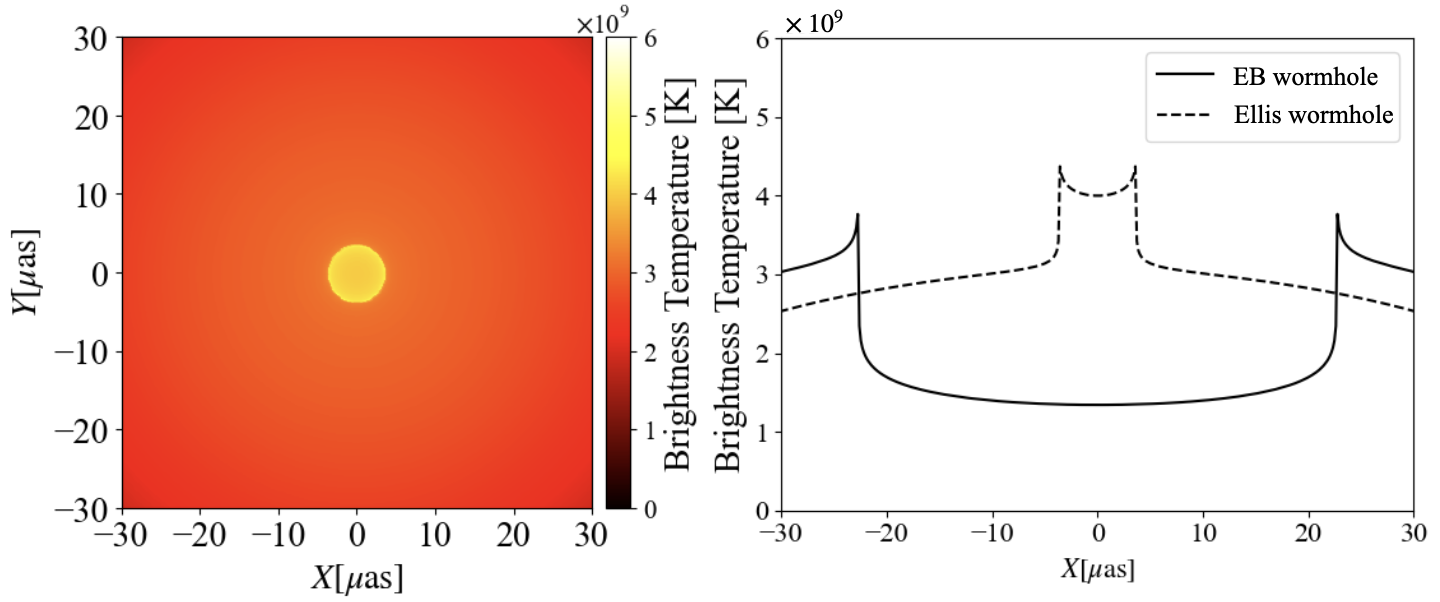
Figure 7: Simulated image (left) and intensity slice (right) for the Ellis wormhole; EB wormhole profile included for reference.
In such wormhole spacetimes with unity lapse, the redshift factor is determined entirely by the fluid motion, resulting in minimal variation compared to the scalar-field-dressed case.
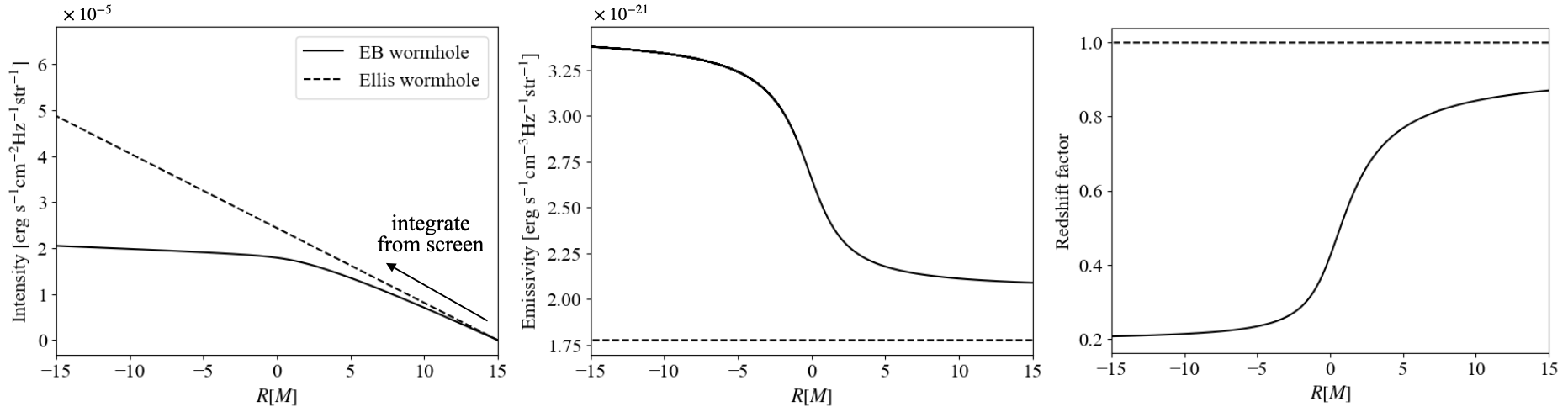
Figure 8: Observed intensity (left), emissivity (center), and redshift factor (right) along the central geodesic for EB and Ellis wormholes.
Observational Comparison with EHT and Implications
Aggregate observables—total flux, photon ring diameter, and central intensity depression—are extracted and benchmarked against EHT results for M87*. EB wormhole and Schwarzschild simulations both reproduce the EHT range for these metrics within uncertainties, with only a modest increase in central brightness for the wormhole (M=05 versus M=06 for the BH in terms of the maximum-to-minimum intensity ratio). The spherically symmetric accretion adopted in these models yields more symmetric and centrally filled images than those expected from realistic, axisymmetric disk accretion. Doppler beaming and disk inclination effects are expected to introduce significant brightness asymmetry, potentially enhancing features that could distinguish horizonless from horizon spacetimes with future high-resolution, high-dynamic range instruments.
Conclusion
Comprehensive GRRT simulations of spherically symmetric transonic accretion flows demonstrate that the EB wormhole produces brighter shadow regions and photon rings than a Schwarzschild BH, given equivalent mass and accretion model parameters. The surplus in intensity arises from the absence of an event horizon, enabling contributions from interior emission, and from increased photon path lengths and larger redshift factors on near-photon-sphere orbits. The resultant synthetic images are compatible with current EHT observations of M87* within uncertainties, underscoring the present challenge in using ring diameter and shadow contrast alone to rule out certain classes of horizonless alternatives. Future observations at increased angular resolution, especially those achievable via space-VLBI, are required to resolve these compact objects' near-horizon structure definitively. Extending these simulations to axisymmetric and GRMHD-driven accretion flows constitutes a necessary next step toward robustly distinguishing between wormholes and black holes using electromagnetic imaging.

