- The paper introduces an extensible quantum architecture employing low-shunt-capacitance couplers to mitigate capacitance loading in 2D fluxonium arrays.
- Methodology details tunability of couplers via external flux bias, enabling strong plasmon-mediated interactions and sub-100 ns CZ gates.
- Simulation results show coupling strengths of 250–650 MHz and CZ gate errors below 10⁻⁵, demonstrating scalable high-fidelity operation.
Extensible Fluxonium Architectures with Low-Shunt-Capacitance Tunable Couplers
Introduction and Motivation
Scalable, high-coherence quantum processors based on superconducting qubits remain a primary target in quantum computing hardware development. Fluxonium qubits exhibit long coherence times and strong anharmonicity, positioning them as a candidate for large-scale quantum processors. However, scaling from small prototype systems to densely connected two-dimensional (2D) arrays is nontrivial due to the "capacitance loading" problem: fluxonium qubits utilize small shunt capacitors, making it challenging to engineer many strong, controllable couplings in confined device geometries without degrading qubit parameters or introducing crosstalk. This paper proposes an extensible architecture leveraging low-shunt-capacitance tunable couplers, implemented via generalized flux-qubit circuits—specifically, quarton and fluxonium couplers—designed to efficiently interconnect fluxonium qubits in 2D grids while maintaining high gate fidelity and minimal spectator-induced error (2606.01647).
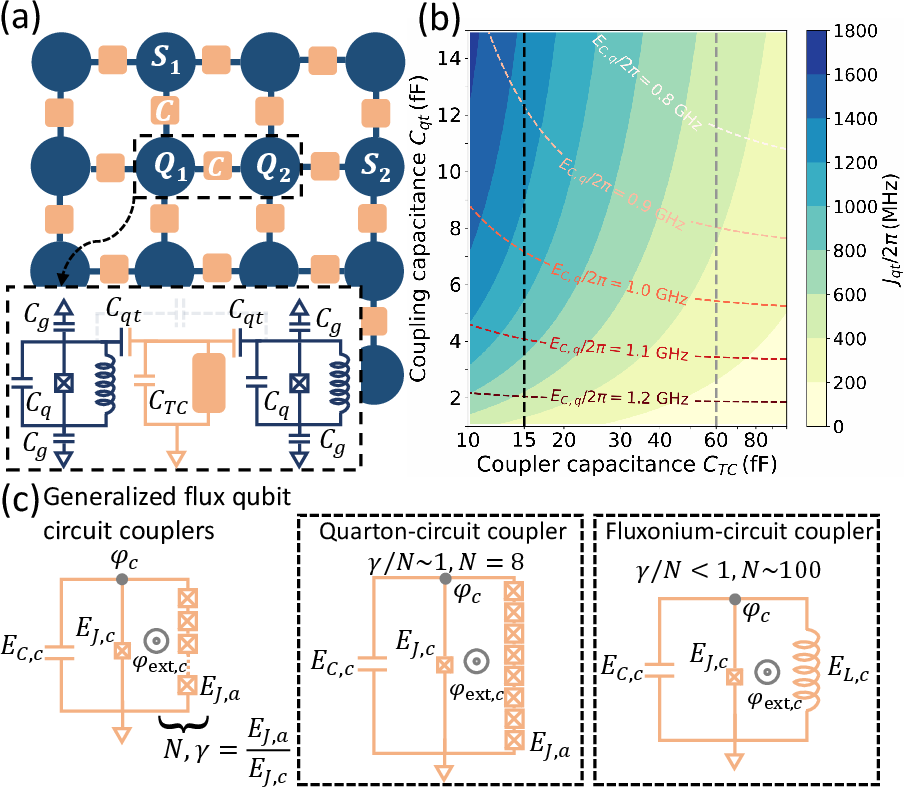
Figure 1: Schematic of a 2D square lattice of fluxonium qubits with low-shunt-capacitance tunable couplers, including device details and coupling capacitance dependencies.
Low-Shunt-Capacitance Circuit Design
The central architectural innovation is the adoption of couplers with small shunt capacitance. For a given coupling energy Jqt, the required coupling capacitance Cqt is reduced as the coupler's shunt capacitance CTC decreases, which preserves the fluxonium regime for the qubits and reserves greater capacitance budget for multiple connections within a 2D lattice. Theoretical analysis and circuit modeling demonstrate that—compared to transmon-based designs—low-shunt-capacitance couplers reduce Cqt by at least a factor of two for the same coupling strength.
The generalized flux-qubit circuit, on which both quarton and fluxonium coupler implementations are based, consists of a primary Josephson junction shunted by both a small capacitor and a Josephson junction array. Tuning the ratio of the Josephson energies (γ=EJ,a/EJ,c) and the number of array elements (N) enables distinct coupler functionality: quarton regime for γ/N∼1, fluxonium regime for γ/N≪1. Simulation results highlight that these designs support strong, tunable interactions while keeping the fluxonium qubits' charging energy and anharmonicity within optimal operational regimes.
Tunable Plasmonic Interactions and Spectator Error Suppression
A central issue in scaling fluxonium-based systems is the suppression of always-on crosstalk ("spectator" effects), which becomes increasingly dominant in large, highly connected systems. The proposed couplers allow for tunability of inter-qubit interactions via external flux bias, especially targeting the ∣1⟩↔∣2⟩ (plasmon) transitions in the fluxonium spectrum. Notably, at the computational transition ∣0⟩↔∣1⟩ ("sweet spot"), the system is passively decoupled due to weak dipole moments; in contrast, interactions involving plasmonic states can be modulated to high values, enabling fast entangling gates.
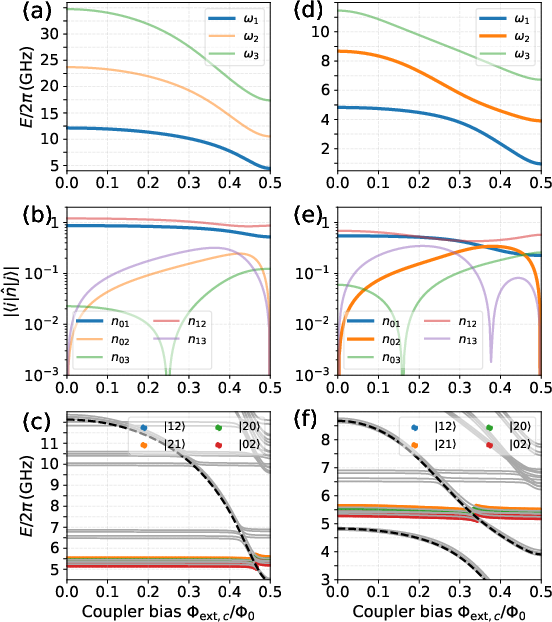
Figure 2: (a) and (d) show the energy spectra of quarton and fluxonium-circuit couplers, (b) and (e) display the transition dipole moments, while (c) and (f) illustrate full coupled system energy levels versus coupler flux bias.
Flux-tunable couplers realize dynamic on/off switching of plasmon-mediated interactions, optimized for high-fidelity two-qubit gates. The quantitative analysis reveals frequency shifts of tens of MHz in the plasmon regime—sufficient to support sub-100 ns controlled-phase gates—while maintaining sub-kHz residual Cqt0 coupling in the computational subspace.
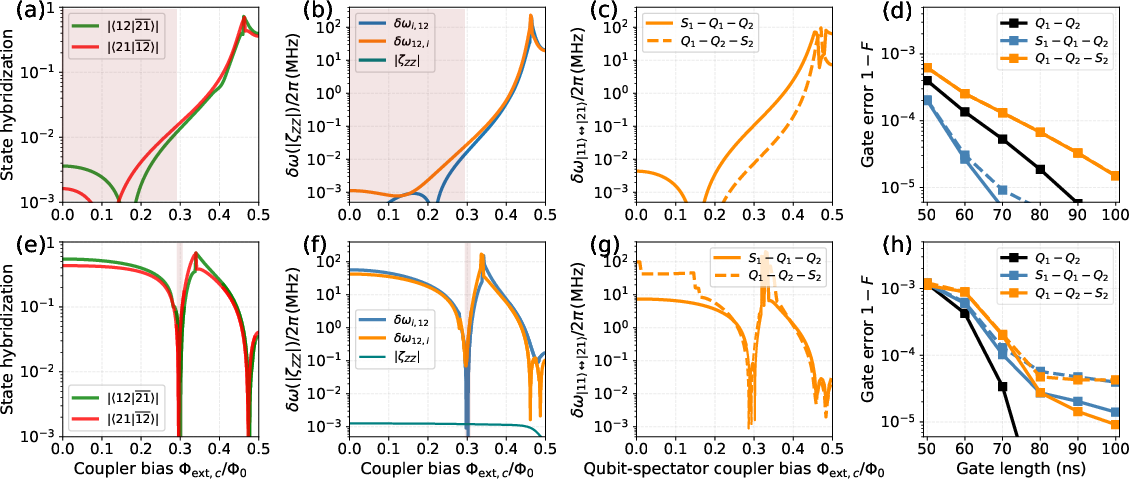
Figure 3: (a)-(b)/(e)-(f): State hybridization and frequency shifts for different coupler designs; (c)/(g): Residual gate frequency shifts due to spectators; (d)/(h): CZ gate errors as a function of spectator state and gate length, confirming effective spectator error suppression.
The practical efficacy is confirmed via multiqubit simulation, considering both direct and mediated coupling and the influence of various circuit parameters. Gate fidelity with an idle spectator qubit is sustained at levels comparable to isolated, two-qubit configurations (CZ error Cqt1), with negligible dependence on spectator population when coupler bias is properly tuned.
Comparative Analysis of Quarton and Fluxonium Coupler Implementations
Both quarton and fluxonium coupler regimes are systematically evaluated. The quarton operates analogously to a tunable transmon with strong nearest-neighbor transitions and efficient frequency tunability. The fluxonium-circuit coupler, in contrast, has a richer transition structure, enabling two distinct coupling mechanisms contingent upon coupler bias. Notably, a zero in the effective interaction is achieved at a particular bias point where competing transition pathways destructively interfere, further reducing unintended coupling in large device networks.
Strong numerical results support these claims:
- Achievable coupling strengths in the range of 250–650 MHz with Cqt2 as low as Cqt31.7–5.5 fF for the proposed designs.
- Passive suppression of non-computational-state interactions (Cqt4 below 1 kHz) across the computational subspace.
- CZ gate errors below Cqt5 even in the presence of spectator qubits, demonstrating robust scalability.
Implications and Future Directions
The proposed architecture addresses a key bottleneck in the extensibility of superconducting qubit arrays: integration of many small-footprint fluxonium qubits without performance degradation or excessive crosstalk. By enabling low-capacitance, tunable coupling in 2D lattices, this work outlines a pathway toward denser quantum hardware, compatible with advanced quantum error-correction schemes—including layouts with connectivity beyond square lattices.
Next steps include addressing residual issues such as:
- Sustaining coherence in noncomputational states and couplers beyond 10–20 Cqt6s.
- Engineering device layouts that balance qubit density and control wiring complexity, e.g., via floating metal islands to optimize spacing.
- Refining error-correction codes and logical architectures to exploit flexible connectivity afforded by compact couplers.
Theoretical results suggest the potential for further miniaturization and scaling, contingent on improvements in fabrication and materials, as well as integrated cryogenic control.
Conclusion
This paper introduces an extensible fluxonium-based architecture using low-shunt-capacitance tunable couplers capable of integrating 2D grids without sacrificing coherence or gate fidelity. By leveraging generalized flux-qubit circuit designs for the couplers, the approach achieves strong, tunable interactions and addresses capacitance loading and spectator error issues intrinsic to high-density device integration. These results represent significant progress toward scalable, high-performance superconducting quantum processors and establish a foundation for leveraging advanced quantum codes and device miniaturization strategies.

