- The paper establishes a robust framework using optical lattice clocks on drag-free satellites to detect gravitational waves via differential clock comparisons.
- It employs phase-coherent spin-echo protocols and advanced noise suppression techniques to achieve strain sensitivities near 10⁻²¹.
- The proposed architecture bridges the gap between LISA and ground-based detectors, enhancing sky localization and parameter estimation for astrophysical events.
Gravitational-Wave Astronomy with a Space-Based Optical Clock Network
Introduction and Motivation
The millihertz band of the gravitational wave spectrum hosts key astrophysical phenomena—from intermediate and supermassive black hole binaries to galactic structure signatures and stochastic backgrounds. While LIGO and successors dominate detection at higher frequencies, terrestrial noise—seismic, Newtonian, and anthropogenic—sets a fundamental low-frequency limit. LISA expands this reach to the mHz regime but is not optimized for higher frequency response above 10 mHz. Hybrid architectures employing atomic sensors, notably optical lattice clocks, provide a mechanism for extending high-sensitivity gravitational wave detection across unexplored decihertz to hertz decades in band, addressing critical science goals in intermediate-mass black hole mergers and early neutron star coalescence.
This work establishes a rigorous systems and measurement framework for space-based optical clock constellations as gravitational wave detectors, analyzing both their quantum and technical noise floors, detector response, and explicit parameter estimation protocols.
Differential Spaceborne Clock Comparisons
The foundational element is a set of optical lattice clocks deployed on drag-free satellites linked by a highly stabilized optical connection. Each satellite's atomic ensemble undergoes interrogation by a local clock laser, synchronized across the baseline through phase-locked transfer lasers referenced to ultra-stable optical cavities. This configuration enables clock comparison instability to be decoupled from laser coherence times, which are typically the dominant constraint in absolute frequency measurements.
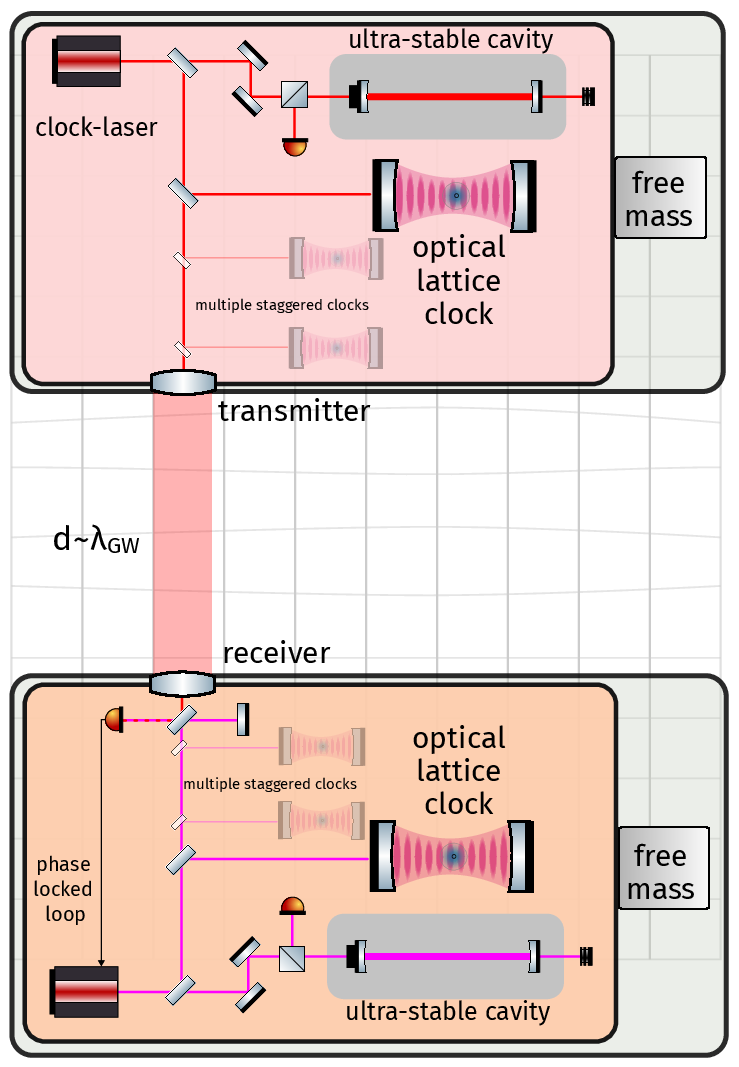
Figure 1: Differential clock comparisons across satellites enable gravitational wave detection via shared and cavity-stabilized laser links, with drag-free reference masses suppressing spurious acceleration noise.
The scheme exploits one-way Doppler tracking—the frequency shift in light pulses due to the spacetime strain induced by a passing gravitational wave—allowing for extended interrogation times that can approach atomic state lifetime, limited only by environmental coherence and residual systematic drifts. The interrogation enables the quantum-projection-limited sensitivity with direct phase extraction protocols compatible with spin-echo or advanced dynamical decoupling.
Detector Response and Frequency Dependent Antenna Pattern
The detector's sensitivity function and geometric response to gravitational wave polarization are formalized in a rigorous coordinate framework. The baseline's orientation with respect to incident gravitational waves and source geometry (θ, ϕ) defines the interferometric antenna pattern, including the frequency-dependent transfer function intrinsic to one-way links.
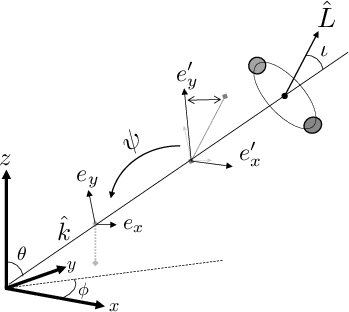
Figure 2: Schematic illustrating the geometry of the gravitational wave source, with (θ,ϕ) specifying sky position and detector polarization orientation.
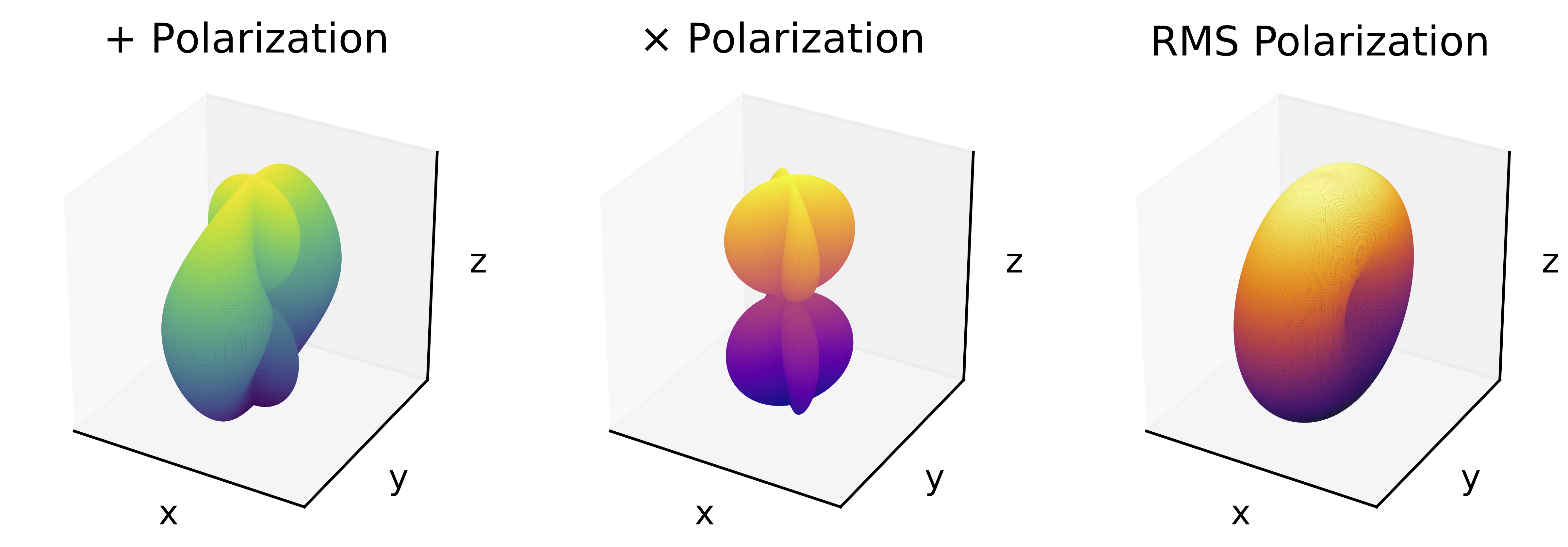
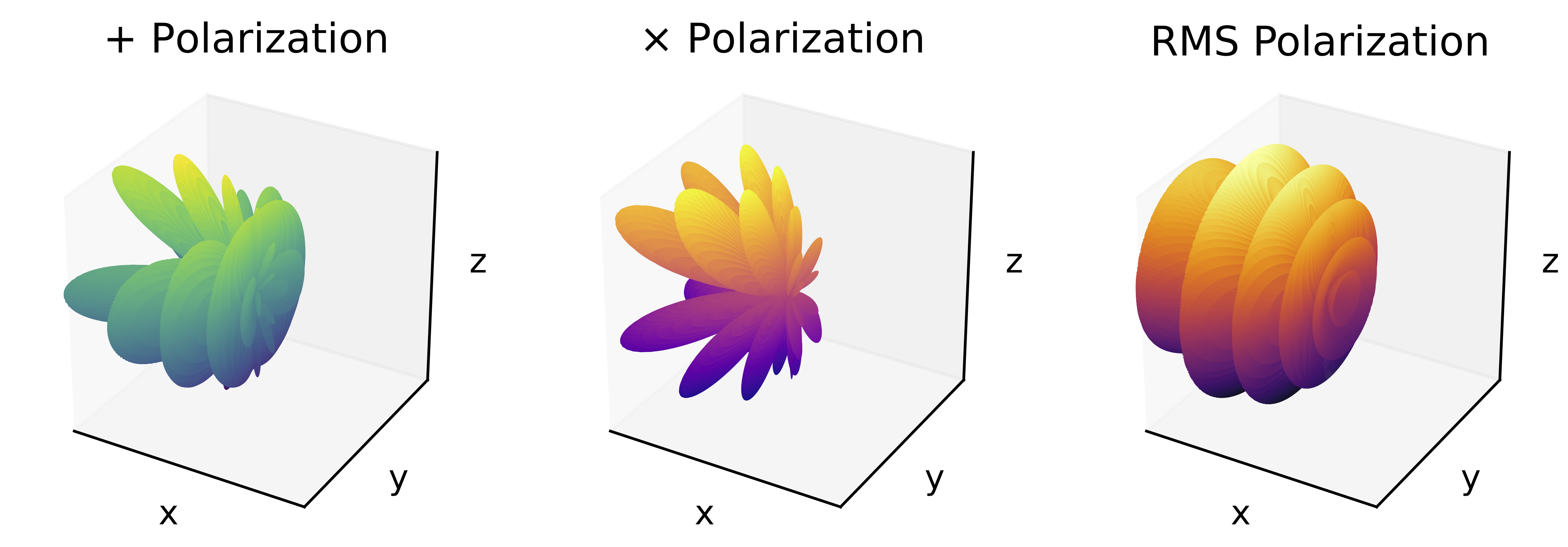
Figure 3: Antenna patterns for a one-way baseline demonstrate symmetry at 1 mHz and pronounced directional response at 100 mHz due to transfer function effects.
Strong, frequency-dependent asymmetries between forward and backward propagation become pronounced as fL/c approaches unity, with near-alignment of photon and wavevector directions yielding maximal coherent response ("surfing" effect). This is sharply distinguished from round-trip detectors, where transfer function averaging eliminates such directionality.
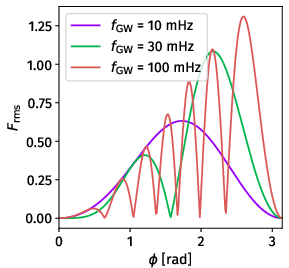
Figure 4: For θ=π/2, co-propagating and counter-propagating response asymmetry is evident; maximum sensitivity is reached when k^⋅n^≈1 due to coherent phase integration.
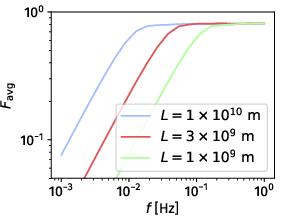
Figure 5: The frequency response, averaged over sky and polarization, with the baseline length controlling the low-frequency cutoff; high-frequency sensitivity is essentially flat.
Noise Budget and Strain Sensitivity
Multiple noise sources are systematically modeled:
- Quantum Projection Noise (QPN): For N=107 atoms, statistical fluctuations set the ideal frequency noise floor.
- Laser Phase Noise: The finite signal-to-noise ratio in the phase-locked inter-satellite link, convolved with the instrumental filter functions for Ramsey, spin-echo, and dynamical decoupling, is dominant in nonideal regimes. Finite Rabi frequency pulse shaping can strongly suppress broad-band laser noise, as demonstrated numerically.
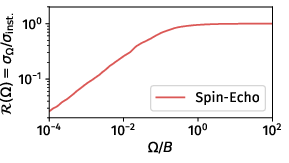
Figure 6: Laser noise suppression as a function of normalized Rabi frequency for spin-echo sequences; substantial noise reduction is achievable at Ω≪B.
- Residual Acceleration Noise: Modeled directly using LISA Pathfinder data, shown to be subdominant over day-long averaging times.
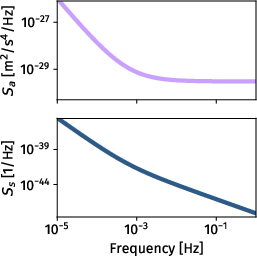
Figure 7: Power spectral density of acceleration noise, with translation into Doppler measurement noise floor.
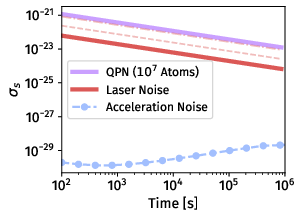
Figure 8: Allan deviation for noise sources shows QPN and residual laser noise dominate the measurement sequence, with acceleration-induced instability negligible.
The resulting strain sensitivity, assuming optimal pulse sequences and L=1010 m baselines, approaches h∼10−21 for multi-hour-long integration, competitive with or surpassing LISA in the critical intermediate band under optimistic laser noise scenarios.
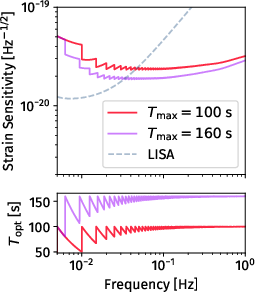
Figure 9: Computed strain noise curves for clock-based detectors highlight tunability by interrogation time and performance relative to LISA.
Measurement Protocols: Phase and Amplitude Estimation
The primary detection strategy leverages phase-coherent spin-echo sequences with staggered clock ensembles to extract signal quadratures at a known frequency, providing direct estimation of gravitational wave phase and amplitude even in the presence of significant technical noise.
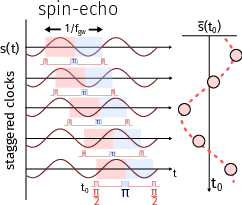
Figure 10: Protocol for phase and amplitude estimation using staggered, overlapping spin-echo interrogations.
Statistical simulations demonstrate that uncertainties on recovered phase and amplitude scale as ϕ0 and ϕ1, respectively.
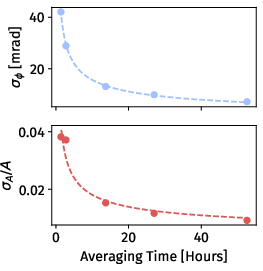
Figure 11: Uncertainty vs. averaging time: estimation error declines ϕ2 for both phase and amplitude.
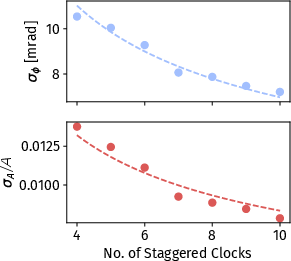
Figure 12: Uncertainty vs. number of staggered clock ensembles: more ensembles enhance the SNR as ϕ3.
Special consideration is given to chirping signals typical of compact binary inspirals. Dynamically updating interrogation windows to match instantaneous GW frequency and integrating phase evolution allows effective tracking and matched filtering in the presence of source-driven frequency drift.
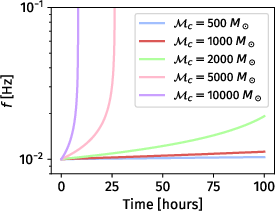
Figure 13: Frequency trajectories for GW inspirals highlight the limited stationary integration time for high-mass systems at ϕ4 mHz.
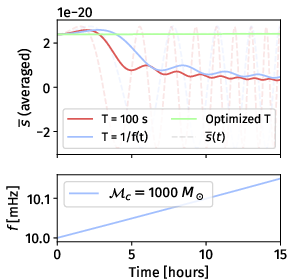
Figure 14: Averaging strategies for chirping signals: naive vs. protocol-aware interrogation windowing.
Network Architecture and Astrophysical Parameter Estimation
A model network comprises three satellite pairs (six links) in heliocentric orbit, each capable of multi-ensemble, phase-coherent operation. The composite network response, including relative amplitude and phase delays, allows full Bayesian inference of sky position, inclination, polarization, and strain amplitude for simulated binary black hole signals.
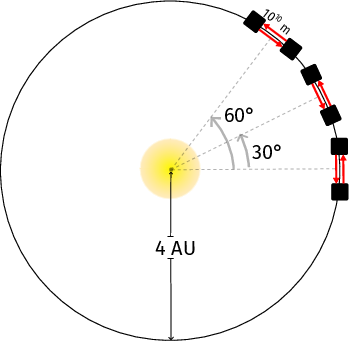
Figure 15: Example orbital configuration for a six-link, three-pair satellite clock network, each baseline ϕ5 m.
Posterior reconstructions confirm Bayesian coverage of injected source parameters, with localization precision improving with averaging time and signal strength.
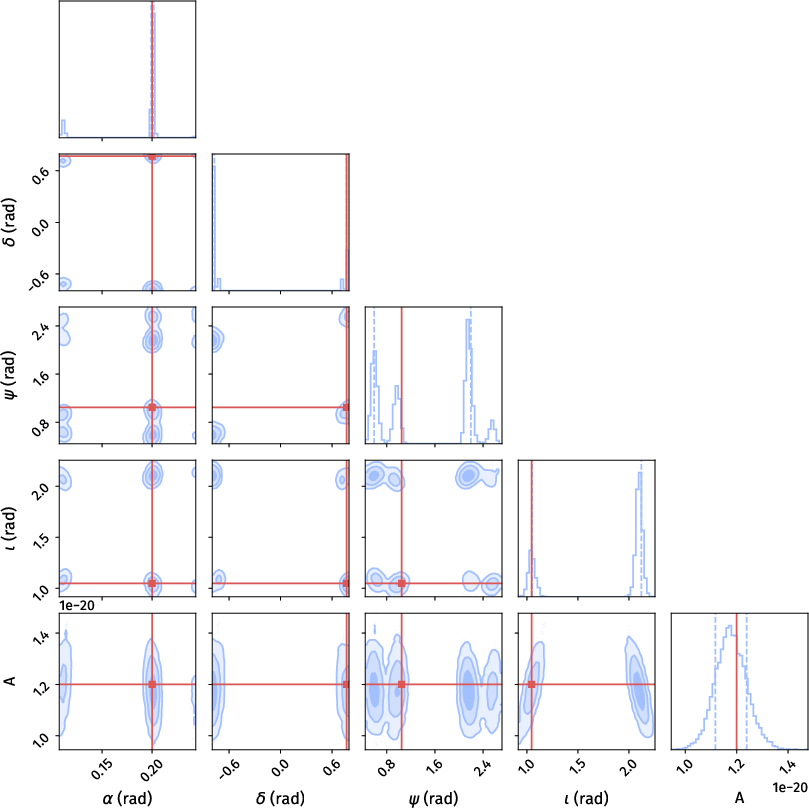
Figure 16: Corner plot of posterior distributions for simulated binary inspiral, validating recovery of injected astrophysical parameters.
Averaging over longer times reduces degeneracies in sky localization, despite the planar network configuration.
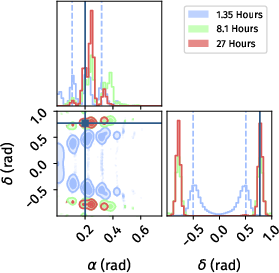
Figure 17: Progressive improvement in sky localization posteriors with increased integration time.
Source distance (redshift) directly controls attainable uncertainty in localization and strain amplitude reconstruction.
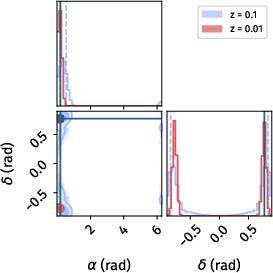
Figure 18: Sky localization posteriors for different source redshifts; higher amplitudes yield tighter constraints.
Systematic Error Floor and Technological Path
Control of time-varying systematic shifts from blackbody radiation, magnetic field, and lattice light fluctuations is necessary to maintain fractional frequency noise below ϕ6 over integration times commensurate with GW events. The work shows this is technically achievable with cryogenic clocks, interleaved magnetic sublevel measurements, and stabilized magic wavelength lattice configurations. Network performance is fundamentally limited by the atomic coherence time, interrogation protocol, and link phase stability.
Conclusion
This study establishes a comprehensive model for gravitational wave astronomy with a space-based optical clock network, demonstrating both the theoretical sensitivity floor and explicit parameter estimation capabilities achievable with next-generation optical lattice clocks. The architecture bridges the frequency sensitivity gap between LISA and ground-based detectors, with the potential to extend GW astrophysics into the decihertz domain. The protocols outlined provide a basis for practical signal extraction and sky localization, highlighting the complementarities between atomic and interferometric platforms.
Deployment of such a network would necessitate advances in space-qualified clock miniaturization, power budget optimization, and drag-free satellite stabilization, but the analysis here provides compelling evidence for the scientific value and the technical feasibility—particularly if emerging nuclear clock platforms can reach the required stability. The platform is also naturally suited for new regimes of tests of general relativity and exotic physics such as dark matter detection via temporal and spatial coherence signatures.
This work supplements the atomic, gravitational wave, and precision metrology communities with a detailed quantitative and architectural template for future hybrid networks and multi-messenger coordinated detection, motivating further development toward operational space-based atomic GW observatories.

