- The paper develops analytic solutions for the Wheeler-DeWitt equation by applying the Eisenhart lift to a Rosen-Lagrangian cosmological model.
- It employs a geometric reformulation that extends the minisuperspace and uses Bessel functions to solve the quantum cosmology equations.
- The results predict cyclic, bouncing universe scenarios and impose constraints on the dynamical cosmological constant parameter (λ > -2).
Analytical Solutions to the Wheeler-DeWitt Equation in Rosen-Lagrangian Cosmology via the Eisenhart Lift
Introduction
This paper undertakes a geometrical reformulation of quantum cosmology, focusing on the Rosen-Lagrangian cosmological framework where the cosmological constant is parameterized as a scale-factor-dependent field, Λ(a)=Λ0aλ. The central methodological advance is the employment of the Eisenhart lift, elevating the dynamical system to a 2D minisuperspace via an auxiliary cyclic field χ. This extension renders the cosmological Lagrangian purely kinetic, facilitating analytical solutions for the Wheeler-DeWitt (WDW) quantum cosmological equation. The work analyzes both the classical and quantum consequences, the structure of the conformal factor via conformal Killing equations, and the emergence of cyclic or bouncing universes dependent on the parameter choice for λ. Additionally, explicit analytic solutions in terms of Bessel functions for the WDW equation are derived, elucidating the quantum structure of such cosmologies.
The Rosen-Lagrangian framework is characterized by promoting the cosmological constant Λ to a dynamical quantity with explicit scale factor dependence, Λ(a)=Λ0aλ. This approach naturally interpolates between standard ΛCDM cosmology (λ=0) and a broader class of dynamical dark energy models, with associated matter degrees of freedom strictly in the energy density sector. The effective potential and the resulting Hamiltonian reproduce the canonical Friedmann and acceleration equations, while permitting broader phenomenology for λ=0.
The Eisenhart lift transforms the 1D minisuperspace trajectory (in a) onto a 2D configuration space (a,χ), where the Rosen Lagrangian is recast into a purely kinetic term:
χ0
Here, χ1 denotes the effective potential and χ2 is an introduced mass scale. The auxiliary field χ3 is cyclic, directly encoding a conserved quantity into the formalism.
The configuration space is manifestly a 2D Riemannian manifold with the lift metric:
χ4
Geodesic analysis and the explicit calculation of Christoffel symbols show that the dynamical system is governed by coupled equations where the Eisenhart condition χ5 ensures consistency with the Friedmann framework.
A distinctive feature of the Eisenhart-lifted framework is the transparent extraction of underlying symmetries via conformal Killing equations. The conformal factor is determined as
χ6
This structure directly relates the evolution of the scale factor to the underlying geometry of configuration space. The explicit analytic form of the Killing vectors and the corresponding conserved charges elucidate integrable sub-classes and enable construction of hidden symmetries, potentially relating the Eisenhart-lifted system to broader classes characterized by Noether symmetries.
The behavior of the universe (cyclic, re-collapsing, or bouncing) is dictated by χ7, with the maximum scale factor given by χ8, and the cyclic period connected to the Eisenhart lift constant of motion. For χ9, the universe undergoes cyclic evolution with an oscillation period compatible with observationally inferred upper bounds from quantum memory universe considerations.
Quantum Cosmology: Wheeler-DeWitt Equation and Analytic Solutions
The Eisenhart lift significantly simplifies the canonical quantization of the theory. In the lifted space, the Wheeler-DeWitt equation assumes the form (with the Laplace-Beltrami operator and vanishing quantum correction due to λ0):
λ1
Separation of variables yields an ODE for λ2, which upon a variable transformation reduces to a Bessel equation; the general solution is expressed as:
λ3
where λ4, λ5 encodes the quantum number associated with the cyclic field λ6, and λ7, λ8 are elementary Bessel functions.
The parameter λ9 thus governs the quantum (semiclassical) structure of cosmological evolution, affecting oscillation frequency and the semiclassical limit. For increasingly positive Λ0 (or Λ1), more rapid oscillations in the WDW wavefunction are observed, indicating a robust classical correspondence at large Λ2. In contrast, for negative Λ3, quantum gravitational effects dominate at small scale factor.
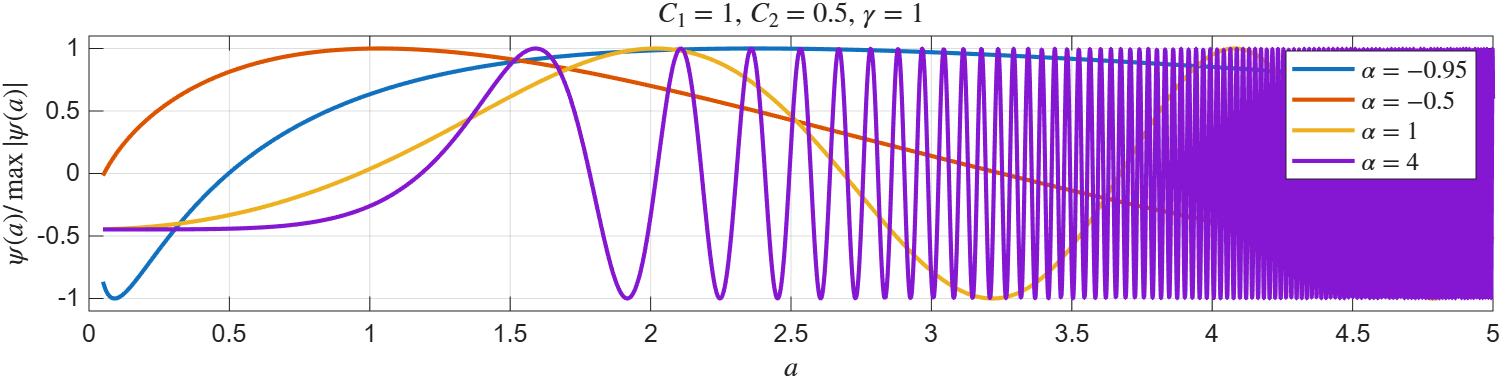
Figure 1: Oscillatory behavior of the Wheeler-DeWitt wavefunction solution as a function of the scale factor Λ4 for several values of Λ5 (Λ6), with increasing Λ7 driving more rapid oscillations.
This structure underlies the assertion that the existence, normalization, and physical relevance of quantum cosmological states are contingent on Λ8, i.e., Λ9.
Physical Implications and Prospective Developments
The formalism provides a precise analytical mapping between geometry, symmetry, and quantum cosmological states in models with dynamical dark energy. The Eisenhart lift completes the geometric structure of the Rosen-Lagrangian cosmology, indicating that cyclic and oscillatory solutions can be generically realized with suitable parameter choices. The WDW equation's analytic tractability in this setting exposes the impact of dynamical cosmological terms on quantum gravitational boundary conditions and the emergence of semiclassical epochs.
The results directly inform questions on cosmic recurrence times, the quantization of periodic cosmological models, and scenarios where the universe undergoes nonsingular bounces. The construction is extendable: coupling to additional fields (e.g., scalar-tensor gravity, non-minimal coupling) or modified gravities would generalize the structure of Λ(a)=Λ0aλ0 and might produce richer symmetry algebras and more diverse quantum structures.
From an integrability perspective, interplay between Eisenhart and Noether symmetries is suggested as a key route for classifying exact cosmological solutions. Direct analytic correspondence between conserved charges in the Eisenhart-lifted theory and observable cosmological parameters remains an avenue for exploration, with potential to constrain dynamical Λ(a)=Λ0aλ1 models via cosmological surveys.
Conclusion
This work establishes that the Eisenhart lift facilitates a transparent and tractable analytic approach to quantum cosmology in Rosen-Lagrangian models with a dynamical cosmological term. The formalism unifies geometric, symmetry, and quantization methods, yielding cyclic and bouncing cosmologies, and explicit Wheeler-DeWitt wavefunctions. Physical and mathematical consistency demands Λ(a)=Λ0aλ2, placing significant constraints on models with varying dark energy. Future research should address extended symmetry structures, matter couplings, and observational consequences in more general dynamical gravity scenarios.
Reference: "Analytical Solutions to the Wheeler-DeWitt Equation in Rosen-Lagrangian Cosmology via the Eisenhart Lift" (2606.01500)

