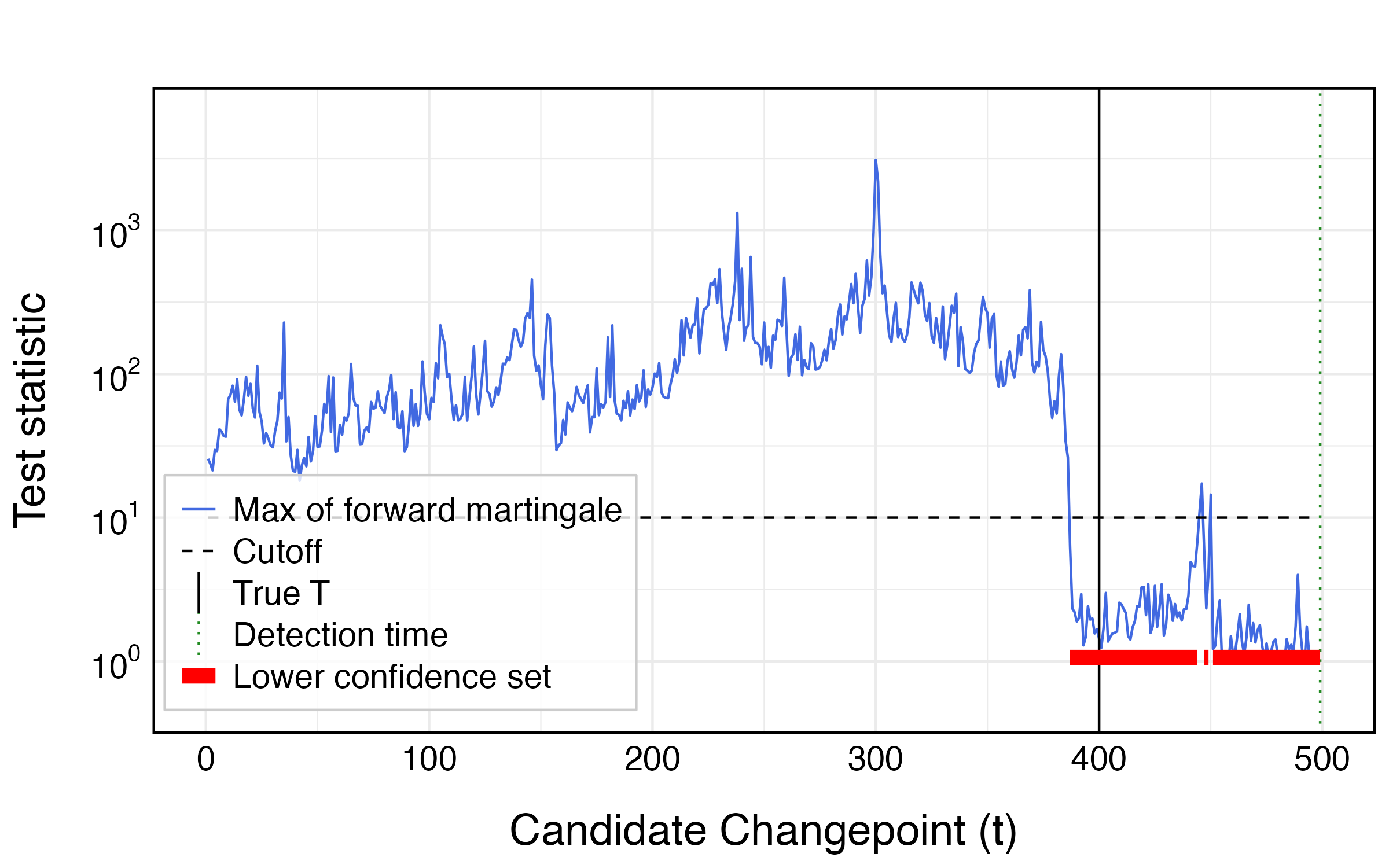
- The paper introduces the first finite-sample, distribution-free method for constructing post-detection confidence intervals for changepoints.
- It leverages conformal martingales and p-values derived from user-specified score statistics to yield lower, upper, and two-sided confidence sets.
- Empirical evaluations on Gaussian, MNIST, and wine data demonstrate that the method achieves sharp, controlled localization even under challenging signal regimes.
Distribution-Free Changepoint Localization After Sequential Change Detection
This paper addresses inferential questions in the context of sequential changepoint detection, considering a data stream X1,X2,… where at some unknown T, the distribution shifts from F0 to F1—both otherwise unrestricted and possibly high-dimensional. While conformal test martingales enable nonparametric, distribution-free sequential change detection, they do not provide uncertainty quantification for the changepoint’s location. Historically, post-detection confidence sets for T have assumed parametric models for F0 and F1 or limited the classes of distributions. The present work introduces the first framework for constructing finite-sample, distribution-free post-detection confidence intervals for changepoints, which is agnostic to both the data model and the detection algorithm.
This is critical in practical monitoring scenarios—such as quality assurance, industrial sensor streams, network security, or large-scale data monitoring—where model assumptions are often implausible. The framework ensures that, following a sequential detection alarm, one can specify with controlled (conditional or unconditional) coverage a valid confidence set for when the change occurred, regardless of the statistical characteristics of the signal distributions.
Distribution-Free Inferential Framework
The methodology leverages conformal inference, specifically conformal test martingales, to facilitate both lower and upper post-detection confidence sets, requiring only exchangeability within pre- and post-change segments. The construction does not assume independence between segments nor knowledge of F0, F1, or their parametric forms.
For each candidate changepoint t≤τ (where T0 is the sequential detection stopping time), the null hypothesis T1 is tested against alternatives T2 ("lower" set) and T3 ("upper" set):
- Lower confidence set: For each T4, a conformal martingale based on p-values derived from a user-specified score statistic T5 is run forward from T6. The test aggregates evidence against T7, retaining T8 in the set if this evidence remains below a calibrated threshold.
- Upper confidence set: A similar process is run backward, using a potentially different score T9.
- Two-sided interval: The intersection of upper and lower sets provides a valid, doubly-sided F00 confidence set for F01.
Calibration utilizes Monte Carlo simulations (using any distribution due to the detection procedure's distribution-freeness) to estimate F02, ensuring adaptivity and coverage control. Notably, this "wrapper" approach is compatible with any underlying sequential detection scheme.
Theoretical Guarantees
Coverage: All confidence sets, under minimal exchangeability assumptions, are shown to achieve conditional coverage at the specified level (e.g., F03). For detectors controlling the probability of false alarm, the coverage is unconditional.
Set size analysis: Rigorous nonasymptotic and asymptotic analysis quantifies the expected size of the constructed confidence sets conditional on correct detection. With suitable signal-to-noise (score discriminability) and detection delay regime, the expected confidence set width is shown to remain F04 (i.e., uniformly bounded) as F05 or decays as F06. Notably, even without distributional assumptions, the localization error does not increase with sample size in regimes typical of practical changepoint detection.
Score function selection: While validity is guaranteed for any score, set sharpness improves dramatically if the score approximates the likelihood ratio or a monotone surrogate (in the sense of Neyman-Pearson optimality); in practice, data-driven or pretrained scores can be incorporated.
Empirical Evaluation
The framework is thoroughly evaluated on simulated and real-world changepoint scenarios:
- Gaussian mean change: Demonstrates that two-sided confidence sets localize the changepoint tightly around the true F07 with high probability, even as F08 increases.
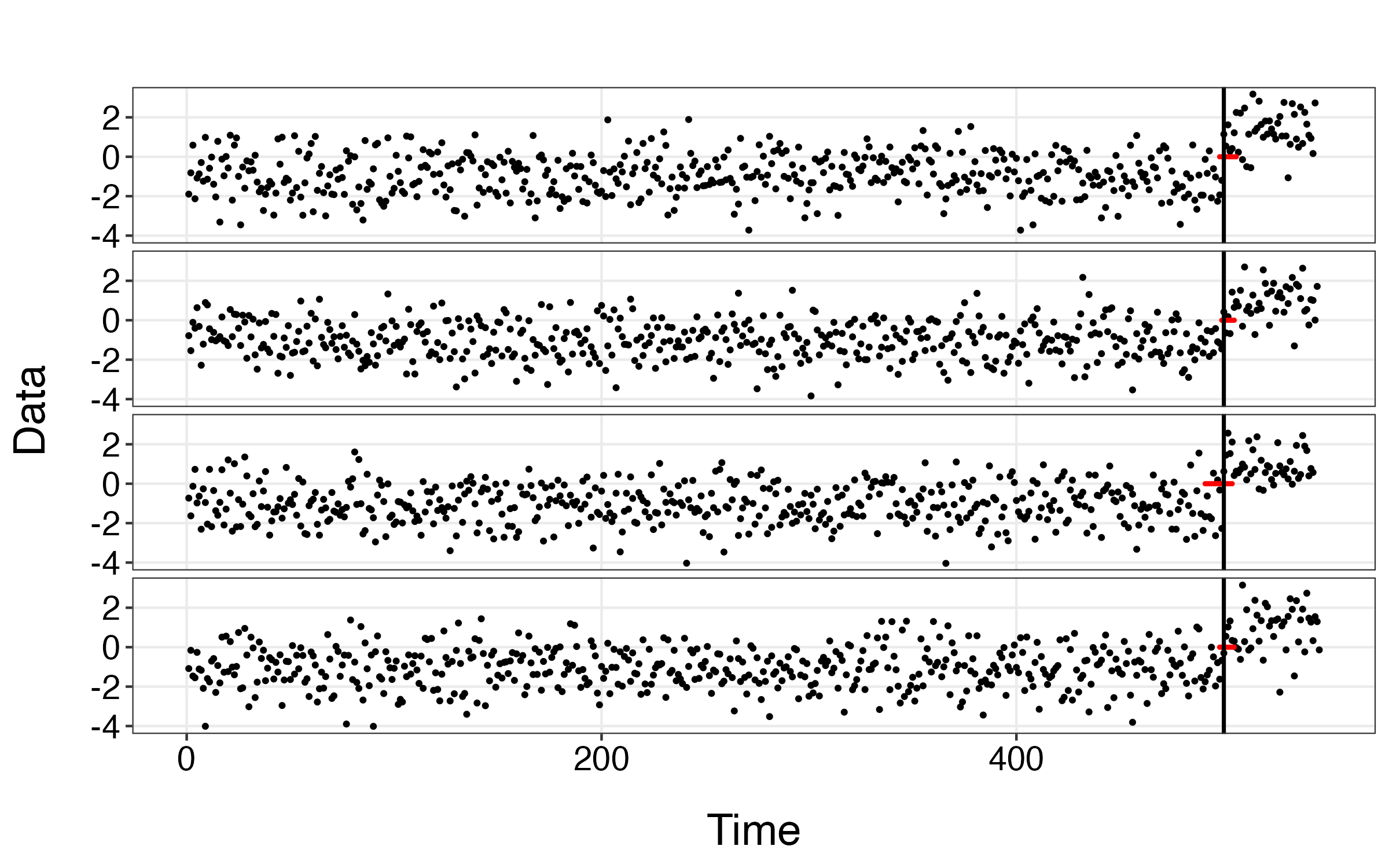
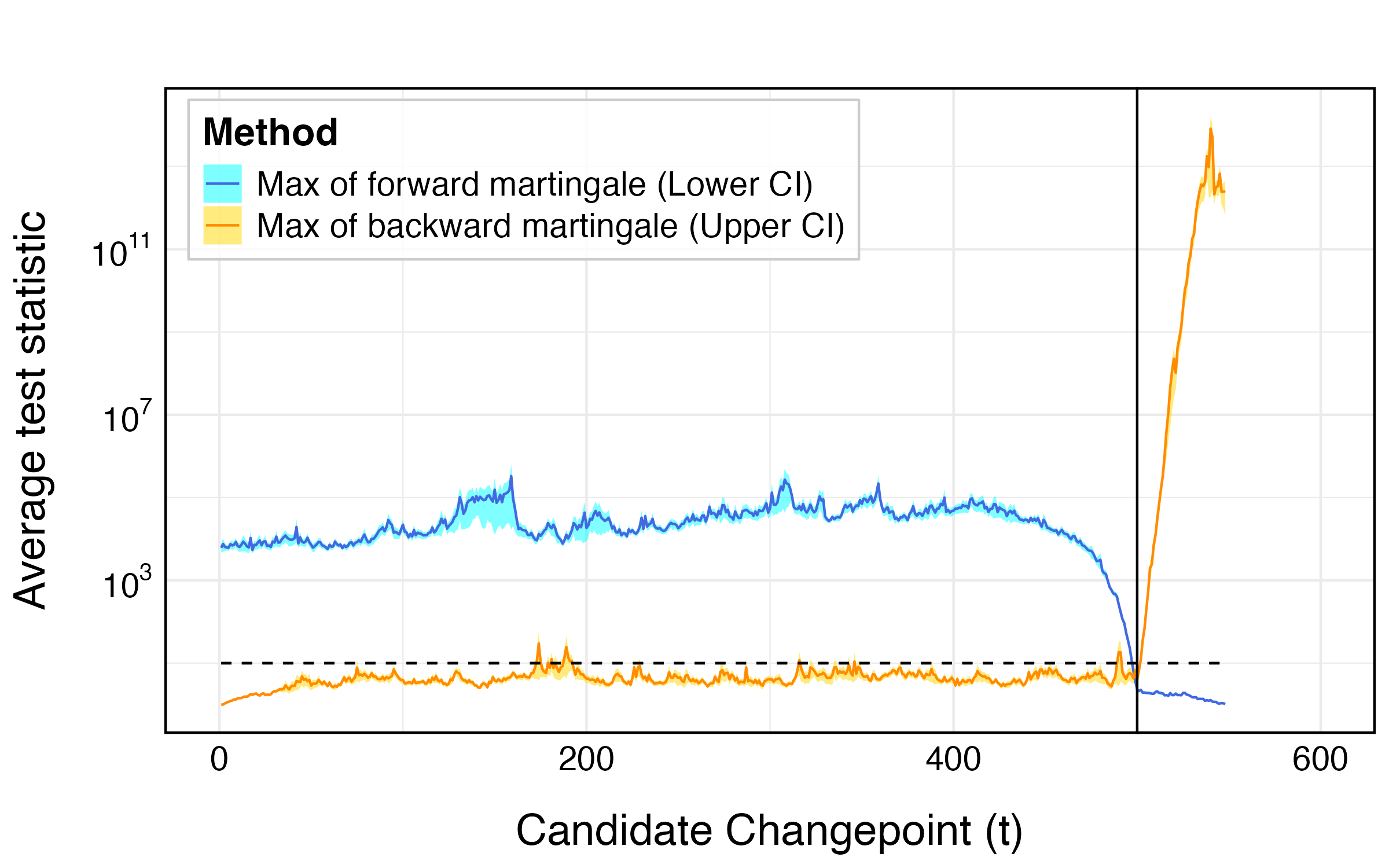
Figure 1: (Left) Raw data stream with detected changepoint and corresponding two-sided confidence sets; (Right) Averaged test statistics exhibit a clear drop at the changepoint, with the threshold marked for easy interpretation.
- MNIST digit shift: On image streams transitioning between digits, the two-sided confidence sets remain narrow at the true transition time, even with class mixing.
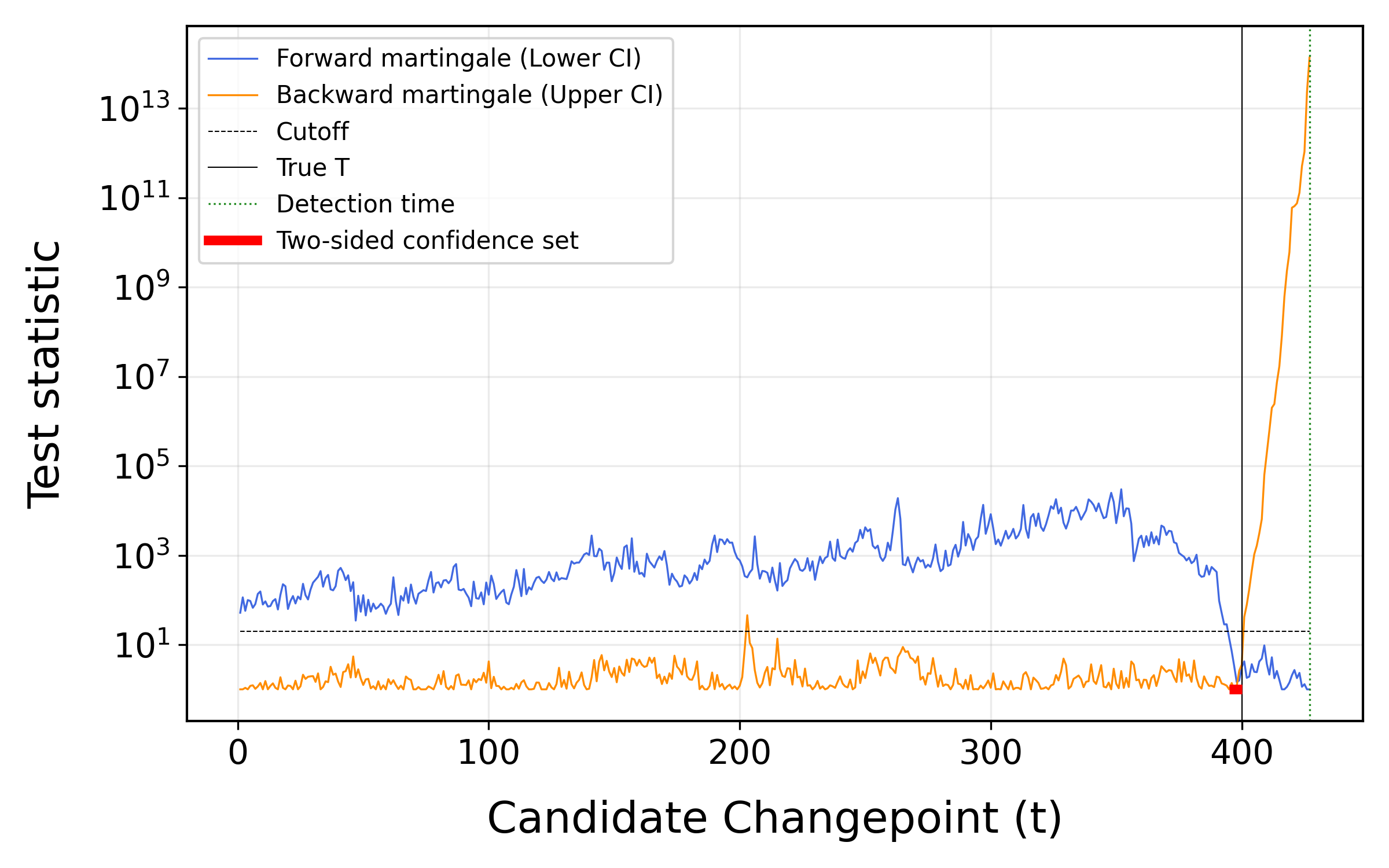
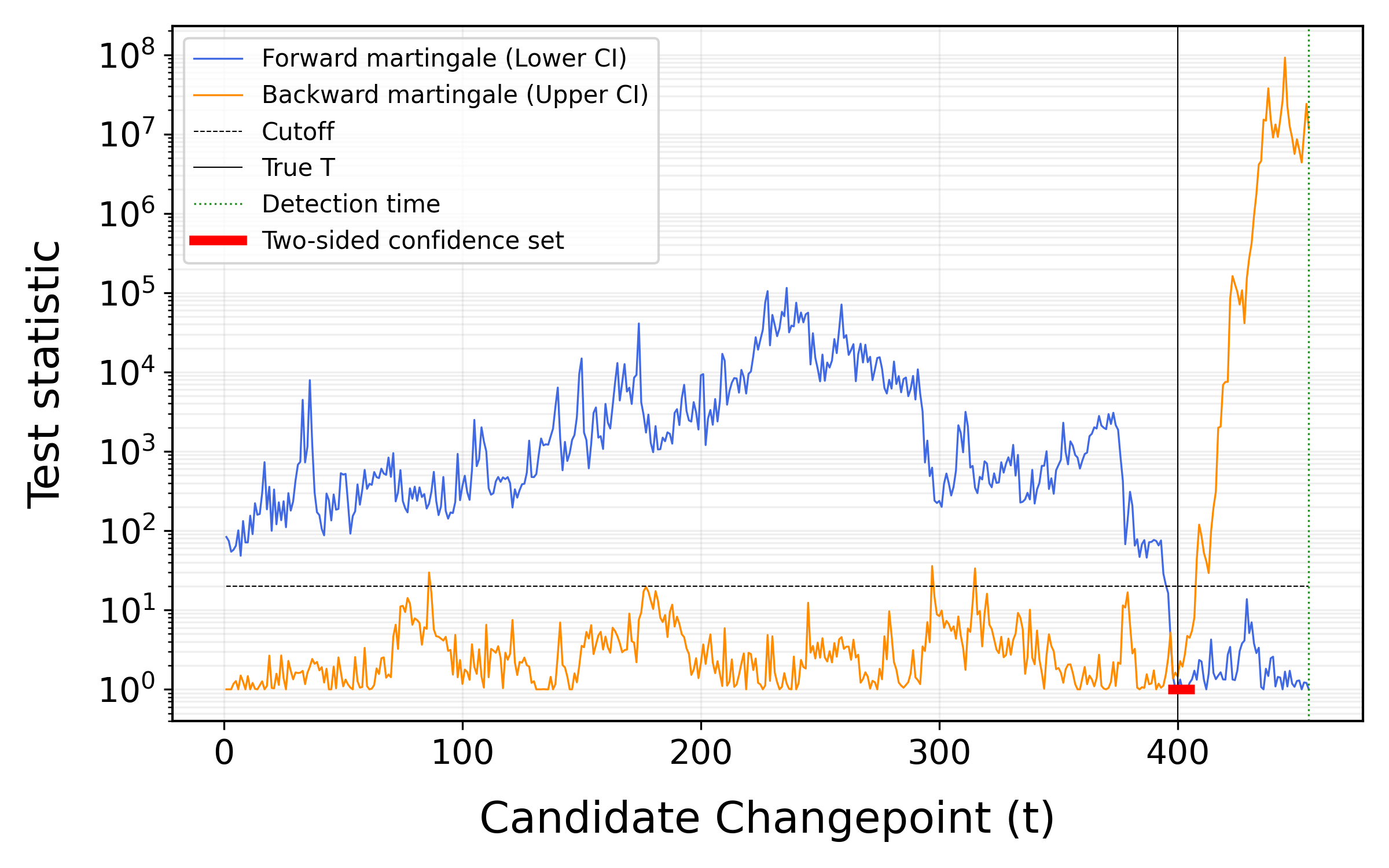
Figure 2: (Left) Pure digit change stream yields exceptionally sharp confidence sets; (Right) Mixed regime remains precise despite partial class overlap.
Across all settings, the empirical results match the sharpness predicted by theory—confidence intervals are short, even under challenging signal regimes, and maintain the prescribed coverage.
Implications and Future Directions
Practically, this construction equips practitioners with a rigorous uncertainty quantification tool for changepoint localization in complex, nonparametric data streams, circumventing the need for restrictive assumptions about the data-generating mechanisms or change structure. Theoretically, it elucidates the power of conformal methods in sequential inference and demonstrates the separability of the detection and localization tasks in a distribution-free context.
The framework’s generality—requiring only black-box detector access and minimal statistical assumptions—suggests broad applicability to streaming, monitoring, and surveillance problems in high-dimensional or structured domains. Extensions to multi-stream scenarios, adaptive scoring via representation learning, or higher-order changepoint structures represent promising avenues for future research.
Conclusion
This work establishes the first general, distribution-free, finite-sample valid method for constructing confidence sets for changepoint localization following sequential change detection (2606.01256). By leveraging conformal test martingales and careful calibration, the methodology achieves guaranteed coverage and sharp, practical localization for arbitrary data—laying a new foundation for uncertainty quantification in modern changepoint analysis.