- The paper provides a group-theoretic foundation for the Unruh effect by showing that Rindler thermality emerges from the affine symmetry on the null horizon.
- It employs the Mellin transform and modular theory to compare Minkowski and Rindler mode decompositions, highlighting the analytic non-unitarity of the transformation.
- The findings offer insights into quantum field behavior near horizons, with implications for thermality in curved spacetime and beyond.
Modular Group-Theoretic Foundations of Rindler Horizon Thermality
Introduction
This work provides a rigorous group-theoretic and operator-algebraic exposition of the Unruh effect for quantum fields on Rindler horizons, revealing the minimal algebraic and representation-theoretic content underlying observer-dependent quantum field thermality. The analysis is carried out for two-dimensional massless scalar fields, with a focus on their restriction to a horizon light ray and the implications for modular theory. The core thesis is that the thermality observed by Rindler observers emerges directly from the local affine symmetry of the null direction, encoded in translations and dilations, rather than requiring explicit reference to the bulk Poincaré or Lorentz structure.
Affine Symmetry, Null Flows, and Mode Structure
The paper demonstrates that the distinction between inertial and uniformly accelerated observers—and consequently between the Minkowski and Rindler quantizations—is representation-theoretically encapsulated within the affine group (the ax+b group) acting on the light ray. Positive-frequency Minkowski modes diagonalize null translations on the ray, while Rindler modes diagonalize null dilations. The crucial observation is that both decompositions live within the same irreducible affine group representation, differing only in their choice of diagonalized generator.
The Mellin transform, mapping L2(R+,dk/k) translation eigenstates to the dilation eigenbasis, serves as the natural intertwiner between these perspectives. This elucidates, at the one-particle level, the analytic non-unitarity of the restriction from the global (Minkowski) to the wedge (Rindler) positive-frequency sectors.
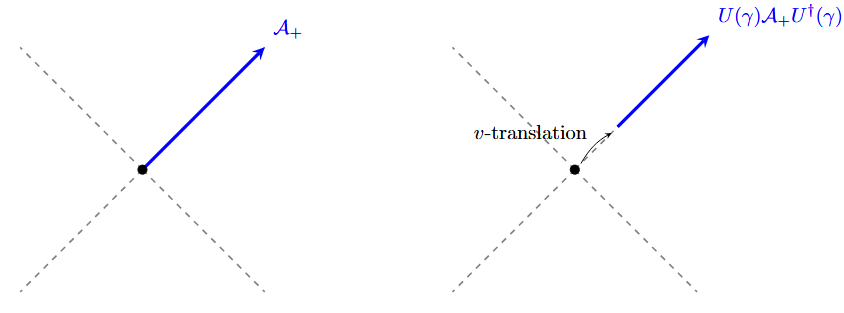
Figure 1: Visualization of the algebra A+ on the Rindler horizon and its translation under the affine group, emphasizing the loss of translation symmetry upon restriction to the half-line.
Representation Theoretic Decomposition and Mellin Analysis
A detailed construction is given: the one-particle Hilbert space for right-moving null modes is L2(R+,dk/k), carrying the irreducible positive-energy affine representation. Null translations v↦v+γ and dilations v↦eλv act unitarily in complementary bases, with the generators P and R satisfying the non-compact commutation relation [R,P]=iP. Passing to logarithmic coordinates, dilations become spectral shifts, and the Mellin transform provides an explicit diagonalization of R.
The analytic comparison of the Minkowski (translation) and Rindler (dilation) bases is mediated by a Gamma function intertwiner, whose modulus encodes the signature thermal Boltzmann factor at temperature L2(R+,dk/k)0 (natural units). This non-trivial intertwiner is not a phase, highlighting the breaking of unitarity in the restriction.
Restriction to the Wedge and Operator-Algebraic Consequences
Upon restricting the field to a single Rindler wedge (the positive half-line, L2(R+,dk/k)1), translations no longer act unitarily, while dilations generate the full modular automorphism group of the wedge algebra. The modular Hamiltonian coincides (as per Bisognano–Wichmann) with the generator of null dilations, matching the wedge's Lorentz boost restriction. This identification is carried out explicitly in the paper, showing how the modular theory KMS condition at inverse temperature L2(R+,dk/k)2 emerges as a direct consequence of the one-dimensional affine structure and the analytic properties of the field’s mode decomposition.
The analysis further shows that the vacuum restricted to the wedge is a KMS state with respect to the dilation (modular) flow, i.e., it satisfies the modular characterization of thermal equilibrium for the wedge algebra. This matches physical expectations for Rindler thermality, independent of the ambient spacetime Poincaré invariance.
Modular Theory, the KMS Condition, and the Affine Group
The interplay between the spectral properties of affine generators and the KMS condition is made rigorous using Tomita–Takesaki modular theory. The modular operator, acting as L2(R+,dk/k)3, generates the modular automorphism group—dilations in the null direction. The modular conjugation arises as null reflection, mapping the algebra of the half-line onto its commutant. The analysis applies Borchers’ theorem to clarify how modular flow arises solely from affine symmetry and the half-line algebra of observables, without recourse to the full Poincaré group.
The Mellin basis diagonalizes this modular flow, and the thermal character of the restricted vacuum is a spectral consequence of the non-trivial intertwiner between translation and dilation modes. The paper makes explicit how the analytic continuation properties and the spectrum of the affine generators underlie modular analyticity, wedge localization, and hence thermality.
Theoretical and Practical Implications
- Minimal Structure for Horizon Thermality: The necessary and sufficient ingredients for observer-dependent thermality near a horizon are identified as (i) null half-line algebras, (ii) translation- and dilation-invariant states on these algebras, and (iii) the affine group structure itself.
- Beyond Minkowski Space: Since the affine group is a universal symmetry of any null hypersurface, the analysis generalizes to local Rindler frames near generic causal horizons (cf. local semiclassical approaches to horizon entropy [Jacobson:1995ab, Padmanabhan:2003gd]).
- Model Independence: The results demonstrate that the algebraic origins of the Unruh effect do not depend on the existence of a global Minkowski vacuum or Poincaré invariance—modular data on the half-line suffice.
- Operator-Algebraic Foundation for Quantum Thermality: The explicit connection between representation theory and Tomita–Takesaki modular theory serves as a template for understanding quantum thermality in algebraic QFT, potentially applicable to other situations with observer horizons (e.g., black holes, de Sitter cosmology).
Future Directions
The work suggests several avenues for further research:
- Algebraic QFT Generalizations: One could construct horizon thermality entirely in terms of half-sided modular inclusions and affine symmetry, enabling application to curved backgrounds and general bifurcate Killing horizons.
- Entanglement Structure and Local Modular Flow: Understanding the entanglement structure induced by the half-line algebra in terms of modular analyticity, independently from any global spacetime symmetries.
- Extensions to Interacting and Higher-Dimensional Theories: Investigating the spectral and modular properties of more complex quantum field theories within this minimal affine-modular framework.
Conclusion
The paper establishes that the essential algebraic and group-theoretic origin of the Unruh effect and Rindler horizon thermality for scalar fields lies in the representation theory of the affine group on the null horizon and the corresponding modular dynamics of the half-line algebra. The Mellin transformation provides the explicit analytic link, while modular theory encapsulates the thermal structure at the operator-algebraic level. This modular-affine synthesis paves the way for a deeper, representation-theoretic understanding of observer-dependent thermodynamics in quantum field theory, independent of global Poincaré structure and with potential relevance for gravitational thermodynamics in more general contexts (2606.01071).