Topological Edge States from Molecular Chirality: A General Framework for Dimerized Dipolar Arrays
Published 30 May 2026 in quant-ph, cond-mat.mtrl-sci, physics.app-ph, and physics.atm-clus | (2606.00877v1)
Abstract: We establish a general theoretical framework for realizing topological edge states in dimerized arrays of chiral dipolar molecules and demonstrate that molecular handedness provides a natural and tunable route to SSH-like topology in an interacting one-dimensional setting. Starting from an effective spin-$\tfrac{1}{2}$ model generated by Stark-dressed chiral molecules, we introduce bond dimerization and show that the chirality-induced Dzyaloshinskii--Moriya interaction amplifies the effective hopping amplitudes and enlarges the bulk topological gap relative to an achiral chain of equivalent dipole strength. Using self-consistent mean-field theory with periodic- and open-boundary calculations, we map out the trivial, critical, and topological regimes through bulk spectra, complex-plane winding, and boundary-localized probability densities. A central result is that the two in-gap boundary modes carry \emph{opposite molecular chirality}: the left edge state localizes on a left-handed molecule and the right edge state on a right-handed molecule, a stereochemical labeling with no analogue in conventional SSH implementations. The two-leg ladder extension supports a richer four-band bulk structure and a rung-split edge sector whose robustness is characterized by a continuous sweep of the interchain coupling. All results are expressed in dimensionless units of the reference hopping scale $t_0$, making the framework directly applicable to any dipolar molecular platform -- from bialkali polar molecules at MHz coupling scales to future arrays of ultracold chiral polyatomic species. These findings establish dimerized chiral molecular arrays as a controllable and chirality-addressable platform for quasi-one-dimensional topological quantum matter.
The paper presents a framework demonstrating how dimerization and molecular chirality enable SSH-like topological edge states in dipolar arrays.
It uses a mean-field Hartree–Fock approach to derive effective spin-1/2 models and quantify enhancements in bulk gaps via Dzyaloshinskii–Moriya interactions.
The study highlights chirality-selective edge mode localization and predicts observable signatures in programmable optical tweezer experiments.
Topological Edge States in Dimerized Chiral Dipolar Molecular Arrays
Theoretical Framework: Chiral Molecular Chains and Dimerization
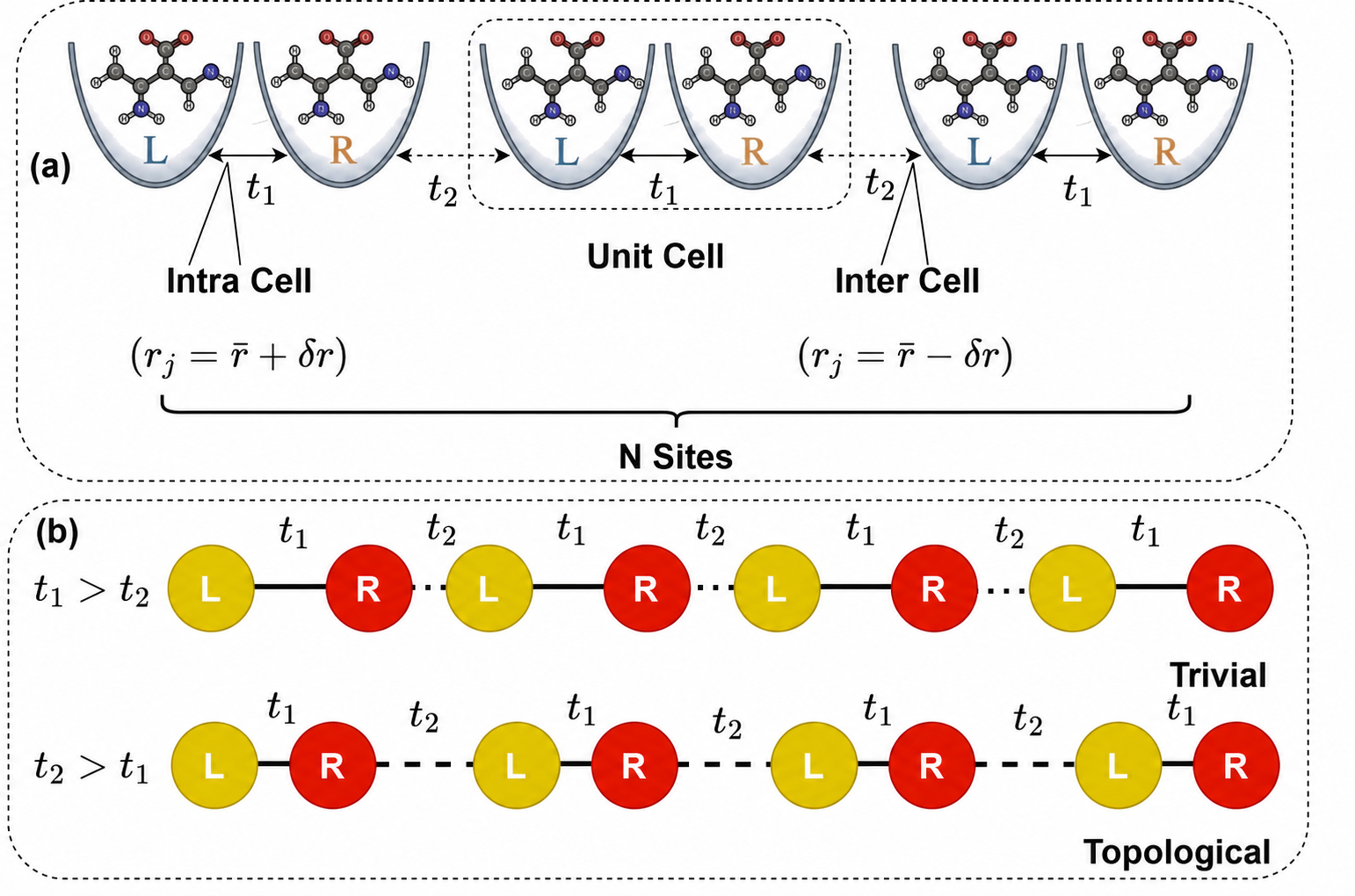
This work establishes a comprehensive theoretical framework for realizing and analyzing topological edge states in dimerized arrays of chiral dipolar molecules. The paradigm is rooted in an effective spin-21 model obtained from Stark-dressed chiral molecules trapped in programmable optical tweezer arrays. Critical in this construction is the alternation of molecular handedness—left-handed (L) and right-handed (R) enantiomers—along the chain, with nearest-neighbor bonds exhibiting a dimerized geometry via modulated intermolecular spacings rj=rˉ−(−1)jδr, giving rise to two distinct hopping amplitudes t1 and t2.
Molecular chirality manifests itself in the effective Hamiltonian through a Dzyaloshinskii–Moriya (DM) term, in addition to the standard XXZ spin interactions. The DM term, arising from the lack of inversion symmetry in chiral molecules, does not affect the bulk SSH topology directly due to its removal from the bulk by a gauge rotation, but critically renormalizes the magnitude of the effective hopping via Jxy,j=Jxy,j2+Dj2. The combination of bond dimerization and chirality-induced exchange allows direct mapping to an SSH-type model with interaction-renormalized hoppings and bond interaction terms.
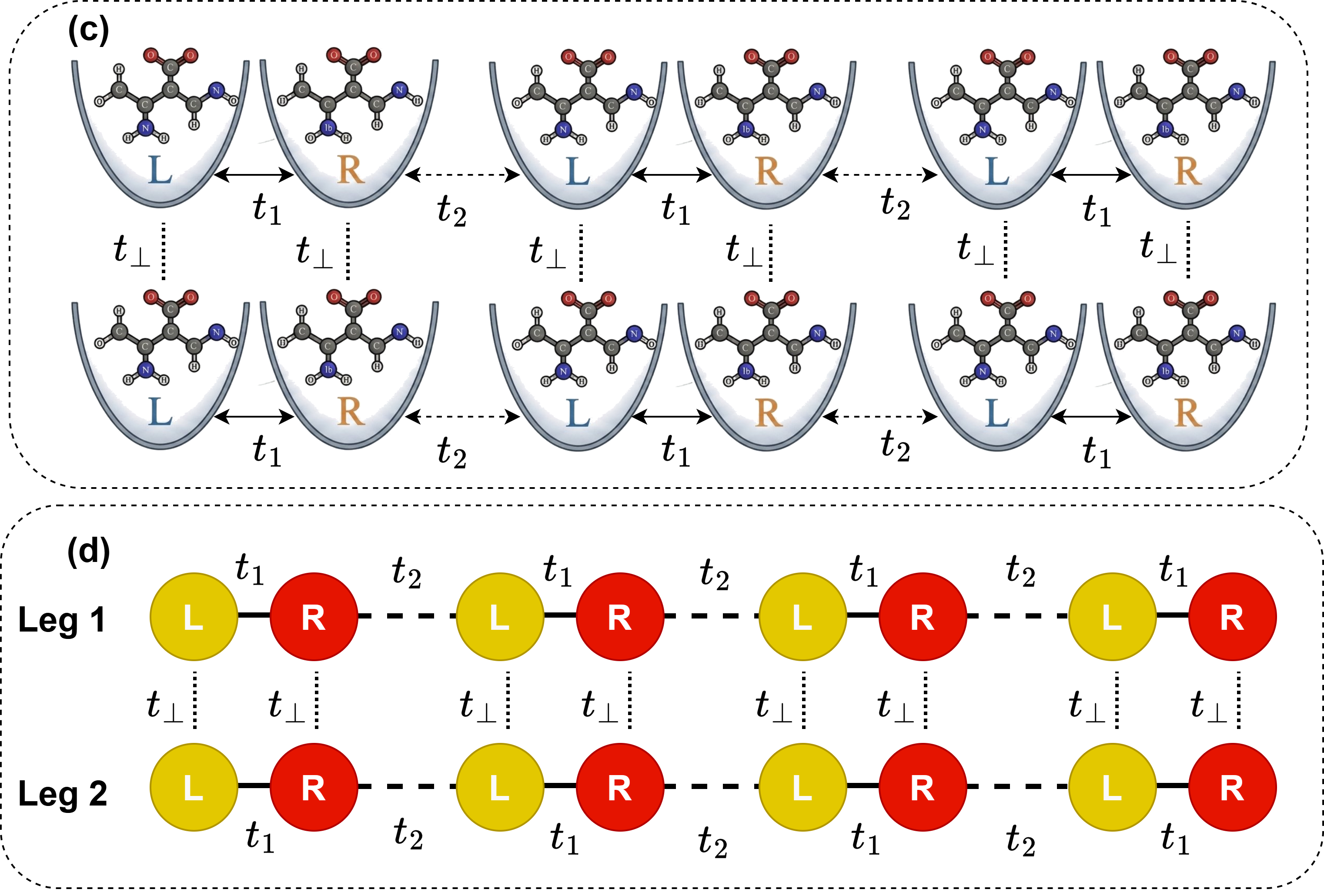
Figure 1: Experimental realization and effective models for dimerized chiral molecular arrays, including the physical Stark-dressed molecular chain, the resulting SSH chain, and two-leg ladder extensions.
A mean-field Hartree–Fock decoupling yields a quadratic Hamiltonian which admits well-controlled analysis of bulk spectra, topological invariants, and real-space boundary physics. The study also extends to the two-leg ladder geometry, where two such chiral chains are coupled by a transverse rung hopping t⊥, introducing further nontrivial topological structure.
Bulk Spectra, Topological Invariants, and Chirality-Induced Gap Enhancement
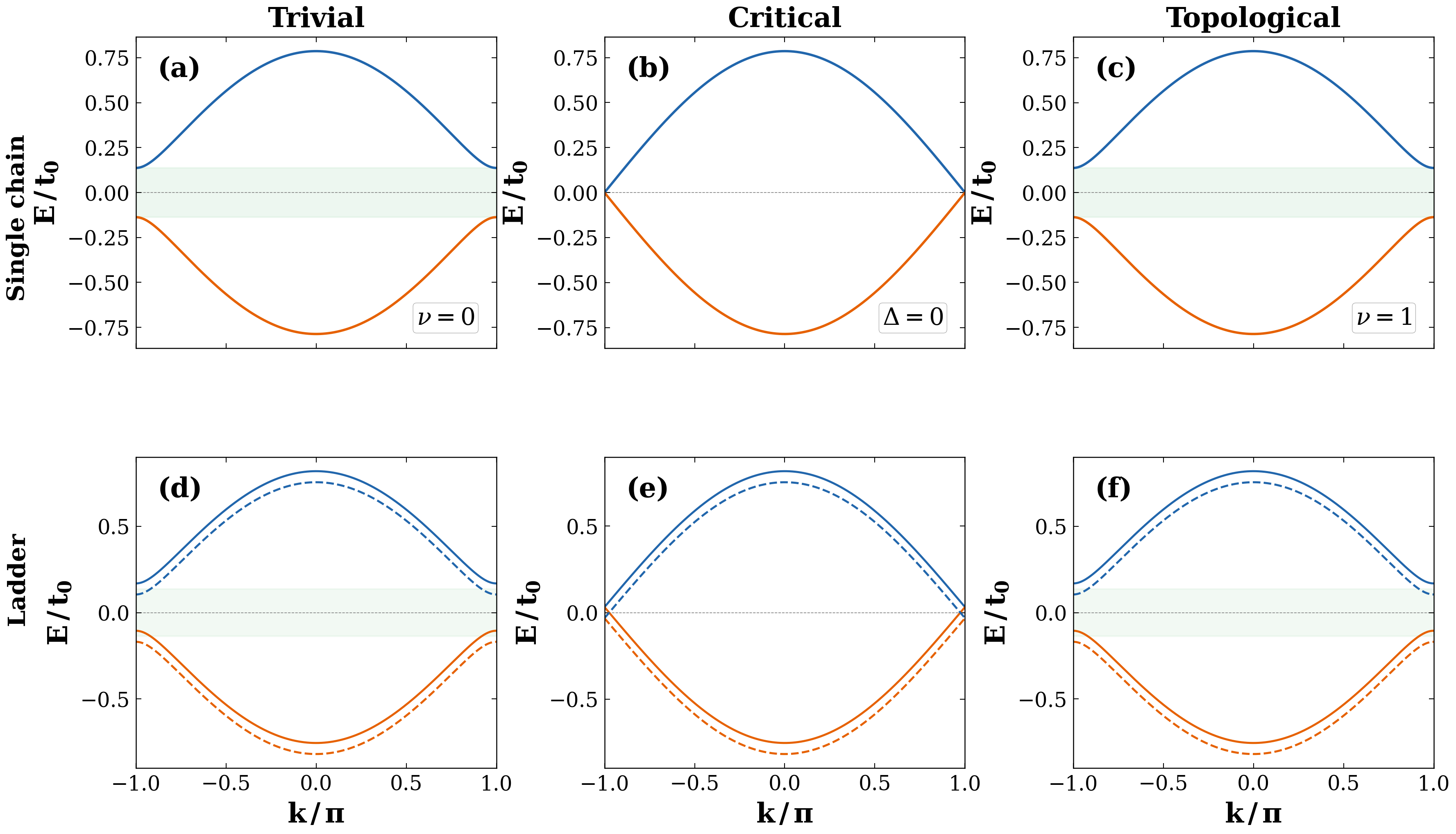
Periodic-boundary spectra reveal the archetypal sequence of trivial (t1eff>t2eff), critical (t1eff=t2eff), and topological (t2eff>t1eff) regimes, mirroring the canonical SSH scenario. Importantly, the DM interaction amplifies the magnitude of both hoppings compared to the non-chiral case, which directly increases the bulk topological gap. For operational parameters corresponding to realistic tweezer arrays, the DM-induced enhancement is non-negligible—on the order of several percent of the exchange interaction—rendering the chiral molecular system more favorable for topologically protected boundary phenomena than its achiral analogues.
Figure 2: Bulk band structure E±(k) for trivial, critical, and topological regimes in both the single chain and two-leg ladder geometry. Chirality enhances the bulk gap.
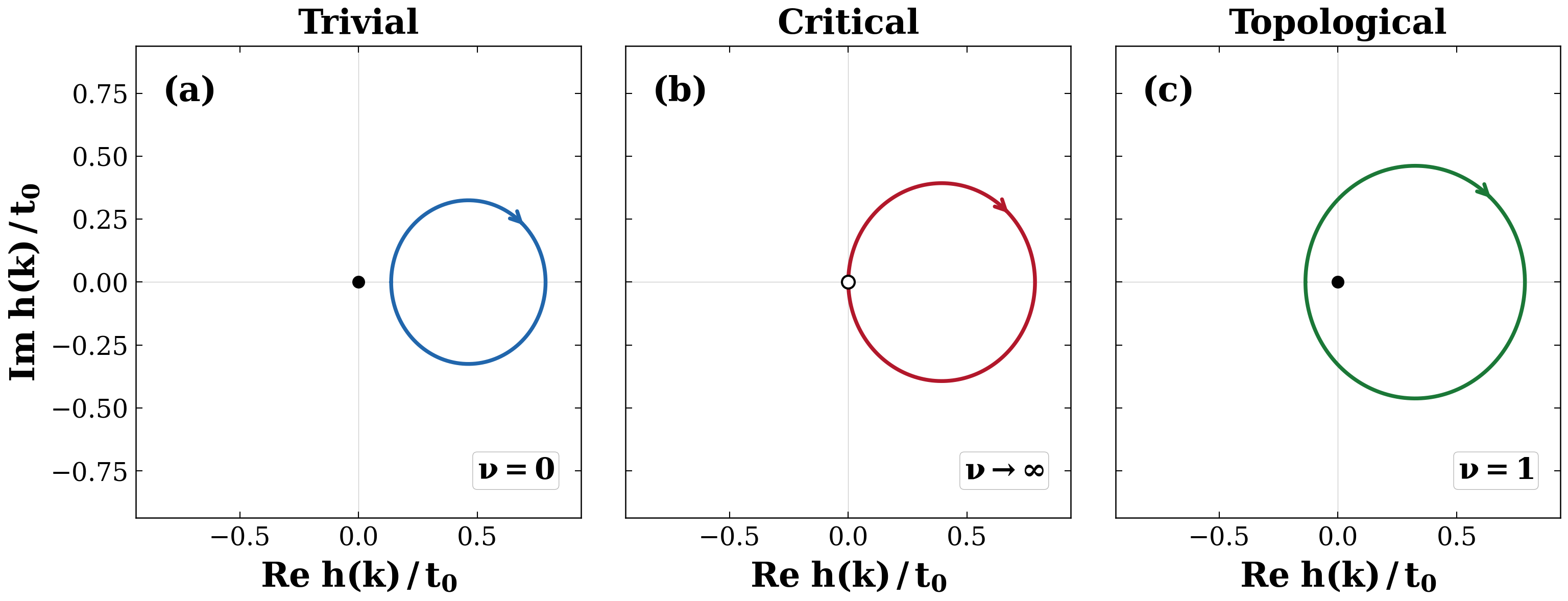
Topological classification is quantified by the winding number rj=rˉ−(−1)jδr0 of the Bloch off-diagonal SSH hopping function rj=rˉ−(−1)jδr1 as rj=rˉ−(−1)jδr2 traverses the Brillouin zone. The geometric criterion for nontrivial topology—the circle traced by rj=rˉ−(−1)jδr3 in the complex plane encloses the origin—remains intact in the presence of chirality, but the radius (controlled by rj=rˉ−(−1)jδr4) is amplified, making the phase boundary more robust.
Figure 3: Complex-plane winding of rj=rˉ−(−1)jδr5 in the trivial, critical, and topological regimes; the DM interaction expands the loop, increasing robustness of the topological phase.
In the two-leg ladder, the ladder Hamiltonian separates into bonding/antibonding SSH sectors shifted by rj=rˉ−(−1)jδr6, doubling the winding number and predicting four boundary-localized modes in the topological phase.
Edge-State Structure: Stereochemical Labeling and Robustness
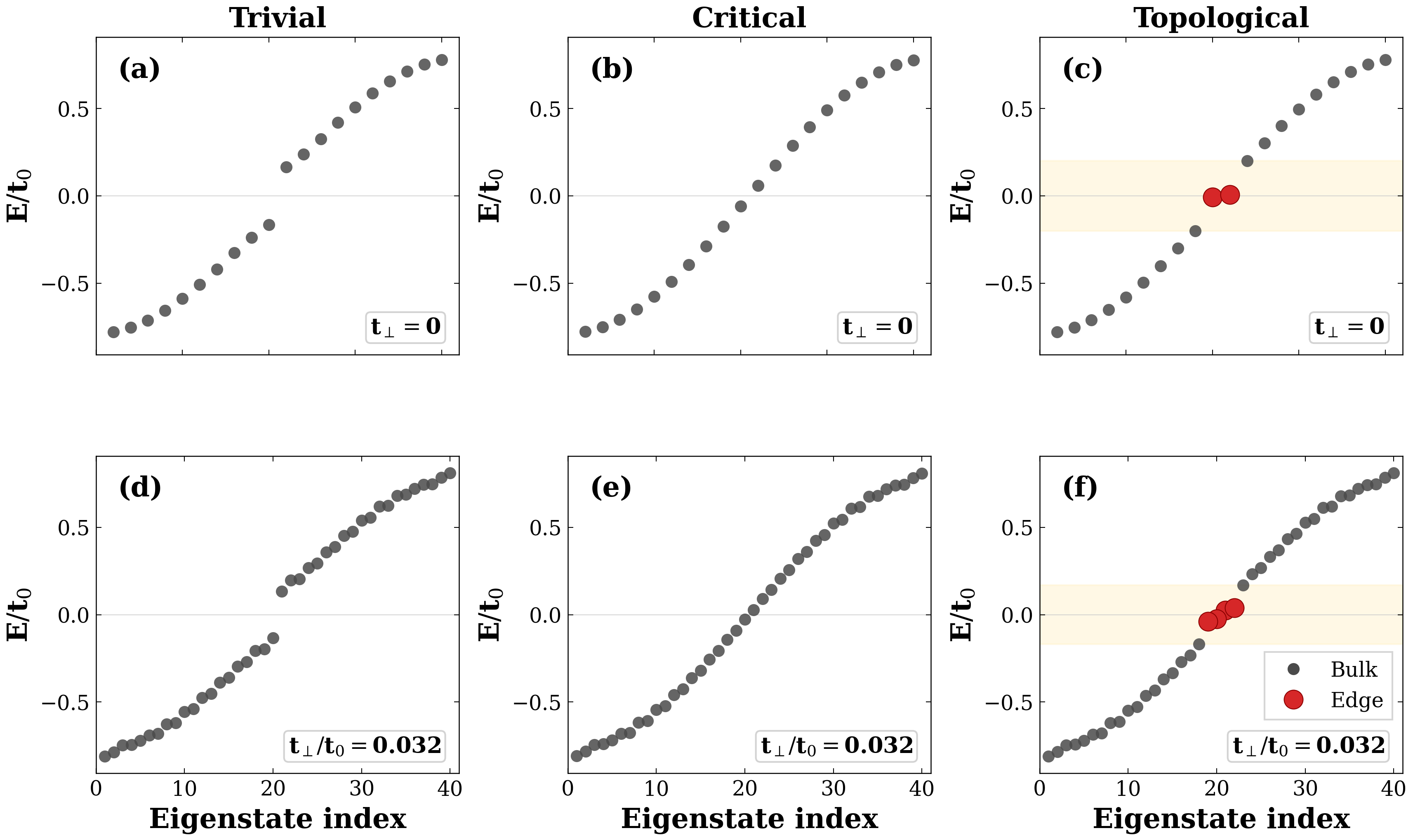
Open-boundary spectra explicitly exhibit the emergence of in-gap edge states in the topological regime. Unlike standard tight-binding SSH systems, the chiral molecular realization enables unambiguous stereochemical labeling of these states: the left edge mode localizes on an L enantiomer and the right mode on an R enantiomer. This property, absent in conventional implementations, directly links molecular symmetry to topological spatial structure and provides a distinguishing experimental signature for the platform.
Figure 4: Open-boundary energy spectra for single and ladder geometries, distinguishing edge-localized modes (red) from bulk states (gray).
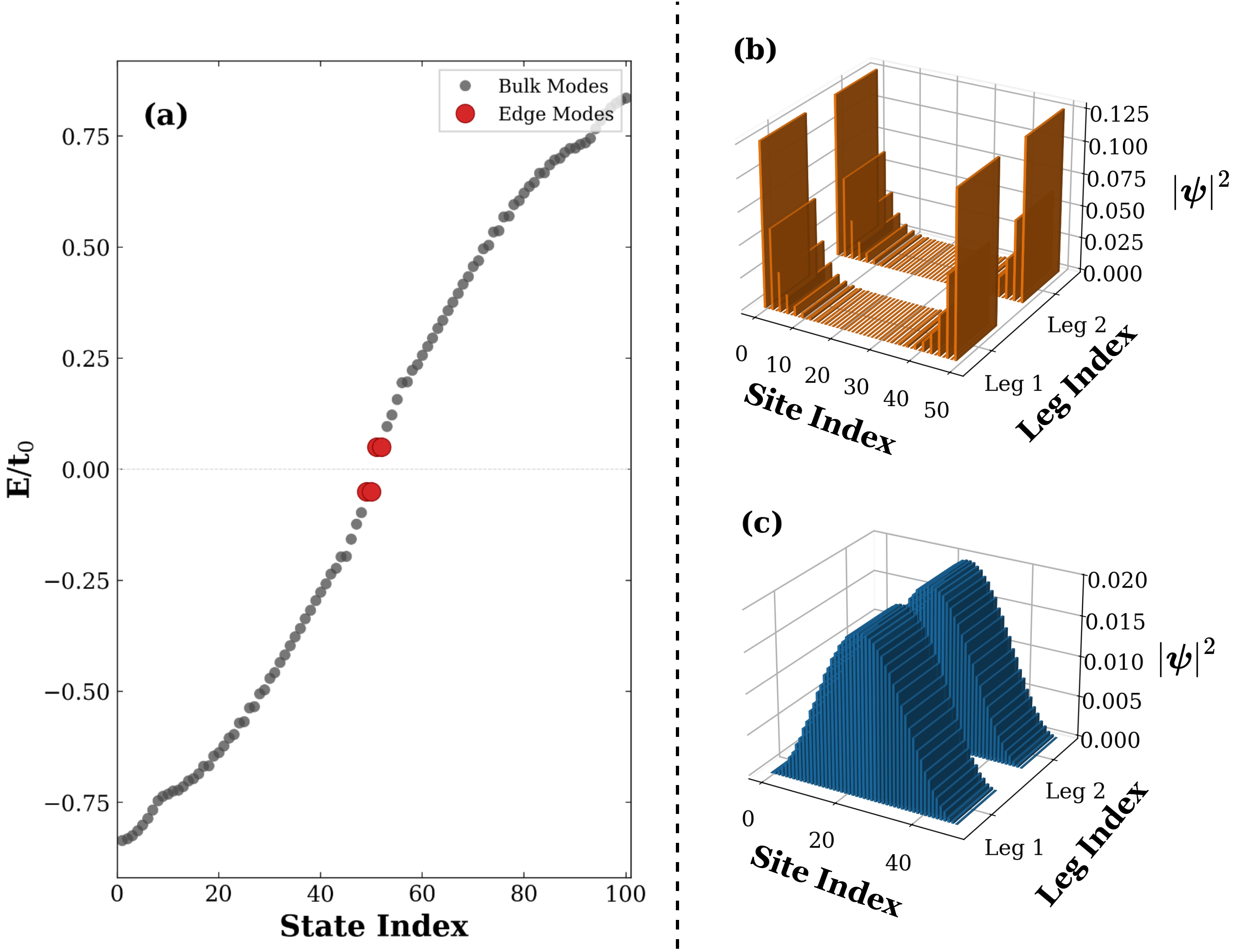
Beyond spectral isolation, site-resolved probability densities confirm that edge modes are exponentially localized at the system boundaries, with localization length rj=rˉ−(−1)jδr7. The finite-size splitting of boundary modes decays exponentially with system size and dimerization strength, as shown by the direct calculation and numerical results.
Figure 5: Probability density of edge and bulk states in the topological ladder, confirming spatial edge localization for in-gap modes.
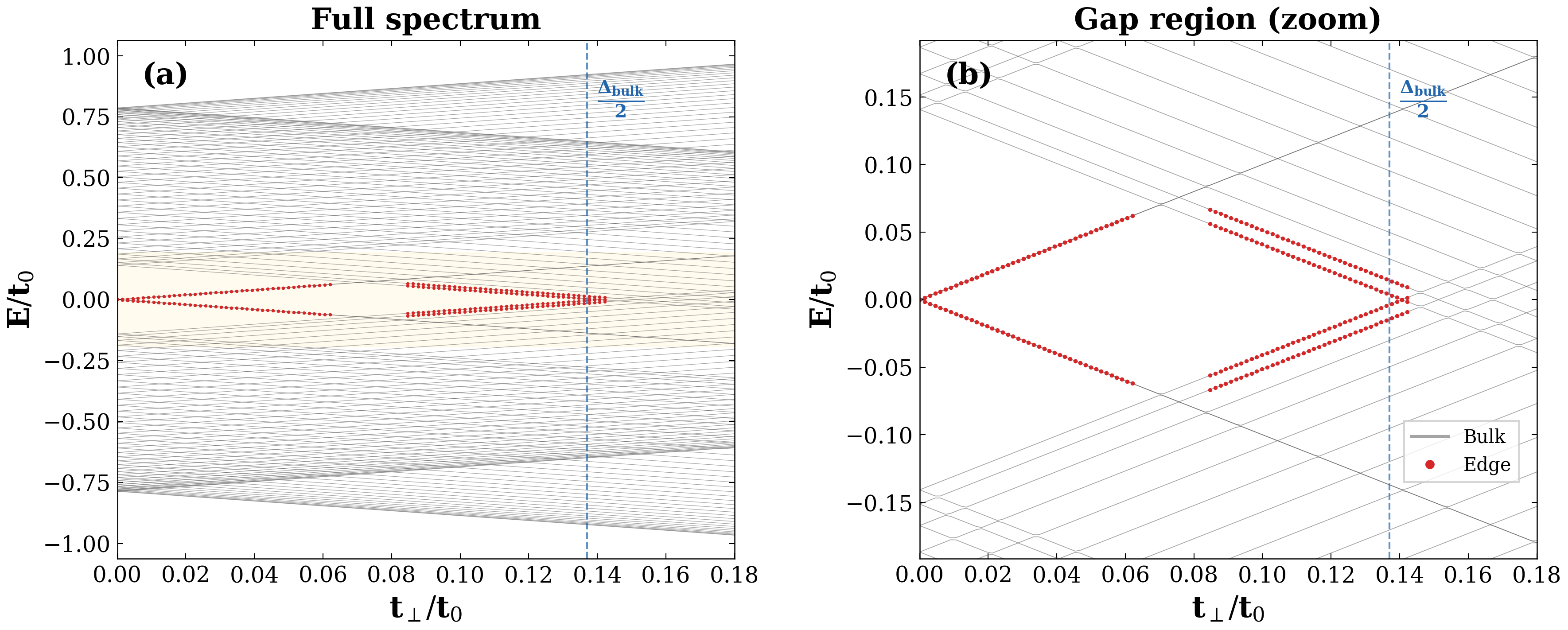
In the ladder geometry, rung coupling rj=rˉ−(−1)jδr8 hybridizes the two boundary modes at each end, splitting them into bonding and antibonding pairs. These four modes remain spectrally and spatially isolated as long as rj=rˉ−(−1)jδr9; beyond this threshold, the edge sector merges with the bulk continuum, and topological protection is lost.
Figure 6: Evolution and eventual merging of ladder edge states with the bulk continuum under increased rung coupling t10; protection persists below the spectral threshold.
Implications, Experimental Feasibility, and Extensions
The theoretical proposal is directly applicable to arrays of Stark-dressed chiral molecules in programmable tweezer traps, with all results parametrized in dimensionless ratios of the effective hopping scale t11, allowing for translation to a range of molecular species and experimental geometries. Experimental realization requires only nanometer-scale modulation in molecular spacing (within reach of current optical tweezer calibration), and the topological gap can be maximized by leveraging the DM amplification with molecular species of large effective dipole moments.
Chirality-selective edge states and the enhanced bulk gap present compelling experimental targets. Detection may employ chiroptical spectroscopies (e.g., circular dichroism), enabling selective addressing of the L or R boundary modes. The framework is robust to both attractive and repulsive interactions, with interaction effects shifting phase boundaries and modulating the edge-state localization and splitting. Theoretical extensions to strongly correlated and/or higher-dimensional chiral systems are natural continuations, particularly to probe the stability of boundary physics beyond mean-field and to investigate interaction-induced topological classification changes.
Conclusion
This study delivers a rigorous framework for the realization and analysis of SSH-like topology in dimerized chiral molecular arrays, demonstrating the emergence of edge-localized, chirality-labeled modes protected by dimerization-induced bulk gaps that are structurally enhanced by the chirality-driven DM interaction. The framework provides a pathway from molecular stereochemistry to controllable quantum topological matter in tunable atomic and molecular platforms, with clear spectral and spatial signatures that are distinct from conventional SSH chains. The anticipated generalizations—ranging from interaction-driven boundary phenomena to chiroptical control—open avenues for further research in both fundamental and programmable topological quantum systems.
“Emergent Mind helps me see which AI papers have caught fire online.”
Philip
Creator, AI Explained on YouTube
Sign up for free to explore the frontiers of research
Discover trending papers, chat with arXiv, and track the latest research shaping the future of science and technology.Discover trending papers, chat with arXiv, and more.