- The paper establishes a synthetic SSH chain in ultracold RbCs molecules to realize and probe topological edge states and phase transitions.
- The paper employs Floquet engineering with stroboscopic microwave pulses for precise control over tunneling rates and long coherence times, enabling detailed spectroscopy.
- The paper measures quantized topological invariants and investigates edge-state robustness under symmetry-preserving perturbations, paving the way for advanced quantum simulations.
Probing Topological Edge States in a Molecular Synthetic Dimension
Introduction
The realization of synthetic dimensions using internal degrees of freedom in quantum systems opens unprecedented avenues for quantum simulation and control. In "Probing topological edge states in a molecular synthetic dimension" (2604.00745), the authors encode a Su-Schrieffer-Heeger (SSH) model—a paradigmatic 1D topological system—into the rotational levels of ultracold RbCs molecules. The approach leverages highly coherent microwave control and state-resolved detection to study topological phase transitions, edge-state robustness, and quantized topological invariants. This work not only benchmarks the molecular platform for quantum simulation in synthetic dimensions but also addresses the potential of ultracold molecules for exploring many-body physics with long-range dipolar interactions.
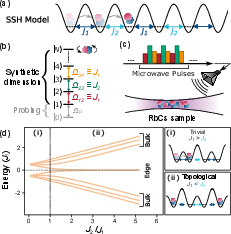
Figure 1: Encoding the SSH model in the rotational structure of RbCs molecules, with alternating tunneling rates J1 and J2 stroboscopically implemented by microwave pulses among rotational states.
Implementation of the Molecular SSH Chain
The SSH chain is realized by encoding lattice sites into specific rotational states N=1 to N of RbCs molecules, while ground-state N=0 serves as an auxiliary probe. Microwaves couple adjacent rotational states, with tunable Rabi frequencies ΩNN′ controlling effective tunneling rates J1 and J2. The target SSH Hamiltonian is synthesized via Floquet engineering using rapid, stroboscopic microwave pulses, yielding negligible Trotterization error due to short pulse durations compared to the tunneling times.
Molecular state preparation and site-selective detection are achieved with high-fidelity STIRAP and coherent π pulses, enabled by a near-magic-wavelength trap that yields coherence times up to 500 times the characteristic tunneling period even across 8-site synthetic lattices. This configuration allows precise engineering and interrogation of Hamiltonian parameters.
Spectroscopy of Topological Phases and Edge States
The eigenstates and energies of the SSH Hamiltonian were characterized using Ramsey-type and absorption spectroscopy, focusing on both minimal 4-site and extended 8-site chains. Spectroscopy involves driving transitions from N=0 to J20 with a weak probe, interleaved with the SSH-driving microwave modulation. The loss of population from J21 as a function of probe detuning and J22 ratio reveals the eigenspectrum and the localization of wavefunctions at the edges.
In both 4-site and 8-site chains, the phase transition from trivial (J23) to topological (J24) is directly observed via the emergence of in-gap, zero-energy edge states as J25 increases. For the 8-site system, the measured energy splitting between edge states becomes smaller than the Fourier-limited probe resolution, requiring complimentary dynamic probes.
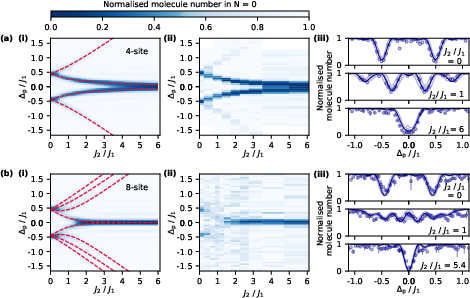
Figure 2: Site-resolved spectroscopy reveals the emergence of topological edge states localized at the ends as J26 increases, for both 4-site and 8-site SSH chains.
Dynamics, Edge-State Splitting, and Length Dependence
Time-resolved population evolution under the SSH Hamiltonian provides an interferometric probe of edge-state splitting and localization. After preparing a molecule in a superposition or localized state, coherent population oscillations are monitored between edge sites, with the oscillation frequency directly measuring the exponentially small energy splitting between edge states—down to a few Hz for the 8-site chain. The extended coherence times enable observation of oscillations over J27 tunneling periods.
The measured exponential decrease of edge-state splitting with system size confirms the finite-size scaling expected for 1D topological chains.
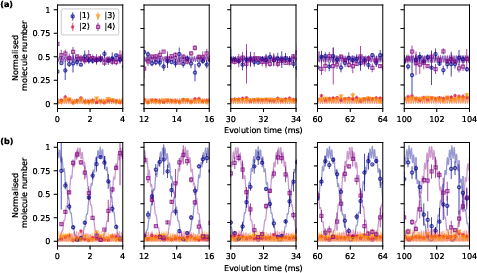
Figure 3: Time evolution of population after initialization in edge eigenstates or their superpositions, demonstrating long-lived coherence and edge-state oscillations.
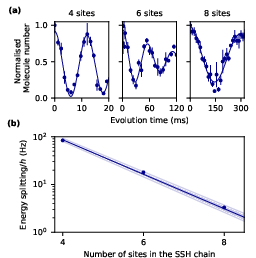
Figure 4: Edge-state energy splitting vs. SSH chain length, showing exponential suppression with increasing system size, in quantitative agreement with theory.
Probing Topological Protection
The robustness of edge states under different symmetry perturbations is directly tested. Chiral-symmetry-preserving perturbations (modifying only J28) leave edge-state localization intact and only shift the energy splitting, whereas non-chiral perturbations (e.g., nonuniform detuning) destroy the topological protection, causing rapid population dynamics and degradation of edge-state overlap fidelity.
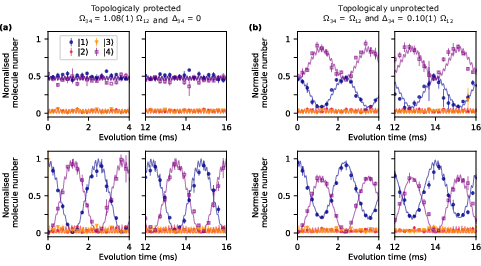
Figure 5: Edge eigenstates retain localization under chiral perturbations but delocalize with non-chiral perturbations, confirming topological robustness only in symmetry-preserving regimes.
Measurement of Topological Invariants
The winding number J29—a quantized invariant distinguishing trivial and topological phases—is experimentally extracted through measurements of the long-time mean chiral displacement after initialization in specific sites. In the topological regime (N=10), the mean chiral displacement approaches values close to unity even for the minimal 4-site system, agreeing with bulk-edge correspondence. In the trivial regime, it converges to near zero, identifying phase boundaries via dynamical probes.
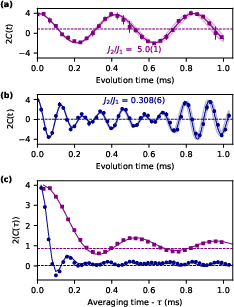
Figure 6: Time evolution and long-time average of mean chiral displacement, yielding winding numbers that sharply distinguish between the trivial and topological regimes.
Implications and Future Directions
This study demonstrates that molecular synthetic dimensions support numerically precise Hamiltonian engineering, with site-resolved preparation and detection, control over topological phase transitions, direct measurement of topological invariants, and robust coherence over many-body timescales. The ability to stroboscopically engineer arbitrary coupling structures in the rotational manifold, and to further enrich the synthetic dimension using hyperfine states, paves the way for extending to higher dimensional, more complex, or even interacting topological systems. Combined with real-space dipolar interactions, future developments may access phases such as dipolar synthetic strings and quantum membranes [sundarStringsUltracoldMolecules2019].
The long coherence and robust microwave addressability demonstrated here suggest that adiabatic preparation of many-body ground states, quantum error correction using molecular codes, mixed synthetic-real dimensional Hamiltonians, and state-selective manipulation for quantum information or precision measurement are all practicable in molecular platforms [cornishQuantumComputationQuantum2024a, demilleQuantumSensingMetrology2024]. The techniques for detecting topological invariants dynamically can be readily generalized to multi-site and multi-dimensional synthetic lattices, offering a scalable route to the exploration of fundamentally novel topological matter.
Conclusion
By encoding and interrogating an SSH model within the rotational synthetic dimension of ultracold RbCs molecules, this work establishes the molecular platform as a precision quantum simulator for topological band structure, edge-state physics, and quantized invariants. The demonstration of long-lived coherence, robustness to symmetry-preserving perturbations, and full state preparation and detection lays a robust foundation for future quantum simulation, quantum computation, and metrology with ultracold molecules. This opens a path toward molecular studies of higher-dimensional, interacting, and topologically ordered phases, leveraging the enhanced control afforded by molecular synthetic dimensions.

