- The paper presents an operator preconditioning strategy using Feynman–Kac Monte Carlo supervision to improve the Hessian conditioning of PINNs.
- Key results demonstrate non-asymptotic error bounds and accelerated convergence, achieving optimal learning rates even for high-frequency PDEs.
- Empirical tests show that FK-PINNs dramatically reduce errors and overcome training stagnation in challenging PDE problems with minimal additional supervision.
FK-PINNs: Operator Preconditioning of PINNs via Feynman–Kac Supervision
Introduction and Motivation
Physics-Informed Neural Networks (PINNs) have emerged as a mesh-free paradigm for numerically solving partial differential equations (PDEs) by leveraging neural networks constrained by the underlying physics. Despite robust performance in many settings, PINNs are notorious for severe pathologies during training—such as slow convergence, stagnation, and failure to reduce residuals—particularly for stiff or high-frequency PDEs. These issues are fundamentally tied to loss landscape conditioning, as the intrinsic ill-conditioning from the differential operators propagates into the PINN optimization problem.
The paper "Taming the Loss Landscape of PINNs with Noisy Feynman-Kac Supervision: Operator Preconditioning and Non-Asymptotic Error Bounds" (2606.00643) advances the theoretical and algorithmic foundations of PINN training by proposing an operator-preconditioned objective, enabled by sparse supervision derived from Monte Carlo (MC) approximations of the Feynman–Kac (FK) representation. The result is a practical, architecture-agnostic augmentation—termed FK-PINN—that directly improves the loss landscape conditioning and accelerates convergence.
Operator-Preconditioning via Data Anchoring
Recent analytical work has established that PINNs' training difficulty is tightly controlled by the smallest eigenvalues of a "Hessian-like" operator associated with the PDE, which typically decays polynomially as the collocation mesh is refined [deryck2024operator, rathore2024challenges]. This leads to the pathologically flat directions responsible for stagnation. While there has been interest in operator-aware optimizers and second-order methods as remedies, this paper takes a direct approach by augmenting the PINN objective with a pointwise data-fidelity (or "mass-anchoring") term.
Crucially, the source of these data labels is agnostic—they may come from experiments, coarse solvers, or in this work, efficiently from stochastic MC estimates using the FK formula. Theoretical analysis shows that including this term acts as an operator-level preconditioning: it ensures that the empirical Gauss–Newton/Hessian matrix has its smallest eigenvalue uniformly bounded away from zero, independently of the collocation density.
PL-based condition number bounds in the paper establish a dramatic contrast: the condition number for the standard PINN loss grows polynomially with the collocation sample size, while the data-augmented loss's condition number remains uniformly bounded. As a consequence, the iteration complexity for gradient descent does not grow with mesh refinement in the FK-PINN scheme, while it does so in standard PINNs.
Feynman–Kac Supervision and Monte Carlo Estimators
Many linear elliptic and parabolic PDEs admit solution representations as expectations over suitable stochastic processes (e.g., Itô diffusions or Lévy processes) via the FK formula. In the FK-PINN approach, the authors select a small set of interior "supervision" points and at each, perform MC simulation of sample diffusion paths. The empirical average over these paths approximates the true solution at that point, providing a noisy but unbiased label.
The supervision term in the loss is then the mean-squared error between the network output and these FK MC averages. This approach is substantially cheaper and more scalable than anchor data from fine-mesh solvers, as only a modest MC budget is needed per point to reap its preconditioning advantages.
Monte Carlo theory is used to derive concentration and bias-variance estimates for these labels, guaranteeing that their influence on statistical and optimization error can be tightly controlled. The sub-exponential tail bounds for the MC error further enable non-asymptotic learning-theoretic guarantees.
Learning-Theoretic Error Bounds
A central technical contribution is the derivation of non-asymptotic L2(Ω) generalization bounds for FK-PINNs trained with gradient descent, including cases where the neural network uses the widely utilized tanh activation. This is accomplished by a novel decomposition of the total error into:
- Approximation: Controlled by the Sobolev regularity of the true PDE solution and the pseudo-dimension of tanh networks (including for their derivatives, which are crucial for operator learning).
- Statistical: Tightly characterized using Rademacher complexity and empirical process theory, respecting the statistical cost of scarce FK supervision points.
- Optimization: Proven exponential decay under the PL condition, with rates not affected by mesh density because of operator preconditioning.
A key result is that, with a suitable allocation of MC supervision points and budget, the FK-PINN achieves optimal or near-optimal learning rates, matching the best theoretical rates for PINNs with densely sampled physics loss, but with dramatically improved optimization robustness.
Numerical Results
Schrödinger-type Equation: Severe Failure of Standard PINN
An emblematic test case is the stationary Schrödinger-type equation with periodic potential. The multi-scale, oscillatory structure is known to induce severe pathologies for standard PINNs.
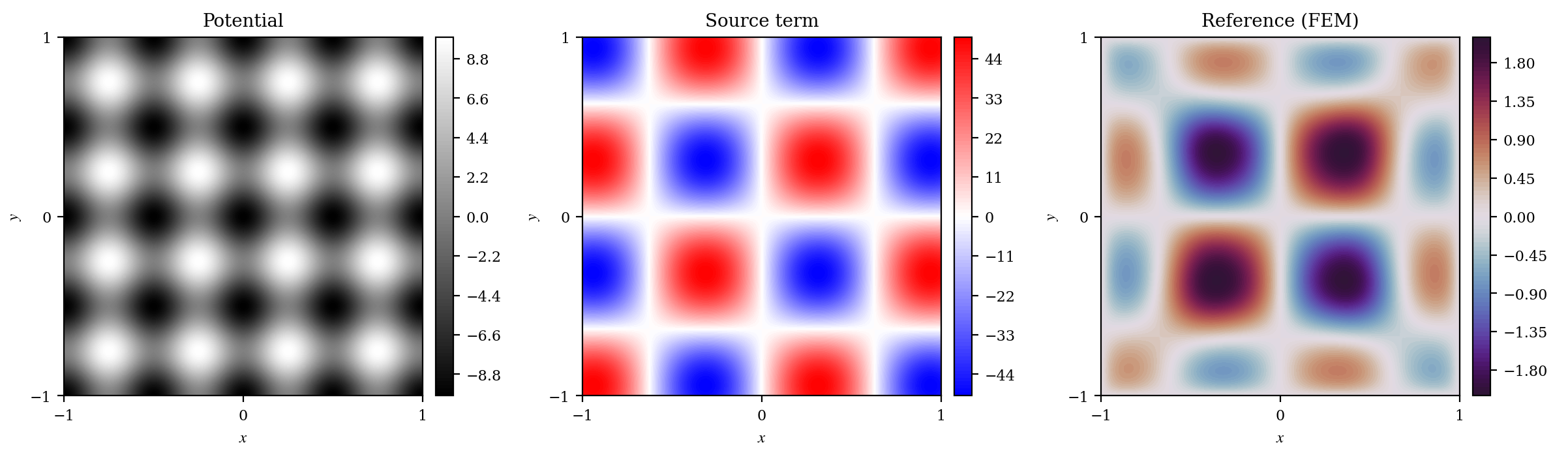
Figure 1: Data for the Schrödinger-type equation, showing the periodic potential, high-frequency source, and the ground-truth wavefunction solution.
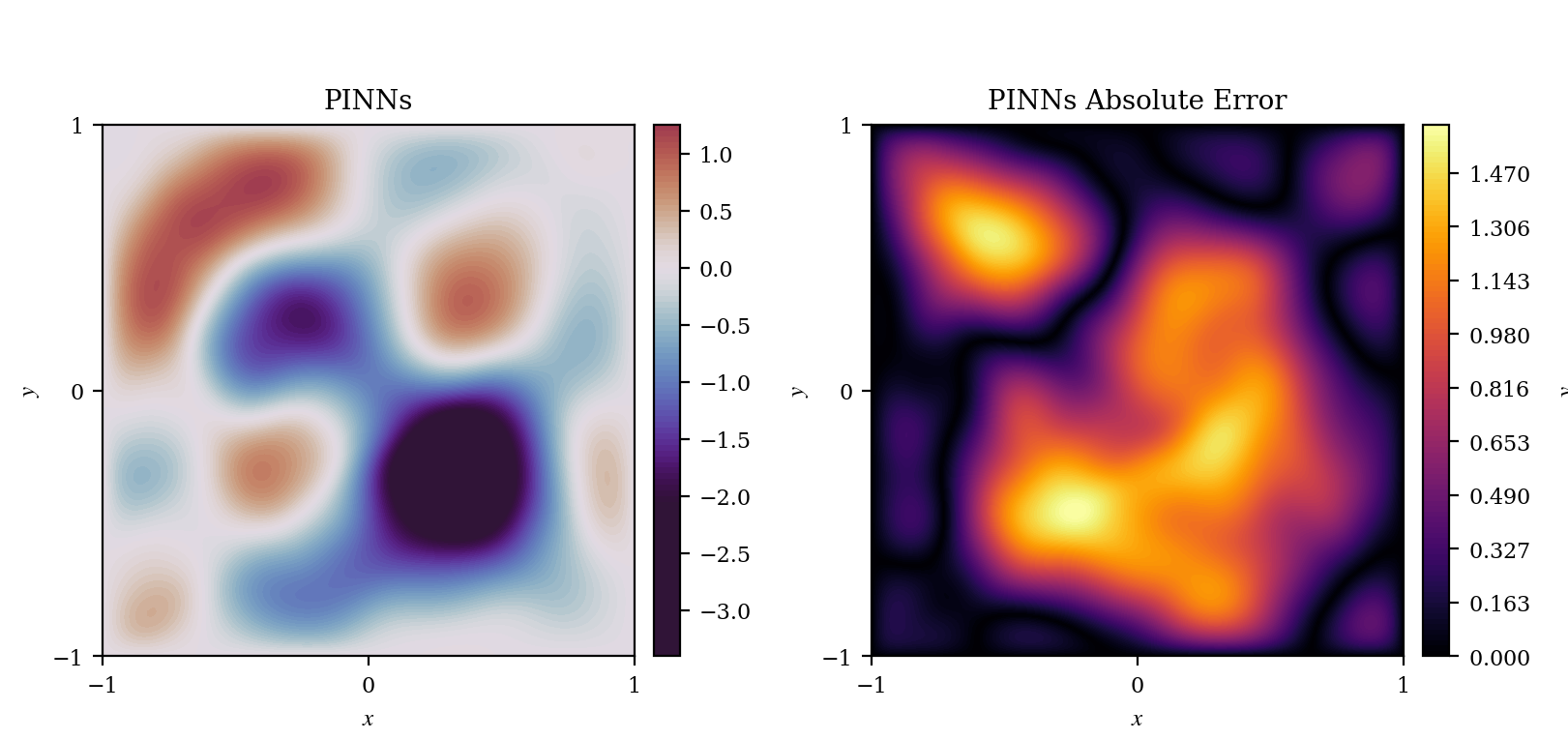
Figure 2: Standard PINN prediction and absolute error for the Schrödinger-type equation. The solution is qualitatively inaccurate, with large absolute errors.
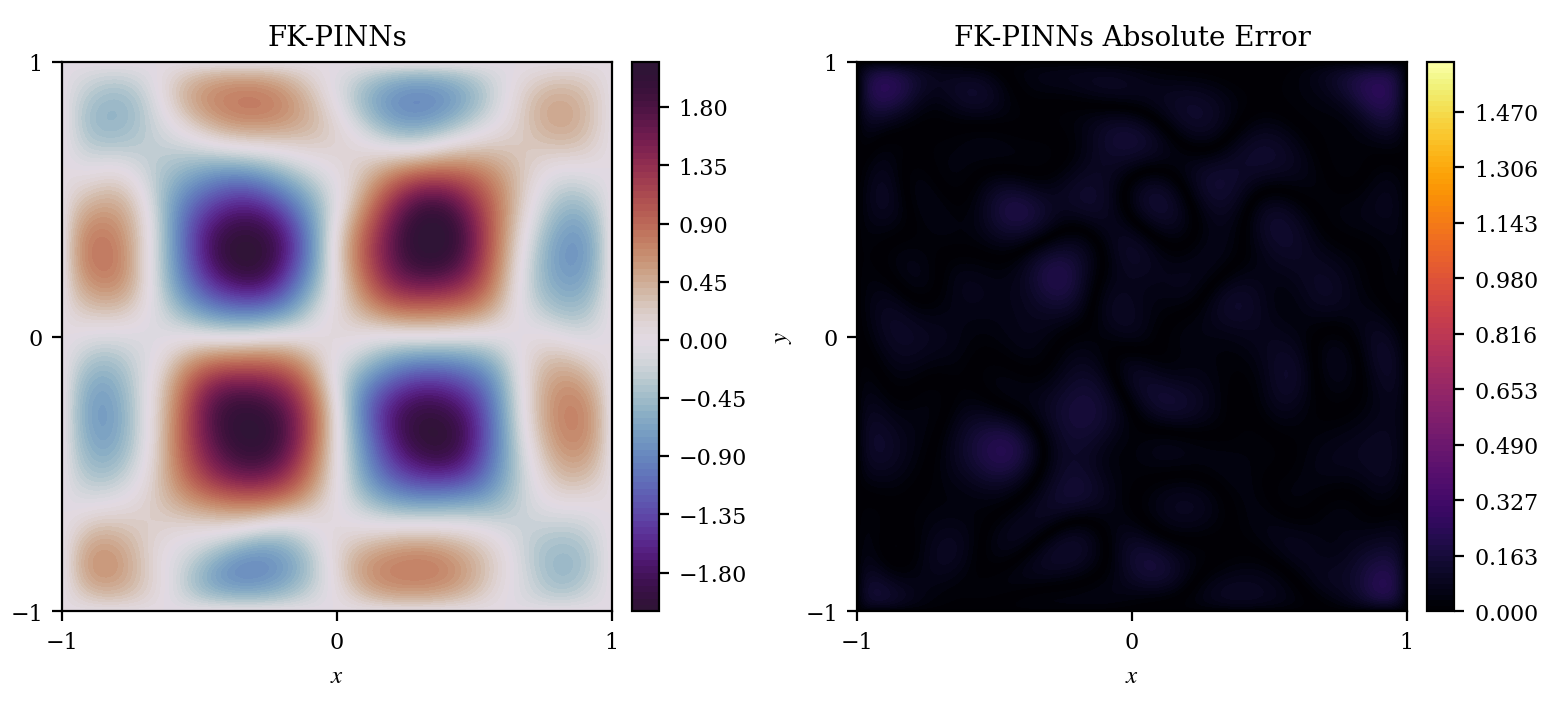
Figure 3: FK-PINN prediction and absolute error for the Schrödinger-type equation. The solution matches the ground truth and the error is minimal, even with modest FK supervision.
The numerical results demonstrate that the addition of FK MC supervision enables successful recovery of the highly oscillatory solution structure, where the standard PINN completely fails.
Broad Empirical Evidence and Further PDEs
The paper compiles extensive empirical results across Poisson, mean escape time, and committor function PDEs, consistently showing that FK-PINNs eliminate stagnation and enable convergence in regimes where PINNs and even sophisticated operator-aware optimizers fail. Relative L2 and H1 errors are often reduced by an order of magnitude or more.
Additional experiments reveal how FK supervision dramatically reduces the Hessian condition number in the loss landscape:
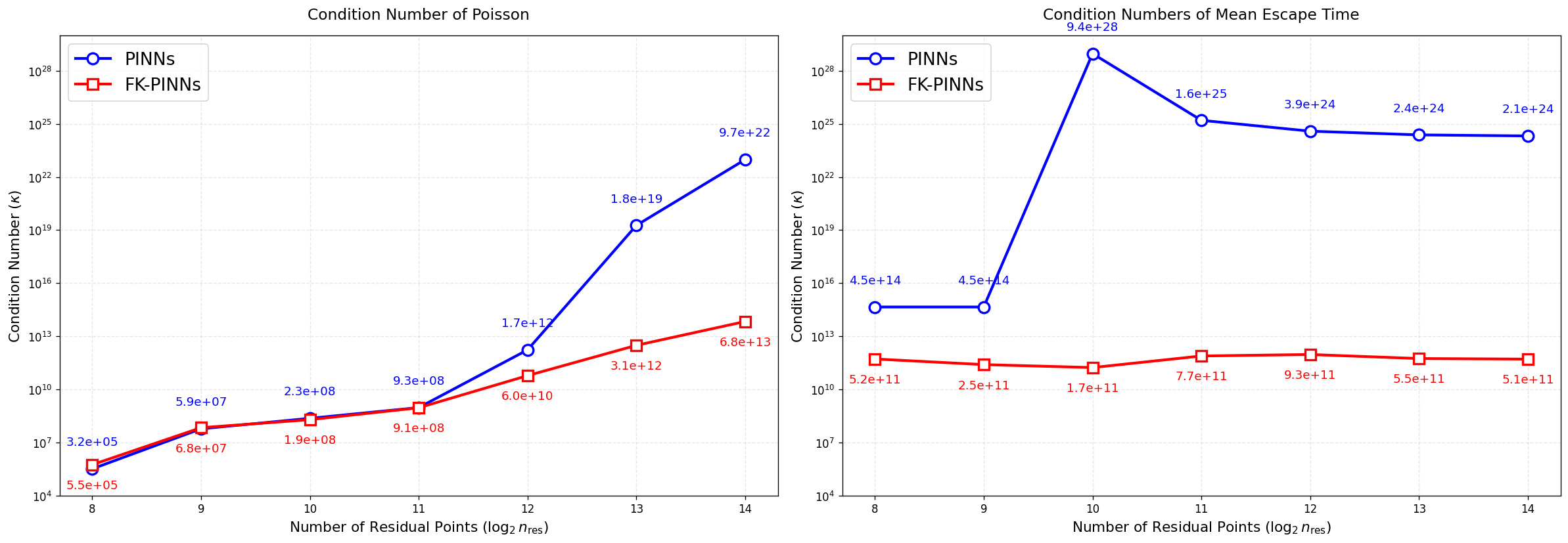
Figure 4: Condition number of the loss Hessian near a minimizer for standard PINN and FK-PINN, for Poisson and mean escape time equations. FK-PINN maintains a low condition number irrespective of collocation density.
Visualization of the loss landscape further reinforces the mechanism:
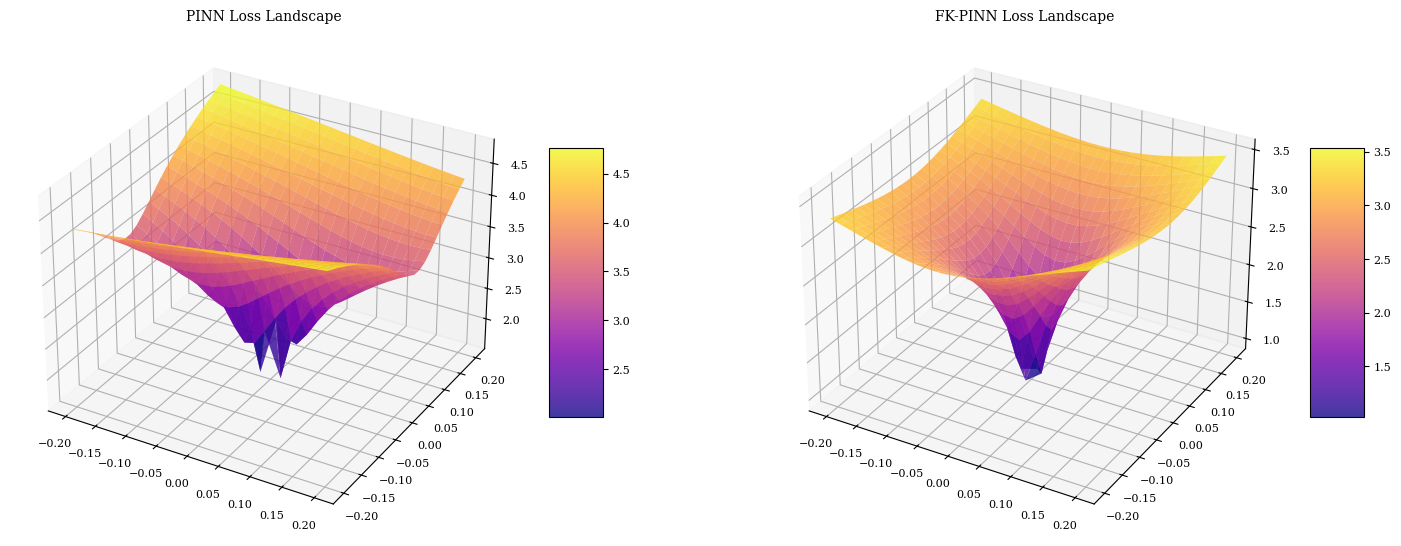
Figure 5: Loss landscape slices near a minimizer for the Mean Escape Time PDE. The standard PINN landscape is highly nonconvex and rough, while FK-PINN has a smooth, well-behaved quadratic basin.
Implications and Future Directions
The theoretical and empirical results collectively establish that incorporating even a small amount of noisy MC supervision fundamentally alters the optimization landscape for PINNs. The strong theoretical guarantees on the PL condition and bounded condition number have both immediate practical value (faster, stable training) and conceptual implications for the design of scientific ML solvers for PDEs.
Practical implications include:
- Robustness: FK-PINNs require far less tuning than standard PINNs since they are not sensitive to collocation mesh density, PDE stiffness, or architecture width.
- Data Agnosticism: The operator preconditioning effect is agnostic to the anchor label source; thus, any available auxiliary data (experiments, coarse models) can be used for preconditioning, subject to coverage properties.
- Statistical–Optimization Tradeoff: There exist diminishing returns in increasing MC supervision budget, and tradeoffs arise between statistical error (coarse labels) and optimization error (conditioning). The structure of FK-PINNs enables principled allocation of computational budget.
Potential directions for future work include:
- Extension to Nonlinear and High-Dimensional PDEs: Extending the theoretical analysis to nonlinear problems, as well as higher-dimensional settings (including those involving BSDEs and controlled diffusions), is a natural next step.
- Adaptive Supervision Placement: Further improving statistical efficiency via online or active placement of FK supervision points, possibly driven by residual-based error indicators.
- Combining with Advanced Optimizers: Synergy between FK supervision and function-space-aware optimizers remains an open question, especially in hardware-constrained or parallel computing environments.
Conclusion
This work provides a rigorous operator-theoretic and learning-based understanding of why mesh-free PINN objectives are ill-conditioned and how sparse, noisy pointwise supervision—efficiently obtained via Feynman–Kac Monte Carlo simulation—serves as an effective preconditioner. The resulting FK-PINN method yields uniform PL-based conditioning, robust convergence, and strong non-asymptotic error bounds with minimal MC budget. These insights set a foundation for designing properly conditioned, scalable PINN objectives and for integrating external supervision into scientific machine learning solvers without adverse effects on generalization or optimization, marking a significant advance in the practical and theoretical development of PINN-based PDE solvers.

