- The paper demonstrates that traversable wormholes can be sustained by effective matter sectors derived from entropy corrections, eliminating the need for arbitrary exotic fluids.
- It systematically analyzes five entropy-inspired models—Barrow, Tsallis, Kaniadakis, logarithmic, and exponential—using flare-out and redshift regularity to validate wormhole traversability.
- The study establishes a direct link between microscopic entropy modifications and macroscopic wormhole geometry, suggesting potential observational signatures for quantum gravity corrections.
Traversable Wormholes Supported by Entropy-Inspired Effective Matter Sectors
Introduction and Motivation
This work undertakes a systematic investigation of traversable wormhole geometries supported by effective matter sectors whose radial density profiles are derived from microscopic modifications of horizon entropy. Rather than relying on arbitrary exotic matter, the authors leverage the entropy–geometry correspondence, utilizing deformed entropy functionals to generate candidate anisotropic effective sources. Five representative modifications—Barrow, Tsallis, Kaniadakis, logarithmic, and exponential—are analyzed to determine their viability in sustaining Morris–Thorne traversable wormholes under strict flare-out and redshift regularity criteria.
Theoretical Framework
Entropy–Geometry Correspondence and Prescribed Density Sectors
Corrections to Bekenstein–Hawking entropy, motivated by quantum or statistical mechanical considerations, generically manifest as higher-derivative deformations in the associated black hole geometry. The entropy–geometry framework expresses the metric function in terms of the entropy derivative, promoting the entropy functional from a thermodynamic surface property to a generator of spacetime structure. This process yields effective anisotropic fluids, with the energy density and anisotropic pressures being explicit functionals of the entropy deformation.
The present work adopts a phenomenological prescription: only the (generally negative) effective energy density profile is imported to the wormhole spacetime, while the radial and tangential pressures are reconstructed via a constant barotropic equation of state, pr=wρ, with w determined by the requirement of redshift regularity at the throat.
Wormhole Geometry and Regularity Constraints
The background is the static, spherically symmetric Morris–Thorne metric, with the wormhole throat determined by the location where the shape function b(r0)=r0. Essential geometric conditions are imposed:
- Flare-out condition: b′(r0)<1, essential for maintaining a traversable throat
- Redshift regularity: Φ′(r) must be finite everywhere; this fixes w=−1/b′(r0)
- Asymptotic flatness: b(r)/r→0 and Φ(r)→0 as r→∞
These connect the chosen density profile, via the field equations, to the metric functions and pressure components.
Analysis of Entropy-Inspired Sectors
Barrow-Inspired Sector
The Barrow sector corresponds to a fractal deformation parameter Δ, yielding a power-law negative-density w0. The shape function inherits this algebraic decay, and redshift regularity at the throat uniquely sets w1. Small values of w2 suppress the exotic matter, but w3 diverges in this limit, aligning with the fact that the Schwarzschild limit is not a regular traversable wormhole branch for fixed w4.
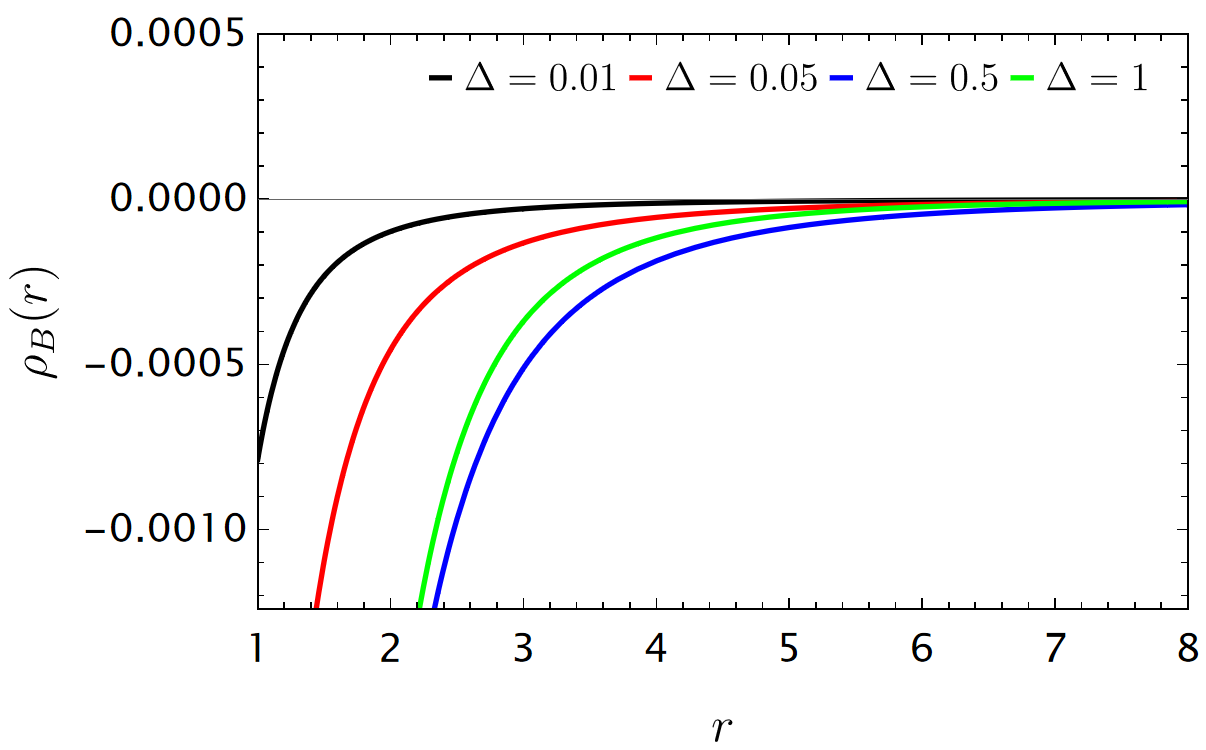
Figure 1: The Barrow-inspired density profile as a function of radius for varying w5.
Violation of the radial NEC is strictly enforced by the flare-out condition, and not by arbitrary matter choice. The tangential NEC and SEC respond nontrivially to w6; for large w7, the tangential sector and the SEC can show partial restoration near the throat.
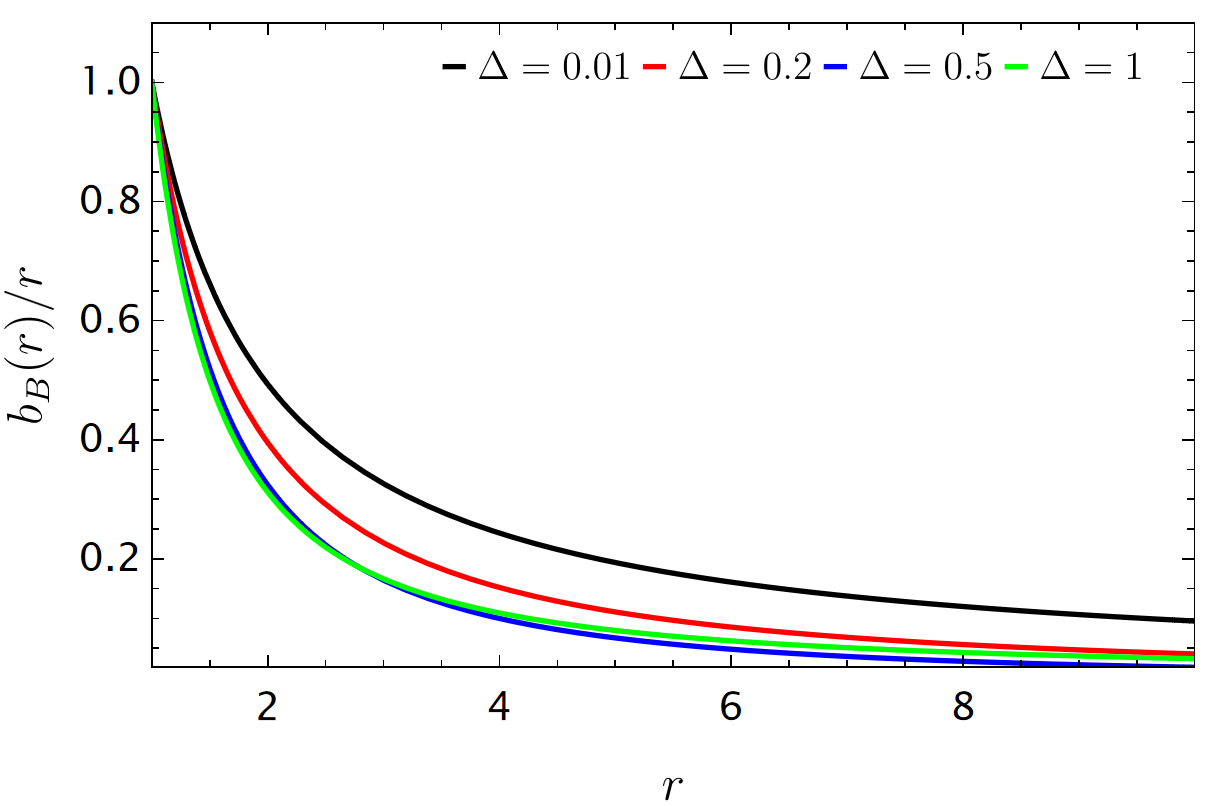
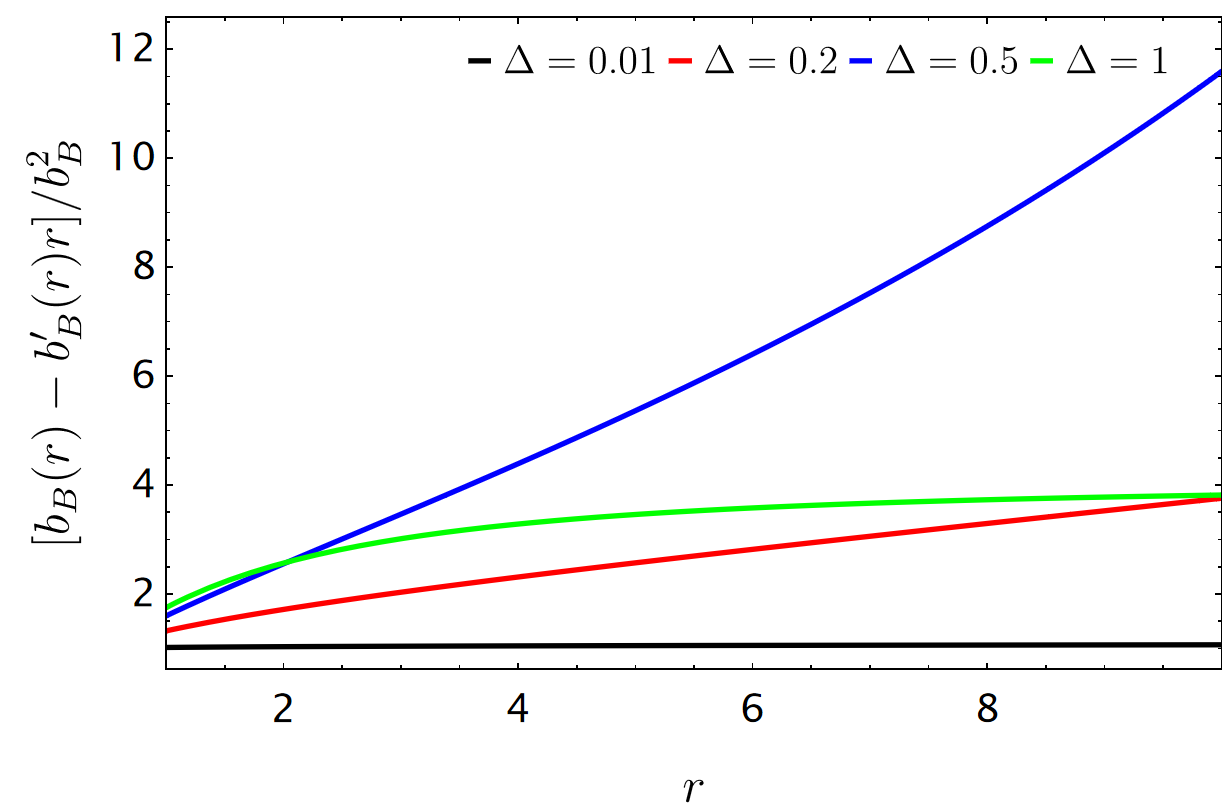
Figure 2: Geometric diagnostics for Barrow-inspired wormholes: w8 (left), flare-out function (right) for several values of w9.
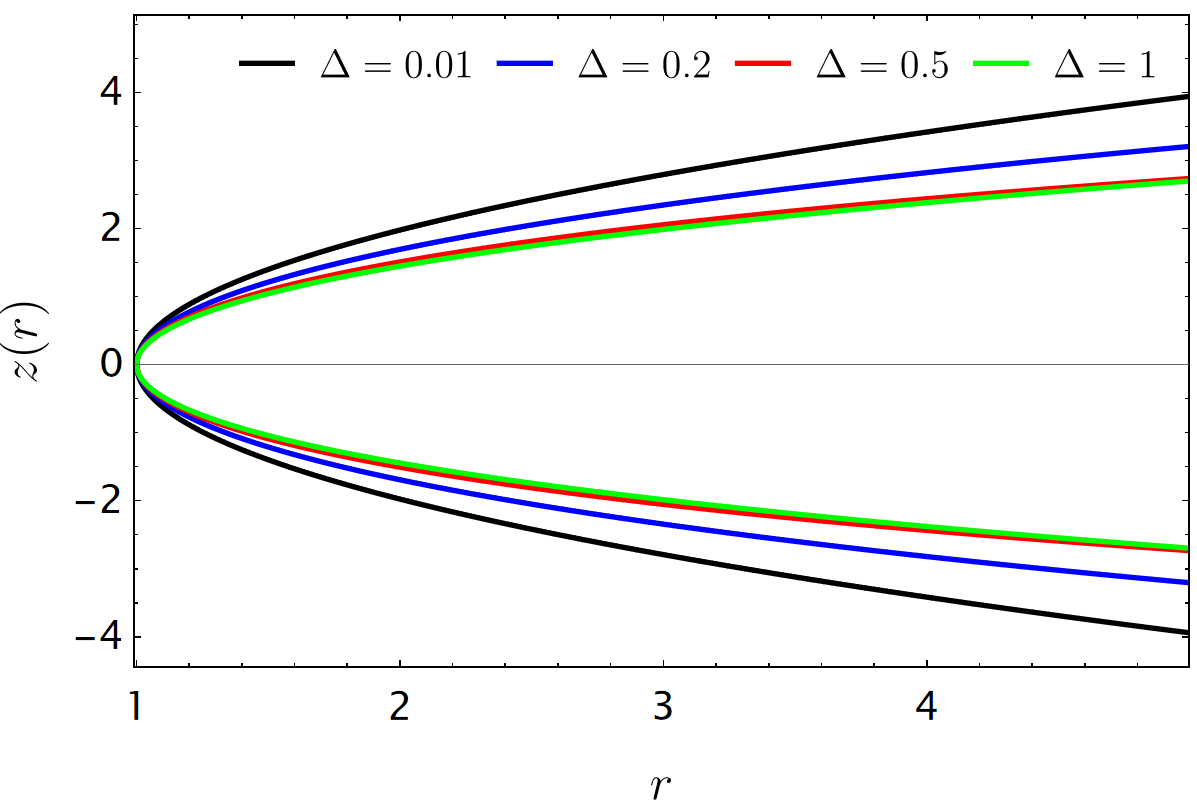
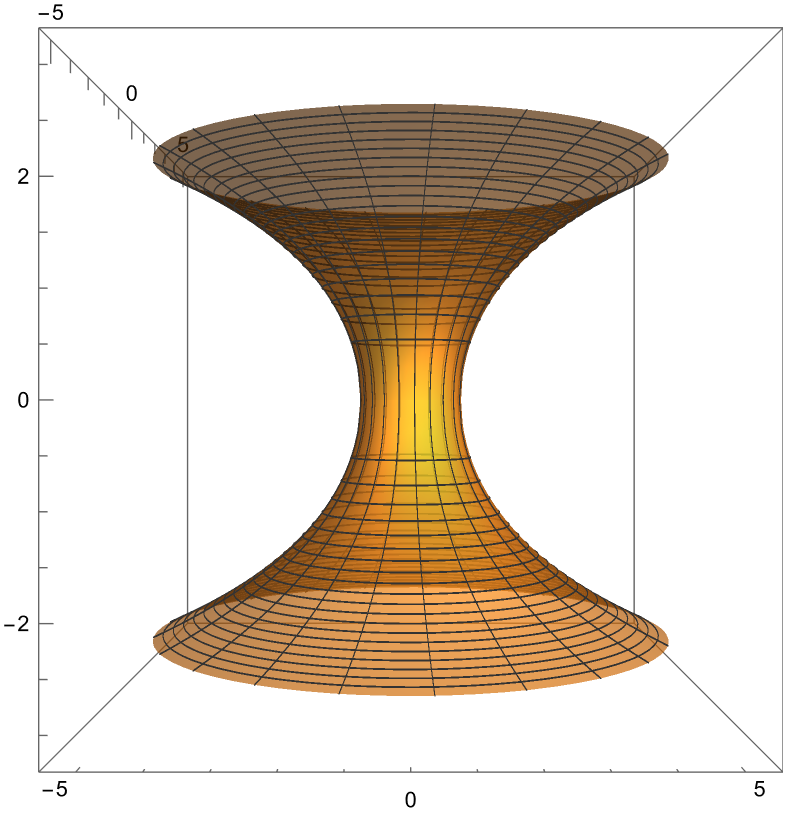
Figure 3: Embedding structure of the spatial wormhole slice for the Barrow sector, illustrating opening at the throat.
Tsallis-Inspired Sector
The Tsallis deformation is parameterized by b(r0)=r00, producing a negative power-law density b(r0)=r01. For b(r0)=r02, NEC is automatically violated at the throat. As with Barrow, b(r0)=r03 is set by throat regularity, and approaches infinity as b(r0)=r04 (the undeformed limit).
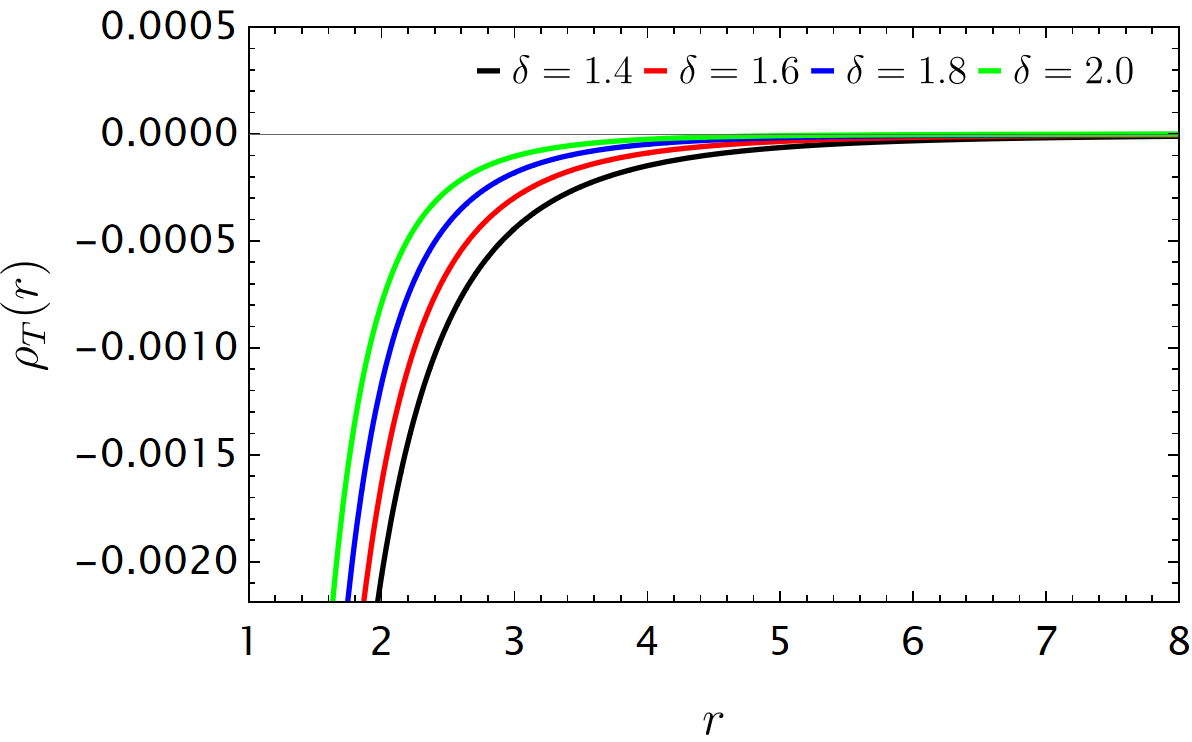
Figure 4: Tsallis-inspired density profiles for several b(r0)=r05.
The tangential sector in Tsallis models compensates the radial NEC violation such that the SEC combination remains positive throughout physical configurations for moderate-to-high b(r0)=r06.
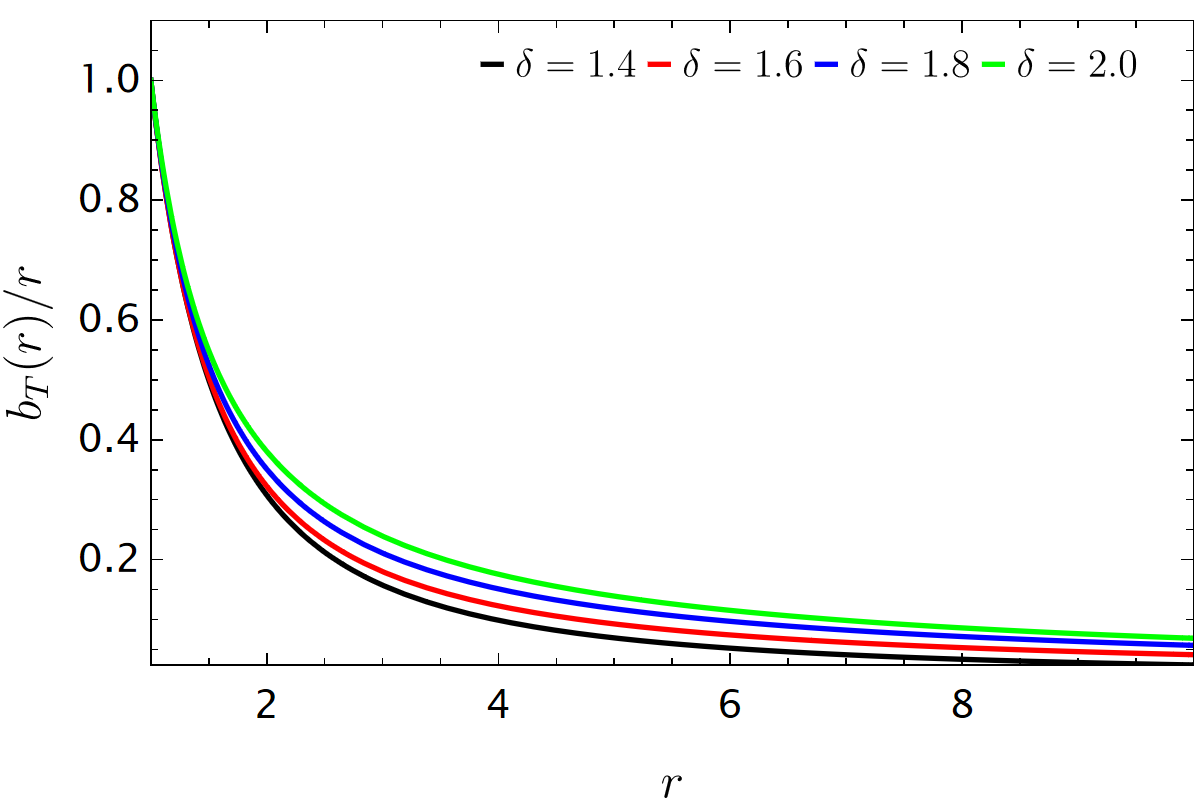
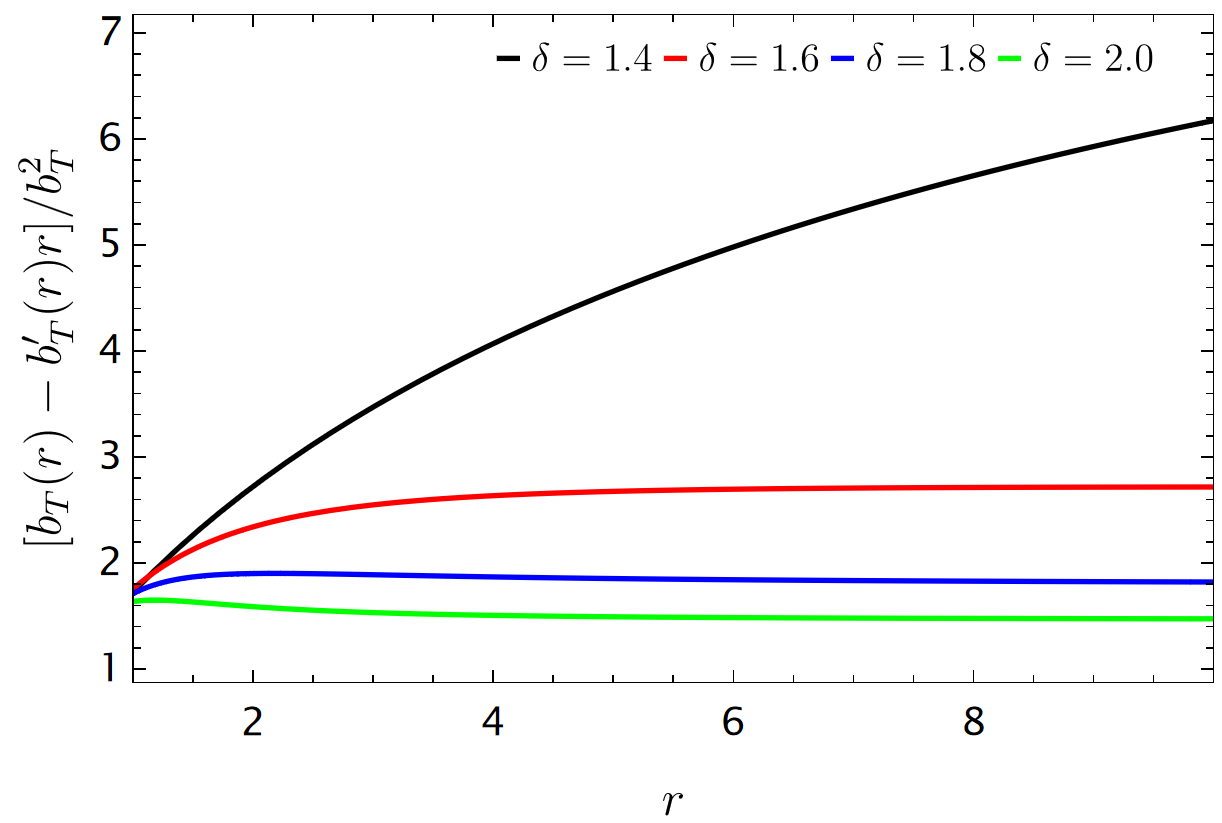
Figure 5: Geometric functions for the Tsallis branch, confirming throat and asymptotics.
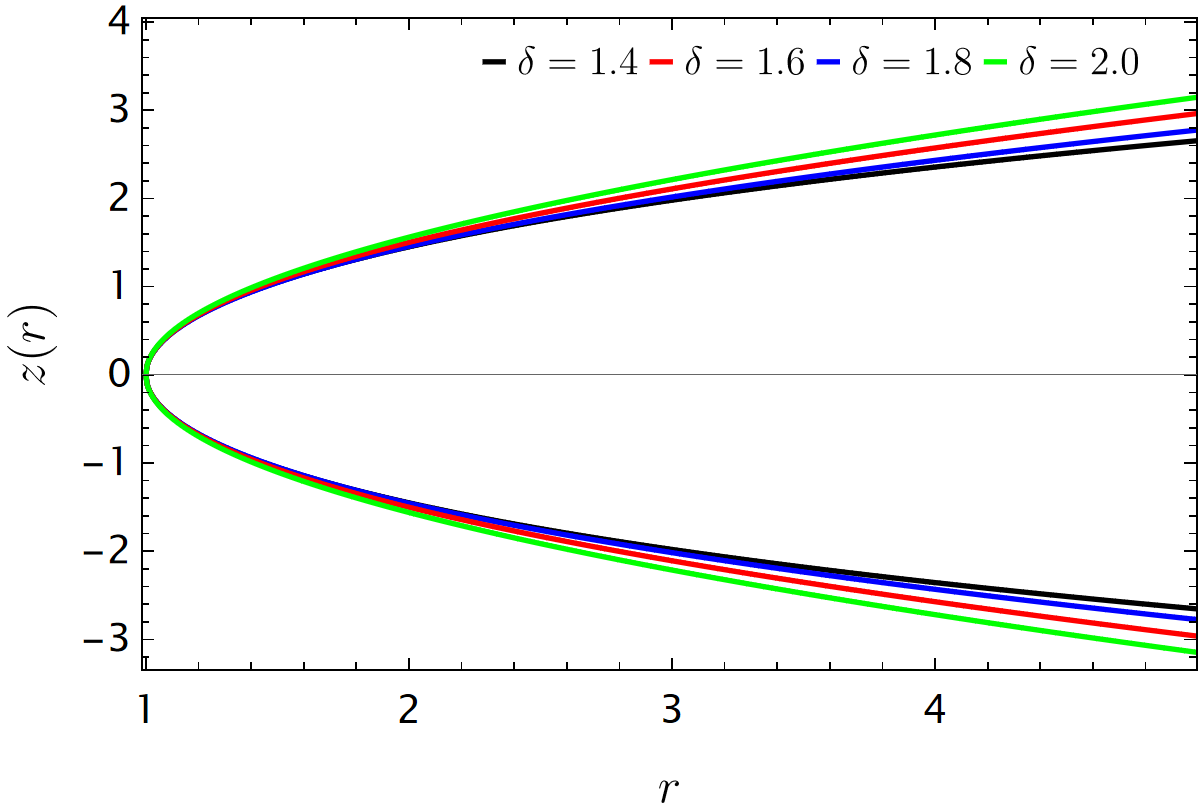
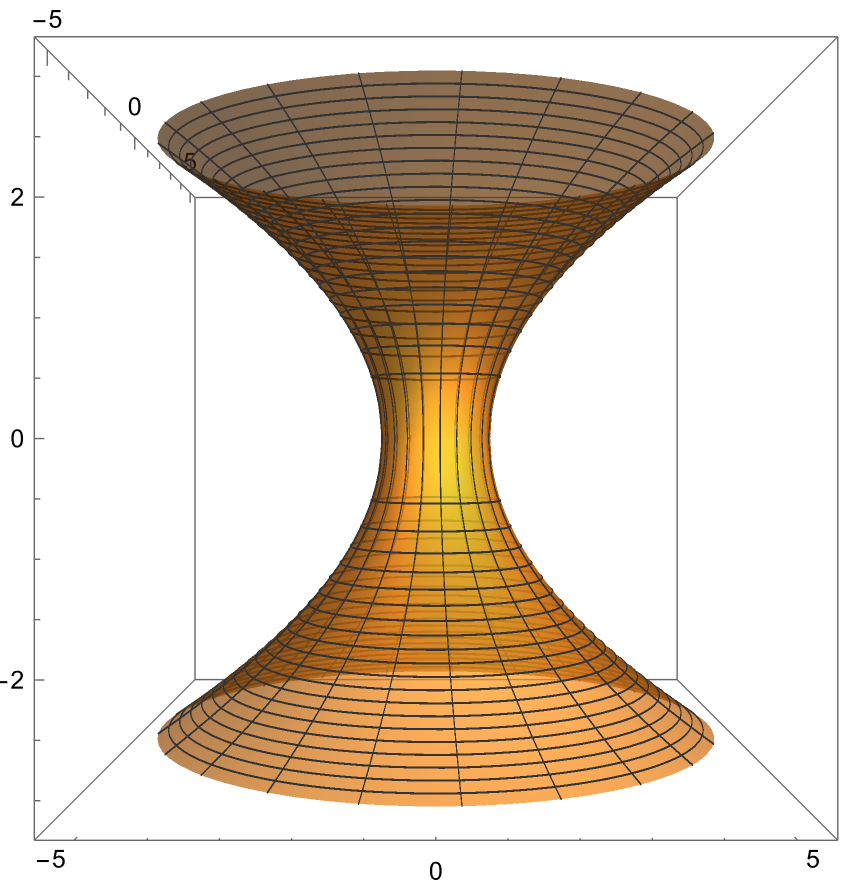
Figure 6: Embedding diagrams for Tsallis-supported wormholes—larger b(r0)=r07 localizes the geometric opening.
Kaniadakis-Inspired Sector
The Kaniadakis profile, characterized by parameter b(r0)=r08, yields a localized negative density using hyperbolic functions, concentrating the exoticity and anisotropy near the throat.
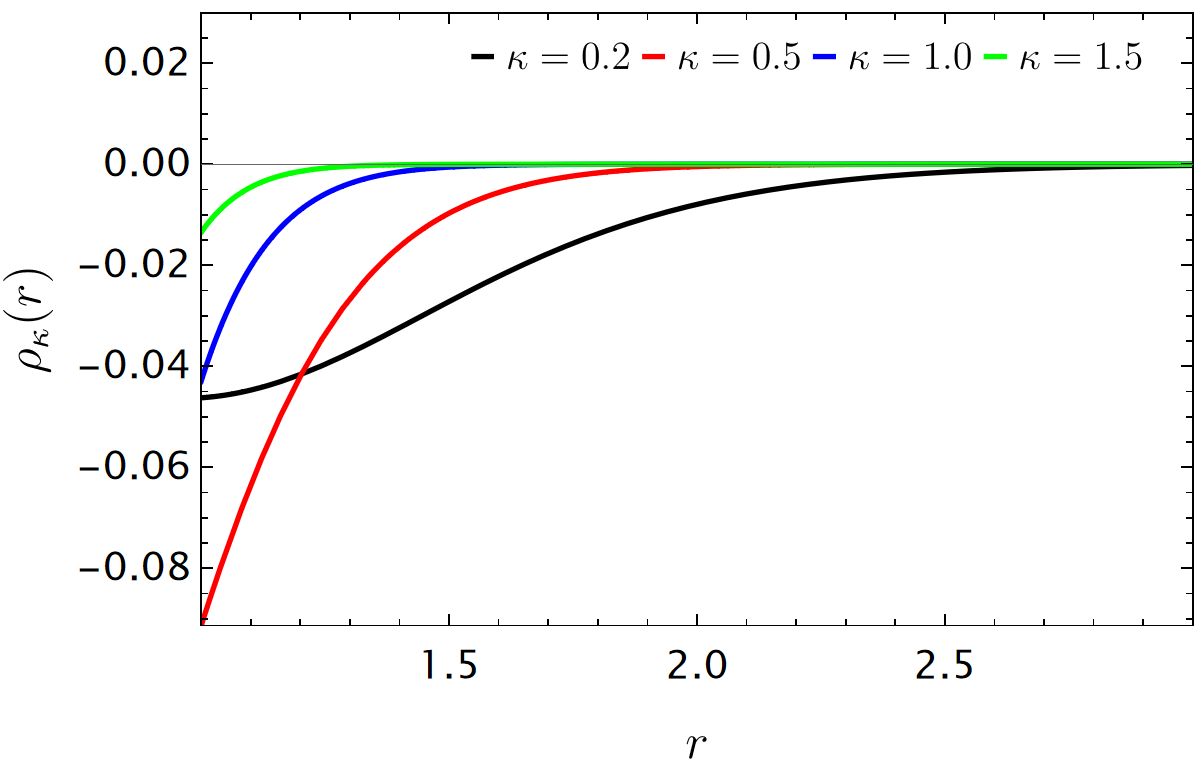
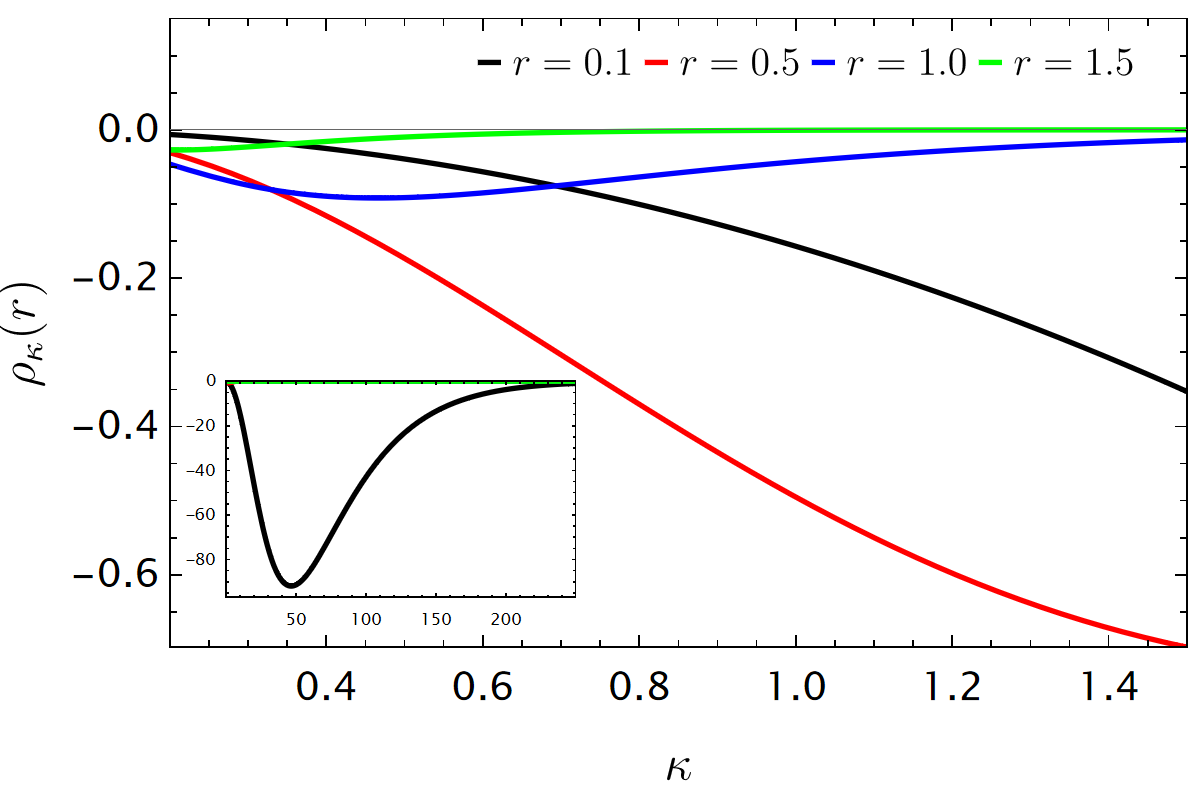
Figure 7: Kaniadakis-inspired density as a function of radius (left) and b(r0)=r09 (right), demonstrating localization and non-monotonic scaling.
NEC violation persists; the SEC combination and tangential NEC demonstrate strong parameter sensitivity, especially for intermediate b′(r0)<10. Analytical expressions for the redshift are unattainable, but all necessary quantities are numerically tractable.
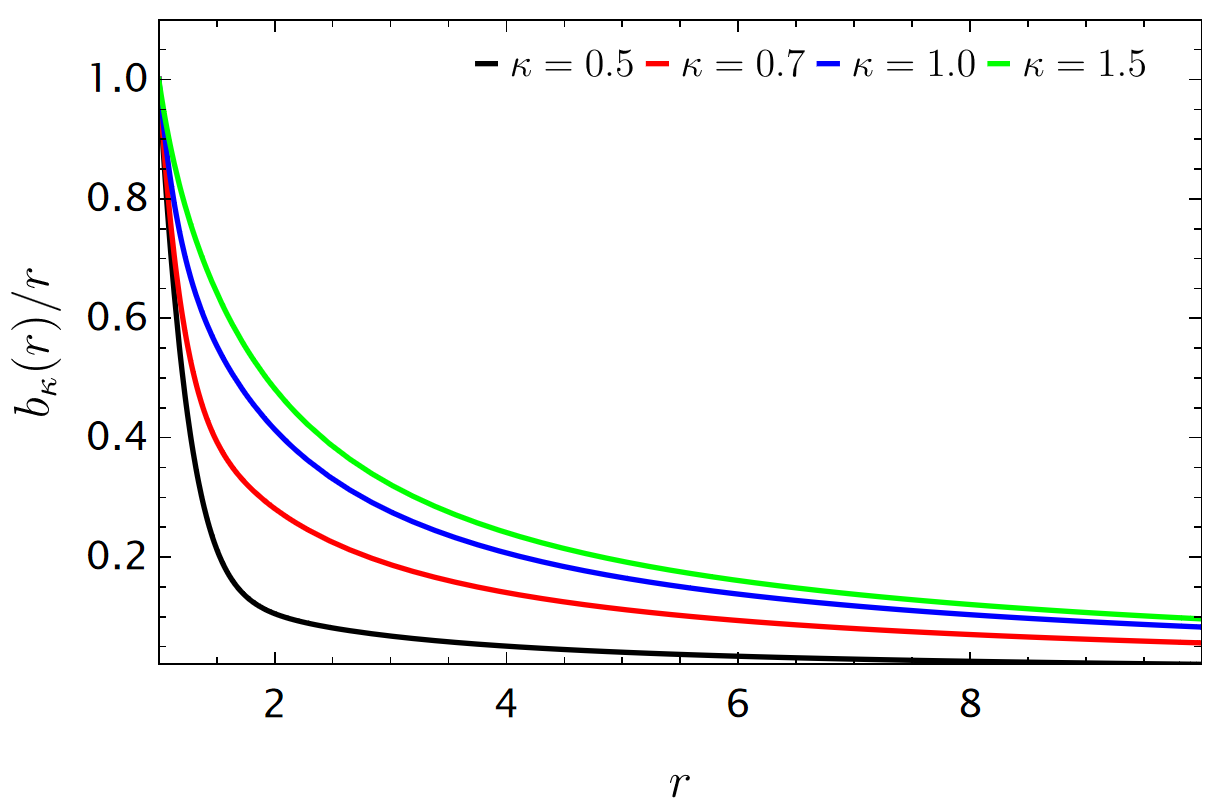
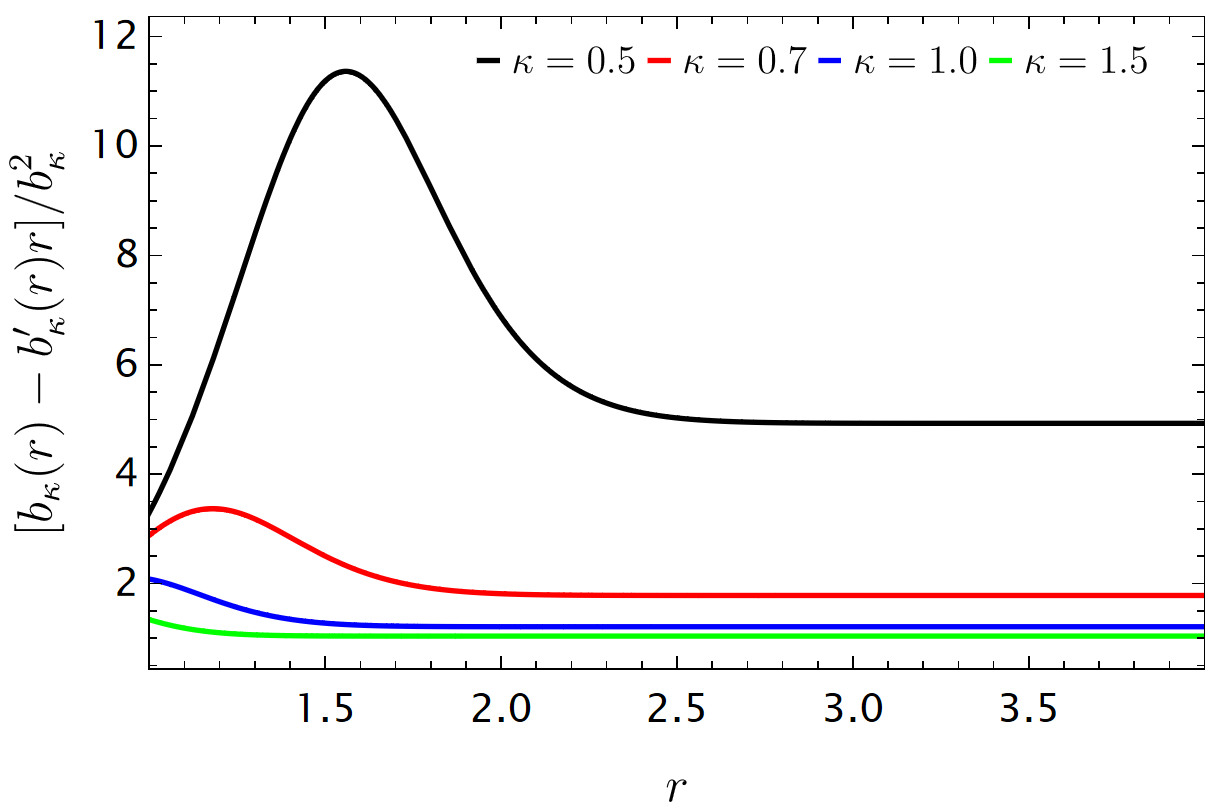
Figure 8: Geometric diagnostics for Kaniadakis-inspired wormholes.
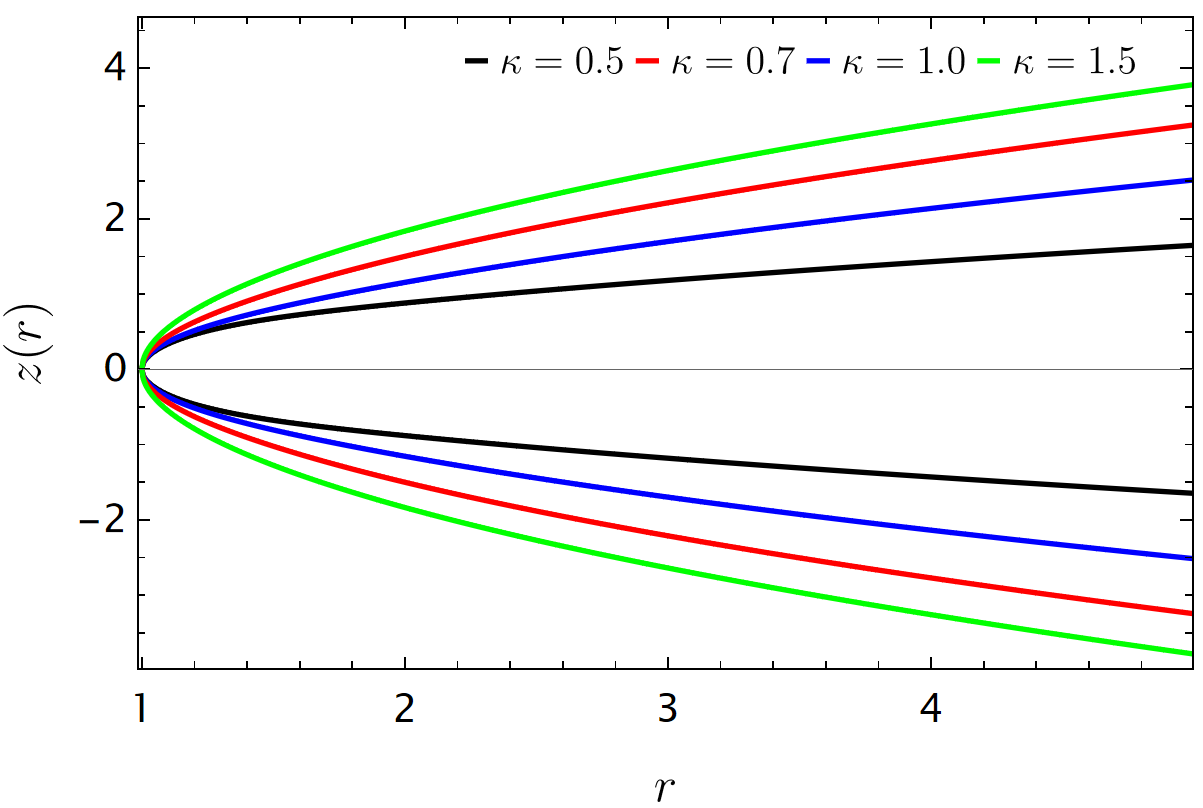
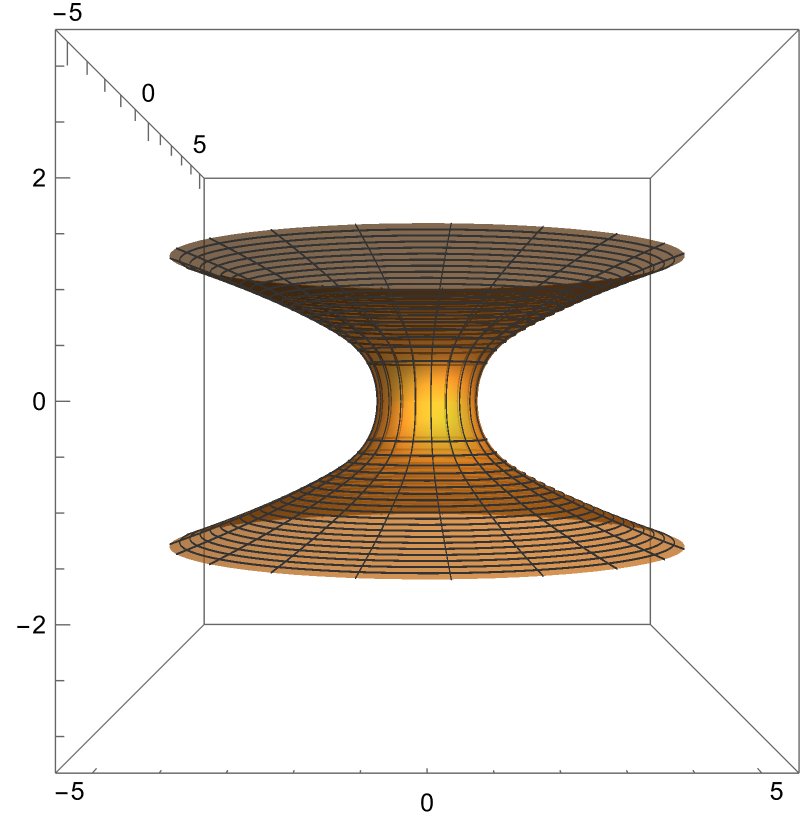
Figure 9: Embedding structures reveal a pronounced, b′(r0)<11-dependent localization near the throat.
Logarithmic-Inspired Sector
The logarithmic entropy correction introduces a rational density profile with a tunable scale b′(r0)<12, supporting both negative-density and positive (phantom-like) regimes within the same functional family. For b′(r0)<13, the sector is negative-density dominated; for b′(r0)<14, the throat is sustained via b′(r0)<15, producing a positive density with strongly negative radial pressure.
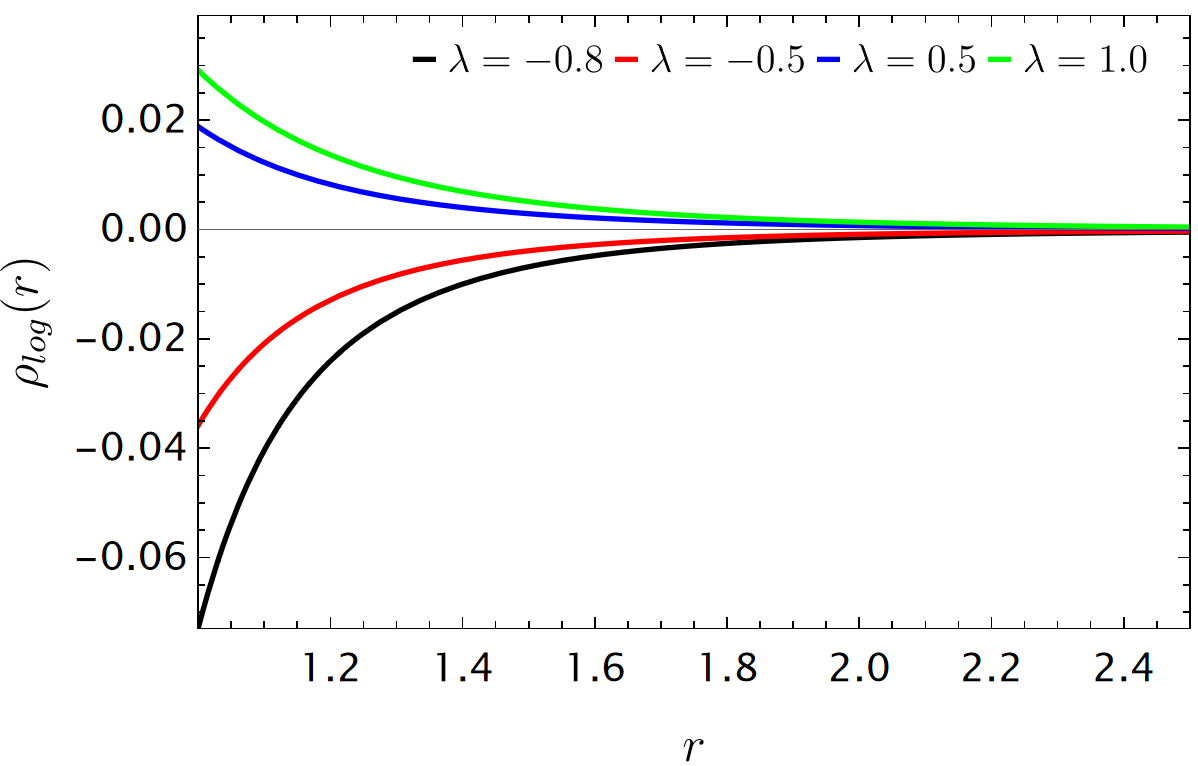
Figure 10: Logarithmic-inspired density curves; sign and scale controlled by b′(r0)<16.
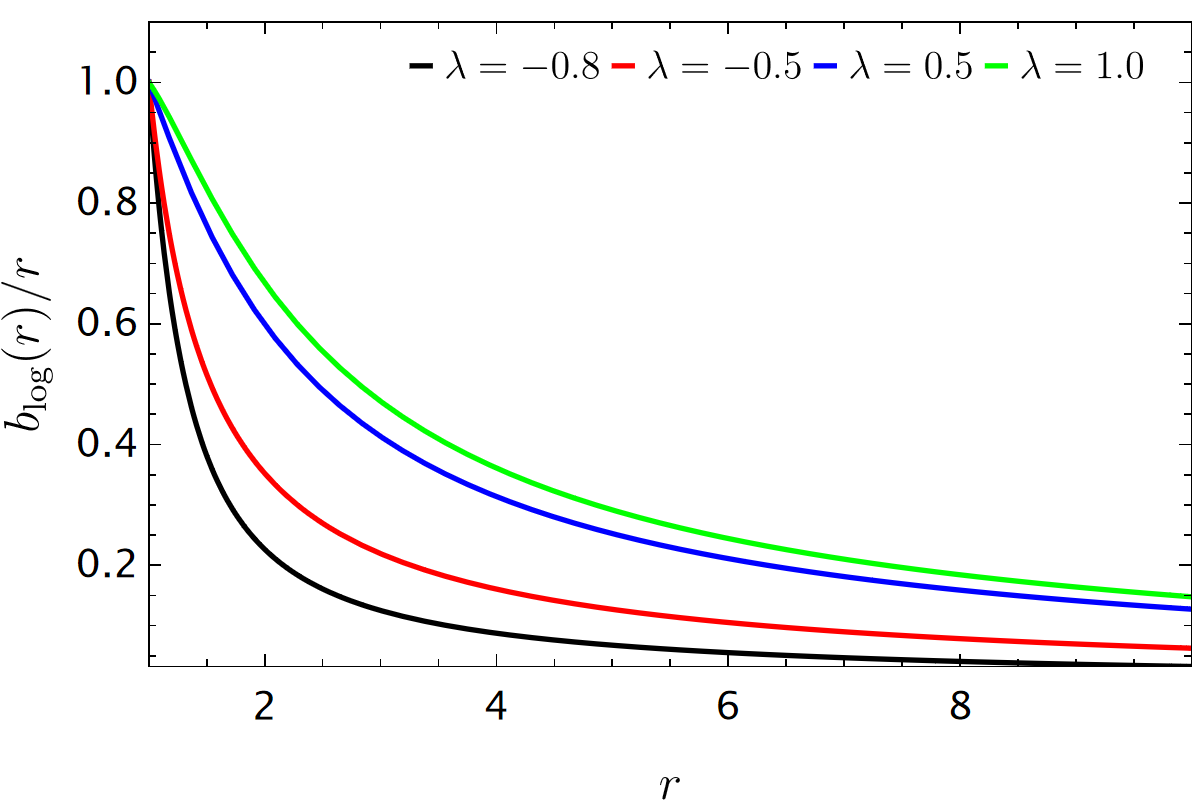
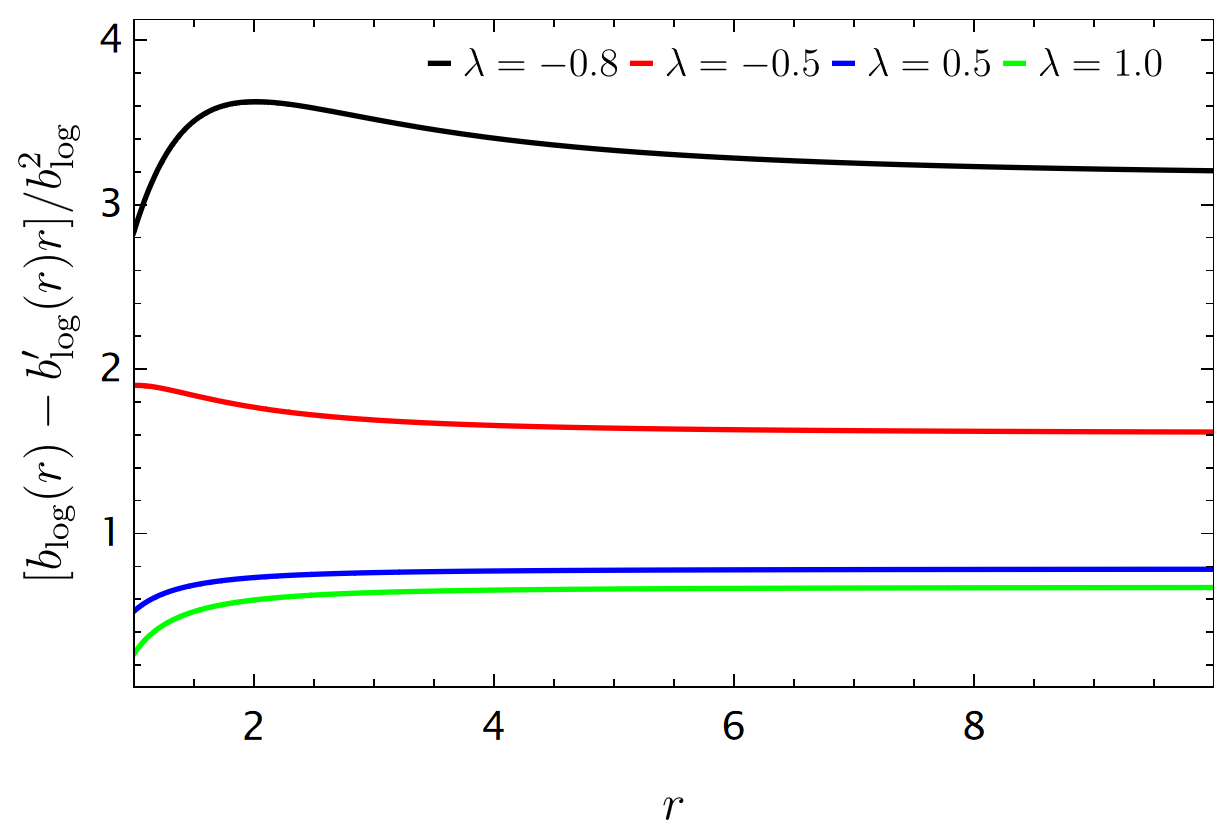
Figure 11: Shape function and flare-out diagnostics for the logarithmic sector, confirming admissibility for both signs of b′(r0)<17.
Analytic integration is available for the redshift function, and the sector exemplifies how both classic exotic matter and effective phantom matter support arise from the same entropy-motivated profile.
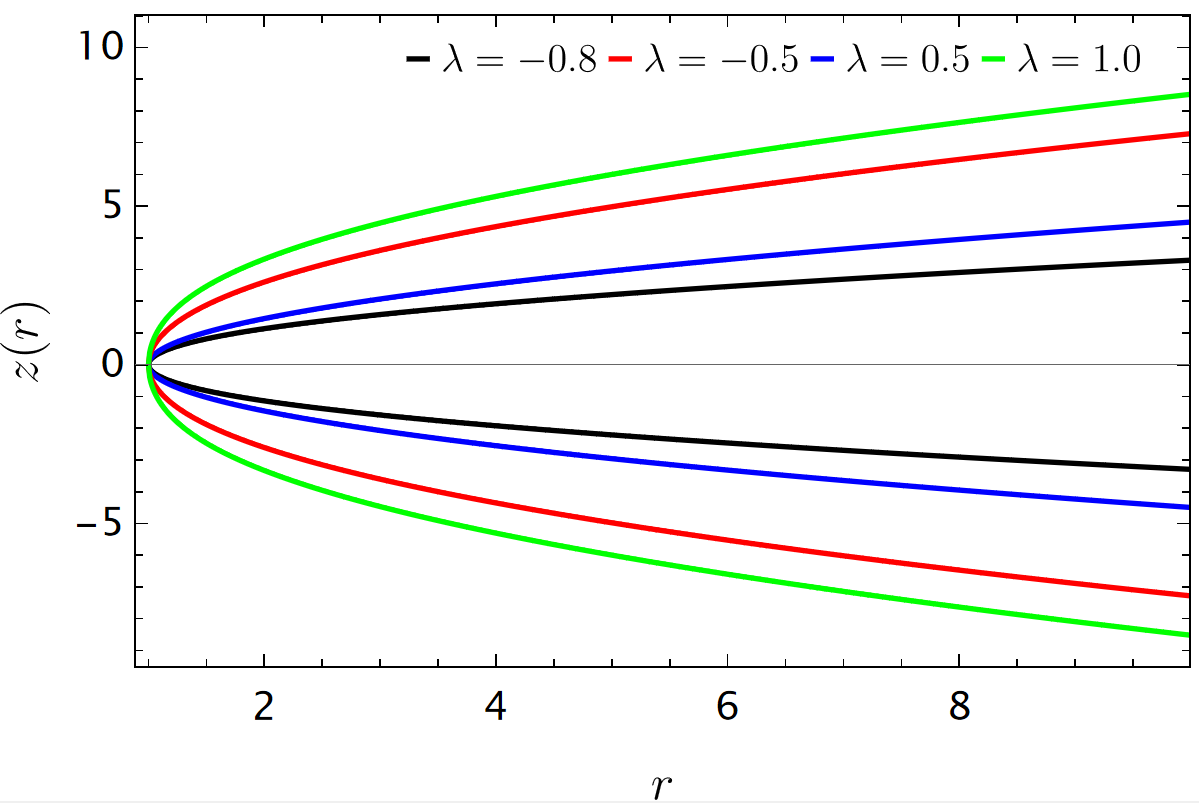
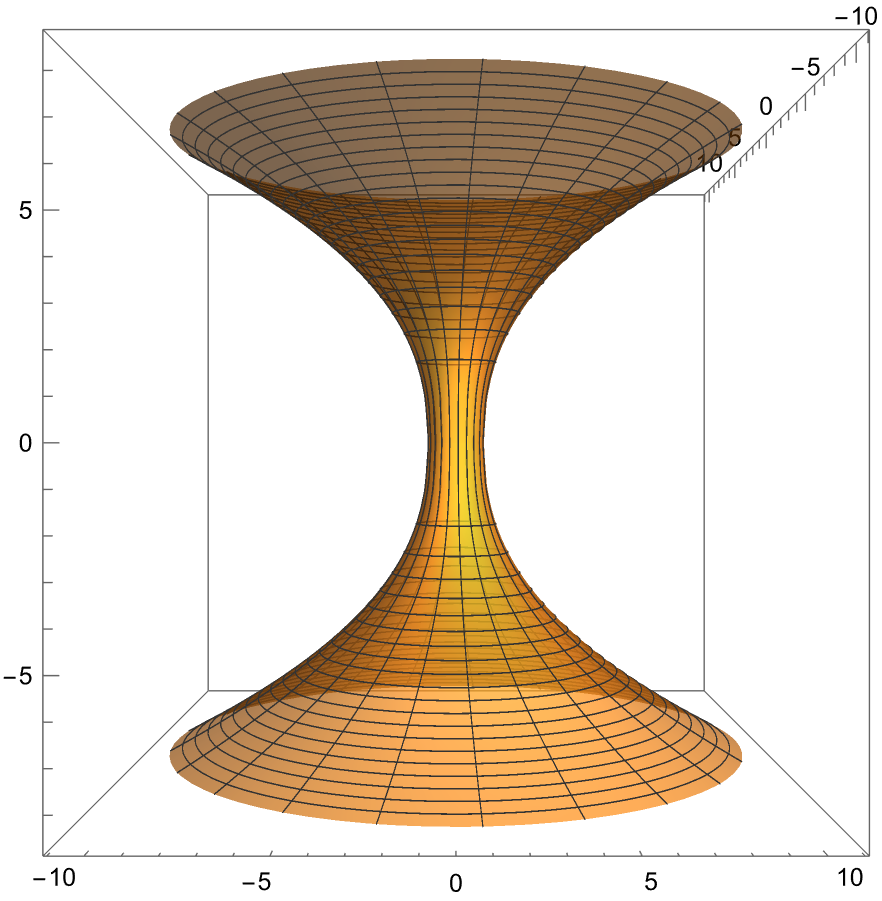
Figure 12: Embedding diagrams showing the effect of b′(r0)<18 on the throat geometry.
Exponential-Inspired Sector
The exponential correction, governed by parameter b′(r0)<19, yields a negative density profile that is extremely localized, with all exoticity and force contributions sharply focused near the throat and rapidly suppressed at infinity.
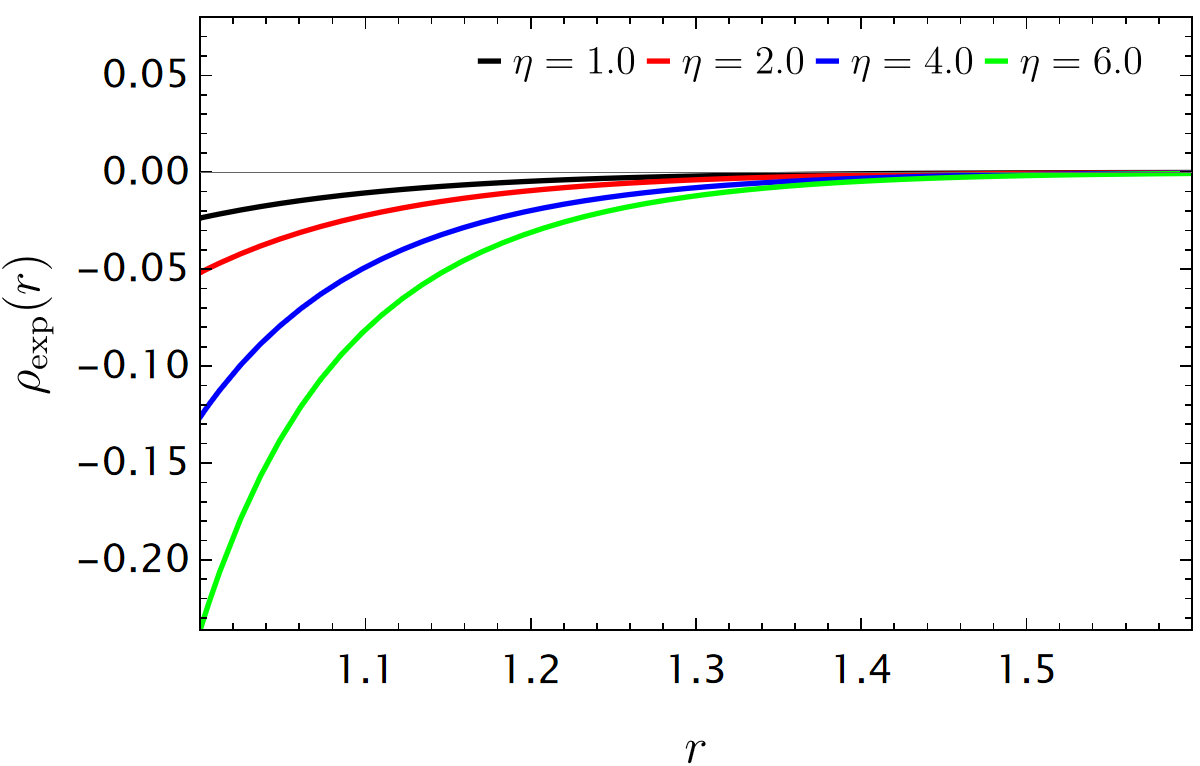
Figure 13: Exponential-inspired density profiles, illustrating rapid decay with increasing Φ′(r)0.
Only negative-density support is achievable in the physically admissible parameter space; the redshift and tangential pressures are similarly exponentially suppressed except near the throat.
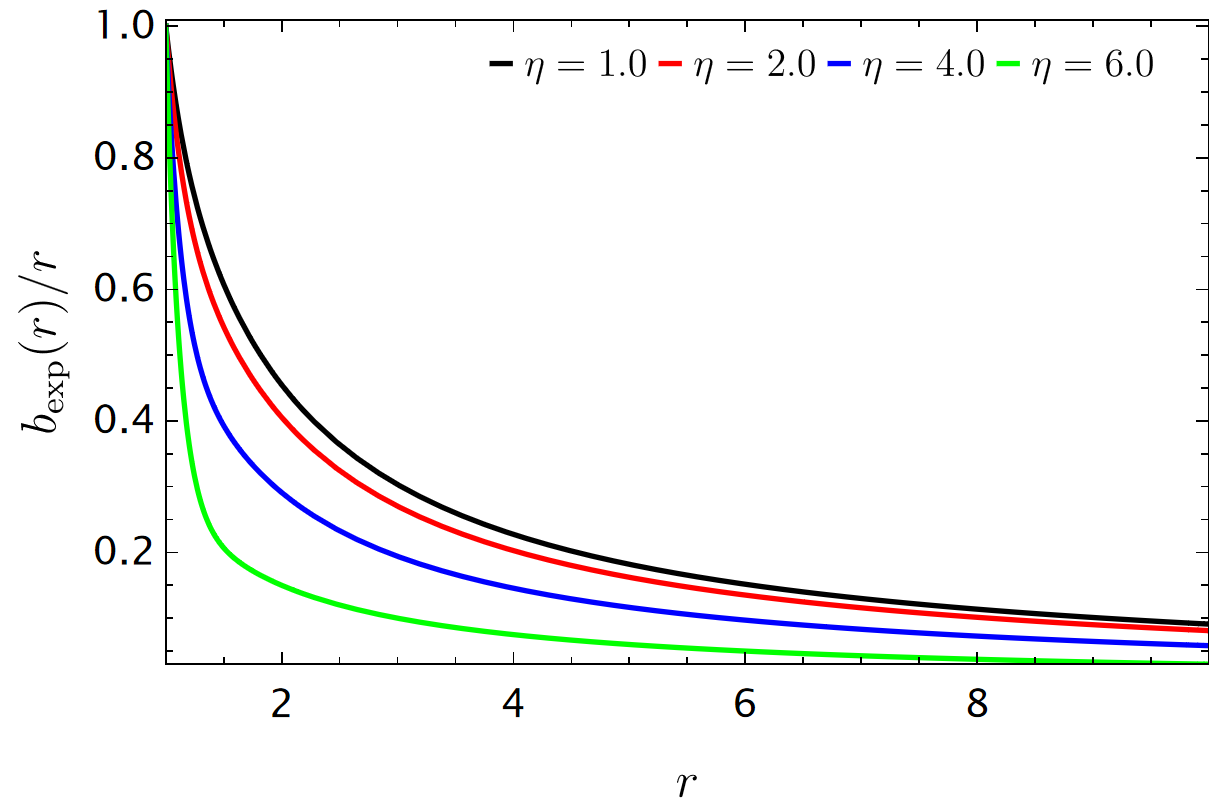
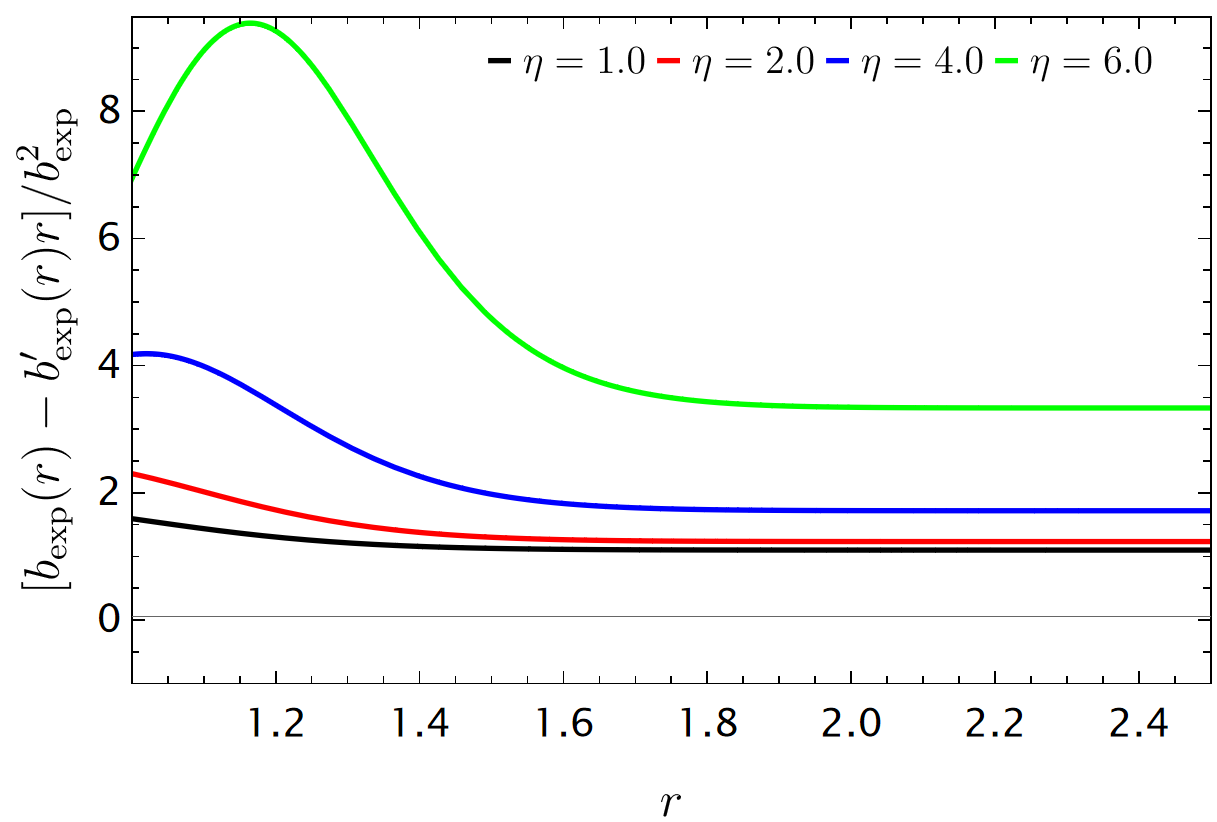
Figure 14: Geometric conditions are satisfied; throat opening intensifies with larger Φ′(r)1 but remains exponentially localized.
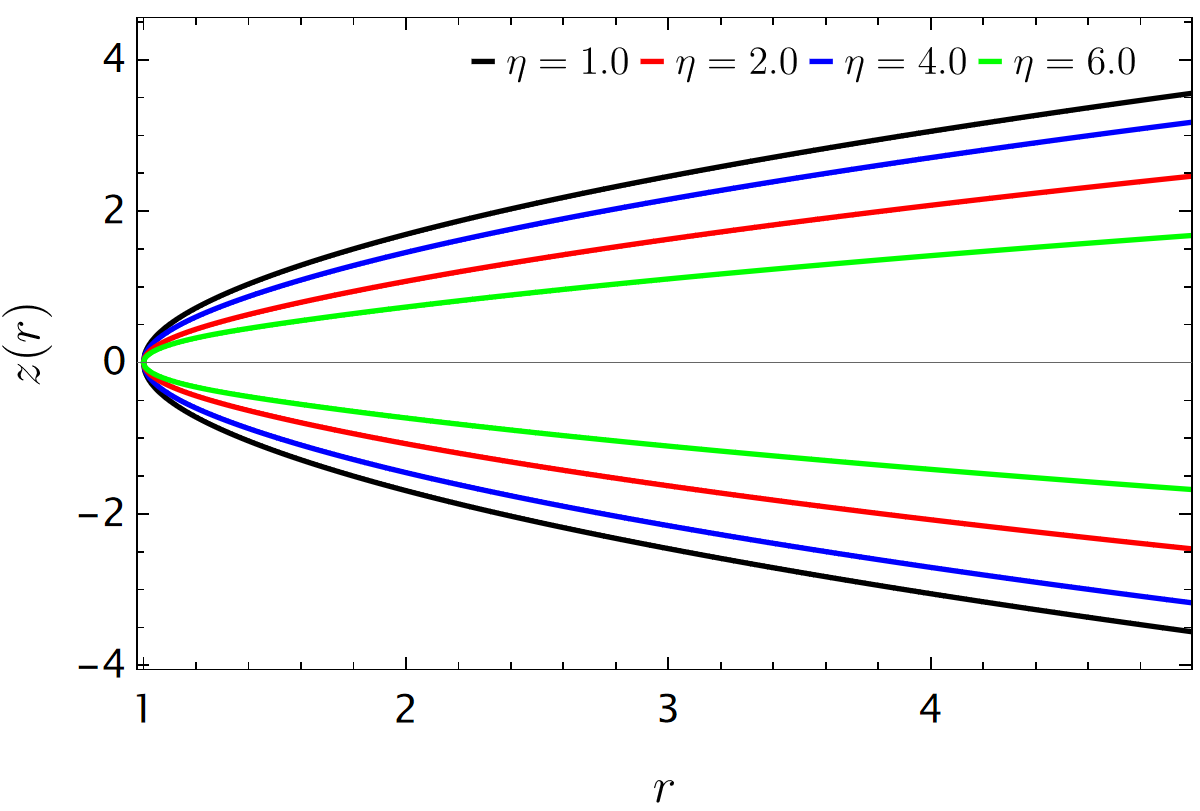
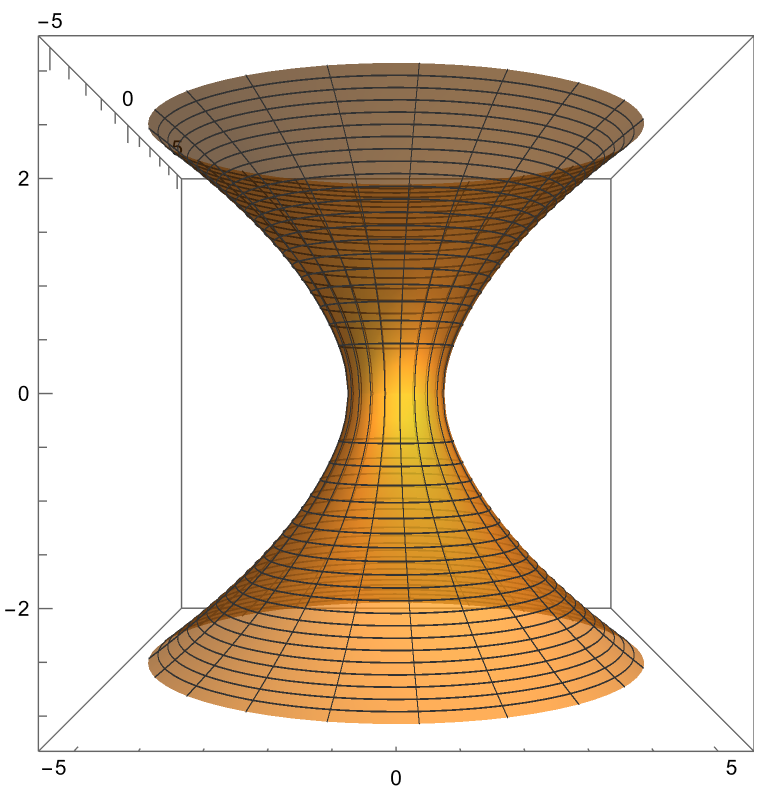
Figure 15: Embedding diagrams for the exponential sector confirm extreme localization of the wormhole opening.
Implications and Discussion
This analysis elucidates the direct relationship between microscopic (entropic) corrections and macroscopic wormhole structure. Notably, the requirement of redshift regularity at the throat fixes the radial equation-of-state parameter Φ′(r)2 in terms of the density's derivative, eliminating any arbitrary matter tuning. The violation of the radial NEC—a necessary and sufficient condition for the throat—is shown to arise geometrically from the flare-out condition, independent of the specific entropy-inspired sector.
Theoretical implications are substantial: the construction demonstrates that wormholes of controlled geometry can be sourced directly by effective densities tied to quantum/thermodynamic deformations, without requiring adhoc exotic fluids. The flexibility of the logarithmic model, in particular, opens the possibility for phantom regimes with positive density yet super-negative pressure, broadening the phenomenology of traversable wormholes. Sectors with rapid localization (Kaniadakis and exponential) suggest that observational consequences (e.g., lensing, tidal forces, or shadow structure) may be sharply limited to immediate throat scales.
Practically, these results provide templates for further studies that match entropy-deformed black hole microphysics to wormhole phenomenology, including stability, matter content quantification, and possible observational discrimination. They also delineate parameter domains where traversability and regularity coexist, a crucial criterion for physically meaningful solutions.
Conclusion
Traversable wormhole solutions supported by entropy-inspired effective matter sectors display nuanced dependence on the underlying entropy deformation. Algebraic sectors (Barrow, Tsallis) distribute exotic matter via power-law profiles, while Kaniadakis and exponential corrections enforce extreme localization. The logarithmic correction uniquely admits both negative-density and positive density (phantom-like) regimes within the same geometric framework. After imposing the minimal physical constraints (flare-out, regular redshift, asymptotic flatness), all regular sectors exhibit automatic NEC violation at the throat, linked to geometry rather than free parametrization.
Analytical tractability varies by sector, with closed forms available for logarithmic corrections and direct numerical schemes required otherwise. Phenomenologically, these results consolidate entropy-modified gravity as a promising mechanism for generating and constraining exotic wormhole geometries. Extensions to variable equations of state, inclusion of the full anisotropic effective fluid, perturbative stability, and ties to observational signatures constitute the next steps for research in this domain.