- The paper demonstrates that MCP-induced cooling shifts the black hole mass gap lower edge to higher masses using high-resolution MESA simulations.
- It employs modified stellar evolution modeling to reveal that additional energy loss reduces helium burning time and influences core composition.
- The findings provide a novel astrophysical probe that constrains otherwise inaccessible sub-MeV millicharged particle parameters.
The Black Hole Mass Gap as a Probe of Millicharged Particles
Introduction
The intersection of gravitational wave (GW) astrophysics and particle physics has enabled novel probes of physics beyond the Standard Model (BSM), particularly in the context of compact object populations. The observed paucity of stellar black holes (BHs) in the 45–130M⊙ mass range—the so-called black hole mass gap (BHMG)—originates from the effects of pair-instability in the most massive stars. The paper "The Black Hole Mass Gap as a New Probe of Millicharged Particles" (2604.02413) advances this program by establishing the BHMG as a sensitive probe of sub-MeV millicharged particles (MCPs), a class of feebly interacting particles that evade conventional stellar or laboratory constraints due to their suppressed couplings and masses.
Theoretical Background and Motivation
The origin of the BHMG arises from pulsational pair-instability supernovae (PPISN) and pair-instability supernovae (PISN), which modify black hole remnant masses as a function of the initial stellar mass and the efficiency of mass loss during advanced nuclear burning. During helium and later burning stages, temperatures and densities in massive stars become sufficient for non-standard energy losses—mediated by new light particles—to potentially impact the competition between mass retention, pair creation, core collapse, and explosive mass ejection.
MCPs are motivated by extensions of the SM featuring an additional, kinetically mixed U(1)H symmetry with light dark sector degrees of freedom. The MCP parameter space of interest, mχ∼35–200 keV and charge q∼10−10–10−9, is difficult to access with SN 1987A, red-giant branch (RGB), or cosmological bounds due to Boltzmann suppression and plasma production rate thresholds. The presence of MCPs can lead to additional energy loss in the late stages of stellar evolution, thereby modifying the location of the BHMG.
Methods and Simulations
The authors modify the MESA code to incorporate MCP production by Compton emission and e+e− annihilation, utilizing recent plasma emissivity results. They simulate non-rotating, low-metallicity helium cores through the PPISN/PISN transition, systematically varying mχ and q. They investigate the shift in the lower edge of the BHMG, defined by the most massive BH that avoids disruption, as a function of MCP parameters and nuclear reaction rates (notably the uncertain 12C(α,γ)16O rate).
Simulations use high-resolution controls and state-of-the-art reaction rates, ensuring precise treatment of the mass gap region. The focus is on the observable impact of MCP emission on the final BH mass as a function of the initial helium core mass.
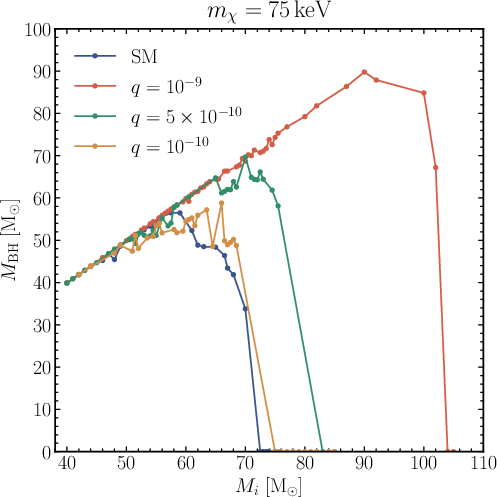
Figure 1: Black hole remnant mass as a function of initial helium core mass, with curves for varying MCP mass and charge, illustrating the upward shift of the BHMG lower edge with increasing MCP-induced cooling.
Numerical Results
The principal result is that MCP-induced energy loss noticeably affects the BHMG for mχ up to U(1)H0 and U(1)H1 as low as U(1)H2. The enhanced cooling during core helium burning reduces the time available for U(1)H3C to U(1)H4O conversion, lowering the U(1)H5O fraction and weakening the pair-instability pulses, thus allowing massive stars to retain more mass and form heavier BHs. This yields a shift of the BHMG lower edge to higher values, which, if measured precisely in population studies, can rule out or support regions of the MCP parameter space that are inaccessible to alternative astrophysical probes.
The region where the predicted mass gap is inconsistent with observations (at U(1)H6 from GWTC-4) is delineated as an exclusion in the U(1)H7 plane.
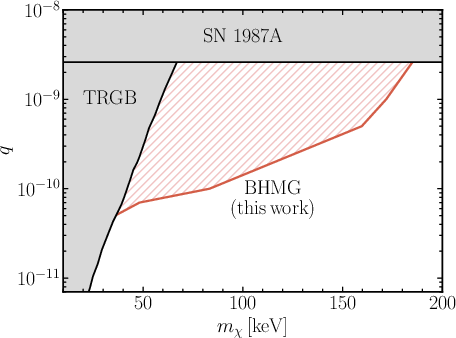
Figure 2: Sensitivity of the BHMG lower edge to MCP mass U(1)H8 and charge U(1)H9, indicating the parameter region probed by future confirmation of the mass gap location.
At fixed mχ∼350, the sensitivity decreases sharply for mχ∼351 keV due to the Boltzmann suppression of MCP production, while for small mχ∼352, existing TRGB or supernova constraints dominate. The exclusion region fills a gap left by the SN 1987A and TRGB bounds.
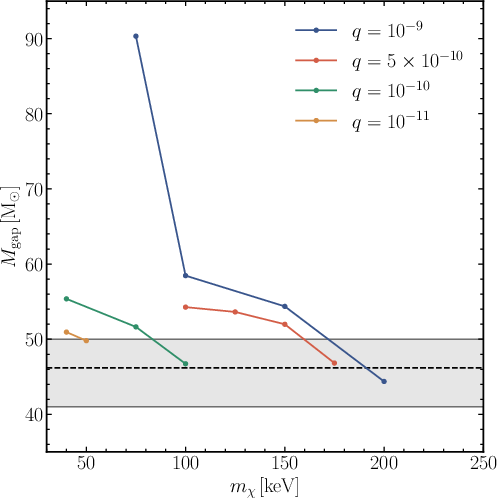
Figure 3: Lower edge of the BHMG as a function of MCP mass and charge for mχ∼353 variation in the mχ∼354Cmχ∼355O rate, showing intersection with the observationally inferred mass gap location.
Robustness and Uncertainties
The location of the BHMG is comparatively insensitive to uncertainties apart from nuclear reaction rates, especially the mχ∼356Cmχ∼357O cross section, which the authors treat conservatively by adopting a mχ∼358 value to avoid over-exclusion. Rotation is neglected, yielding conservative bounds; rapid rotation can only increase the predicted lower BHMG edge and thus strengthen MCP constraints.
The exclusion contours are delineated not just for the median, but across the allowed range of reaction rates, with interpolations to prevent discretization bias in the MCP parameter space.
Implications and Outlook
The BHMG emerges as a competitive probe of BSM particles with masses above the reach of RGB and comparable to SN 1987A probes but requiring less extreme couplings, due to the unique thermal environment and evolutionary consequences of massive stars. This methodology is only sensitive to FIPs that are efficiently produced and stable (or invisible in the SN or stellar context), such as stable MCPs, not to ALPs decaying to photons or particles with large SM branching fractions.
The precision of GW catalogs in mapping the BH mass function thus becomes a meaningful constraint on BSM models, linking high-energy particle properties to low-frequency GW observations via detailed stellar astrophysics. Future data releases with improved mass gap statistics will directly translate into tighter bounds or potential evidence for MCP-like physics.
The framework is extendable to FIPs with similar coupling and kinematic properties, with the primary limitation being the plasma conditions necessary for efficient production. Unexplored probes in dense stellar environments, such as the AGB/HB population ratios in globular clusters, may further test the MCP parameter space or constrain other BSM particles.
Conclusion
This work establishes the BHMG as a unique astrophysical laboratory for sub-MeV MCPs, exploiting the advanced stages of massive stellar evolution and the precise mapping of black hole populations by GW interferometers. Confirmation of the BHMG lower edge at mχ∼359 would robustly constrain MCPs in an otherwise unconstrained part of parameter space. The integration of advanced stellar modeling with GW data sets a paradigm for future multimessenger probes of dark sector physics, highlighting the synergy between astrophysics and particle phenomenology (2604.02413).