- The paper demonstrates self-dual holography by deriving explicit three- and four-point correlators for massless higher-spin fields in AdS4 using a chiral formulation.
- The paper constructs a precise holographic dictionary via boundary condition analysis and Fefferman-Graham expansion across helicity sectors.
- The paper confirms that the flat space limit recovers SDYM behaviors, positioning chiral HiSGRA as a UV-finite and computationally tractable quantum gravity model.
Self-Dual Holography and Higher-Spin AdS/CFT Correlators
Overview and Motivation
This paper systematically develops the concept of self-dual holography, focusing on the AdS_4/CFT_3 correspondence for theories whose bulk is described by self-dual higher-spin (HS) gravities. The principal aim is to establish the holographic dictionary and compute explicit three- and four-point correlators for massless higher-spin fields in AdS4, primarily within a truncation of chiral higher-spin gravity (HiSGRA), which admits all spins and all vertices compatible with self-duality. A key motivation is that self-dual theories are UV-finite, integrable, and amenable to exact computation, in stark contrast to generic gravitational theories which suffer from non-renormalizability and require stringy completions. Thus, self-dual HS extensions are proposed as a tractable framework for constructing precise models of quantum gravity and holography.
Self-dual theories also serve as consistent, UV-finite truncations of their parent non-chiral theories, with all amplitudes in the self-dual sector directly inherited from the parent theory. This establishes self-dual HS gravity as a minimal, effective subsector of a broader theory, e.g., Chern-Simons matter models. These frameworks admit simple twistor and light-cone gauge formulations, which are crucial for uncovering the structure of scattering amplitudes and for defining the AdS/CFT correspondence in a highly computationally accessible setting.
The structural landscape of self-dual theories and their higher-spin extensions is illustrated in the following schematic:
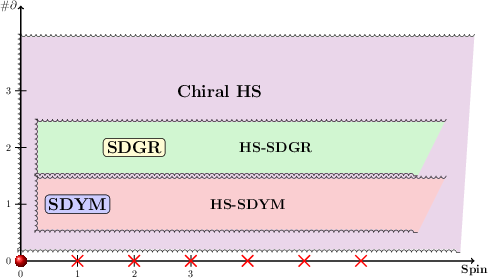
Figure 1: The map of self-dual theories displaying spin (x-axis) and number of derivatives in cubic vertices (y-axis), ranging from SDYM and SDGR up to chiral higher-spin gravity, with multiple intermediate cases.
Theoretical Framework and Holographic Dictionary
The paper constructs HS-SDYM (higher-spin self-dual Yang-Mills) as a direct generalization of SDYM via generating function techniques and spinorial notation. It provides an explicit gauge-invariant action for HS-SDYM and demonstrates that its three-point interactions are exclusively of V−++ type, restricted by ∑iλi=1 for the helicities—these are the single derivative, Yang-Mills-type vertices generalized to all spins. Chiral HiSGRA encompasses all such interactions, encoding them via an explicit coupling constant dependent on the sum of helicities:
Cλ1,λ2,λ3=κlpλ1+λ2+λ3−1Γ(λ1+λ2+λ3)
The holographic dictionary is developed by analyzing the Fefferman-Graham expansion for chiral HS fields, both positive and negative helicity sectors. Precise boundary conditions are identified through regularity requirements of bulk solutions, and the conformal dimensions are rigorously extracted:
- For negative helicity fields (ΨA(2s)): Δ=s+1, matching the unitarity bound for conserved HS currents.
- For positive helicity gauge fields (ΦA(2s−1),A′): Δ=2−s, corresponding to the source dimension for HS currents.
The spectrum on the boundary is shown to supply the necessary conserved currents and gauge fields to realize the dual CFT—both sectors contain two off-shell physical degrees of freedom, precisely reconstructed via polarization spinors _30 with definitive helicity assignments.
Explicit Computation of AdS/CFT Correlators
Bulk-to-bulk and boundary-to-bulk propagators for arbitrary spin are constructed, filling a gap for _31 in previous literature. Gauge fixing (Feynman/Lorenz and physical gauges) is systematically explored, and pure gauge ambiguities associated with homogeneous bulk solutions are shown to be eliminated in the physical gauge. The structure of propagators using generating function techniques and spinorial polarization bases is fully derived, ensuring analytical tractability and precise boundary conditions.
Three-point and four-point AdS/CFT correlators are explicitly computed in HS-SDYM:
- The three-point correlator matches the SDYM structure, dressed by a higher-spin factor dependent on helicity and spin configuration.
- The four-point _32-channel diagram is evaluated using Berends-Giele recursion methods, with flat-limit behavior shown to recover the expected vanishing for generic kinematics (due to the self-duality constraint), while nontrivial contributions arise in collinear regimes.
These computations demonstrate that the leading energy pole of AdS/CFT correlators agrees precisely with flat-space amplitudes, providing a stringent numerical test.
Numerical Results and Bold Claims
The paper establishes that:
- HS-SDYM three- and four-point correlators in the AdS/CFT setting are completely determined by regular solutions of the chiral formulation and their boundary conditions.
- The flat space limit of AdS/CFT four-point functions vanishes for generic kinematics, identical to SDYM, but does not vanish for collinear configurations—confirming previous amplitude computations [Ponomarev:2017nrr, Guarini:2026vds, Serrani:2026azw].
- Chiral HiSGRA provides a closed, computationally accessible and UV-finite subsector dual to specific sectors of Chern-Simons matter theories, which avoids the nonlocality no-go arguments present in generic bulk constructions and supplies exact AdS/CFT correlators.
Implications and Speculative Outlook
Practically, the success of self-dual HS holography provides an exact, UV-finite playground for exploring quantum gravity models in AdS, yielding amenable boundary CFTs with closed operator spectra and explicit correlators. Theoretically, it bridges twistor constructions, celestial algebras, and higher-spin integrability into precise holographic dualities. The approach circumvents standard no-go obstacles, such as perturbative nonlocality and anomaly generation, and sets the stage for the systematic expansion over chiral sectors analogous to MHV expansions in gauge theory.
Future directions hinted at by the results include:
- Computation of loop corrections and study of anomalous dimensions in AdS self-dual higher-spin gravity.
- Generalization of the kinematic algebra to AdS, potentially exploiting light-cone gauge and celestial construction.
- Formulation of the self-dual holographic dictionary in twistor space, thereby bypassing conventional spacetime analysis.
- Quantification and systematic expansion of nonlocality when venturing beyond the chiral sector, e.g., in the duals of generic vector models.
Conclusion
This paper rigorously builds the theoretical and computational foundations for self-dual holography in AdS/CFT, establishing a concrete holographic dictionary and explicit correlator calculations for self-dual higher-spin theories. The approach demonstrates that self-dual sectors, particularly chiral HiSGRA and HS-SDYM, provide an exact, UV-finite, and computationally tractable model of quantum gravity holography, unlocking new avenues in explicit correlator computation, integrable quantum gravity, and higher-spin theory. The implications reach both practical computations of AdS/CFT observables and deeper understanding of nonlocality, symmetry, and twistor-based constructions in quantum field theory and gravity.