Geometry Matters: 3D Foundation Priors for Learning Semantic Correspondence
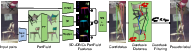
Abstract: Foundation features from self-supervised vision models and text-to-image diffusion models have proven effective for semantic correspondence estimation. However, because these features are learned primarily from 2D image objectives, they lack explicit 3D awareness and often confuse symmetric object sides, repeated parts, and visually similar structures that are distinct in 3D. We introduce a 3D-aware post-training framework that goes beyond available 2D foundation features by incorporating priors from 3D foundation models. Given an image, our method uses SAM3D to estimate object geometry and pose, and refines the pose through render-and-compare optimization. Subsequently, we render PartField descriptors from the reconstructed geometry into the image plane based on the estimated object pose. The resulting geometry-aware feature maps complement DINO and Stable Diffusion features, while geodesic distances on the reconstructed shapes enable reliable filtering of candidate correspondences. We use the filtered matches as supervision to train a lightweight adapter on top of DINO and Stable Diffusion for semantic correspondence. In contrast to prior post-training approaches that require pose annotations and rely on coarse spherical geometry, our method automatically obtains instance-specific 3D structure and uses it to guide correspondence learning. Experiments show that our approach improves semantic correspondence over the prior methods while reducing manual geometric supervision. Code and model can be found at https:/github.com/GenIntel/3D-SC.


Paper Prompts
Sign up for free to create and run prompts on this paper using GPT-5.
Top Community Prompts
Explain it Like I'm 14
Overview
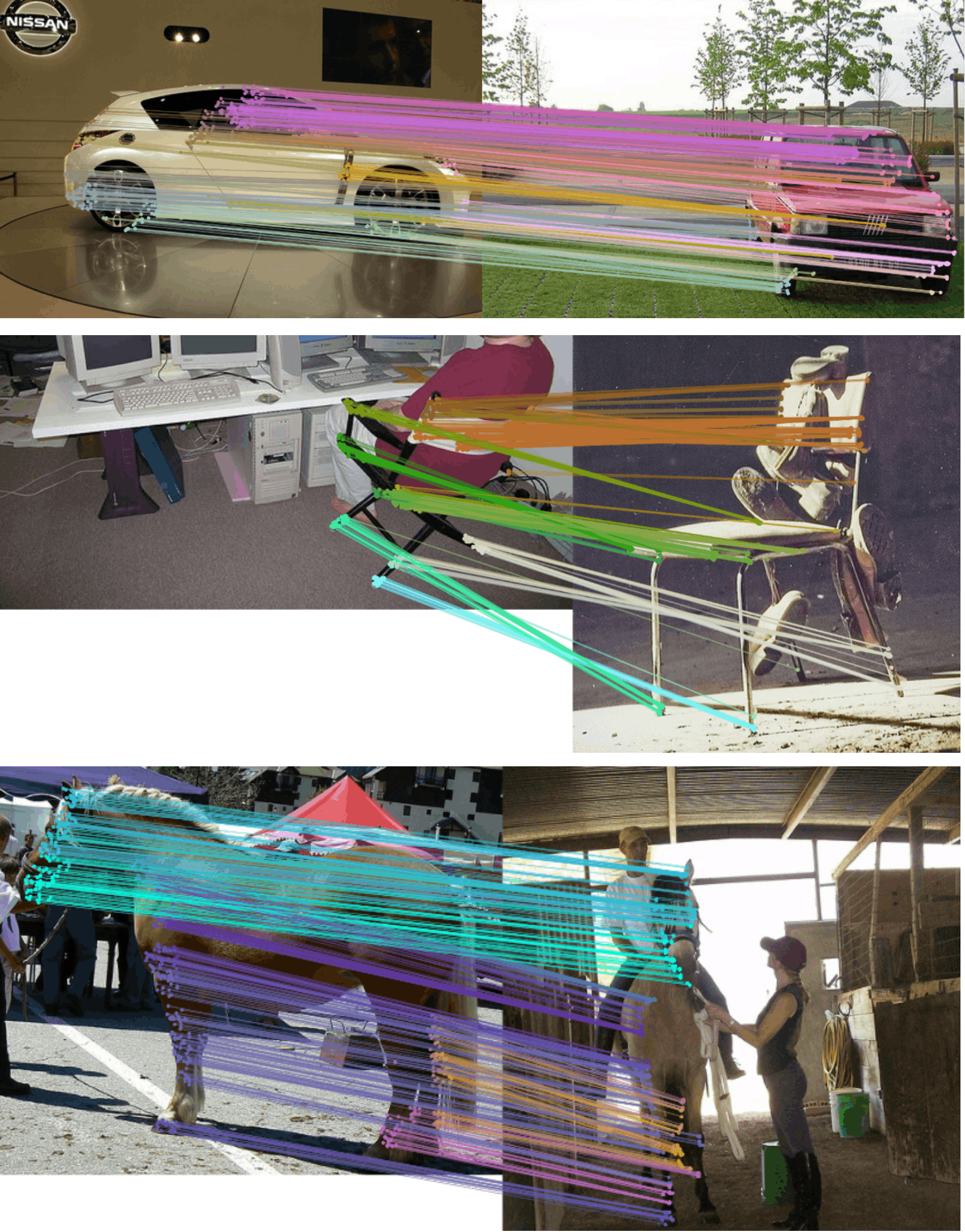
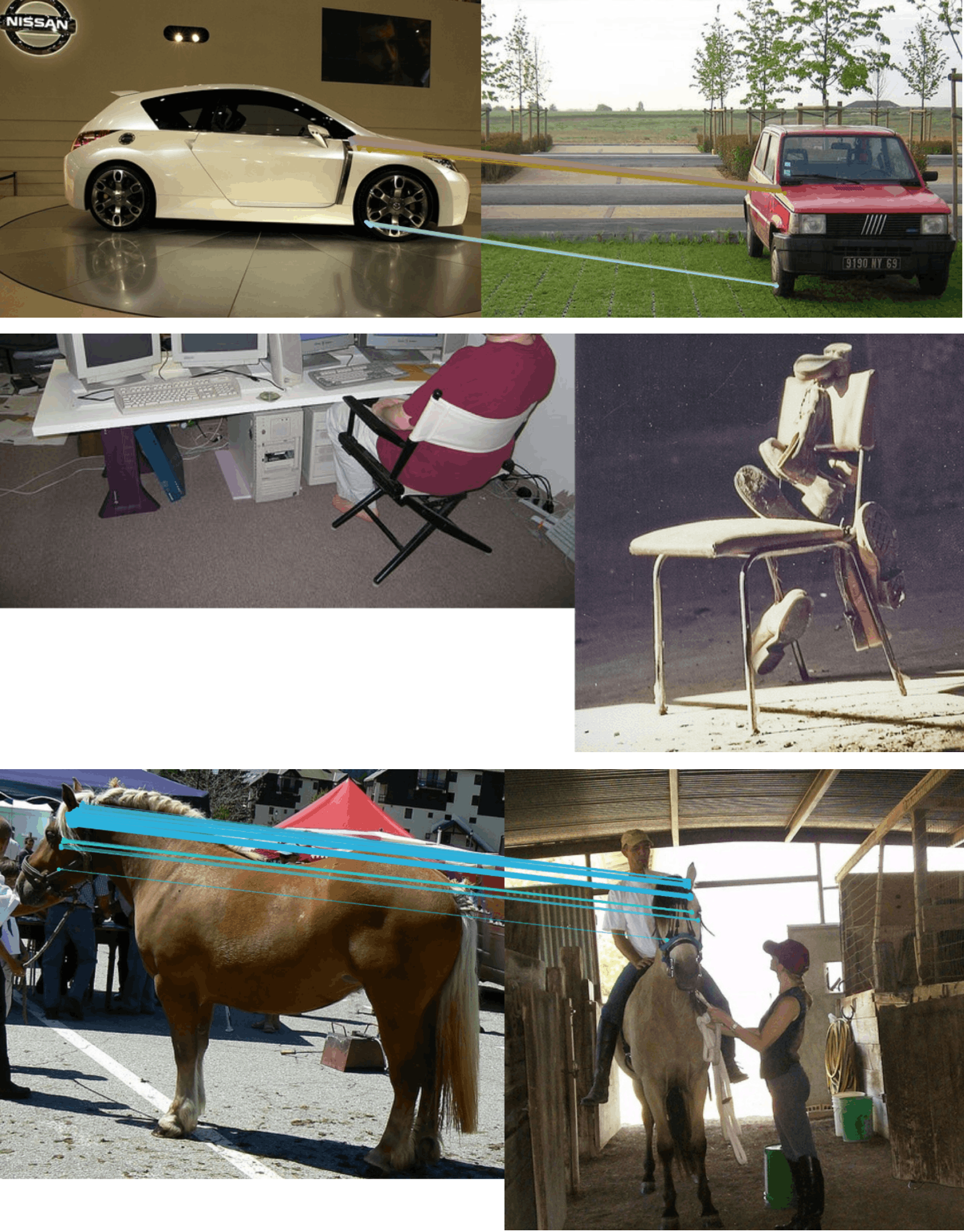
This paper is about helping computers find the same “parts” of an object across different photos. For example, if you have two pictures of different cars, the system should figure out which pixel in one picture matches the front-left wheel in the other, even if the cars are at different angles or have different colors. The authors show that adding 3D knowledge about the object’s shape makes these matches much more reliable, especially when parts look similar in 2D (like left vs. right sides or repeated parts like wheels and windows).
Key Objectives
Here are the questions the paper tries to answer:
- Can we reduce common mistakes in 2D matching, like confusing left and right sides or mixing up repeated parts?
- Can we use 3D information about an object’s shape to guide better 2D matching, without needing humans to label the object’s pose?
- Can this 3D-aware approach improve accuracy on standard tests while keeping the system simple and practical?
How They Did It
The authors build a pipeline that combines strong 2D image features with 3D “shape priors.” Think of it like making a small 3D toy of the object from each photo, then using that toy to guide which pixels should match. The process has several steps:
- Build and align a 3D model from a single image
- Imagine the computer guesses a 3D toy model of the object from one photo (using a tool called SAM3D) and also guesses how the camera saw it.
- The guess isn’t perfect, so they “render and compare”: they project the 3D toy back onto the photo and nudge its size and position until the outline matches the object’s silhouette. First, they do a coarse fix to quickly pull the outline into place, then a finer alignment to tighten the fit.
- Finally, they fix the model’s rotation so all instances of the same category face a consistent “front,” removing confusing 90-degree flips (important for symmetric objects like buses or trains).
- Give each 3D surface point a stable “part identity”
- They use a 3D technique called PartField to assign a distinctive descriptor to each point on the 3D surface. You can think of it like painting the 3D toy so that each part has a unique, consistent code that doesn’t change much with viewpoint.
- They then “project” these part descriptors back into the 2D image, so each pixel gets extra 3D-aware information.
- Propose 2D matches using fused features
- They combine three kinds of features at each pixel:
- DINO (a vision transformer’s 2D features)
- Stable Diffusion features (also 2D, complementary to DINO)
- PartField features (3D-aware part codes projected into the image)
- With this fused feature at each pixel, they find nearest neighbors between two images to propose candidate matches.
- They keep candidates that pass a “round trip” check: if a pixel in image A matches to one in image B, then going back from that pixel in B should land near the original in A. This is a relaxed cyclic consistency check.
- Double-check matches using the 3D surface
- Now the clever part: they lift each matched pixel up onto its 3D toy model in each image.
- They compare how well the 2D match agrees with the 3D logic by measuring a “walking distance” along the surface (a geodesic distance) between the matched points. If the surface-walking distance is small, the match is believable; if it’s large, it’s likely wrong.
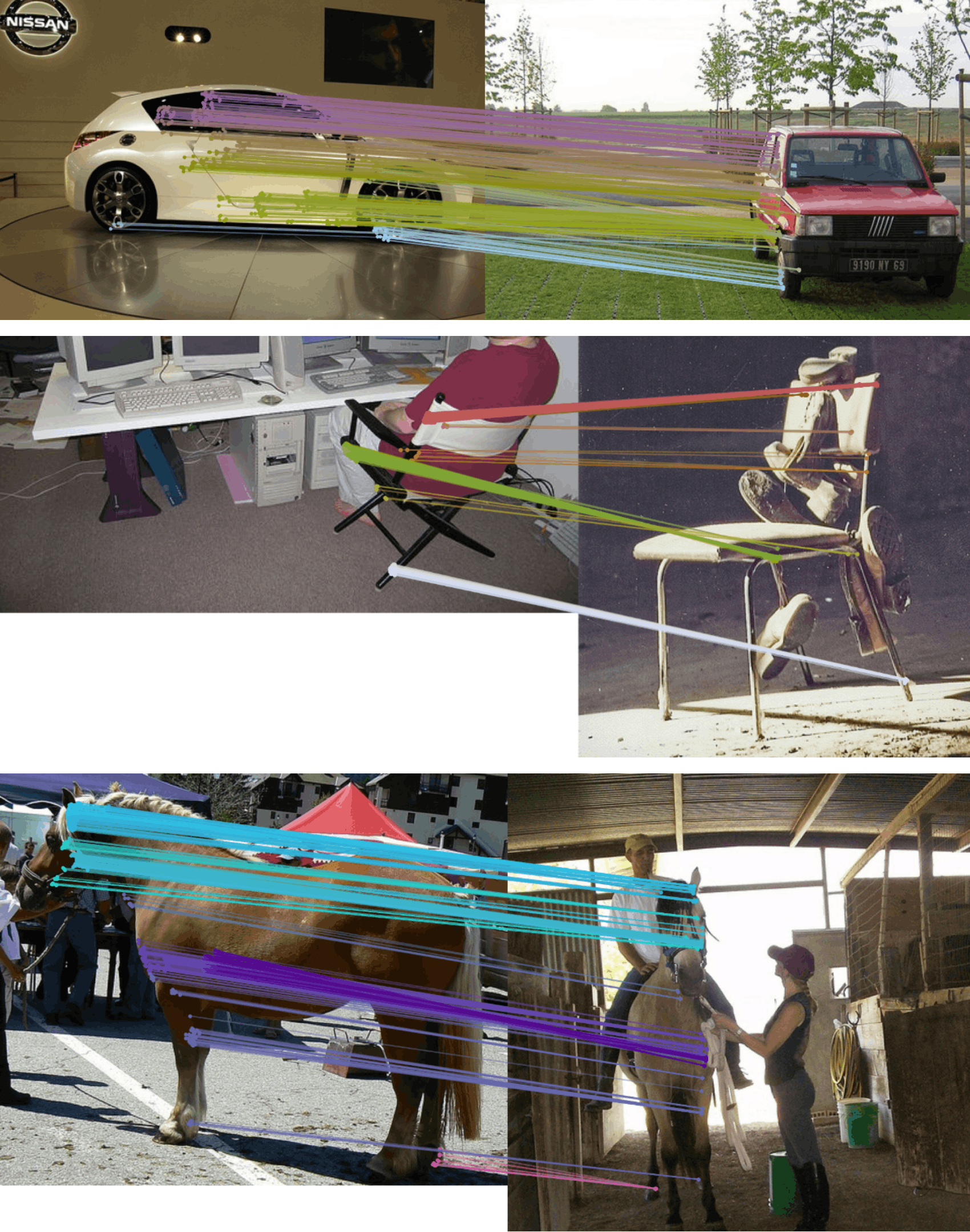
- This geodesic filter removes many tricky mistakes that look similar in 2D but are far apart on the actual 3D shape (like left leg vs. right leg).
- Teach a small adapter network with the good matches
- The surviving matches are treated as “pseudo-labels” (machine-generated training tips).
- A small adapter network is trained on top of the frozen DINO and Stable Diffusion features so it learns to match even better next time. It’s taught to pull correct pairs closer and push incorrect ones apart, and to predict the matched location more precisely.
Main Findings
- Fewer left–right and repeated-part mistakes: Adding 3D priors makes the system much better at telling apart symmetric sides and repeated parts like wheels or windows.
- Stronger overall results without manual pose labels: On standard benchmarks (like SPair-71k and AP-10K), the method achieves higher scores than prior approaches that don’t rely on human pose annotations. For example, on SPair-71k it reaches about 73% [email protected], outperforming earlier “no-human-annotation” methods.
- Especially good on geometry-heavy cases: The gains are biggest for rigid, symmetric objects (cars, buses, trains), where 2D-only methods often get confused.
- Better pseudo-label quality: The 3D geodesic check filters out wrong matches reliably, which means the adapter is trained on cleaner, more trustworthy supervision.
Why that matters:
- Cleaner supervision leads to better learning.
- Reducing manual labeling (like pose annotations) saves time and money.
- Stronger geometry awareness makes matching more robust across views and appearances.
What This Could Mean
- Practical applications: More reliable part matching can help in robotics (grasping the right place on an object), augmented reality (anchoring graphics to the correct parts), 3D-aware photo editing, and organizing large image collections by object parts.
- A new way to learn from 3D: The paper shows that modern 3D “foundation models” can act as teachers for 2D tasks. As 3D reconstruction keeps improving, this approach should get even stronger.
- Less human effort: Because the pipeline doesn’t need humans to label object poses, it can scale to many categories more easily.
In short, the paper demonstrates that bringing 3D shape understanding into a 2D matching problem makes a big difference: it cuts through confusing look-alikes in images and leads to more accurate, reliable correspondences.
Knowledge Gaps
Knowledge gaps, limitations, and open questions
Below is a single, concrete list of unresolved issues that future work could address.
- Reliance on single-image 3D reconstruction (SAM3D): the pipeline assumes reliable meshes and cameras; failure modes (category coverage, topology errors, textureless objects, heavy occlusion/truncation) and their impact on pseudo-label quality are not quantified or mitigated.
- Limited pose refinement: optimization adjusts only scale and translation; rotation (pitch/roll) and full camera parameters are not refined beyond a discrete yaw correction, leaving potential misalignments unaddressed.
- Yaw canonicalization scope: resolving only four-fold yaw ambiguity via OrientAnything V2 does not handle arbitrary rotational errors or symmetries outside 90° multiples; sensitivity to orientation estimator errors is not analyzed.
- No shape refinement: the method does not optimize mesh geometry post-reconstruction; inaccurate shapes directly affect rasterized PartField features and geodesic distances, especially for thin structures and concavities.
- Occlusion handling: silhouette-based alignment and PF rasterization do not explicitly model occlusions; holes are filled by nearest-neighbor propagation, which may inject inconsistent features in heavily occluded or truncated regions.
- Cross-mesh correspondence via PartField NN: using nearest-neighbor matching in PF space lacks global consistency and may be brittle under topology changes; no comparison to globally-consistent registrations (e.g., functional maps, optimal transport) is provided.
- Geodesic distance computation granularity: snapping barycentric hits to the dominant vertex introduces quantization; the effect of mesh resolution and this approximation on filtering decisions is not evaluated.
- Geodesic normalization choice: normalizing by bounding-box diagonals may not reflect intrinsic surface scale; alternative normalizations (e.g., geodesic diameter) and per-instance adaptive thresholds are not explored.
- Fixed geodesic threshold τ_geo: a single, global threshold is applied across categories and instances; sensitivity analyses and adaptive strategies based on reconstruction confidence are missing.
- Feature fusion weights: α/β/γ are fixed and category-agnostic; there is no mechanism to adapt weights per instance, per region, or based on reconstruction quality, and no learning-based fusion baseline is evaluated.
- PartField limitations for within-part localization: PF offers coarse part-level cues and is not tailored to disambiguate keypoints inside the same part (e.g., mid-limb), limiting gains on benchmarks like SPairU; exploration of finer-grained 3D descriptors is left open.
- Deformable and articulated objects: geodesic distances on pose-specific meshes can penalize semantically correct matches across different articulations; articulation-aware metrics (e.g., skeleton/geodesic along kinematic chains) or deformation-invariant 3D descriptors are not investigated.
- Category and domain generalization: it is unclear how SAM3D and PartField perform on categories or domains not represented in their training; robustness to unseen object families remains an open question.
- Dependence on category labels: although no pose annotations are used, the pipeline leverages dataset category labels for segmentation; applicability in fully unlabeled, open-vocabulary scenarios (multi-object scenes, unknown categories) is not tested.
- Multiple-instance handling: the method assumes a single dominant instance per image; behavior with multiple same-category instances and cross-image instance association is not addressed.
- Resolution limits: correspondences are computed at a fixed 60×60 grid; the trade-off between resolution, computational cost, and accuracy (especially for small structures) is not studied.
- Hyperparameter robustness: beyond a brief weight sweep (in supplement), there is no systematic analysis of sensitivity to τ_cc, τ_geo, rasterization resolution, optimizer schedules, or DT/IoU phase settings.
- Computational efficiency and scalability: no runtime or memory profile is reported for SAM3D, render-and-compare, PF rasterization, and geodesic computations; feasibility at large scale and potential accelerations (e.g., mesh simplification, fast geodesics) are open.
- Confidence and uncertainty: the pipeline uses hard thresholds for cyclic and geodesic checks; modeling and propagating uncertainty from reconstruction, orientation, and matching into training is unexplored.
- End-to-end learning: DINO/SD encoders and 3D stages are frozen; jointly learning 2D–3D features or adapters with differentiable rendering/geodesics to reduce error accumulation is not examined.
- Camera intrinsics variability: the approach assumes SAM3D’s predicted intrinsics are adequate; robustness to incorrect intrinsics (e.g., focal length) and cross-dataset camera variability is not evaluated.
- PF rasterization gaps: vertices outside the frustum or mask are discarded and gaps filled via nearest neighbors; the impact of this heuristic on boundary accuracy and repeated structures is unmeasured.
- Failure detection and fallback: the method lacks mechanisms to detect unreliable reconstructions/canonicalizations and revert to weaker priors (e.g., spherical proxies) to avoid over-pruning matches.
- Evaluation breadth: results focus on PCK; coverage/density of correspondences, precision–recall characteristics, and calibration of match confidences are not reported.
- Orientation canonicalization beyond yaw: effects of residual pitch/roll misalignments between instances on PF alignment and geodesic filtering are not ablated.
- Benchmark coverage: scenarios with severe background clutter, reflective/transparent materials, or indoor object categories are underexplored; broader evaluations would clarify limits of 3D priors in the wild.
Practical Applications
Immediate Applications
Below are concrete, deployable use cases that can leverage the paper’s released code and the described pipeline (SAM3D-based reconstruction and pose refinement, PartField rasterization, geodesic filtering, and a lightweight adapter on top of DINO/Stable Diffusion).
- 3D-aware pseudo-labeling for correspondence datasets (Academia, Software/Data Ops)
- What: Auto-generate dense, geometry-verified correspondence pseudo-labels to reduce or replace manual keypoint/pose annotation in new categories.
- How: Run SAM3D + render-and-compare pose refinement, rasterize PartField features, fuse with DINO/SD, apply relaxed cyclic consistency + geodesic filtering, then train the lightweight adapter.
- Tools/workflows: “3D-SC Adapter Trainer” script or service; integration with labeling platforms (e.g., CVAT/Labelbox plugins) to pre-seed correspondences; Python SDK/CLI to batch process image pairs.
- Dependencies/assumptions: Accurate instance masks (e.g., SAM3), viable single-image 3D reconstructions from SAM3D in the target domain, available category labels for canonicalization, and sufficient compute (GPU).
- Part-consistent texture/style transfer across object instances (Media/Entertainment, AR/VR, Software)
- What: Transfer textures or styles between different instances of the same category without left–right or front–back confusion (e.g., car liveries from one vehicle to another).
- How: Use fused DINO/SD+PartField features to establish part-to-part correspondences and map textures via rasterized PartField and geodesic-verified matches.
- Tools/workflows: Plugins for Blender/Unreal/Unity to import meshes from SAM3D, generate correspondences, and bake textures; Python APIs for batch texture transfer.
- Dependencies/assumptions: Quality of single-image reconstructions and canonical orientation; adequate mesh completeness for geodesic distances; lighting/occlusion that does not break SAM3D.
- Symmetry-robust visual product matching and attribute localization (E-commerce/Retail, Search)
- What: Improve cross-instance product alignment (e.g., align wheels/handles/windows consistently) for visual search, duplicate detection, variant comparison, and attribute tagging.
- How: Fuse DINO/SD features with PartField maps and apply geodesic filtering to derive high-precision part correspondences across catalog images.
- Tools/workflows: Microservice that accepts product image pairs and returns correspondence maps and part-aligned bounding boxes; integration with MLOps pipelines for catalog curation.
- Dependencies/assumptions: Reasonable single-view 3D reconstructions for product categories; consistent category labels; processing latency acceptable for offline or near-real-time workflows.
- CAD-to-image alignment for inspection with symmetry disambiguation (Manufacturing/Quality Control, Robotics)
- What: Align observed products with their canonical parts (e.g., front vs. rear wheel, left vs. right panel) to localize defects relative to part semantics and to reduce false positives from repeated features.
- How: Reconstruct object from image, apply PartField descriptors and geodesic consistency to transfer part annotations or CAD landmarks onto camera images with correct orientation.
- Tools/workflows: QC station software that consumes camera feeds and overlays inspected regions by matching to CAD or canonical mesh; ROS node for factory robots to query part-level correspondences.
- Dependencies/assumptions: Tolerable domain shift between SAM3D training data and factory imagery; sufficiently clean segmentation; latency compatible with station cycle-time.
- Part-aware grasp/interaction point transfer for symmetric objects (Robotics/Automation)
- What: Transfer grasp points or interaction targets from a known instance to a novel, symmetric instance (e.g., where left/right confusion previously caused failure).
- How: Use geodesic-verified correspondences between instance meshes to map grasp affordances robustly to the correct side/part.
- Tools/workflows: ROS package that takes a reference image with affordance annotations and maps them to a target image; integration with grasp planners.
- Dependencies/assumptions: Reliable mask extraction in clutter; single-image recon quality; acceptable compute for onboard or edge deployments (may run offline/planning time).
- Vehicle and object comparison for forensics and asset tracking (Security/Forensics, Insurance)
- What: Match object-specific parts across images (e.g., wheel rims, spoilers, windows) with reduced left–right confusion to aid identification and comparison.
- How: Employ the fused features and geodesic filtering to produce verified correspondences and part-level similarity scores.
- Tools/workflows: Backend service/API to return confidence-scored part matches and overlays for investigator dashboards.
- Dependencies/assumptions: Domain robustness of SAM3D and PartField; privacy/compliance for processing surveillance imagery; higher latency acceptable in offline investigations.
- Faster research iteration on geometry-aware 2D tasks (Academia)
- What: Use 3D priors to supervise 2D dense tasks (correspondence, segmentation, keypoint transfer) without manual pose labels, accelerating experiments.
- How: Treat SAM3D + PartField as a geometric “teacher” to generate pseudo-labels; train 2D adapters or distillations for new datasets.
- Tools/workflows: Reproducible pipelines and notebooks; ablation-friendly modules (pose refinement, geodesic filter) for easy swapping.
- Dependencies/assumptions: Availability of pre-trained SAM3D/PartField for the categories of interest; GPUs; dataset masks or robust instance segmentation.
- Orientation-stable AR overlays for objects with repeated parts (AR/VR, Daily Life)
- What: More reliable AR labels/effects anchored to the correct side/part on symmetric items (e.g., cars, appliances) when users move their phones around.
- How: Infer object mesh and pose, rasterize PartField into the image, and use it to stabilize overlay anchoring; filter drifts via geodesic consistency.
- Tools/workflows: Mobile/edge-friendly variant that runs parts of the pipeline on-device or in a low-latency edge server; caching meshes per object.
- Dependencies/assumptions: Efficient models or server assistance; less accurate than desktop setups; robust segmentation and pose under mobile conditions.
Long-Term Applications
These use cases require further research, scaling, or domain-specific modeling (e.g., deformables, real-time constraints, privacy, or integration with additional sensors).
- Deformable-object correspondence and tracking (Healthcare, Sports Analytics, Animation)
- What: Part-consistent matching for soft-tissue organs, animal/human bodies in motion, or clothing for analysis, guidance, and retargeting.
- How: Extend the pipeline with deformable 3D reconstructions and part-aware 3D descriptors tailored to non-rigid categories; adapt geodesic filtering to dynamic topologies.
- Potential outcomes: Anatomy-aware correspondences in surgery planning; motion retargeting in VFX; cross-athlete pose analysis.
- Assumptions/dependencies: High-quality single-view deformable 3D recon (or multi-view capture); domain-specific PartField-like features; strict privacy and regulatory compliance in healthcare.
- Real-time, on-device 3D-aware correspondence for manipulation and AR (Robotics, Mobile/XR)
- What: Achieve sub-100ms correspondence to guide grasping or AR overlays during live operations.
- How: Compress SAM3D-like recon, accelerate render-and-compare, and approximate geodesic filtering; pre-bake category priors; hardware acceleration.
- Potential outcomes: Onboard robot modules; mobile SDKs for geometry-consistent AR.
- Assumptions/dependencies: Model distillation/quantization; optimized rasterization; battery/compute constraints; graceful degradation when recon fails.
- Category-agnostic 3D teachers for 2D foundation models (Software, Academia)
- What: Scale the “3D teacher → 2D student” paradigm to many categories without categorical labels, enabling pervasive geometry-aware 2D features.
- How: Train broader 3D foundation models (or multi-task 3D fields) and integrate teacher signals during large-scale 2D pretraining/adaptation.
- Potential outcomes: Next-gen 2D backbones with intrinsic 3D sensitivity; plug-and-play 3D-aware adapters.
- Assumptions/dependencies: Massive training corpora; reliable 3D recon across long-tail categories; compute budgets; harmonized licenses.
- Fleet-level correspondence for autonomy and mapping (Autonomous Vehicles, Mapping)
- What: Match parts and substructures across vehicles, scenes, and time for improved tracking, map updates, and cross-sensor alignment.
- How: Extend to multi-view/video and multi-sensor (LiDAR/camera) settings, integrate with SLAM, and use geodesic consistency to stabilize loop closures and part tracking.
- Potential outcomes: More robust object tracking, map maintenance, and lane/asset annotation.
- Assumptions/dependencies: Robust segmentation and recon in outdoor conditions; sensor fusion; real-time constraints; safety validation.
- Assembly guidance and verification with robust part matching (Manufacturing, Training/Education)
- What: Provide step-by-step orientation-correct part identification and verify assembly order in AR or robot-assisted lines.
- How: Fuse CAD priors with image-driven meshes and 3D-aware descriptors; use geodesic-verified correspondences to confirm correct part placement.
- Potential outcomes: AR manuals, worker guidance systems, automated verification reports.
- Assumptions/dependencies: Tight integration with CAD; occlusion handling; fast inference; UI/UX for frontline workers.
- Geometry-consistent generative editing and retrieval (Media/Content Creation, Software)
- What: Apply diffusion-driven edits that respect 3D structure and part consistency across instance variants or frames.
- How: Constrain generative models using geometry-aware correspondences and geodesic-consistent masks; cross-instance edit transfer.
- Potential outcomes: Video-consistent object edits; cross-asset style libraries; automated variant creation.
- Assumptions/dependencies: Integrations with diffusion pipelines; stable 3D recon under diverse edits; UX for creators.
- Standardization and policy for geometry-aware annotations (Policy/Standards, Research Infrastructure)
- What: Define benchmarks and best practices for 3D-informed pseudo-labeling to reduce annotation costs and improve reproducibility.
- How: Community-driven protocols for reporting geometry-aware supervision levels, confidence scores (e.g., geodesic error), and failure cases.
- Potential outcomes: Dataset and evaluation standards adopted by public benchmarks and procurement specs.
- Assumptions/dependencies: Broad stakeholder consensus (academia/industry); transparent licensing for 3D foundation models; governance of synthetic supervision.
- Cross-domain asset alignment and reuse (Cultural Heritage, AEC/BIM)
- What: Align parts across different scans or photographs of artifacts/buildings for restoration, cataloging, or BIM integration.
- How: Apply mesh reconstruction and geodesic-verified correspondences to register parts across modalities/time.
- Potential outcomes: More consistent archives; automated damage tracking; cross-source asset merging.
- Assumptions/dependencies: Robust recon on varied materials/conditions; multi-modal integration; careful curation of domain-specific models.
Notes on feasibility across applications:
- The method’s strengths are most pronounced on rigid or near-rigid objects with symmetries/repeated parts; performance may drop on highly non-rigid categories unless domain-specific 3D recon and descriptors are used.
- Pipeline quality hinges on four components: robust instance segmentation, SAM3D mesh fidelity, pose refinement success, and the reliability of PartField descriptors. Failures in any step can degrade correspondence; geodesic filtering mitigates but does not eliminate this.
- Latency and compute costs currently favor offline or near-real-time settings; real-time deployment is a long-term engineering goal.
- Licensing and data governance for third-party models (SAM3D, Stable Diffusion, PartField, OrientAnything) must be respected in commercial deployments.
Glossary
- Adapter: A small learnable module added to fixed features to specialize them for a task without changing the backbone. "We use the pseudo-labels to train a lightweight adapter on top of frozen DINOv2 and Stable Diffusion features"
- AdamW: An optimizer that decouples weight decay from the gradient-based updates for better regularization. "We train it with AdamW with , weight decay of , and a one-cycle schedule for 200k iterations."
- Barycentric coordinates: Coordinates that express a point inside a triangle as a convex combination of its vertices. "obtaining the unprojected points and together with their containing triangles and barycentric coordinates."
- Bicyclic geodesic distance: A symmetry-aware distance that averages forward and backward geodesic errors between two meshes to score match consistency. "We measure the disagreement between the two target predictions as a bicyclic geodesic distance"
- Bounding-box diagonal normalization: Scaling distances by the diagonal of a mesh’s bounding box to make scores comparable across sizes. "We average the two and normalize by the mesh bounding-box diagonals so that the score is comparable across instances and categories of varying scale:"
- Camera frustum: The pyramidal volume defining what the camera can see; geometry outside it is not rendered. "Vertices outside the camera frustum"
- Canonical frame: A shared, consistent coordinate system used to align objects across instances. "a 3D mesh for each object instance, expressed in a canonical frame that is consistent across instances of the same category."
- Canonical yaw correction: A discrete rotation applied to resolve yaw orientation ambiguities and enforce a canonical orientation. "to select the canonical yaw correction ."
- Cyclic consistency (relaxed): A matching constraint that requires a round-trip match to return close to the source within a tolerance. "we apply a relaxed cyclic consistency check"
- Distance transform (DT): A representation assigning each pixel the distance to the nearest boundary, used here to guide silhouette alignment. "a distance-transform (DT) phase"
- Geodesic consistency: Enforcing that matched points correspond to nearby locations along the surface of reconstructed meshes. "we therefore add a geodesic consistency stage"
- Geodesic distance: The shortest path length along a surface between two points, used for mesh-based verification. "geodesic distances on the 3D reconstructed shape enable more reliable filtering of candidate correspondences."
- Geodesic filter: A post-processing step that rejects matches whose lifted 3D points are far apart on the surface. "Adding our geodesic filter (b) removes wrong matches"
- Geometric prior: Prior knowledge about 3D structure that constrains or informs learning and inference. "these foundation models provide a strong geometric prior"
- L2 normalization: Scaling feature vectors to unit Euclidean norm before fusion or comparison. "independently L2-normalizing each"
- Majority vote: A decision rule that selects the option chosen by most candidates to increase robustness. "and aggregate the eight candidates into a single one by majority vote"
- Nearest-neighbor search: Selecting the most similar feature vector in a target set for each source feature. "we propose candidate matches via nearest-neighbor search"
- Object-centric mesh: A 3D mesh reconstructed around the object of interest, aligned to an object-centered frame. "SAM3D~\citep{sam3d} reconstructs an object-centric mesh from the masked image"
- One-cycle schedule: A learning rate policy that increases then decreases the learning rate in a single cycle during training. "a one-cycle schedule for 200k iterations."
- OrientAnything V2: An external model used to estimate orientation to help canonicalize object pose. "we use OrientAnything V2~\citep{OriAny2} as an external orientation estimator."
- PartField: A 3D descriptor field defined over a shape’s surface that encodes part-aware geometry. "PartField~\citep{liu2025partfield} (PF) predicts a continuous per-vertex feature field"
- Percentage of Correct Keypoints (PCK): An evaluation metric counting keypoints predicted within a normalized distance of ground truth. "we use the Percentage of Correct Keypoints (PCK@) as metric"
- Pseudo-labels: Automatically generated supervision signals used to train models when ground-truth labels are unavailable. "The retained pseudo-labels are used to train a lightweight correspondence adapter"
- Ray casting: Tracing rays from the camera through image pixels to intersect a 3D mesh and retrieve surface points. "we cast a ray from each camera through the corresponding pixel"
- Render-and-compare optimization: An alignment procedure that optimizes pose/scale by minimizing discrepancies between rendered and observed images. "we apply a render-and-compare optimization"
- Silhouette (soft silhouette): A (differentiable) mask indicating the projected shape’s outline and coverage in the image. "the rendered soft silhouette $\hat{\mathbf{M}(s, \mathbf{t}) \in [0,1]^{H \times W}$"
- Soft IoU: A differentiable relaxation of Intersection-over-Union used as a loss for mask overlap optimization. "a differentiable soft-IoU loss"
- Spherical geometry (coarse): A simplified 3D shape prior that approximates object structure with a sphere, used in earlier methods. "coarse spherical geometry"
- Window soft-argmax: A differentiable operator that estimates a point location by soft-averaging coordinates within a local window over a similarity map. "with a window soft-argmax over the feature similarity map"
- Yaw ambiguity: An uncertainty in object orientation around the vertical axis, often in multiples due to symmetry. "a four-fold yaw ambiguity"
Collections
Sign up for free to add this paper to one or more collections.