- The paper introduces GenBloom, a two-stage model that pretrains on 794,527 hematological cell images and aligns them with genetic profiles.
- It utilizes transformer-based aggregation and contrastive supervision to achieve notable improvements in classification and cross-modal retrieval.
- Its architecture demonstrates data efficiency and robust generalization across diverse hematologic subtypes and retrieval tasks.
GenBloom: Genetically Aligned Patient Representations in Hematological Diagnosis
Motivation and Background
The clinical practice of hematology integrates cellular morphology, cytogenetics, and molecular genetics to enable precise classification, prognostication, and therapeutic decisions in blood cancers. Peripheral blood smear cytology provides detailed morphological insight at single-cell resolution, but existing computational approaches frequently neglect the genetic heterogeneity that underpins morphologic variation. Previous deep learning models have focused predominantly on morphology alone, with recent advances in multimodal alignment showing improved downstream performance by coupling visual encoders with transcriptomic or genomic data. GenBloom addresses the technical and data curation challenges of aligning high-resolution single-cell morphology with cytogenetic and molecular profiles, proposing a domain-adapted multimodal encoder for hematology.
Framework and Methodology
GenBloom follows a two-stage training paradigm:
- Self-supervised Morphology Pretraining: A transformer-based patient-level aggregator, GenBloom, is pretrained using an iBOT/DINOv2 adaptation on 794,527 single-cell images from 1,634 patients, encompassing diverse hematological diseases and healthy controls (Figure 1). This stage leverages permutation-invariant aggregation by operating on unordered sets of frozen DinoBloom-B cell embeddings.
- Genetic Alignment via Contrastive Supervision: Using the AML-Hehr dataset (189 acute myeloid leukemia patients with paired cytogenetics and mutation panels), the model undergoes supervised contrastive alignment in a three-modal space: slide, karyotype, and mutation. Modality-specific MLPs project each to normalized 128-dim embeddings, with cross-modal supervised contrastive loss and bottleneck decoders for reconstruction regularization, preserving biological fidelity and reducing representational collapse.
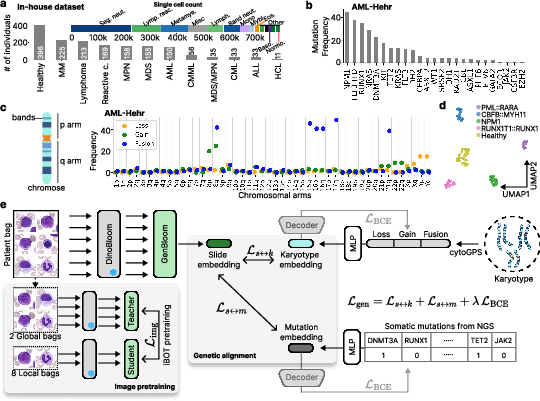
Figure 1: Overview of GenBloom’s pretraining cohort, genetic feature distributions, cytogenetic encoding, UMAP visualization of patient embeddings, and the alignment pipeline.
Single-cell image normalization, band-level cytogenetic encoding via CytoGPS, and targeted molecular feature selection ensure robust multi-source data harmonization. The two-stage paradigm encourages the model to capture realistic cell composition statistics while anchoring patient-level representations within the genetically defined latent space.
GenBloom’s downstream evaluation encompasses:
- Genetic Subtyping: AML-Hehr test set classification (5 classes) using k-NN and logistic regression, with PML::RARA, CBFB::MYH11, NPM1, and RUNX1::RUNX1T1 fusions, as well as healthy controls.
- Generalization Assessment: Out-of-domain performance on APL-AML (acute promyelocytic leukemia vs. AML) and AMH (AML vs. healthy) datasets.
- Retrieval Analysis: Embedding-based slide↔genomics and slide↔slide retrieval using cosine similarity, evaluated by mAP@3 and mean reciprocal rank.
In all tasks, GenBloom-G (with genetic alignment) achieved significant improvements over slide-level foundation models (GigaPath, PRISM, TITAN) and DinoBloom mean pooling. On AML-Hehr 5-class classification, GenBloom-G outperformed TITAN by 38% (k-NN) and 5% (logistic regression). For APL-AML, the margin over PRISM reached 45% (logistic regression). Retrieval tasks demonstrated clear superiority, with mAP@3 and top-5 accuracy gains exceeding 2-3 fold versus random baselines.
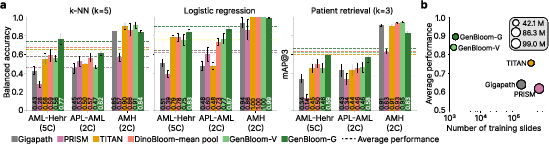
Figure 2: GenBloom’s hematology task performance (top) and parameter/pretraining data efficiency comparison (bottom).
Despite lower parameter counts and smaller training scale, GenBloom’s domain-specific pretraining afforded substantial advantages, underscoring the critical value of tailored morphology-genetics alignment.
Genetic Alignment and Cross-Modal Retrieval
Genetic alignment equipped GenBloom-G with robust cross-modal retrieval capabilities, enabling off-the-shelf ranking and querying between slide images, cytogenetic profiles, and gene mutation vectors. Top-5 retrieval accuracy for slide-to-karyotype and karyotype-to-slide directions exceeded 0.6 on AML-Hehr, compared to ~0.2 for random baselines (Table 1). Mutation-to-slide and slide-to-mutation retrieval attained similar improvements, essential for genetics-aware smear analysis.
Out-of-domain gene retrieval analysis in the cAItomorph cohort confirmed that GenBloom generalizes to clinically actionable mutations (NPM1, FLT3-ITD, JAK2, IDH2, NRAS), achieving fold improvements up to 10.6× in F1 scores (Table 2). This supports the hypothesis that morphogenomic alignment captures latent relationships beyond the original training distribution.
Ablation Studies
Three ablation experiments systematically validated core design decisions:
- Aggregator Architecture: Finetuned transformer (GenBloom-V) initialization outperformed random or mean pooling, highlighting the necessity of paired pretraining and supervised alignment.
- Cytogenetic Resolution: Band-level encoding yielded superior results versus arm-level representations, showing that fine-grained cytogenetic inputs provide richer alignment signals.
- Reconstruction Regularization: The reconstruction loss for genetic branches improved both cross-modal retrieval and classification, promoting biological consistency in learned embeddings.
Practical and Theoretical Implications
GenBloom’s approach offers tangible clinical benefits:
- Integrating Morphology and Genetics: Enables more accurate and biologically informed patient representation, directly supporting diagnostic classification tasks that reflect real-world workflows.
- Retrieval and Querying: Off-the-shelf retrieval between modalities facilitates triage, prioritization for confirmatory testing, and hypothesis generation for genetics-driven morphology.
- Data Efficiency: Demonstrates strong performance even with reduced parameterization and training scale, making it accessible for domain-specific deployment.
Theoretically, GenBloom expands multimodal latent space modeling in pathology, showing that alignment at the single-cell and patient levels uncovers clinically relevant structure. The permutation-invariant transformer aggregator and contrastive alignment framework can generalize to other hematological and cytological settings, potentially paving the way for more granular, interpretable, and genetics-aware computational pathology models.
Conclusion
GenBloom introduces a domain-adapted, genetically aligned slide-level encoder for hematology, outperforming large-scale histopathology foundation models and providing robust cross-modal retrieval. Its two-stage architecture and use of fine-grained cytogenetic and mutation features reflect the practical realities of hematology diagnosis, highlighting the value of domain-specific multimodal alignment. This paradigm supports rapid, genetics-aware patient triage and lays the groundwork for future AI systems in personalized hematological diagnostics and treatment planning.