- The paper introduces TriMod-DTI, a triple-modal framework that leverages sequence, graph, and 3D data to significantly improve drug–target interaction prediction.
- The framework employs cross-modal contrastive learning to align diverse representations, outperforming unimodal and bimodal baselines in key evaluation metrics.
- Ablation studies and case evaluations validate the model's robustness and highlight its potential for reliable in silico drug discovery and repurposing.
A Triple-Modal Contrastive Learning Framework for Enhanced Drug–Target Interaction Prediction
Motivation and Problem Context
Drug–target interaction (DTI) prediction underpins target-based drug discovery, but experimental DTI mapping is costly and not readily scalable. Deep learning, leveraging molecular and protein representations, has shown promise in predicting DTIs, yet unimodal and bimodal approaches either compress complex molecular information or risk feature redundancy when simply concatenating features without explicitly modeling cross-modal relationships. The complementary nature of sequence, graph, and 3D data—demonstrated via low inter-modal cosine similarities—suggests that synergistic fusion of these modalities could expand the expressiveness of learned DTI predictors.
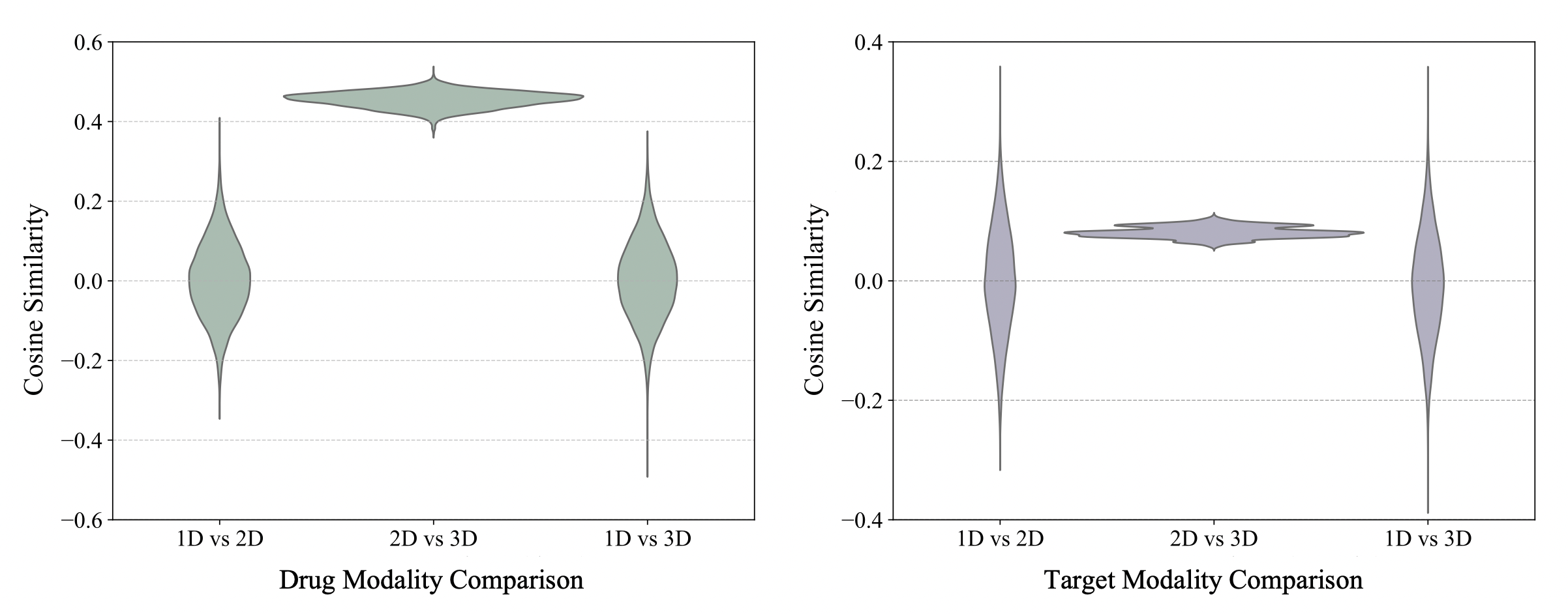
Figure 1: Cosine similarity between embeddings of different modalities reveals low overlap, confirming strong complementarity between 1D sequence, 2D graph, and 3D structural representations.
TriMod-DTI: Architecture and Methodology
TriMod-DTI introduces a triple-modal multimodal contrastive learning framework that systemically integrates 1D (SMILES/protein sequence), 2D (molecular/protein graph), and 3D (molecule spatial structure/protein structure) features for both drugs and proteins. The architecture comprises three sequential stages: modality-specific encoding, cross-modal alignment, and prediction via fused representations.
- Drug Encoding: SMILES sequences are segmented and processed via Transformers; 2D molecular graphs are encoded using GCNs; 3D structures are modeled as molecular graphs with atomic coordinates and processed using GVP-GNNs, capturing both spatial and chemical context.
- Protein Encoding: Target sequences are encoded with Transformers. Protein binding-site pockets are identified, structured as atom-level graphs, and processed with TAGCN. 3D protein structures are turned into residue-level graphs and passed to a GCN encoder.
Cross-Modal Contrastive Learning and Fusion
The core component is a cross-modal contrastive loss strategy. By constructing positive/negative sample pairs, embeddings from the same underlying molecule/protein (across modalities) are aligned, and representations of different entities are pushed apart. This approach is inspired by CLIP and is formalized using a symmetric contrastive loss with cosine similarity and temperature scaling. Final joint representations for each DTI pair are obtained by concatenating the tri-modality-aligned drug and protein vectors:
F=(d1⊕d2⊕d3)⊕(t1⊕t2⊕t3)
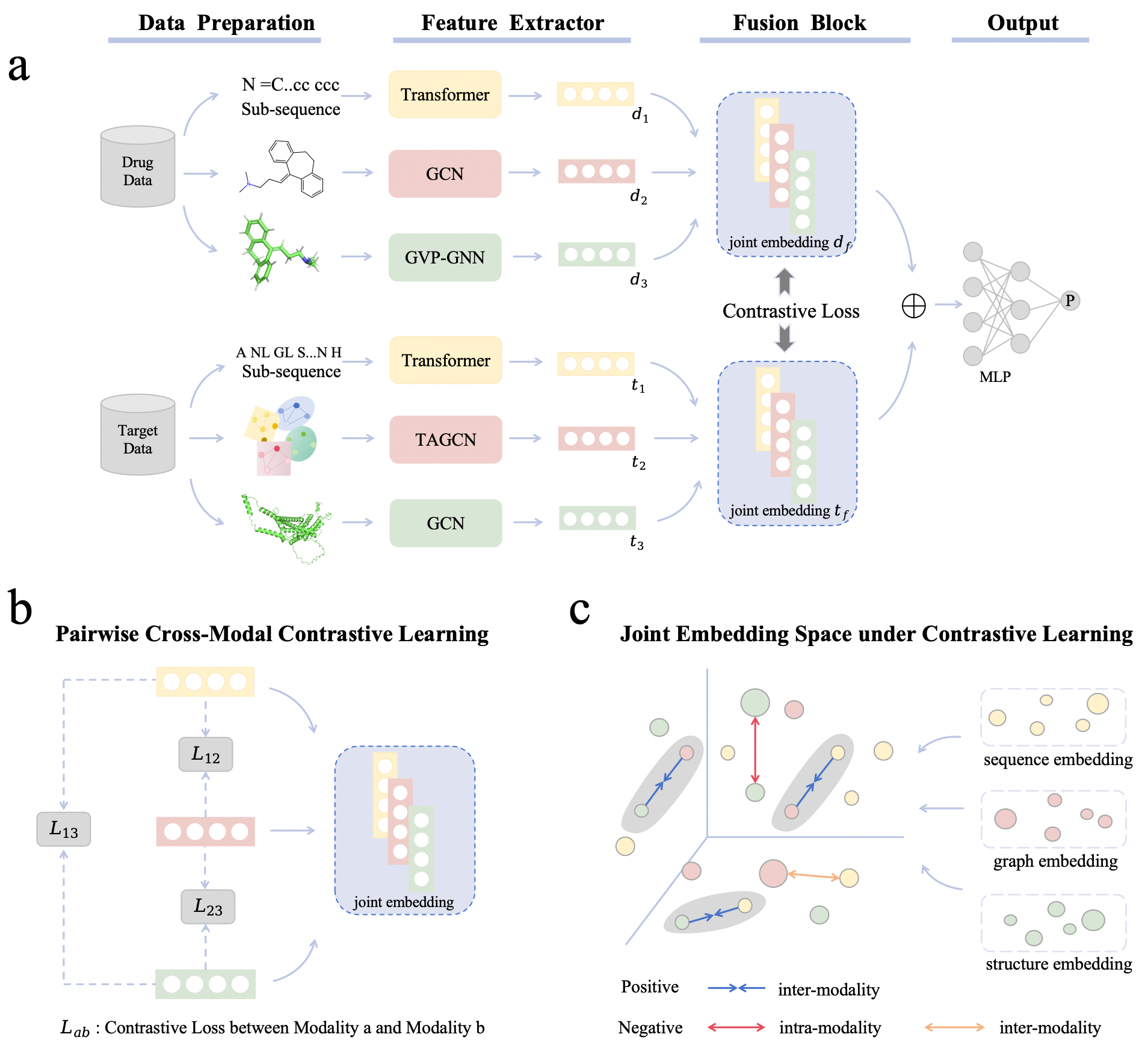
Figure 2: (a) Overall architecture of TriMod-DTI. (b) Cross-modal contrastive learning within the fusion block. (c) Schematic of joint tri-modality vector space alignment.
Empirical Evaluation and Ablation Analysis
TriMod-DTI was benchmarked on Human, GPCR, and DrugBank datasets, with rigorous splits and metrics including AUC, AUPR, and Precision. TriMod-DTI outperformed strong baselines—including sequence-only (TransformerCPI, Mutual-DTI, MGMA-DTI), sequence+graph (GraphDTA, IIFDTI, CSCL-DTI)—on all datasets. On Human, it improved AUC by up to 0.7 points and AUPR by 0.5 over leading competitors. For GPCR, where 3D information is particularly informative about protein pockets, TriMod-DTI attained clear improvements (AUC +0.2, AUPR +1.6, Precision +0.7 compared to the best baseline).
Ablation studies clarified the relative significance of each modality. Sequence information provided the strongest independent signal, followed by 2D graph, while the standalone 3D model lagged—an effect attributed to omission of key atom-level chemical attributes in the current 3D encoder design. However, the combined tri-modal system achieved the best results, underscoring complementary benefits:
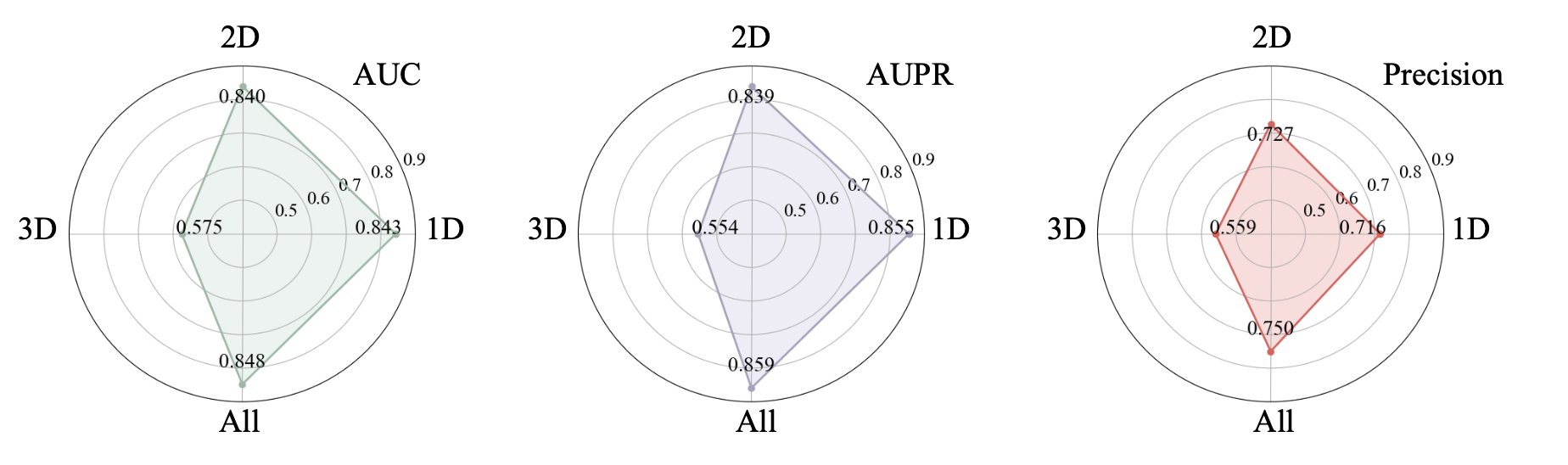
Figure 3: Independent performance of each modality (sequence, graph, 3D) on the GPCR dataset reveals sequence dominance but enhanced results via full integration.
Ablating the cross-modal contrastive loss (or individual alignment terms) consistently degraded model performance (up to 1.1 in AUC and 2.0 in AUPR), confirming the necessity of explicit cross-modal alignment.
Parameter Sensitivity and Robustness
A systematic sensitivity analysis explored dropout, learning rate, GCN layers, and attention heads. The model demonstrated robust performance near optimal hyperparameter zones (dropout 0.2, learning rate 1e-3, 2 GCN layers, and 4 attention heads):
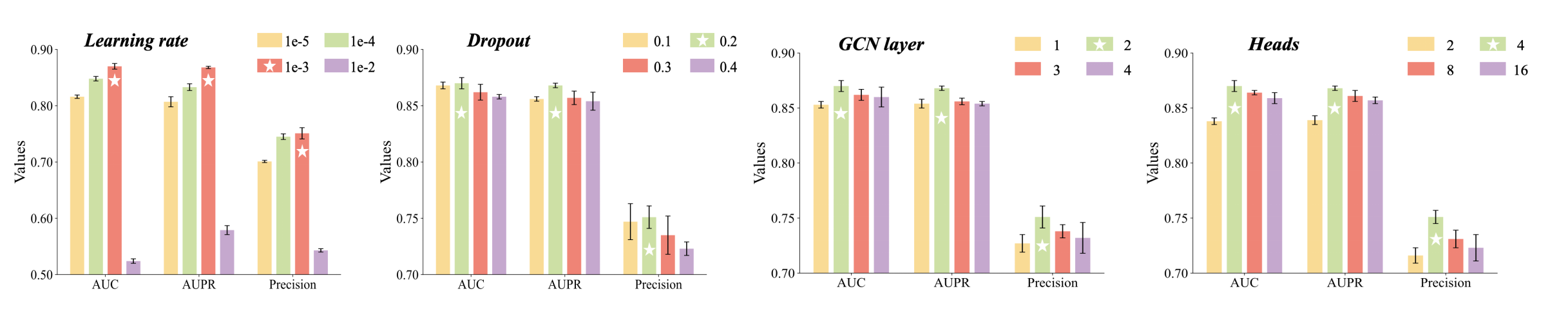
Figure 4: Parameter sensitivity analysis on the GPCR dataset showing TriMod-DTI’s stability and optimal settings.
Case Study: Structural Interpretability and Drug Discovery Potential
A case study positioned TriMod-DTI on Verapamil and D2 dopamine receptor, recovering literature-verified interactions in the top predictions. Further, molecular docking visualizations of Verapamil with its predicted protein targets elucidated plausible hydrogen bonding patterns within protein binding pockets, indicating that the learned fused representations encode meaningful biochemical information and structural relationships.
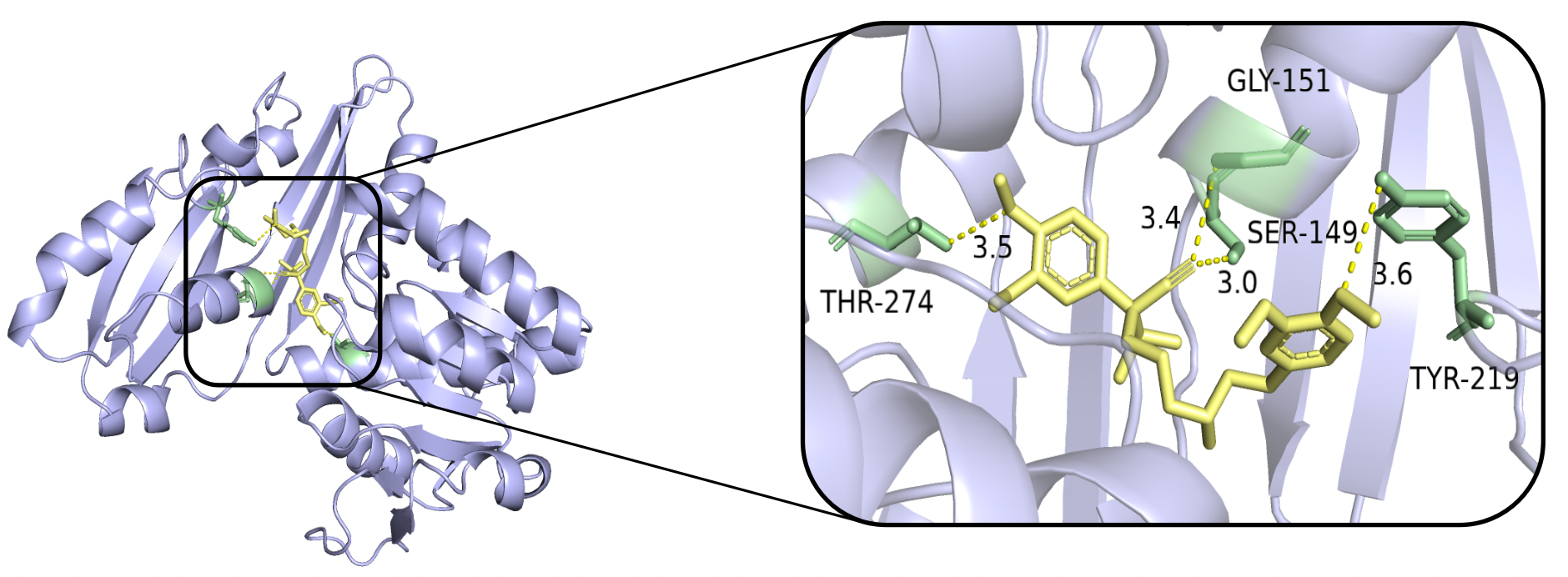
Figure 5: Visualized drug–protein interactions demonstrate that TriMod-DTI’s predictions correspond to plausible physical complexes, as validated via molecular docking.
Discussion and Future Directions
TriMod-DTI substantively advances the state-of-the-art in DTI prediction by (i) incorporating tri-modal encoding for maximal feature complementarity, (ii) enforcing cross-modal consistency at the representation level, and (iii) validating superiority through extensive benchmarks, ablations, and case studies. While the 3D encoding pipeline provides only incremental improvements independently, its integration proves essential for extracting the full landscape of chemical–biological interactions—particularly for cases where sequence and graph features saturate.
The approach offers both practical and theoretical implications: enabling more reliable in silico DTI screening for drug repurposing and discovery, and motivating refined multi-modal contrastive mechanisms. Future directions include architectural refinement of the 3D modality to better encode chemical information and tailoring contrastive alignment to accommodate more sophisticated geometric and chemical priors.
Conclusion
TriMod-DTI presents a tri-modal, cross-modal contrastive learning framework that achieves consistently superior DTI prediction by leveraging the orthogonal strengths of sequence, graph, and 3D modalities. Explicit modal alignment delivers robust, highly discriminative representations—facilitating both improved prediction performance and structurally explicable results—thus providing an effective blueprint for multimodal learning in cheminformatics and computational biology (2605.29926).