- The paper presents a two-layer pipeline that harvests a diverse skill library and generates Unix-competence tasks via mechanical validation and LM-driven exploration.
- It demonstrates significant RL improvements, achieving up to a 43.6% solve rate on out-of-distribution benchmarks through focused Unix-specific challenges like ELF manipulation and IPC.
- The study reveals a trade-off between high training rewards and effective downstream transfer, underscoring the importance of curriculum design in reinforcement learning.
Procedural Generation of Unix-Competence Environments for RL Agents
Motivation and Benchmark Taxonomy
The paper presents unix-ctf, a procedural generation framework for evaluating and training RL agents on Unix-competence skills distinct from general terminal coding. The authors argue most terminal benchmarks conflate shell proficiency (programming via terminal) with Unix-system knowledge (OS, shell, file-format features inaccessible to regular programming paradigms) and demonstrate major benchmarks—Terminal-Bench, Cybench, AgentBench-OS, InterCode—rarely probe Unix-competence directly. Tasks solved by generic glue (awk, grep, find, sed, SQLite) have clean cross-language analogues; tasks that depend on irreducible Unix artifacts (e.g., extended file attributes, ELF internals, IPC primitives) are substantially underrepresented.
This dichotomy is quantitatively analyzed via rubric-driven task taxonomy, revealing Unix-competence tasks represent less than 30% of most benchmarks, and procedural-generation pipelines fail to generate rich shells for skill acquisition.
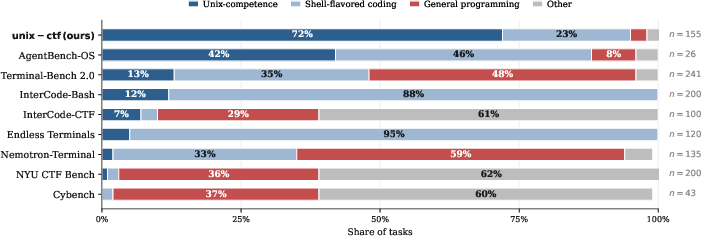
Figure 1: Distribution of task-types across terminal benchmarks, showing Unix-competence tasks as a minority.
Pipeline Architecture and Skill Library Construction
Unix-ctf constructs a scalable procedural evaluation and training surface via a two-layer pipeline: offline skill library harvest and on-demand environment generation. The library is built by sequential LM-driven exploration, mechanical validation (no plaintext flag on disk, canonical recovery validated), parameterized script synthesis (plant.sh, recovery.sh), portability checks, and template-based deduplication. Harvesting yields 155 canonical techniques spanning 16 Unix-surfaces, aggregated from 441 deduplicated variants; representative categories include configuration files, binary and ELF manipulation, IPC, X.509 certs, filesystem traits, encoding/steganography, and OS process artifacts.
Task-quality audits via three independent LLM judges indicate unix-ctf tasks are superior on input richness, solution non-triviality, format independence, tool diversity, and discovery requirements compared to prior LLM-driven generators, with nearly two points aggregate advantage.
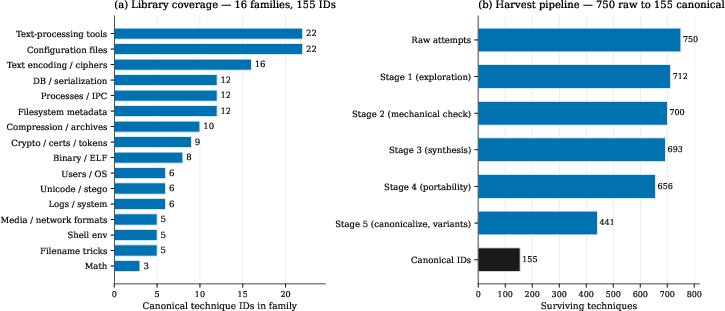
Figure 2: Unix-ctf’s skill library coverage and production pipeline, illustrating high task yield and diversity relative to prior generators.
Training Regimen and Environment Scheduling
For agent fine-tuning, the environment generator samples batches of eight techniques per Docker container, each role-dressed as plausible server types. Flags are planted via canonical plant.sh scripts, deleted post-execution, and agents must find and print them via RL interaction. Reward is densified (multi-flag per episode), with scheduling via a sticky-pool mechanism: high-solve-rate techniques are retired per batch, replaced by low-frequency skills from the library, ensuring broad coverage and curricular exposure.
GRPO (Group Relative Policy Optimization) is employed for RL; Qwen3-8B serves as the base agent, optionally pre-adapted via supervised format pass. Training is treated primarily as a probe of the procedural surface, not a recipe for optimal RL.
Empirical Evaluation and Generalization
Evaluation is performed across three benchmarks: (1) InterCode-CTF (100 tasks), (2) InterCode-Bash filesystem variant (60 tasks), and (3) an internal multi-family holdout (225 tasks across 15 OOD skills). The principal findings:
- On the multi-family holdout, GRPO from SFT init achieves 43.6% solve rate, a 3.8x lift over base; GRPO from base reaches 27.6%.
- On IC-CTF, training redistributes agent capabilities: the largest observed gain is Forensics (+33 pp), indicating transfer of Unix-system knowledge; overall aggregate does not substantially increase.
- There is a decoupling between in-distribution training reward and OOD downstream transfer—GRPO from SFT init peaks in training reward but underperforms in downstream solve rate versus GRPO from base.
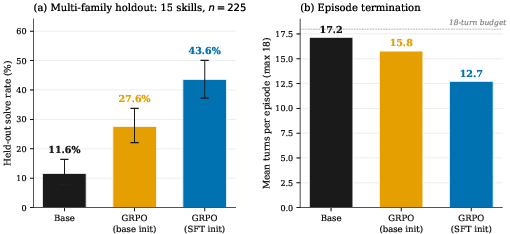
Figure 3: Multi-family holdout results, demonstrating significant performance gains for agents trained with the unix-ctf procedural surface.
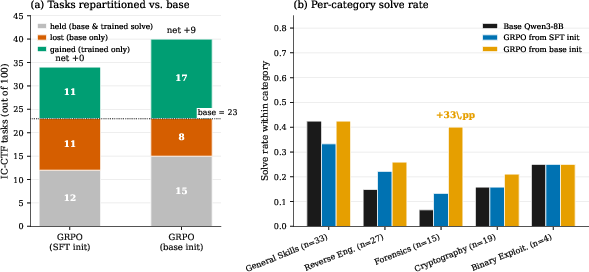
Figure 4: IC-CTF capability redistribution: training enhances skill acquisition in Unix-proximal task categories.
Reward Dynamics and Pool Rotation
The decoupling of training reward and downstream transfer further manifests in reward curves; GRPO-from-SFT peaks at much higher batch reward but achieves lower IC-CTF solve rate than GRPO-from-base. This indicates format pre-adaptation aids harness-specific recovery but may impede generalization across distributions.
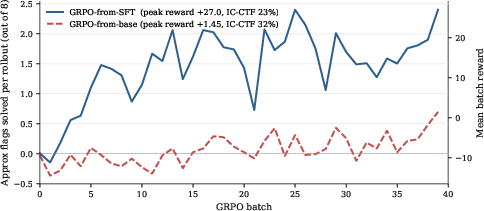
Figure 5: GRPO training-reward curves over batches, showing reward–transfer inversion between initialization variants.
Theoretical Implications and Prospects
Unix-ctf delineates rigorous evaluation methodology for distinguishing Unix-competence from general coding proficiency and provides a mechanistically validated procedural-generation approach. The multi-step LM harvest, deduplication, and mechanical evaluation contract yield robust task surfaces that probe non-trivial OS knowledge.
Practically, unix-ctf enables more granular RL agent assessment, curriculum generation, and up-skilling for real-world server management and offensive security (red-team/blue-team training). The approach’s limitations reside in reliance on LMs for skill harvest (potential bias toward overrepresented techniques) and the CTF-task-type framing (excluding broader Unix workflows). Directions for further research include curriculum learning, adaptive task difficulty scaling, multi-agent interaction, and transfer studies to real-world system administration settings.
Conclusion
Unix-ctf establishes a procedural pipeline for Unix-competence RL evaluation, separating OS-internal skills from generic shell coding. Empirical evidence underscores that task surfaces constructed via canonicalized library and mechanical contracts significantly enhance agent acquisition of Unix-specific knowledge, and that training on such surfaces produces robust capability transfer—especially in forensics and reverse engineering—across standard benchmarks. The methodology advances procedural-task generation, curriculum structuring, and systematic evaluation for shell-based agent learning.

