- The paper demonstrates that reframing LLM zeroth-order fine-tuning as an inference workload yields up to 8.13× speedup and preserves convergence accuracy.
- It leverages direct worker-side scoring and in situ GPU low-rank updates to minimize memory writes and latency.
- Empirical results on OPT models show enhanced throughput, faster SST-2 training, and strong statistical fidelity with 99–100% sign agreement.
LLM Zeroth-Order Fine-Tuning as an Inference Workload
Introduction and Motivation
Zeroth-order (ZO) optimization methods for LLM fine-tuning forgo backpropagation in favor of forward-only objective evaluations, thus reducing memory and computation requirements. Yet, the majority of ZO implementations retain the conventional training-loop abstraction, which incurs substantial overhead and obfuscates the actual structure of the dominant computation: repeated forward scoring under slightly perturbed model states. This paper identifies a fundamental workload-runtime mismatch in current ZO training pipelines and makes the core claim that LLM ZO fine-tuning is more effectively executed as an inference-style workload.
Methodological Innovation: Inference-Native ZO Execution
The authors retain the LoZO optimizer's exact semantics—including the low-rank perturbation structure, random direction sampling, and update rules—while reimplementing the repeated scoring phase directly through the vLLM serving runtime. The key technical innovations enabling this shift include:
- Direct worker-side scoring: Objective evaluations (option-token log-probabilities) bypass high-level trainers, invoking vLLM worker paths to decrease latency and orchestration overhead.
- Direct update path: Low-rank parameter updates are performed in situ on GPU worker-side memory using packed QKV updates, eliminating host-device transfer bottlenecks.
- Memory-write reduction: Utilization of factor accumulation within the ν-step interval when direction factors (e.g., LoRA V) are held fixed, such that only minimal LoRA-shaped adapters must be modified per step.
This design leverages the fact that both LoRA-style adapter updates and temporary ZO perturbations can be represented as dynamic LoRA adapter slots, seamlessly composable with the base model without explicit materialization or full-weight updates.
Empirical Results
Extensive evaluation was conducted on the OPT-13B model fine-tuned on SST-2 under LoZO; core throughput and convergence metrics were analyzed across OPT-1.3B, 2.7B, 6.7B, and 13B. Key numerical results include:
- Training Time: The vLLM-inference path (ν=50) completes 20k OPT-13B LoZO (LoRA-only) steps in $0.51$ hours ($30.7$ minutes), while the official LoZO baseline requires $4.15$ hours, yielding an 8.13× end-to-end speedup with equivalent or better final evaluation accuracy ($0.922$ vs $0.902$).
- Step Throughput: Core optimization-step speedups across models and batch sizes reach up to 7.7×, with V0--V1 range overall (Figure 1, Figure 2).
- Paradigm Transfer: MeZO-style high-rank factorized ZO evaluation (OPT-1.3B) achieves almost identical loss reduction and increased validation accuracy within V2--V3 runtime of the MeZO baseline.
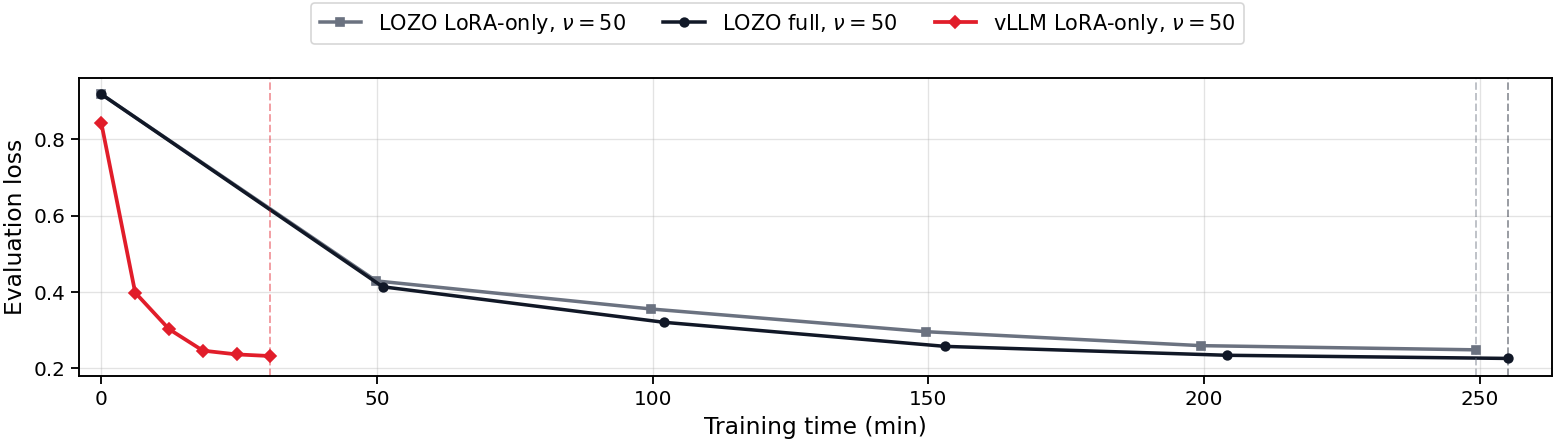
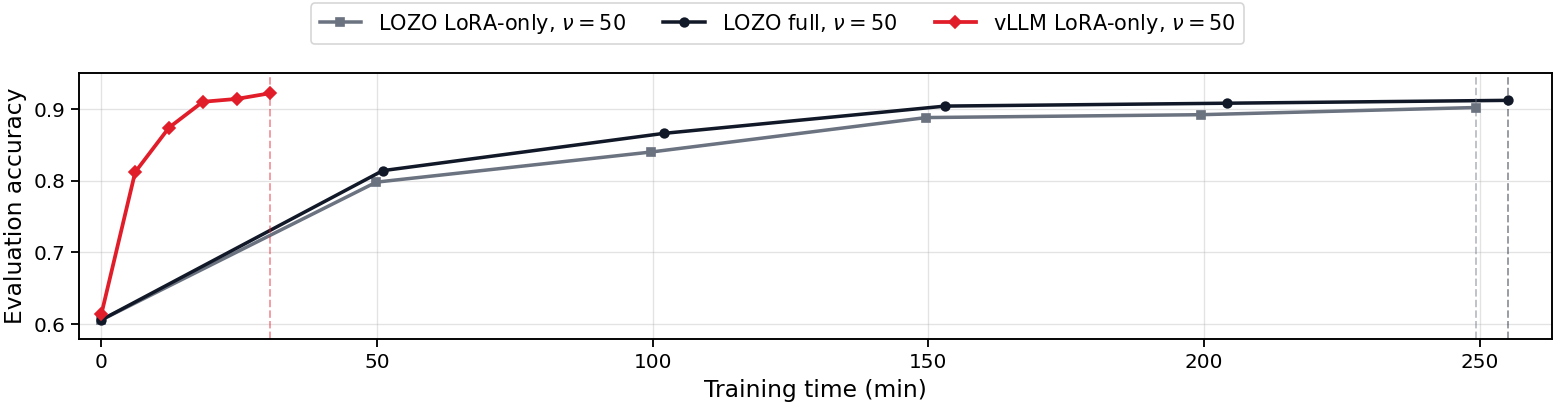
Figure 1: OPT-13B SST-2 evaluation versus training time: vLLM V4 completes in V5 minutes vs V6 for LoZO LoRA-only baseline, V7 speedup.
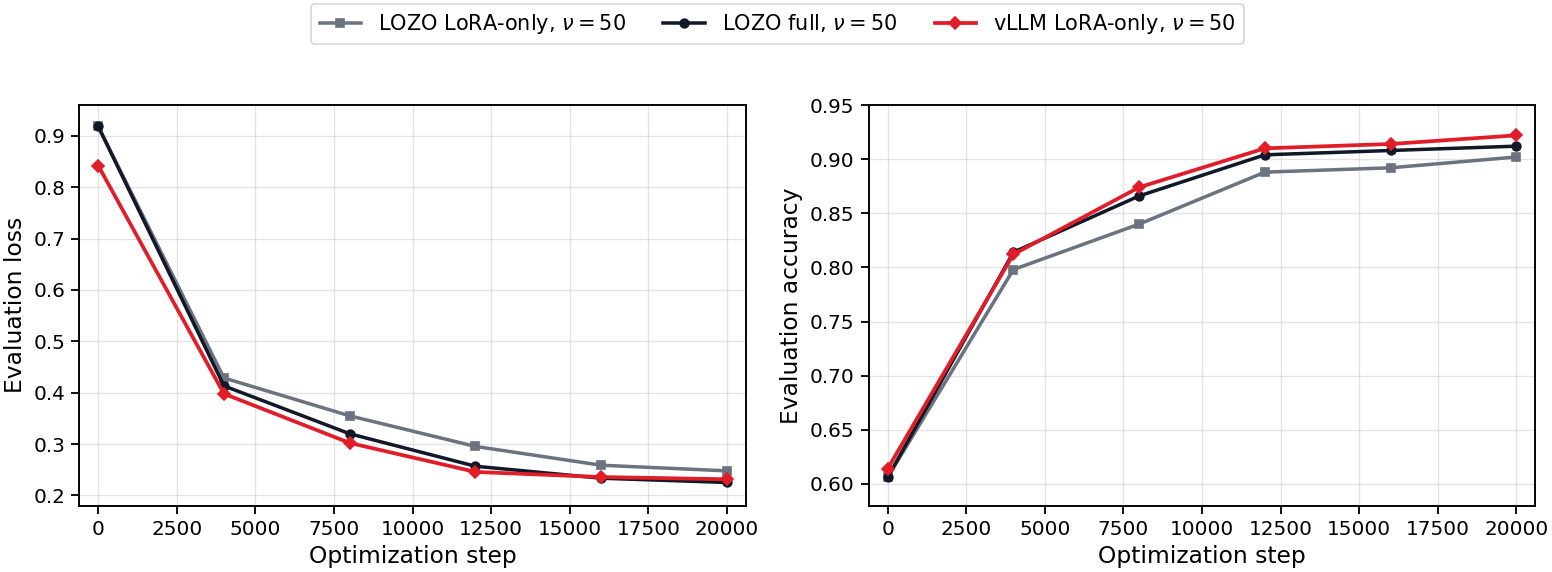
Figure 2: OPT-13B SST-2 evaluation loss per optimization step, demonstrating matched convergence behavior across implementations.
A correctness analysis confirms statistical fidelity, with 99–100% sign agreement in high-signal regions between the vLLM and LoZO code paths.
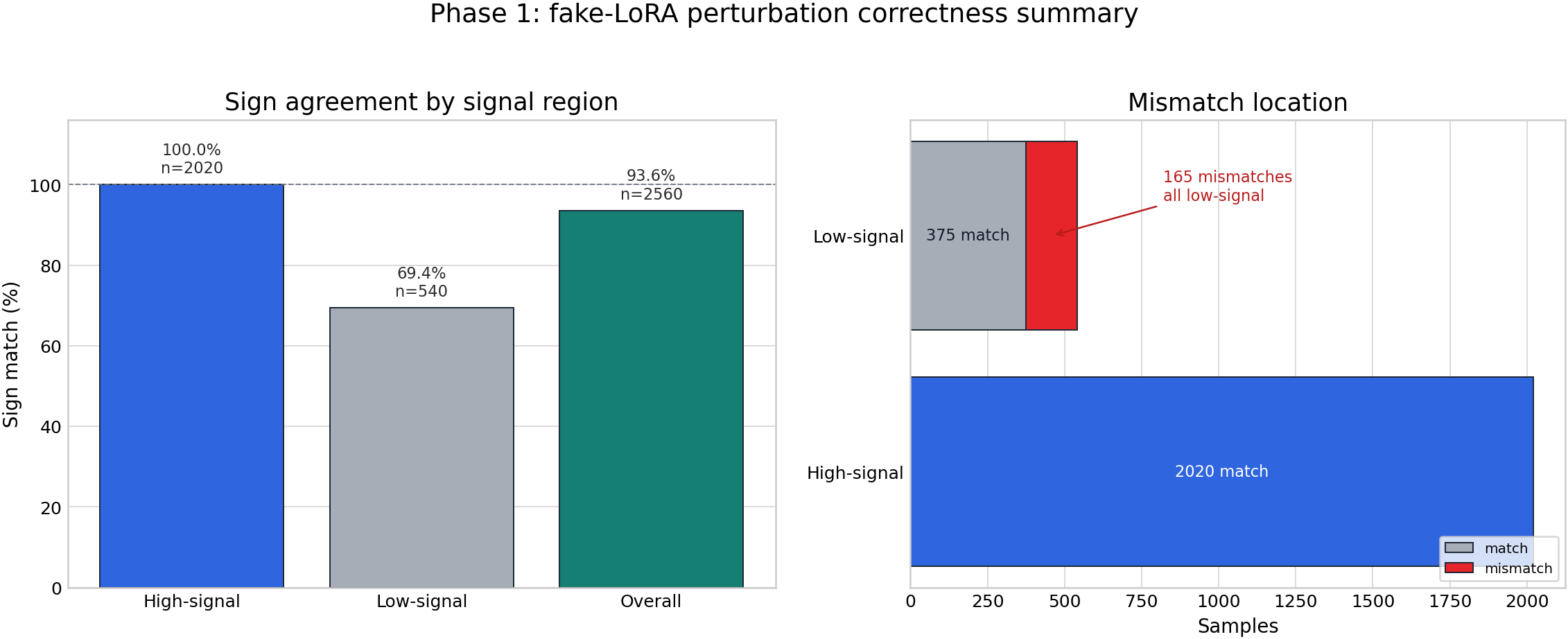
Figure 3: Phase 1 perturbation-score correctness summary, separating high- and low-signal discrepancy distribution.
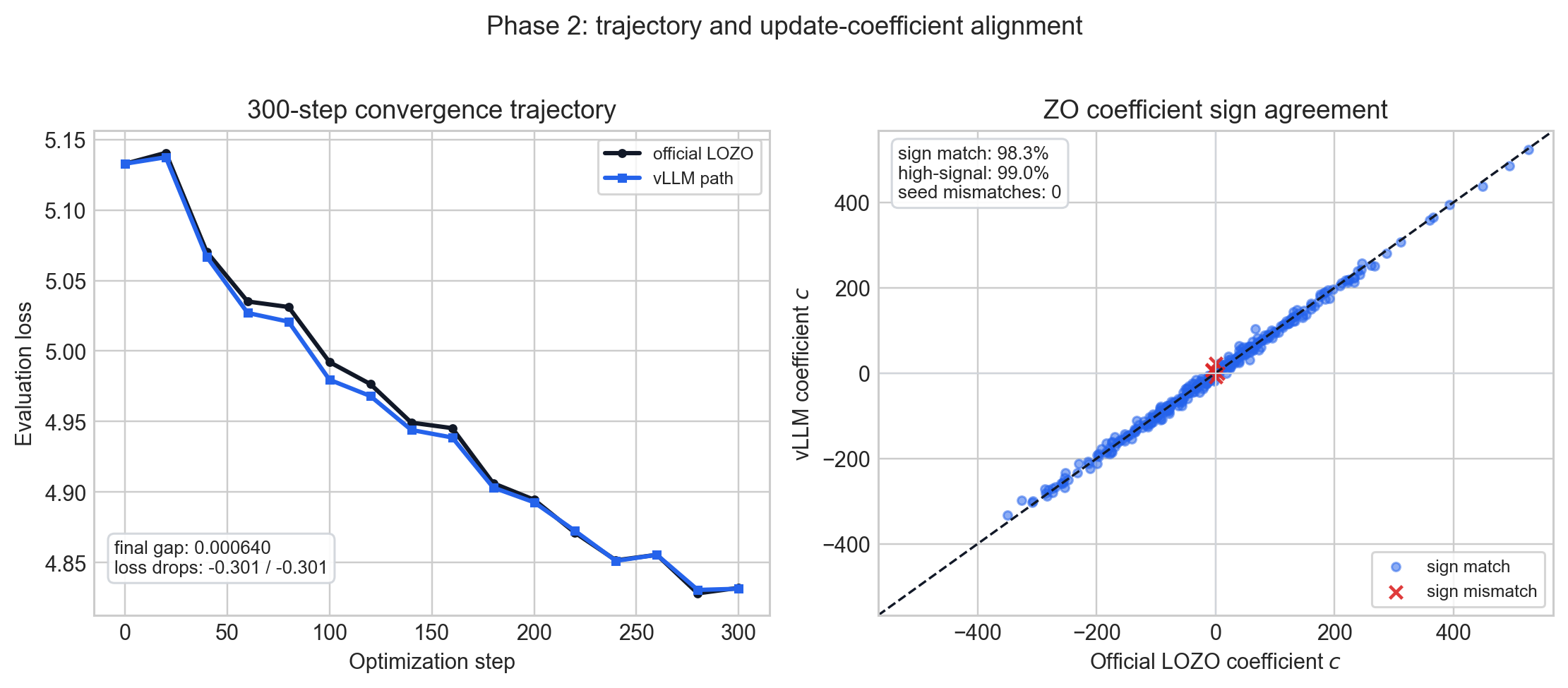
Figure 4: 300-step side-by-side convergence and per-step ZO coefficient agreement: vLLM and LoZO paths are tightly aligned.
Theoretical and System Implications
The core contribution reframes ZO fine-tuning not as a stripped-down version of backprop but as a structured pattern of inference-like calls over parameterizations that can be mapped onto LoRA adapter slots. This reconceptualization facilitates several practical advances:
- Adapter-centric adaptation: Both the persistent update and current perturbation are LoRA-shaped adapters. This abstraction enables all ZO state to reside in inference-native representations, and allows for hot swapping, batching, and scheduling analogous to batched inference.
- Serving-native adaptation: Since the immutable base model can be heavily quantized and persisted, only adapter states must remain in higher precision. This supports resource isolation, stateless serving models, and fine-grained rollout or rollback of adaptation via adapter slot management.
- Elastic and opportunistic scheduling: ZO probes (forward loss differences) may be batched, canceled, or opportunistically injected in idle GPU cycles. This enables lightweight, request-driven or feedback-driven continual adaptation in both cloud and edge settings, without explicit training job boundaries.
Furthermore, the workload view imposes a new systems criterion on ZO method design: serving compatibility becomes as essential as estimator variance or sample efficiency. Estimators that enable adapter-state-based perturbations, batching, compatibility with quantized models, preemption, and state isolation are favored for deployment.
Limitations
The strongest empirical benchmarks are limited to OPT-13B on SST-2 classification under LoZO, with limited coverage of broader task classes (e.g., generation) or comprehensive model families. The presented vLLM code path remains a minimal prototype rather than an integrated, production-ready runtime feature.
Conclusion
This paper establishes that the typical pattern of zeroth-order LLM fine-tuning is, from a systems perspective, an inference-dominated workload rather than a conventional training workload. Mapping ZO fine-tuning onto the inference runtime yields significant throughput and efficiency gains (up to V8 wall-clock speedup for OPT-13B LoZO), while maintaining convergence and accuracy parity. Moreover, this paradigm facilitates lightweight, adapter-scoped, and flexible adaptation that can be scheduled like inference, supporting continual or context-driven parameter updates. The results advocate for the co-design of ZO algorithms and LLM inference runtimes, with adapter-centric representations taking center stage in future LLM adaptation infrastructure.