- The paper introduces BIRDNet, a neurosymbolic framework that mines Boolean implications and encodes them as fixed, interpretable neural units.
- It leverages statistical tests and binary masking to construct extremely sparse layers, achieving near-parity with dense models with up to 99.8% parameter sparsity.
- Empirical results in transcriptomics and proteomics validate its approach by mapping rule-based explanations to known biological markers.
BIRDNet: Encoding Data-Mined Boolean Implication Knowledge Graphs as Sparse, Interpretable Neural Architectures
Introduction and Motivation
BIRDNet represents a neurosymbolic approach that integrates data-mined Boolean implication relationships (BIRs) into the structural prior of deep neural networks. The motivation arises from the observation that tabular data in knowledge-rich scientific domains, particularly transcriptomics and proteomics, frequently exhibits strong binary implication structure among feature pairs. These relationships, often corresponding to biological regulatory logic, are typically lost to standard deep networks that do not incorporate such priors. BIRDNet seeks to bridge this gap by both discovering and operationalizing such structure, realizing a model that is both highly sparse and inherently interpretable without recourse to external symbolic rule bases or post-hoc explanations.
Methodology: Mining and Encoding Boolean Implications
The BIRDNet workflow consists of two key steps: mining the Boolean implication graph from data and encoding this graph as a neural architecture with fixed, rule-bound connectivity.
The BIR mining procedure takes a binarized input matrix representing samples and features, where binarization is performed feature-wise via the StepMiner algorithm—yielding thresholds that segment features into low and high value regimes. For each feature pair, all six possible implication relationships are statistically tested using a sparse-exception binomial test controlling for marginal independence. Edges whose right-tail p-values fall below a stringent threshold and with few exceptions are accepted, resulting in a typed directed graph annotated with implication type and statistical support.
The six BIR types are visualized as quadrant patterns over feature pairs and include directed co-expression, co-repression, and equivalence or opposition classes. The mined BIR graph is then layered into the neural architecture: each hidden unit in a given BIR layer implements one discovered implication, connecting precisely to its two antecedent features (or, recursively, activations from the previous layer), enforced structurally via a binary mask.
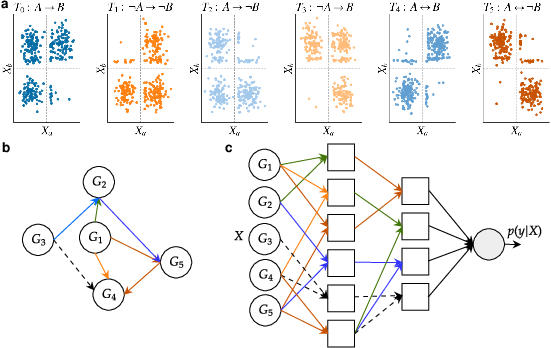
Figure 1: BIRDNet construction. (a) The six BIR types as binarised-quadrant patterns; (b) a fragment of the mined Boolean implication knowledge graph; (c) the graph encoded as network connectivity, with each hidden unit binding exactly two predecessors.
This design enforces an upper bound of $2/d$ on the fraction of nonzero weights in each layer, yielding extreme architectural sparsity—especially for wide input domains (d≫1)—with each hidden unit's learned parameters directly traceable to a pair of named features and an explicit logical rule.
Layer Construction, Training, and Rule Extraction
BIRDNet is constructed greedily, layer by layer. Layer $0$ is defined by implications among binarized input features. For each subsequent layer, the output activations from the previous BIR layer are binarized again, and fresh BIRs are mined, yielding new units that bind strictly to two predecessors. This process continues up to a specified maximum depth or until too few rules remain to warrant a new layer. The classifier head is a small, dense subnetwork projecting the final BIR-layer activations onto predicted class logits.
All connectivity is fixed at construction, with only masked parameters active. Type-aware initialization assigns sign to each connection according to BIR type semantics. Rules remain stable throughout training due to hard masking; batch normalization, ReLU, and dropout are applied to each hidden layer.
Interpretability is retained by preserving the mapping from each trained unit back to its associated logical implication. Rule extraction is facilitated by quantifying the class enrichment (precision, lift) of each BIR-defined unit on held-out data, and class-wise attributions can be decomposed using LRP. This results in model explanations that are natively hierarchical and symbolic, without mediation by surrogates or sampling-based local explanations.
Empirical Results
BIRDNet is evaluated on six transcriptomics and proteomics datasets, spanning up to d=54,675 and up to 27 classes, with 5-fold cross-validation. Feature preselection (ANOVA F-test) reduces high-dimensional data to tractable width (d=2,000) for all but the two proteomic datasets, which are retained at native dimensionality.
Numerically, BIRDNet delivers highly competitive classification performance. The AUROC of BIRDNet is within $0.02$ of the best dense MLP baseline across all datasets, and within $0.005$ on three datasets, despite using between 3× and 95× fewer active parameters in the main BIR layers. BIRDNet achieves near-parity with the dense baseline on AUROC but shows a moderate drop in accuracy in certain settings (up to 7 points absolute), highlighting the regularization cost inherent to the bounded-degree prior. These sparsity ratios scale linearly with input width, achieving up to $2/d$0 masked parameters when $2/d$1.
Biologically, the top rules extracted from trained BIRDNet layers correspond to established canonical markers and feature modules. For instance, co-amplification of PGAP3/ERBB2 reliably identifies HER2 breast cancer; ROPN1B/ROPN1 marks the basal subtype. For pan-cancer tasks, rules such as SFTPA1 $2/d$2 SFTPA2 for lung adenocarcinoma closely track tissue-specific expression programs. These rule-based explanations are supported quantitatively by high lift and precision when mapped to held-out data and maintain direct traceability from rule to prediction.
Implications and Future Directions
BIRDNet demonstrates that data-mined symbolic structure can be operationalized as the architectural prior of a deep neural network, yielding an interpretable, sparse, and competitive model without recourse to externally curated domain rules. The practical upshot is twofold: the compression and computational gains from extreme architectural sparsity, and the transparency of having every model decision decomposable into a stable, domain-grounded chain of propositional implications.
On the theoretical front, BIRDNet formalizes the equivalence of a propositional rule base and a fixed-topology neural network wherein each hidden unit is the neural analog of a 2-literal clause. The design is akin to structurally-bounded relational networks but with all logic mined empirically, bypassing the need for explicit logic programming or hand-curated ontologies.
Several limitations persist. The exclusive use of 2-arity implications constrains the representational capacity for domains where higher-order interactions are biologically or scientifically paramount. Furthermore, the strict reliance on data-mined rules precludes the integration of established domain knowledge, which may be essential in low-sample regimes or fields with robust causal priors. Extensions involving n-ary clause mining, hybrid architectural integration of rule bases with data-driven mining, or the use of continuous-valued logical relationships could address these limitations.
Conclusion
BIRDNet exemplifies a class of neurosymbolic models that are interpretable by construction and sparse by design, encoding domain structure discovered directly from data. Its empirical competitiveness with overparameterized dense baselines, combined with direct rule-level interpretability, underscores the value of leveraging mined symbolic priors. As AI systems become increasingly prevalent in knowledge-rich scientific domains, approaches like BIRDNet illustrate the practical and epistemic benefits of operationalizing data-derived symbolic structure within modern neural architectures (2605.28739).