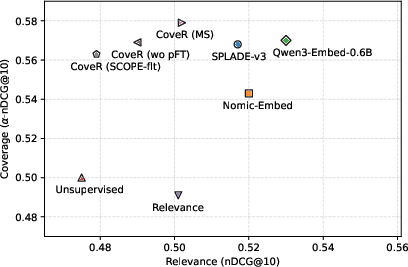
- The paper introduces CoveR, a bi-encoder model that leverages coverage contrastive learning and self-distillation to boost document nugget diversity.
- It incorporates CovCon and CovDistil objectives to enhance long-form RAG by prioritizing comprehensive fact-level coverage without sacrificing relevance.
- Evaluation results show up to 10% improvement in nugget coverage metrics compared to relevance-only models, supporting robust retrieval for synthesis.
Motivation and Problem Setting
Recent advances in Retrieval-Augmented Generation (RAG) for long-form tasks have redefined the objectives of retrieval models. Rather than solely prioritizing document-level relevance, these models must ensure comprehensive coverage of the diverse fact-level (nugget) information needs embedded within complex queries. The paper "Search for Coverage: Learning Coverage-Aware Retrieval with Augmented Sub-Question Answerability" (2605.28522) introduces CoveR, a bi-encoder framework explicitly optimized for coverage-aware retrieval scenarios relevant to long-form RAG.
Traditional neural retrievers, trained predominantly on relevance-centric datasets such as MSMARCO, suffer from narrow clustering of query-document pairs, which often fails to maximize nugget diversity and coverage. The practical consequence is redundancy in retrieved contexts for RAG, limiting the synthesizable breadth of outputs—a concern highlighted in prior nugget-based evaluation studies.
Modeling Approach: CoveR and Coverage-Based Objectives
CoveR employs a bi-encoder with contextualized representations for queries and documents. The distinctive contribution is two coverage-driven training objectives:
- CovCon (Coverage Contrastive Learning): Redefines positive and negative document sampling based on coverage scores, which quantify the fraction of sub-questions (nuggets) answered by a document. CovCon anchors the query to documents with high nugget coverage while discouraging selection of low-coverage distractors, thus reshaping embedding geometry to prioritize diversity and coverage.
- CovDistil (Coverage Self-Distillation): Utilizes decomposed sub-questions for each query, computes embeddings and similarity scores for each, and aggregates them into a teacher distribution over candidate documents. Student scores from the main query are regularized against this teacher using KL-divergence, promoting coverage-awareness in the query encoding.
The model is initialized with relevance-based pre-finetuning and further optimized on coverage signals as a regularizer, mitigating relevance collapse and maintaining document-level ranking efficacy.
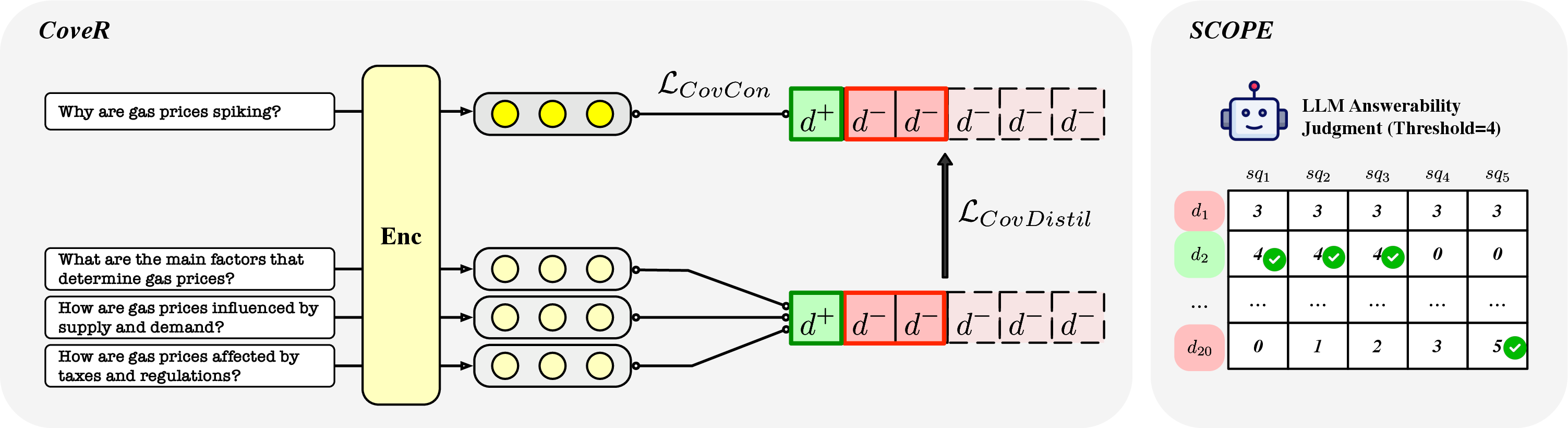
Figure 1: The CovCon and CovDistil training pipelines, sampling positive and negative documents based on synthetic coverage scores derived from sub-questions.
SCOPE Dataset: Synthetic Coverage Signals for Training
A fundamental bottleneck is the absence of large-scale nugget-coverage supervision. The authors construct SCOPE, a dataset with 90K queries and 12M decomposed sub-questions from Researchy Questions [Rosset2024-hq], augmented with LLM-driven document answerability judgments. Documents are retrieved and re-ranked using a Qwen3 Reranker, and answerability is rated on a 0–5 scale via Llama-3, yielding over 24M judgments. Positive/negative document groups are synthesized by thresholding coverage—fraction of sub-questions answered above η=4.
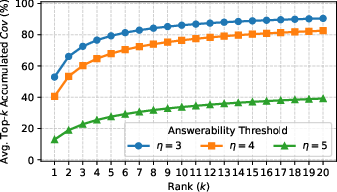
Figure 2: Accumulated coverage scores of the top-k selected relevant documents for varying answerability thresholds, illustrating the trade-off between strictness and diversity.
Empirical Evaluation: Nugget Coverage and Relevance Trade-Offs
The evaluation benchmarks span NeuCLIR Report Generation and CRUX multi-document summarization datasets that provide nugget-level annotations. Performance is measured using both relevance (P@10, nDCG@10) and coverage (α-nDCG@10, Cov@10) metrics:
Ablation studies affirm the criticality of carefully balancing positive and negative sampling ranges based on coverage scores; overly narrow or broad coverage thresholds can impact both relevance and coverage retrieval capabilities.
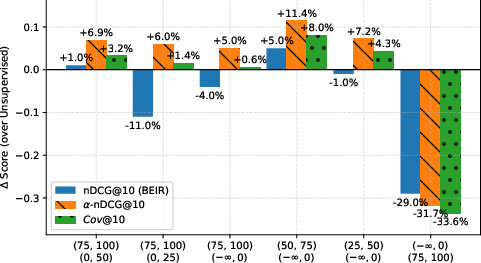
Figure 4: Impact of sampling range for positives/negatives in coverage-based training on the performance changes relative to the unsupervised baseline.
Theoretical and Practical Implications
By jointly optimizing relevance and coverage, CoveR directly addresses the fine-grained diversity requirements of RAG contexts. Practically, it facilitates the retrieval of complementary documents for downstream synthesis, minimizing redundancy and maximizing the factual breadth available to LLM-based generators.
The results challenge the conventional reliance on document-level relevance, suggesting that nugget-based signals and coverage-aware modeling should inform future retriever architectures—especially for knowledge-intensive, multi-aspect queries in long-form generation settings.
Limitations and Future Directions
While CoveR's coverage-aware retriever significantly outperforms relevance-optimized baselines, the paper identifies the limitation of static document ranking. Unlike oracle multi-query retrievals (where sub-questions are explicit), CoveR relies on implicit coverage estimation and cannot guarantee redundancy avoidance or set-level optimality. Future advances will likely explore set selection paradigms [Lee2025-xm], iterative retrieval [trivedi2023interleaving], and agentic pipelines to further enhance coverage assurance.
Furthermore, the integration of sparse retrieval paradigms (e.g., SPLADE) and explicit sub-question generation mechanisms could further elevate coverage performance.
Conclusion
"Search for Coverage" (2605.28522) rigorously investigates coverage-aware retrieval as a critical enabler for long-form RAG. The CoveR model, trained on coverage signals synthesized from sub-question answerability, empirically demonstrates substantial gains in nugget diversity over relevance-only dense retrievers. This paradigm shift underlines the necessity to adapt retrieval models to evolving RAG demands, prioritizing both document-level relevance and fact-level coverage for comprehensive context assembly. The research catalyzes future exploration into dynamic, set-based, and agentic retrieval strategies for complex information needs.