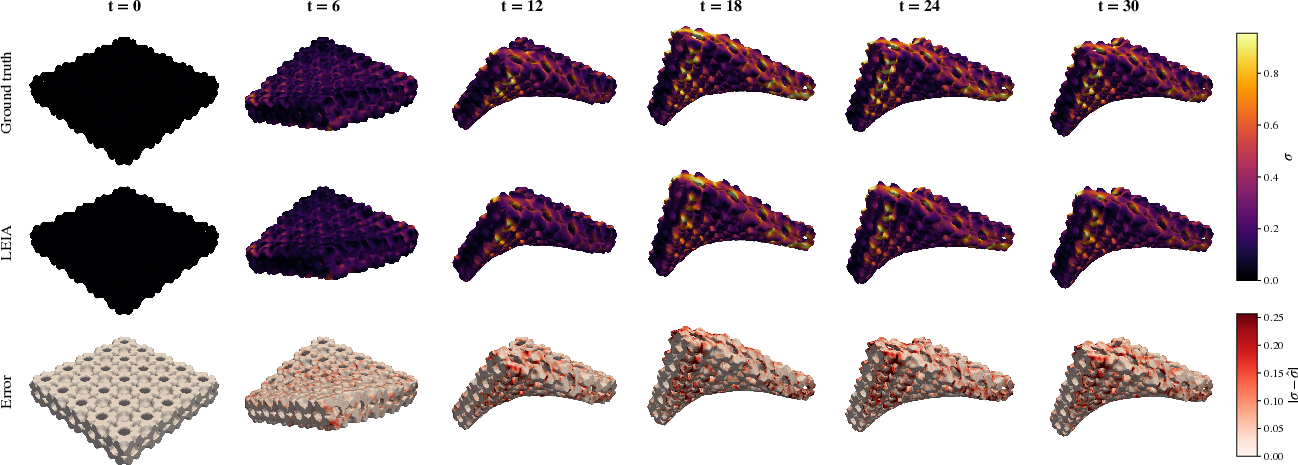
- The paper introduces LEIA with direct stress supervision that boosts stress prediction accuracy (von Mises correlation up to 0.942) in complex materials.
- It employs mesh-invariant tokenization and action-conditioned, autoregressive dynamics to simulate high-resolution lattices in real time.
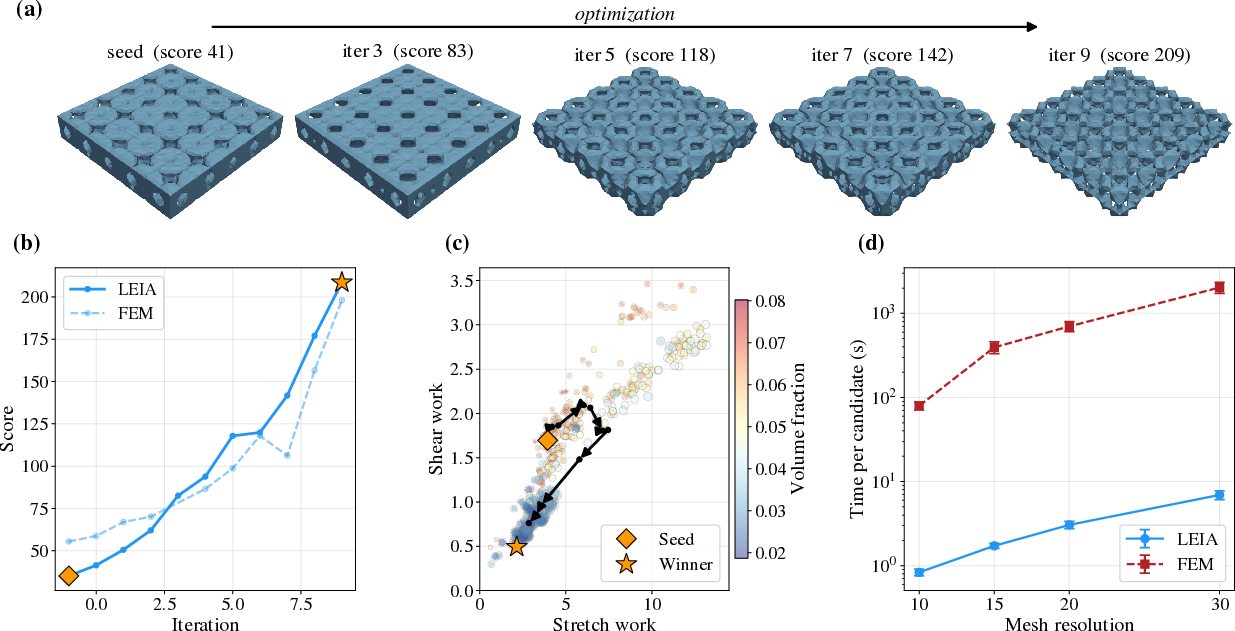
- LEIA enables rapid surrogate-guided design optimization with 100–300x speedup over traditional FEM, facilitating interactive design exploration.
LEIA: Learned Environment for Interactive Architected Materials
Overview and Problem Context
The paper introduces LEIA, an interactive, action-conditioned neural world model for simulating architected materials under nonlinear, history-dependent mechanics at unprecedented scale (2605.28368). Unlike traditional FEM, which is computationally costly for three-dimensional, high-resolution lattices and complex constitutive laws, LEIA delivers real-time field-level simulation—providing both displacement and stress fields—by leveraging mesh-invariant encoding, autoregressive dynamics, and direct stress supervision. The authors further release the MicroPlate benchmark, specifically designed to assess both mesh-expressive and homogenized material response over a large suite of complex topologies and constitutive settings.
LEIA Model Architecture and Methodology
LEIA consists of three principal elements:
- Mesh-Resolution-Invariant Tokenization: Physical fields (displacement, stress) on arbitrary unstructured meshes are compressed to a fixed-length latent via Perceiver cross-attention. This enables inference at constant computational cost, irrespective of mesh size.
- Action-Conditioned Latent Dynamics: A transformer processes latents, with FiLM-style boundary condition injection at every layer, to autoregressively advance physical state in response to arbitrary user-imposed boundary actions.
- Direct Stress Prediction (Stress Head): A linear output branch maps shared latent states directly to per-node Cauchy stress, supporting high-accuracy, constant-cost stress inference even for path-dependent constitutive laws.
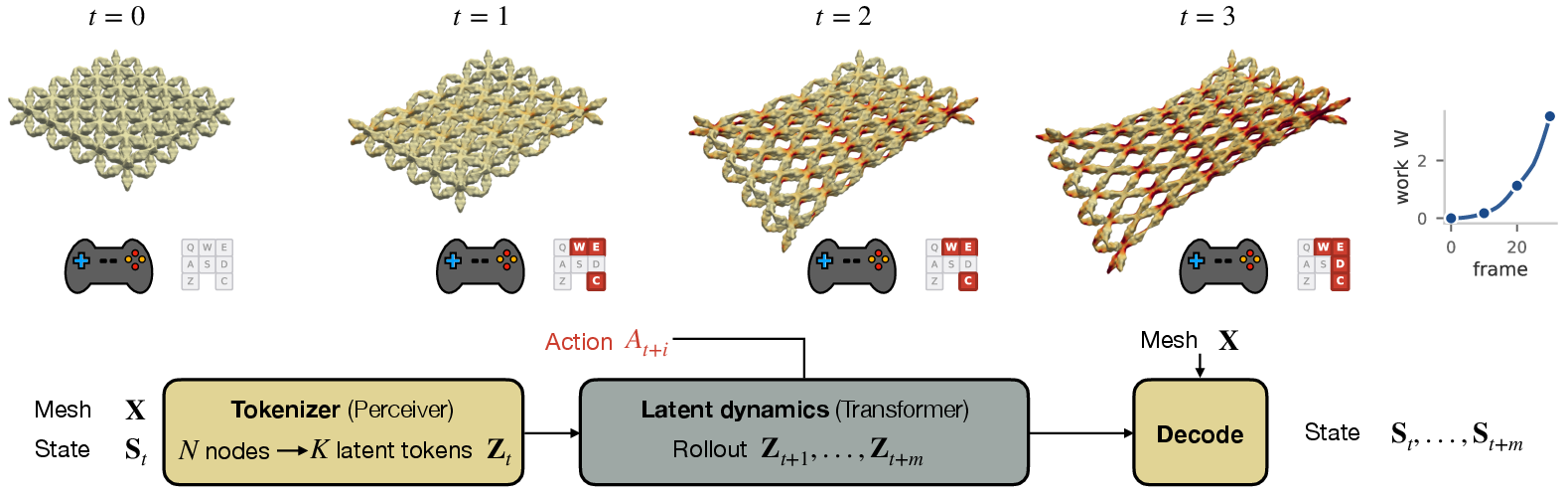
Figure 1: LEIA architecture: tokenizer compresses mesh fields to latents; action-conditioned transformer predicts latent dynamics; decoder reconstructs physical fields from latents.
Training is staged: the tokenizer is optimized to reconstruct ground truth displacements and stress from FEM, then the dynamics transformer is trained on these latents for robust long-horizon rollouts.
MicroPlate Benchmark
MicroPlate is a two-regime benchmark designed for high-fidelity evaluation of mesh-based surrogate models:
- Architected Lattice Regime: 63 distinct cubic-symmetry lattices, each meshed at 71k–442k nodes, resolve microstructure explicitly, generating diverse, localized stress patterns.
- Visco-Hyperelastic Plate Regime: Homogenized continuum plate (363 nodes) includes multiple viscoelastic branches, yielding path- and history-dependent stress even under repeated loading cycles.
The benchmark goes far beyond previous solid-mechanics datasets in both mesh scale and physical complexity.
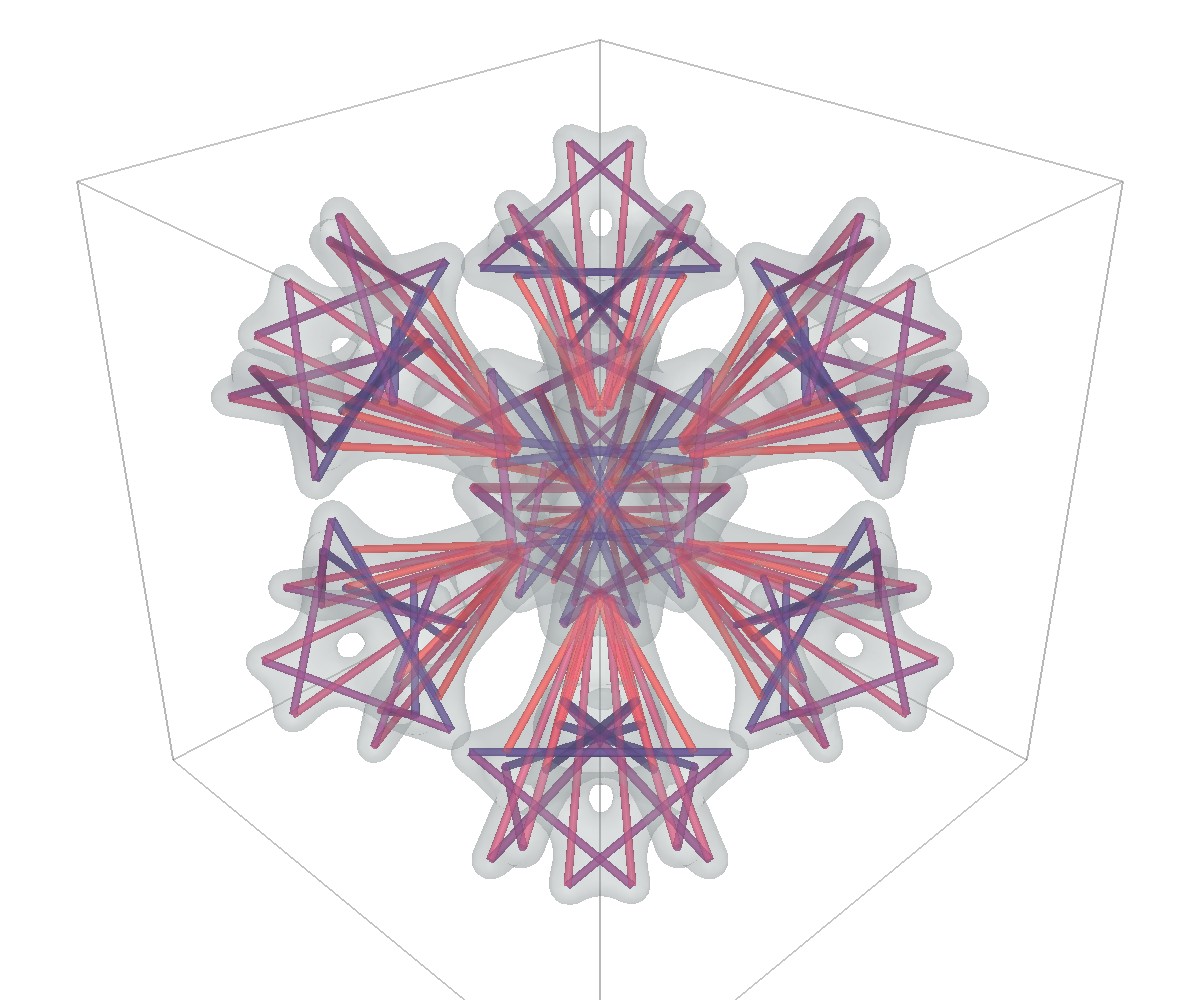
Figure 2: MicroPlate unit cell construction: compact seed beam graphs expand under cubic symmetry to full lattice, enabling systematic topology diversity.
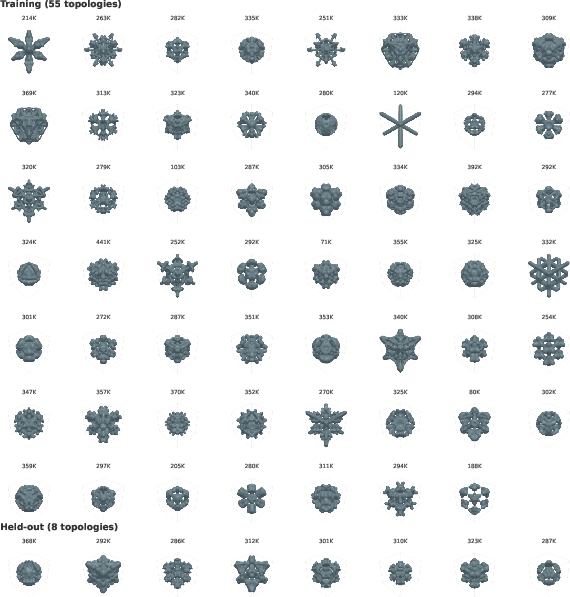
Figure 3: Visual catalog of 63 architected lattice topologies (top: training; bottom: held-out) after symmetry expansion and meshing.
Empirical Results
Stress Supervision and Ablations
LEIA systematically evaluates a spectrum of stress-prediction strategies—no supervision, traditional Sobolev (gradient-based), learned gradient and learned stress heads—on MicroPlate. The key findings:
Temporal Rollout and History-Dependent Materials
In the viscoelastic/hyperelastic regime, accurate prediction of history-dependent stress fields is critical. All baselines—even those with full internal variable supervision—fail to achieve usable stress correlation under long autoregressive rollout. Only the addition of a direct stress head closes this gap.
On 100-step rollouts for viscoelastic deformation, LEIA achieves >0.98 von Mises field correlation with ground truth—substantially higher and more stable than all baseline neural operator architectures.
Surrogate-Guided Design Optimization
LEIA enables interactive and scalable design optimization by rapidly ranking thousands of candidate lattice topologies:
Out-of-Distribution Detection and Surrogate Confidence
LEIA integrates latent-space and reconstruction-based signals to estimate the reliability of its own predictions without any FEM recourse:
- Latent PCA projections and round-trip errors identify geometry-induced uncertainty, but a learned confidence head combining multiple signals gives the best correlation to FEM-calculated error.
- Screening via the confidence head enables practical surrogate-aided design loops: candidates flagged as unreliable are reserved for selective high-fidelity FEM validation or dataset expansion.

Figure 6: OOD-detection PCA landscape: (A) ground-truth error, (B) tokenizer round-trip error, (C) encoder-cycle inconsistency, (D) predicted confidence from learned head.
Theoretical and Practical Implications
LEIA demonstrates that:
- Mesh-invariant, action-conditioned world models with direct stress supervision generalize across both explicit-microstructure lattices and complex history-dependent constitutive materials.
- Direct stress supervision enforces richer latent representations and should be standard for field-level mechanical surrogate modeling.
- Real-time stress-resolved simulation on unstructured million-element 3D meshes is achievable—enabling, for the first time, fully interactive design exploration for architected materials.
The methodology also provides a modular path to further physics inclusion (e.g., coupled multi-physical phenomena), generalized action spaces, and broader geometry classes, contingent on future benchmark expansion.
Limitations and Future Directions
While demonstrating superior accuracy and efficiency, LEIA’s generalization beyond cubic-symmetry lattices, more diverse loading actions, or entirely different constitutive frameworks (plasticity, fracture) remains untested. Integration with active learning—using the confidence head to dynamically acquire new ground truth—could further enhance reliability and data efficiency.
Broader theoretical questions include:
- Characterization of the latent space’s physical invariant structure,
- Scaling and transfer to non-lattice and non-plate geometries,
- Extension to fully end-to-end differentiable controllers for automated synthesis of target properties.
Conclusion
LEIA advances neural surrogate modeling in solid mechanics, delivering real-time, stress-accurate, and mesh-resilient simulation for complex architected materials and enabling interactive engineering design at scale. The combination of tokenization, action-conditioned dynamics, and direct stress readout represents a substantial methodological refinement for field-level prediction tasks. With MicroPlate and the associated open-source release, LEIA sets a new standard for benchmarking and surrogate-aided scientific design workflows in materials engineering.